2010 Edition
CIA World Factbook 2010 (Project Gutenberg)
Introduction
Background
The Mongols gained fame in the 13th century when under Chinggis KHAAN they established a huge Eurasian empire through conquest. After his death the empire was divided into several powerful Mongol states, but these broke apart in the 14th century. The Mongols eventually retired to their original steppe homelands and in the late 17th century came under Chinese rule. Mongolia won its independence in 1921 with Soviet backing and a Communist regime was installed in 1924. The modern country of Mongolia, however, represents only part of the Mongols' historical homeland; more ethnic Mongolians live in the Inner Mongolia Autonomous Region in the People's Republic of China than in Mongolia. Following a peaceful democratic revolution, the ex-Communist Mongolian People's Revolutionary Party (MPRP) won elections in 1990 and 1992, but was defeated by the Democratic Union Coalition (DUC) in the 1996 parliamentary election. The MPRP won an overwhelming majority in the 2000 parliamentary election, but the party lost seats in the 2004 election and shared power with democratic coalition parties from 2004-08. The MPRP regained a solid majority in the 2008 parliamentary elections but nevertheless formed a coalition government with the Democratic Party. In 2010 the MPRP voted to retake the name of the Mongolian People's Party (MPP), a name it used in the early 1920s. The prime minister and most cabinet members are MPP members.
Geography
Area
- land
- 1,553,556 sq km
- total
- 1,564,116 sq km
- water
- 10,560 sq km
Area - comparative
slightly smaller than Alaska
Climate
desert; continental (large daily and seasonal temperature ranges)
Coastline
0 km (landlocked)
Elevation extremes
- highest point
- Nayramadlin Orgil (Huyten Orgil) 4,374 m
- lowest point
- Hoh Nuur 560 m
Environment - current issues
limited natural fresh water resources in some areas; the policies of former Communist regimes promoted rapid urbanization and industrial growth that had negative effects on the environment; the burning of soft coal in power plants and the lack of enforcement of environmental laws severely polluted the air in Ulaanbaatar; deforestation, overgrazing, and the converting of virgin land to agricultural production increased soil erosion from wind and rain; desertification and mining activities had a deleterious effect on the environment
Environment - international agreements
- party to
- Biodiversity, Climate Change, Climate Change-Kyoto Protocol, Desertification, Endangered Species, Environmental Modification, Hazardous Wastes, Law of the Sea, Ozone Layer Protection, Ship Pollution, Wetlands, Whaling signed, but not ratified: none of the selected agreements
Freshwater withdrawal (domestic/industrial/agricultural)
- per capita
- 166 cu m/yr (2000)
- total
- 0.44 cu km/yr (20%/27%/52%)
Geographic coordinates
46 00 N, 105 00 E
Geography - note
landlocked; strategic location between China and Russia
Irrigated land
840 sq km (2003)
Land boundaries
- border countries
- China 4,677 km, Russia 3,543 km
- total
- 8,220 km
Land use
- arable land
- 0.76%
- other
- 99.24% (2005)
- permanent crops
- 0%
Location
Northern Asia, between China and Russia
Map references
Asia
Maritime claims
none (landlocked)
Natural hazards
dust storms; grassland and forest fires; drought; "zud," which is harsh winter conditions
Natural resources
oil, coal, copper, molybdenum, tungsten, phosphates, tin, nickel, zinc, fluorspar, gold, silver, iron
Terrain
vast semidesert and desert plains, grassy steppe, mountains in west and southwest; Gobi Desert in south-central
Total renewable water resources
34.8 cu km (1999)
People and Society
Age structure
0-14 years: 28.1% (male 436,391/female 418,923) 15-64 years: 67.9% (male 1,031,819/female 1,033,806) 65 years and over: 4% (male 52,430/female 67,773) (2010 est.)
Birth rate
21.03 births/1,000 population (2010 est.)
Death rate
6.08 deaths/1,000 population (July 2010 est.)
Education expenditures
5.1% of GDP (2007)
Ethnic groups
Mongol (mostly Khalkha) 94.9%, Turkic (mostly Kazakh) 5%, other (including Chinese and Russian) 0.1% (2000)
HIV/AIDS - adult prevalence rate
less than 0.1% (2007 est.)
HIV/AIDS - deaths
fewer than 200 (2003 est.)
HIV/AIDS - people living with HIV/AIDS
fewer than 500 (2007 est.)
Infant mortality rate
- female
- 35.35 deaths/1,000 live births (2010 est.)
- male
- 41.63 deaths/1,000 live births
- total
- 38.56 deaths/1,000 live births
Languages
Khalkha Mongol 90%, Turkic, Russian (1999)
Life expectancy at birth
- female
- 70.54 years (2010 est.)
- male
- 65.54 years
- total population
- 67.98 years
Literacy
- definition: age 15 and over can read and write
- female
- 97.5% (2000 census)
- male
- 98%
- total population
- 97.8%
Median age
- female
- 26.2 years (2010 est.)
- male
- 25.3 years
- total
- 25.8 years
Nationality
- adjective
- Mongolian
- noun
- Mongolian(s)
Net migration rate
0 migrant(s)/1,000 population
Population
3,086,918 (July 2010 est.)
Population growth rate
1.495% (2010 est.)
Religions
Buddhist Lamaist 50%, Shamanist and Christian 6%, Muslim 4%, none 40% (2004)
School life expectancy (primary to tertiary education)
- female
- 14 years (2008)
- male
- 13 years
- total
- 14 years
Sex ratio
- at birth
- 1.05 male(s)/female under 15 years: 1.04 male(s)/female 15-64 years: 1 male(s)/female 65 years and over: 0.77 male(s)/female
- total population
- 1 male(s)/female (2010 est.)
Total fertility rate
2.22 children born/woman (2010 est.)
Urbanization
- rate of urbanization
- 1.2% annual rate of change (2005-10 est.)
- urban population
- 57% of total population (2008)
Government
Administrative divisions
21 provinces (aymguud, singular - aymag) and 1 municipality* (singular - hot); Arhangay, Bayanhongor, Bayan-Olgiy, Bulgan, Darhan-Uul, Dornod, Dornogovi, Dundgovi, Dzavhan (Zavkhan), Govi-Altay, Govisumber, Hentiy, Hovd, Hovsgol, Omnogovi, Orhon, Ovorhangay, Selenge, Suhbaatar, Tov, Ulaanbaatar*, Uvs
Capital
- geographic coordinates
- 47 55 N, 106 55 E
- name
- Ulaanbaatar
- time difference
- UTC+8 (13 hours ahead of Washington, DC during Standard Time)
Constitution
13 January 1992
Country name
- conventional long form
- none
- conventional short form
- Mongolia
- former
- Outer Mongolia
- local long form
- none
- local short form
- Mongol Uls
Diplomatic representation from the US
- chief of mission
- Ambassador Jonathan ADDLETON
- embassy
- Big Ring Road, 11th Micro Region, Ulaanbaatar, 14171 Mongolia
- FAX
- [976] (11) 320-776
- mailing address
- PSC 461, Box 300, FPO AP 96521-0002; P.O. Box 1021, Ulaanbaatar-13
- telephone
- [976] (11) 329-095
Diplomatic representation in the US
- chancery
- 2833 M Street NW, Washington, DC 20007
- chief of mission
- Ambassador Khasbazar BEKHBAT
- consulate(s) general
- New York
- FAX
- [1] (202) 298-9227
- telephone
- [1] (202) 333-7117
Executive branch
- cabinet
- Cabinet nominated by the prime minister in consultation with the president and confirmed by the State Great Hural (parliament) (For more information visit the World Leaders website )
- chief of state
- President Tsakhia ELBEGDORJ (since 18 June 2009)
- election results
- in elections in May 2009, Tsakhia ELBEGDORJ elected president; percent of vote - Tsakhia ELBEGDORJ 51.2%, Nambar ENKHBAYAR 47.4%, others 1.3%
- elections
- presidential candidates nominated by political parties represented in State Great Hural and elected by popular vote for a four-year term (eligible for a second term); election last held on 24 May 2009 (next to be held in May 2013); following legislative elections, leader of majority party or majority coalition usually elected prime minister by State Great Hural
- head of government
- Prime Minister Sukhbaatar BATBOLD (since 29 October 2009); First Deputy Prime Minister (Norov ALTANKHUYAG (since 20 September 2008); Deputy Prime Minister Miegombyn ENKHBOLD (since 6 December 2007)
Flag description
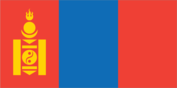
three equal, vertical bands of red (hoist side), blue, and red; centered on the hoist-side red band in yellow is the national emblem ("soyombo" - a columnar arrangement of abstract and geometric representation for fire, sun, moon, earth, water, and the yin-yang symbol); blue represents the sky, red symbolizes progress and prosperity
Government type
parliamentary
Independence
11 July 1921 (from China)
International organization participation
ADB, ARF, CD, CICA, CP, EBRD, FAO, G-77, IAEA, IBRD, ICAO, ICCt, ICRM, IDA, IFAD, IFC, IFRCS, ILO, IMF, IMO, Interpol, IOC, IOM, IPU, ISO, ITSO, ITU, ITUC, MIGA, MINURSO, MONUSCO, NAM, OPCW, OSCE (partner), SCO (observer), UN, UNCTAD, UNESCO, UNIDO, UNMIL, UNMIS, UNWTO, UPU, WCO, WHO, WIPO, WMO, WTO
Judicial branch
Supreme Court (serves as appeals court for people's and provincial courts but rarely overturns verdicts of lower courts; judges are nominated by the General Council of Courts and approved by the president)
Legal system
blend of Soviet and German systems that employ "continental" or "civil" code; case-precedent may be used to inform judges, but all decisions must refer to the law as written; constitution ambiguous on judicial review of legislative acts; has not accepted compulsory ICJ jurisdiction
Legislative branch
- unicameral State Great Hural 76 seats; members elected by popular vote to serve four-year terms
- election results
- percent of vote by party - NA; seats by party - MPP 46, DP 27, others 3
- elections
- last held on 29 June 2008 (next to be held in June 2012)
National anthem
- lyrics/music
- Tsendiin DAMDINSUREN/Bilegiin DAMDINSUREN and Luvsanjamts MURJORJ note: music adopted 1950, lyrics adopted 2006; the anthem's lyrics have been altered on numerous occasions
- name
- "Mongol ulsyn toriin duulal" (National Anthem of Mongolia)
National holiday
Independence Day/Revolution Day, 11 July (1921)
Political parties and leaders
Democratic Party or DP [Norov ALTANHUYAG]; Mongolian People's Party or MPP [Sukhbaatar BATBOLD]
Political pressure groups and leaders
- other
- human rights groups; women's groups
Suffrage
18 years of age; universal
Economy
Agriculture - products
wheat, barley, vegetables, forage crops; sheep, goats, cattle, camels, horses
Central bank discount rate
10.82% (31 December 2009) 14.78% (31 December 2008)
Commercial bank prime lending rate
21.67% (31 December 2009 est.) 20.58% (31 December 2008 est.)
Current account balance
-$228.7 million (2009 est.) -$710 million (2008 est.)
Debt - external
$1.86 billion (2009) $1.6 billion (2008)
Distribution of family income - Gini index
32.8 (2002) 44 (1998)
Economy - overview
Economic activity in Mongolia has traditionally been based on herding and agriculture - Mongolia's extensive mineral deposits, however, have attracted foreign investors. The country holds copper, gold, coal, molybdenum, fluorspar, uranium, tin, and tungsten deposits, which account for a large part of foreign direct investment and government revenues. Soviet assistance, at its height one-third of GDP, disappeared almost overnight in 1990 and 1991 at the time of the dismantlement of the USSR. The following decade saw Mongolia endure both deep recession, because of political inaction and natural disasters, as well as economic growth, because of reform-embracing, free-market economics and extensive privatization of the formerly state-run economy. Severe winters and summer droughts in 2000-02 resulted in massive livestock die-off and zero or negative GDP growth. This was compounded by falling prices for Mongolia's primary sector exports and widespread opposition to privatization. Growth averaged nearly 9% per year in 2004-08 largely because of high copper prices and new gold production. In 2008 Mongolia experienced a soaring inflation rate with year-to-year inflation reaching nearly 30% - the highest inflation rate in over a decade. By late 2008, as the country began to feel the effects of the global financial crisis, falling commodity prices helped lower inflation, but also reduced government revenues and forced cuts in spending. In early 2009, the International Monetary Fund reached a $236 million Stand-by Arrangement with Mongolia, and the country has started to move out of the crisis. Although the banking sector remains unstable, the government is now enforcing stricter supervision regulations. In October 2009, the government passed long-awaited legislation on an investment agreement to develop Mongolia's Oyu Tolgoi mine, considered to be one of the world's largest untapped copper deposits. The economy grew an estimated 7% in 2010, largely on the strength of exports to nearby countries, and international reserves reached $1.6 billion in September, an all time high for Mongolia. Mongolia's economy continues to be heavily influenced by its neighbors. Mongolia purchases 95% of its petroleum products and a substantial amount of electric power from Russia, leaving it vulnerable to price increases. Trade with China represents more than half of Mongolia's total external trade - China receives about two-thirds of Mongolia's exports. Remittances from Mongolians working abroad are sizable, but have fallen due to the economic crisis; money laundering is a growing concern. Mongolia joined the World Trade Organization in 1997 and seeks to expand its participation in regional economic and trade regimes.
Electricity - consumption
3.439 billion kWh (2009)
Electricity - exports
21.2 million kWh (2009)
Electricity - imports
186.1 million kWh (2009)
Electricity - production
4.03 billion kWh (2009)
Exchange rates
togrog/tugriks (MNT) per US dollar - 1,442.8 (2009), 1,267.51 (2008), 1,170 (2007), 1,165 (2006)
Exports
$1.902 billion (2009) $2.539 billion (2008)
Exports - commodities
copper, apparel, livestock, animal products, cashmere, wool, hides, fluorspar, other nonferrous metals, coal
Exports - partners
China 78.52%, Canada 9.46%, Russia 3.02% (2009)
GDP - composition by sector
- agriculture
- 21.2%
- industry
- 29.5%
- services
- 49.3% (2009 est.)
GDP - per capita (PPP)
$3,300 (2010 est.) $3,100 (2009 est.) $3,200 (2008 est.) note: data are in 2010 US dollars
GDP - real growth rate
7% (2010 est.) -1.6% (2009 est.) 8.9% (2008 est.)
GDP (official exchange rate)
$5.807 billion (2010 est.)
GDP (purchasing power parity)
$10.16 billion (2010 est.) $9.5 billion (2009 est.) $9.654 billion (2008 est.) note: data are in 2010 US dollars
Household income or consumption by percentage share
lowest 10%: 2.9% highest 10%: 24.9% (2005)
Imports
$2.131 billion (2009) $3.224 billion (2008)
Imports - commodities
machinery and equipment, fuel, cars, food products, industrial consumer goods, chemicals, building materials, sugar, tea
Imports - partners
China 35.99%, Russia 31.56%, South Korea 7.08%, Japan 4.8% (2009)
Industrial production growth rate
3% (2006 est.)
Industries
construction and construction materials; mining (coal, copper, molybdenum, fluorspar, tin, tungsten, and gold); oil; food and beverages; processing of animal products, cashmere and natural fiber manufacturing
Inflation rate (consumer prices)
4.2% (2009 est.) 28% (2008 est.)
Labor force
1.068 million (2008)
Labor force - by occupation
- agriculture
- 34%
- industry
- 5%
- services
- 61% (2008)
Market value of publicly traded shares
$430.2 million (31 December 2009) $407 million (31 December 2008) $612.2 million (31 December 2007)
Natural gas - consumption
0 cu m (2008 est.)
Natural gas - exports
0 cu m (2008 est.)
Natural gas - imports
0 cu m (2008 est.)
Natural gas - production
0 cu m (2008 est.)
Natural gas - proved reserves
0 cu m (1 January 2010 est.)
Oil - consumption
16,000 bbl/day (2009 est.)
Oil - exports
5,300 bbl/day (2009 est.)
Oil - imports
0 bbl/day (2009)
Oil - production
5,100 bbl/day (2009)
Oil - proved reserves
NA bbl (1 January 2010 est.)
Population below poverty line
36.1% (2004)
Stock of broad money
$1.996 billion (31 December 2009) $1.791 billion (31 December 2008)
Stock of direct foreign investment - abroad
$NA
Stock of direct foreign investment - at home
$NA
Stock of domestic credit
$1.664 billion (31 December 2008 est.) $1.183 billion (31 December 2007 est.)
Stock of narrow money
$451.4 million (31 December 2009) $510.7 million (31 December 2008)
Unemployment rate
2.8% (2008) 3% (2007)
Communications
Broadcast media
following a law passed in 2005, Mongolia's state-run radio and TV provider converted to a public service provider; also available are private radio and TV broadcasters, as well as multi-channel satellite and cable TV providers; more than 100 radio stations, including some 20 via repeaters for the public broadcaster; transmissions of multiple international broadcasters are available (2008)
Internet country code
.mn
Internet hosts
7,942 (2010)
Internet users
330,000 (2008)
Telephone system
- domestic
- very low fixed-line teledensity; there are multiple mobile- cellular providers and subscribership is increasing rapidly;
- general assessment
- network is improving with international direct dialing available in many areas; a fiber-optic network has been installed that is improving broadband and communication services between major urban centers with multiple companies providing inter-city fiber-optic cable services
- international
- country code - 976; satellite earth stations - 7
Telephones - main lines in use
188,900 (2009)
Telephones - mobile cellular
2.249 million (2009)
Transportation
Airports
46 (2010)
Airports - with paved runways
- total
- 14 over 3,047 m: 1 2,438 to 3,047 m: 10 1,524 to 2,437 m: 3 (2010)
Airports - with unpaved runways
- total
- 32 over 3,047 m: 1 2,438 to 3,047 m: 4 1,524 to 2,437 m: 25 914 to 1,523 m: 1 under 914 m: 1 (2010)
Heliports
1 (2010)
Merchant marine
- by type
- bulk carrier 20, cargo 29, chemical tanker 2, liquefied gas 2, passenger/cargo 1, roll on/roll off 3, vehicle carrier 1
- foreign-owned
- 44 (Indonesia 2, North Korea 1, Russia 4, Singapore 1, Turkey 1, Ukraine 1, Vietnam 34) (2010)
- total
- 58
Railways
- broad gauge
- 1,810 km 1.520-m gauge (2008)
- total
- 1,810 km
Roadways
- paved
- 2,824 km
- total
- 49,250 km
- unpaved
- 46,426 km (includes 1,994 km with gravel surface and 1,874 km with improved surface) (2009)
Waterways
580 km note: only waterway in operation is Lake Hovsgol (135 km); Selenge River (270 km) and Orhon River (175 km) are navigable but carry little traffic; lakes and rivers freeze in winter, are open from May to September (2010)
Military and Security
Manpower available for military service
males age 16-49: 887,059 females age 16-49: 880,788 (2010 est.)
Manpower fit for military service
males age 16-49: 715,585 females age 16-49: 748,083 (2010 est.)
Manpower reaching militarily significant age annually
- female
- 28,156 (2010 est.)
- male
- 29,240
Military branches
- Mongolian Armed Forces
- Mongolian Army, Mongolian Air Force; there is no navy (2010)
Military expenditures
1.4% of GDP (2006)
Military service age and obligation
18-25 years of age for compulsory military service; conscript service obligation - 12 months in land or air defense forces or police; a small portion of Mongolian land forces (2.5 percent) is comprised of contract soldiers; women cannot be deployed overseas for military operations (2006)
Transnational Issues
Disputes - international
none page last updated on January 20, 2011 ======================================================================