2000 Edition
CIA World Factbook 2000 (Project Gutenberg)
Introduction
Background
Long a province of China, Mongolia won its independence in 1921 with Soviet backing. A communist regime was installed in 1924. During the early 1990s, the ex-communist Mongolian People's Revolutionary Party (MPRP) gradually yielded its monopoly on power. In 1996, the Democratic Union Coalition (DUC) defeated the MPRP in a national election and has attempted to establish a number of reforms to modernize the economy. However, many former communists retain key posts and implementation has been difficult.
Geography
Area
- land
- 1.565 million sq km
- total
- 1.565 million sq km
- water
- 0 sq km
Area - comparative
slightly smaller than Alaska
Climate
desert; continental (large daily and seasonal temperature ranges)
Coastline
0 km (landlocked)
Elevation extremes
- highest point
- Tavan Bogd Uul 4,374 m
- lowest point
- Hoh Nuur 518 m
Environment - current issues
limited natural fresh water resources; policies of the former communist regime promoting rapid urbanization and industrial growth have raised concerns about their negative effects on the environment; the burning of soft coal in power plants and the lack of enforcement of environmental laws have severely polluted the air in Ulaanbaatar; deforestation, overgrazing, the converting of virgin land to agricultural production have increased soil erosion from wind and rain; desertification and mining activities have also had a deleterious effect on the environment
Environment - international agreements
- party to
- Biodiversity, Climate Change, Climate Change-Kyoto Protocol, Desertification, Endangered Species, Environmental Modification, Hazardous Wastes, Law of the Sea, Nuclear Test Ban, Ozone Layer Protection, Wetlands signed, but not ratified: none of the selected agreements
Geographic coordinates
46 00 N, 105 00 E
Geography - note
landlocked; strategic location between China and Russia
Irrigated land
800 sq km (1993 est.)
Land boundaries
- border countries
- China 4,673 km, Russia 3,441 km
- total
- 8,114 km
Land use
- arable land
- 1%
- forests and woodland
- 9%
- other
- 10% (1993 est.)
- permanent crops
- 0%
- permanent pastures
- 80%
Location
Northern Asia, between China and Russia
Map references
Asia
Maritime claims
none (landlocked)
Natural hazards
dust storms can occur in the spring; grassland fires
Natural resources
oil, coal, copper, molybdenum, tungsten, phosphates, tin, nickel, zinc, wolfram, fluorspar, gold
Terrain
vast semidesert and desert plains; mountains in west and southwest; Gobi Desert in southeast
People and Society
Age structure
0-14 years: 34% (male 461,719; female 447,426) 15-64 years: 62% (male 816,851; female 816,651) 65 years and over: 4% (male 46,682; female 61,623) (2000 est.)
Birth rate
21.53 births/1,000 population (2000 est.)
Death rate
6.14 deaths/1,000 population (2000 est.)
Ethnic groups
Mongol 90%, Kazakh 4%, other 6%
Infant mortality rate
41.22 deaths/1,000 live births (2000 est.)
Languages
Khalkha Mongol 90%, Turkic, Russian
Life expectancy at birth
- female
- 69.64 years (2000 est.)
- male
- 64.98 years
- total population
- 67.25 years
Literacy
- definition
- age 15 and over can read and write
- female
- 77.2% (1988 est.)
- male
- 88.6%
- total population
- 82.9%
Nationality
- adjective
- Mongolian
- noun
- Mongolian(s)
Net migration rate
0 migrant(s)/1,000 population (2000 est.)
Population
2,650,952 (July 2000 est.)
Population growth rate
1.54% (2000 est.)
Religions
- predominantly Tibetan Buddhist, Muslim 4%
- note
- previously limited religious activity because of communist regime
Sex ratio
- at birth
- 1.05 male(s)/female under 15 years: 1.03 male(s)/female 15-64 years: 1 male(s)/female 65 years and over: 0.76 male(s)/female
- total population
- 1 male(s)/female (2000 est.)
Total fertility rate
2.4 children born/woman (2000 est.)
Government
Administrative divisions
18 provinces (aymguud, singular - aymag) and 3 municipalities* (hotuud, singular - hot); Arhangay, Bayanhongor, Bayan-Olgiy, Bulgan, Darhan*, Dornod, Dornogovi, Dundgovi, Dzavhan, Erdenet*, Govi-Altay, Hentiy, Hovd, Hovsgol, Omnogovi, Ovorhangay, Selenge, Suhbaatar, Tov, Ulaanbaatar*, Uvs
Capital
Ulaanbaatar
Constitution
12 February 1992
Country name
- conventional long form
- none
- conventional short form
- Mongolia
- former
- Outer Mongolia
- local long form
- none
- local short form
- Mongol Uls
Data code
MG
Diplomatic representation from the US
- chief of mission
- Ambassador Alphonse F. LA PORTA
- embassy
- inner north side of the Big Ring, just west of the Selbe Gol, Ulaanbaatar
- mailing address
- c/o American Embassy Beijing, Micro Region 11, Big Ring Road, C. P. O. 1021, Ulaanbaatar 13; PSC 461, Box 300, FPO AP 96521-0002
- telephone
- (1) 329095
Diplomatic representation in the US
- chancery
- 2833 M Street NW, Washington, DC 20007
- chief of mission
- Ambassador Jalbuugiyn CHOINHOR
- telephone
- (202) 333-7117
Executive branch
- cabinet
- Cabinet appointed by the State Great Hural in consultation with the president
- chief of state
- President Natsagiyn BAGABANDI (since 20 June 1997)
- election results
- Natsagiyn BAGABANDI elected president; percent of vote - Natsagiyn BAGABANDI (MPRP) 60.8%, Punsalmaagiyn OCHIRBAT (MNDP and MSDP) 29.8%, Jambyn GOMBOJAV 6.6%; Rinchinnyamin AMARJARGAL elected prime minister by a vote in the State Great Hural of 50 to 2
- elections
- president nominated by parties in the State Great Hural and elected by popular vote for a four-year term; election last held 18 May 1997 (next to be held summer 2001); following legislative elections, the leader of the majority party or majority coalition is usually elected prime minister by the State Great Hural; election last held 30 August 1999 (next to be held NA)
- head of government
- Prime Minister Rinchinnyamin AMARJARGAL (since 30 August 1999)
FAX
- (202) 298-9227
- (1) 320776
- consulate(s) general
- New York
Flag description
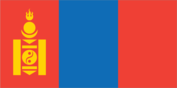
three equal, vertical bands of red (hoist side), blue, and red; centered on the hoist-side red band in yellow is the national emblem ("soyombo" - a columnar arrangement of abstract and geometric representation for fire, sun, moon, earth, water, and the yin-yang symbol)
Government type
republic
Independence
13 March 1921 (from China)
International organization participation
AsDB, ASEAN (observer), CCC, ESCAP, FAO, G-77, IAEA, IBRD, ICAO, ICFTU, ICRM, IDA, IFAD, IFC, IFRCS, ILO, IMF, IMO, Intelsat, Interpol, IOC, ISO, ITU, NAM, OPCW, UN, UNCTAD, UNESCO, UNIDO, UPU, WHO, WIPO, WMO, WToO, WTrO
Judicial branch
Supreme Court, serves as appeals court for people's and provincial courts, but to date rarely overturns verdicts of lower courts, judges are nominated by the General Council of Courts for approval by the State Great Hural
Legal system
blend of Russian, Chinese, Turkish, and Western systems of law that combines aspects of a parliamentary and presidential system; constitution ambiguous on judicial review of legislative acts; has not accepted compulsory ICJ jurisdiction
Legislative branch
- unicameral State Great Hural (76 seats; members elected by popular vote to serve four-year terms)
- election results
- percent of vote by party - DUC 66%, MPRP 33%, MCP 1%; seats by party - DUC 50 (MNDP 34, MSDP 13, independents 3), MPRP 25, MCP 1
- elections
- last held 30 June 1996 (next to be held NA June 2000)
National holiday
National Day, 11 July (1921)
Political parties and leaders
Democratic Union Coalition or DUC (includes the MNDP and the MSDP); Independence Party ; Mongolian Conservative Party or MCP ; Mongolian Democratic New Socialist Party or MDNSP ; Mongolian Democratic Renaissance Party or MDRP [BYAMBASUREN, chairman]; Mongolian National Democratic Party or MNDP [R. AMARJARGAL, chairman; B. DELGERMAA, general secretary]; Mongolian People's Revolutionary Party or MPRP [N. ENKHBAYAR, chairman; L. ENEBISH, general secretary]; Mongolian Republican Party or MRP [B. JARGALSAIHAN]; Mongolian Social Democratic Party or MSDP [Radnaasumbereliyn GONCHIGDORJ, chairman; N. ALTANKHUYAG, general secretary]; Mongolian United Heritage Party or UHP (includes the United Party of Herdsman and Farmers, Independence Party, Traditional United Conservative Party, and Mongolian United Private Property Owners Party); Mongolian United Private Property Owners Party ); United Party of Herdsman and Farmers ; Traditional United Conservative Party ; Workers' Party
Suffrage
18 years of age; universal
Economy
Agriculture - products
wheat, barley, potatoes, forage crops; sheep, goats, cattle, camels, horses
Budget
- expenditures
- $366 million, including capital expenditures of $NA (1999)
- revenues
- $260 million
Currency
1 tughrik (Tug) = 100 mongos
Debt - external
$715 million (1998 est.)
Economic aid - recipient
$250 million (1998 est.)
Economy - overview
- Economic activity traditionally has been based on agriculture and breeding of livestock. Mongolia also has extensive
- mineral deposits
- copper, coal, molybdenum, tin, tungsten, and gold account for a large part of industrial production. Soviet assistance, at its height one-third of GDP, disappeared almost overnight in 1990-91, at the time of the dismantlement of the USSR. Mongolia was driven into deep recession, which was prolonged by the Mongolian People's Revolutionary Party's (MPRP) reluctance to undertake serious economic reform. The Democratic Union Coalition (DUC) government has embraced free-market economics, easing price controls, liberalizing domestic and international trade, and attempting to restructure the banking system and the energy sector. Major domestic privatization programs have been undertaken, as well as fostering of foreign investment through international tender of the oil distribution company, a leading cashmere company, and banks. Reform has been held back by the ex-communist MPRP opposition and by the political instability brought about through four successive governments under the DUC. Economic growth picked up in 1997-99 after stalling in 1996 due to a series of natural disasters and declines in world prices of copper and cashmere. Public revenues and exports collapsed in 1998 and 1999 due to the repercussions of the Asian financial crisis. In August and September 1999, the economy suffered from a temporary Russian ban on exports of oil and oil products. Mongolia joined the World Trade Organization (WTrO) in 1997. The international donor community pledged over $300 million per year at the last Consultative Group Meeting, held in Ulaanbaatar in June 1999.
Electricity - consumption
2.816 billion kWh (1998)
Electricity - exports
0 kWh (1998)
Electricity - imports
342 million kWh (1998)
Electricity - production
2.66 billion kWh (1998)
Electricity - production by source
- fossil fuel
- 100%
- hydro
- 0%
- nuclear
- 0%
- other
- 0% (1998)
Exchange rates
tughriks (Tug) per US$1 - 1,070.39 (December 1999), 1,072.37 (1999), 840.83 (1998), 789.99 (1997), 548.40 (1996), 448.61 (1995)
Exports
$316.8 million (f.o.b., 1998)
Exports - commodities
copper, livestock, animal products, cashmere, wool, hides, fluorspar, other nonferrous metals
Exports - partners
China 30.1%, Switzerland 21.5%, Russia 12.1%, South Korea 9.7%, US 8.1% (1998)
Fiscal year
calendar year
GDP
purchasing power parity - $6.1 billion (1999 est.)
GDP - composition by sector
- agriculture
- 33%
- industry
- 24%
- services
- 43% (1999 est.)
GDP - per capita
purchasing power parity - $2,320 (1999 est.)
GDP - real growth rate
3.5% (1999 est.)
Household income or consumption by percentage share
lowest 10%: 2.9% highest 10%: 24.5% (1995)
Imports
$472.4 million (f.o.b., 1998)
Imports - commodities
machinery and equipment, fuels, food products, industrial consumer goods, chemicals, building materials, sugar, tea
Imports - partners
Russia 30.6%, China 13.3%, Japan 11.7%, South Korea 7.5%, US 6.9% (1998)
Industrial production growth rate
3.2% (1998)
Industries
construction materials, mining (particularly coal and copper); food and beverages, processing of animal products
Inflation rate (consumer prices)
9.5% (1998)
Labor force
1.256 million (1998)
Labor force - by occupation
primarily herding/agricultural
Population below poverty line
40% (1999 est.)
Unemployment rate
4.5% (1998)
Communications
Internet Service Providers (ISPs)
NA
Radio broadcast stations
AM 12, FM 2, shortwave 13 (1998)
Radios
360,000 (1997)
Telephone system
- domestic
- NA
- international
- satellite earth station - 1 Intersputnik (Indian Ocean Region)
Telephones - main lines in use
93,800 (1998)
Telephones - mobile cellular
NA
Television broadcast stations
1 (plus 18 provincial repeaters) (1997)
Televisions
118,000 (1997)
Transportation
Airports
34 (1994 est.)
Airports - with paved runways
- total
- 8 2,438 to 3,047 m: 7 under 914 m: 1 (1994 est.)
Airports - with unpaved runways
- total
- 26 over 3,047 m: 3 2,438 to 3,047 m: 5 1,524 to 2,437 m: 10 914 to 1,523 m: 3 under 914 m: 5 (1994 est.)
Highways
- note
- much of the unpaved rural road system consists of rough cross-country tracks
- paved
- 1,674 km
- total
- 49,250 km
- unpaved
- 47,576 km (1998 est.)
Ports and harbors
none
Railways
- broad gauge
- 1,928 km 1.524-m gauge (1994)
- total
- 1,928 km
Waterways
400 km of principal routes (1999)
Military and Security
Military branches
Mongolian People's Army (includes Internal Security Forces and Border Guards), Air Force, Civil Defense troops
Military expenditures - dollar figure
$20 million (FY97)
Military expenditures - percent of GDP
2% (FY97)
Military manpower - availability
males age 15-49: 727,844 (2000 est.)
Military manpower - fit for military service
males age 15-49: 473,326 (2000 est.)
Military manpower - military age
18 years of age
Military manpower - reaching military age annually
- males
- 29,364 (2000 est.)
Transnational Issues
Disputes - international
- none
- MONTSERRAT