2008 Edition
CIA World Factbook 2008 (Project Gutenberg)
Introduction
Background
Formerly part of Romania, Moldova was incorporated into the Soviet Union at the close of World War II. Although independent from the USSR since 1991, Russian forces have remained on Moldovan territory east of the Dniester River supporting the Slavic majority population, mostly Ukrainians and Russians, who have proclaimed a "Transnistria" republic. One of the poorest nations in Europe, Moldova became the first former Soviet state to elect a Communist as its president in 2001.
Geography
Area
total: 33,843 sq km land: 33,371 sq km water: 472 sq km
Area - comparative
slightly larger than Maryland
Climate
moderate winters, warm summers
Coastline
0 km (landlocked)
Elevation extremes
lowest point: Dniester River 2 m highest point: Dealul Balanesti 430 m
Environment - current issues
heavy use of agricultural chemicals, including banned pesticides such as DDT, has contaminated soil and groundwater; extensive soil erosion from poor farming methods
Environment - international agreements
party to: Air Pollution, Air Pollution-Persistent Organic Pollutants, Biodiversity, Climate Change, Climate Change-Kyoto Protocol, Desertification, Endangered Species, Hazardous Wastes, Ozone Layer Protection, Ship Pollution, Wetlands signed, but not ratified: none of the selected agreements
Freshwater withdrawal (domestic/industrial/agricultural)
total: 2.31 cu km/yr (10%/58%/33%) per capita: 549 cu m/yr (2000)
Geographic coordinates
47 00 N, 29 00 E
Geography - note
landlocked; well endowed with various sedimentary rocks and minerals including sand, gravel, gypsum, and limestone
Irrigated land
3,000 sq km (2003)
Land boundaries
total: 1,390 km border countries: Romania 450 km, Ukraine 940 km
Land use
arable land: 54.52% permanent crops: 8.81% other: 36.67% (2005)
Location
Eastern Europe, northeast of Romania
Map references
Europe
Maritime claims
none (landlocked)
Natural hazards
landslides
Natural resources
lignite, phosphorites, gypsum, arable land, limestone
Terrain
rolling steppe, gradual slope south to Black Sea
Total renewable water resources
11.7 cu km (1997)
People and Society
Age structure
0-14 years: 16.3% (male 361,000/female 341,785) 15-64 years: 72.9% (male 1,528,080/female 1,622,620) 65 years and over: 10.9% (male 174,448/female 296,517) (2008 est.)
Birth rate
11.01 births/1,000 population (2008 est.)
Death rate
10.8 deaths/1,000 population (2008 est.)
Education expenditures
7.6% of GDP (2006)
Ethnic groups
Moldovan/Romanian 78.2%, Ukrainian 8.4%, Russian 5.8%, Gagauz 4.4%, Bulgarian 1.9%, other 1.3% (2004 census) note: internal disputes with ethnic Slavs in the Transnistrian region
HIV/AIDS - adult prevalence rate
0.2% (2001 est.)
HIV/AIDS - deaths
fewer than 300 (2001 est.)
HIV/AIDS - people living with HIV/AIDS
5,500 (2001 est.)
Infant mortality rate
total: 13.5 deaths/1,000 live births male: 14.95 deaths/1,000 live births female: 11.96 deaths/1,000 live births (2008 est.)
Languages
Moldovan (official, virtually the same as the Romanian language), Russian, Gagauz (a Turkish dialect)
Life expectancy at birth
total population: 70.5 years male: 66.81 years female: 74.41 years (2008 est.)
Literacy
definition: age 15 and over can read and write total population: 99.1% male: 99.7% female: 98.6% (2005 est.)
Median age
total: 34.3 years male: 32.4 years female: 36.4 years (2008 est.)
Nationality
noun: Moldovan(s) adjective: Moldovan
Net migration rate
-1.13 migrant(s)/1,000 population (2008 est.)
Population
4,324,450 (July 2008 est.)
Population growth rate
-0.092% (2008 est.)
Religions
Eastern Orthodox 98%, Jewish 1.5%, Baptist and other 0.5% (2000)
School life expectancy (primary to tertiary education)
total: 12 years male: 12 years female: 13 years (2006)
Sex ratio
at birth: 1.06 male(s)/female under 15 years: 1.06 male(s)/female 15-64 years: 0.94 male(s)/female 65 years and over: 0.59 male(s)/female total population: 0.91 male(s)/female (2008 est.)
Total fertility rate
1.26 children born/woman (2008 est.)
Government
Administrative divisions
32 raions (raioane, singular - raionul), 3 municipalities (municipiul), 1 autonomous territorial unit (unitatea teritoriala autonoma), and 1 territorial unit (unitatea teritoriala) raions: Anenii Noi, Basarabeasca, Briceni, Cahul, Cantemir, Calarasi, Causeni, Cimislia, Criuleni, Donduseni, Drochia, Dubasari, Edinet, Falesti, Floresti, Glodeni, Hincesti, Ialoveni, Leova, Nisporeni, Ocnita, Orhei, Rezina, Riscani, Singerei, Soldanesti, Soroca, Stefan-Voda, Straseni, Taraclia, Telenesti, Ungheni municipalities: Balti, Bender, Chisinau autonomous territorial unit: Gagauzia territorial unit: Stinga Nistrului (Transnistria)
Capital
name: Chisinau (Kishinev) note: pronounced kee-shee-now geographic coordinates: 47 00 N, 28 51 E time difference: UTC+2 (7 hours ahead of Washington, DC during Standard Time) daylight saving time: +1hr, begins last Sunday in March; ends last Sunday in October
Constitution
new constitution adopted 29 July 1994, effective 27 August 1994; replaced old Soviet constitution of 1979
Country name
conventional long form: Republic of Moldova conventional short form: Moldova local long form: Republica Moldova local short form: Moldova former: Moldavian Soviet Socialist Republic, Moldovan Soviet Socialist Republic
Diplomatic representation from the US
chief of mission: Ambassador Asif CHAUDHRY embassy: 103 Mateevici Street, Chisinau MD-2009 mailing address: use embassy street address telephone: [373] (22) 40-8300
Diplomatic representation in the US
chief of mission: Ambassador Nicolae CHIRTOACA chancery: 2101 S Street NW, Washington, DC 20008 telephone: [1] (202) 667-1130
Executive branch
chief of state: President Vladimir VORONIN (since 4 April 2001) head of government: Prime Minister Zinaida GRECEANII (since 31 March 2008); First Deputy Prime Minister Igor DODON (since 31 March 2008) cabinet: Cabinet selected by president, subject to approval of Parliament elections: president elected by Parliament for a four-year term (eligible for a second term); election last held 4 April 2005 (next to be held in 2009); note - prime minister designated by the president upon consultation with Parliament; within 15 days from designation, the prime minister-designate must request a vote of confidence from the Parliament regarding his/her work program and entire cabinet; prime minister designated 21 March 2008; cabinet received a vote of confidence 31 March 2008 election results: Vladimir VORONIN reelected president; parliamentary votes - Vladimir VORONIN 75, Gheorghe DUCA 1; Zinaida GRECEANII designated prime minister; parliamentary votes of confidence - 56 of 101
FAX
- [1] (202) 667-1204
- [373] (22) 23-3044
Flag description
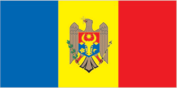
three equal vertical bands of blue (hoist side), yellow, and red; emblem in center of flag is of a Roman eagle of gold outlined in black with a red beak and talons carrying a yellow cross in its beak and a green olive branch in its right talons and a yellow scepter in its left talons; on its breast is a shield divided horizontally red over blue with a stylized ox head, star, rose, and crescent all in black-outlined yellow; same color scheme as Romania
Government type
republic
Independence
27 August 1991 (from Soviet Union)
International organization participation
BSEC, CE, CEI, CIS, EAEC (observer), EAPC, EBRD, FAO, GCTU, GUAM, IAEA, IBRD, ICAO, ICCt (signatory), IDA, IFAD, IFC, IFRCS, ILO, IMF, IMO, Interpol, IOC, IOM, IPU, ISO (correspondent), ITU, MIGA, OIF, OPCW, OSCE, PFP, SECI, UN, UNCTAD, UNESCO, UNIDO, Union Latina, UNMIL, UNMIS, UNOCI, UNOMIG, UNWTO, UPU, WCO, WFTU, WHO, WIPO, WMO, WTO
Judicial branch
Supreme Court; Constitutional Court (the sole authority for constitutional judicature)
Legal system
based on civil law system; Constitutional Court reviews legality of legislative acts and governmental decisions of resolution; accepts many UN and Organization for Security and Cooperation in Europe (OSCE) documents; has not accepted compulsory ICJ jurisdiction
Legislative branch
unicameral Parliament or Parlamentul (101 seats; parties and electoral blocs elected by popular vote to serve four-year terms) elections: last held 6 March 2005 (next to be held in 2009) election results: percent of vote by party - PCRM 46.1%, Democratic Moldova Bloc (AMN, PD, PSL) 28.4%, PPCD 9.1%, other parties 16.4%; seats by party - PCRM 56, Democratic Moldova Bloc (AMN, PD, PSL) 34, PPCD 11
National holiday
Independence Day, 27 August (1991)
Political parties and leaders
Christian Democratic People's Party or PPCD [Iurie ROSCA]; Communist Party of the Republic of Moldova or PCRM [Vladimir VORONIN]; Democratic Party or PD [Dumitru DIACOV]; Liberal Democratic Party or PLDM [Vladmir FILAT]; National Liberal Party or PNL [Vitalia PAVLICENKO]; Our Moldova Alliance or AMN [Serafim URECHEAN]; Party for Social Democracy or PDSM [Dumitru BRAGHIS]; Social Liberal Party or PSL [Oleg SEREBRIAN]
Political pressure groups and leaders
NA
Suffrage
18 years of age; universal
Economy
Agriculture - products
vegetables, fruits, wine, grain, sugar beets, sunflower seed, tobacco; beef, milk
Budget
revenues: $1.83 billion expenditures: $1.841 billion (2007 est.)
Commercial bank prime lending rate
18.83% (31 December 2007)
Currency (code)
Moldovan leu (MDL)
Currency code
MDL
Current account balance
-$694.7 million (2007 est.)
Debt - external
$3.3 billion (31 December 2007)
Distribution of family income - Gini index
33.2 (2003)
Economic aid - recipient
$191.8 million (2005)
Economy - overview
Moldova remains one of the poorest countries in Europe despite recent progress from its small economic base. It enjoys a favorable climate and good farmland but has no major mineral deposits. As a result, the economy depends heavily on agriculture, featuring fruits, vegetables, wine, and tobacco. Moldova must import almost all of its energy supplies. Moldova's dependence on Russian energy was underscored at the end of 2005, when a Russian-owned electrical station in Moldova's separatist Transnistria region cut off power to Moldova and Russia's Gazprom cut off natural gas in disputes over pricing. Russia's decision to ban Moldovan wine and agricultural products, coupled with its decision to double the price Moldova paid for Russian natural gas, slowed GDP growth in 2006. However, in 2007 growth returned to the 6% level Moldova had achieved in 2000-05, boosted by Russia's partial removal of the bans, solid fixed capital investment, and strong domestic demand driven by remittances from abroad. Economic reforms have been slow because of corruption and strong political forces backing government controls. Nevertheless, the government's primary goal of EU integration has resulted in some market-oriented progress. The granting of EU trade preferences and increased exports to Russia will encourage higher growth rates in 2008, but the agreements are unlikely to serve as a panacea, given the extent to which export success depends on higher quality standards and other factors. The economy remains vulnerable to higher fuel prices, poor agricultural weather, and the skepticism of foreign investors. Also, the presence of an illegal separatist regime in Moldova's Transnistria region continues to be a drag on the Moldovan economy.
Electricity - consumption
5.806 billion kWh (2006 est.)
Electricity - exports
229 million kWh (2006 est.)
Electricity - imports
3.741 billion kWh (2006 est.)
Electricity - production
3.824 billion kWh (2006 est.)
Electricity - production by source
fossil fuel: 90.6% hydro: 9.4% nuclear: 0% other: 0% (2001)
Exchange rates
Moldovan lei (MDL) per US dollar - 12.177 (2007), 13.131 (2006), 12.6 (2005), 12.33 (2004), 13.945 (2003)
Exports
$1.361 billion f.o.b. (2007 est.)
Exports - commodities
foodstuffs, textiles, machinery
Exports - partners
Russia 25.3%, Romania 13%, Italy 10%, Ukraine 8.7%, Germany 8.5%, Poland 6.2%, Belarus 4.2% (2007)
Fiscal year
calendar year
GDP - composition by sector
agriculture: 17.8% industry: 21.7% services: 60.5% (2007 est.)
GDP - per capita (PPP)
$2,300 (2007 est.)
GDP - real growth rate
3% (2007 est.)
GDP (official exchange rate)
$4.227 billion (2007 est.)
GDP (purchasing power parity)
$9.756 billion (2007 est.)
Household income or consumption by percentage share
lowest 10%: 3.2% highest 10%: 26.4% (2003)
Imports
$3.677 billion f.o.b. (2007 est.)
Imports - commodities
mineral products and fuel, machinery and equipment, chemicals, textiles
Imports - partners
Russia 20.5%, Ukraine 15.8%, Romania 15%, Germany 8.7%, Italy 5.7%, Poland 4.1% (2007)
Industrial production growth rate
1% (2007 est.)
Industries
sugar, vegetable oil, food processing, agricultural machinery; foundry equipment, refrigerators and freezers, washing machines; hosiery, shoes, textiles
Inflation rate (consumer prices)
12.3% (2007 est.)
Investment (gross fixed)
33.3% of GDP (2007 est.)
Labor force
1.333 million (2007 est.)
Labor force - by occupation
agriculture: 40.7% industry: 12.1% services: 47.2% (2005)
Market value of publicly traded shares
$573.9 million (2004)
Natural gas - consumption
2.44 billion cu m (2007 est.)
Natural gas - exports
0 cu m (2007 est.)
Natural gas - imports
2.44 billion cu m (2007 est.)
Natural gas - production
50 million cu m (2006 est.)
Natural gas - proved reserves
0 cu m (1 January 2006 est.)
Oil - consumption
15,770 bbl/day (2006 est.)
Oil - exports
50.03 bbl/day (2005)
Oil - imports
14,450 bbl/day (2005)
Oil - production
0 bbl/day (2007 est.)
Oil - proved reserves
0 bbl (1 January 2006 est.)
Population below poverty line
29.5% (2005)
Public debt
23.3% of GDP (2007 est.)
Reserves of foreign exchange and gold
$1.334 billion (31 December 2007 est.)
Stock of direct foreign investment - abroad
$NA
Stock of direct foreign investment - at home
$NA
Stock of domestic credit
$1.896 billion (31 December 2007)
Stock of money
$965 million (31 December 2007)
Stock of quasi money
$1.449 billion (31 December 2007)
Unemployment rate
2.1%; note - roughly 25% of working age Moldovans are employed abroad (2007 est.)
Communications
Internet country code
.md
Internet hosts
223,869 (2008)
Internet Service Providers (ISPs)
2 (1999)
Internet users
700,000 (2007)
Radio broadcast stations
AM 2, FM 29, shortwave NA (2006)
Radios
3.22 million (1997)
Telephone system
general assessment: inadequate, outmoded, poor service outside Chisinau; some modernization is under way domestic: depending on location, new subscribers may face long wait for service; multiple private operators of GSM mobile-cellular telephone service are operating; GPRS system is being introduced; a CDMA mobile telephone network began operations in 2007; combined fixed-line and mobile-cellular teledensity approaching 70 per 100 persons international: country code - 373; service through Romania and Russia via landline; satellite earth stations - at least 3 (Intelsat, Eutelsat, and Intersputnik) (2007)
Telephones - main lines in use
1.08 million (2007)
Telephones - mobile cellular
1.883 million (2007)
Television broadcast stations
40 (2006)
Televisions
1.26 million (1997)
Transportation
Airports
10 (2007)
Airports - with paved runways
total: 6 over 3,047 m: 1 2,438 to 3,047 m: 2 1,524 to 2,437 m: 2 under 914 m: 1 (2007)
Airports - with unpaved runways
total: 4 1,524 to 2,437 m: 2 914 to 1,523 m: 1 under 914 m: 1 (2007)
Merchant marine
total: 39 by type: bulk carrier 2, cargo 32, chemical tanker 2, combination ore/oil 2, petroleum tanker 1 foreign-owned: 17 (Egypt 1, Romania 3, Russia 3, Syria 1, Turkey 3, Ukraine 5, Yemen 1) (2008)
Pipelines
gas 1,980 km (2007)
Railways
total: 1,138 km broad gauge: 1,124 km 1.520-m gauge standard gauge: 14 km 1.435-m gauge (2006)
Roadways
total: 12,666 km paved: 12,117 km unpaved: 549 km (2007)
Waterways
424 km (on Dniester and Prut rivers) (2007)
Military and Security
Manpower available for military service
males age 16-49: 1,161,924 females age 16-49: 1,187,771 (2008 est.)
Manpower fit for military service
males age 16-49: 877,070 females age 16-49: 994,091 (2008 est.)
Manpower reaching militarily significant age annually
male: 33,053 female: 31,712 (2008 est.)
Military expenditures
0.4% of GDP (2005 est.)
Military service age and obligation
18 years of age for compulsory military service; 12-month service obligation (2006)
National Army
Ground Forces, Rapid Reaction Forces, Air and Air Defense Forces (2008)
Transnational Issues
Disputes - international
Moldova and Ukraine operate joint customs posts to monitor the transit of people and commodities through Moldova's break-away Transnistria region, which remains under OSCE supervision
Illicit drugs
limited cultivation of opium poppy and cannabis, mostly for CIS consumption; transshipment point for illicit drugs from Southwest Asia via Central Asia to Russia, Western Europe, and possibly the US; widespread crime and underground economic activity This page was last updated on 18 December, 2008
Trafficking in persons
current situation: Moldova is a major source and, to a lesser extent, a transit country for women and girls trafficked for the purpose of commercial sexual exploitation; Moldovan women are trafficked to the Middle East, Eastern Europe, and Western Europe; girls and young women are trafficked within the country from rural areas to Chisinau; children are also trafficked to neighboring countries for forced labor and begging; labor trafficking of men to work in the construction, agriculture, and service sectors of Russia is increasingly a problem tier rating: Tier 3 - Moldova does not fully comply with the minimum standards for the elimination of trafficking and is not making significant efforts to do so; the government failed to follow-up on allegations of officials complicit in trafficking cited in the 2007 Report, and it did not demonstrate proactive efforts to identify trafficking victims (2008)