2001 Edition
CIA World Factbook 2001 (Project Gutenberg)
Introduction
Administrative divisions
10 juletule (singular - juletul), 1 municipality*, and 1 autonomous territorial unit**; Balti, Cahul, Chisinau, Chisinau*, Dubasari, Edinet, Gagauzia**, Lapusna, Orhei, Soroca, Tighina, Ungheni
Age structure
0-14 years: 22.44% (male 506,303; female 488,311) 15-64 years: 67.62% (male 1,437,492; female 1,559,090) 65 years and over: 9.94% (male 163,473; female 276,901) (2001 est.)
Agriculture - products
vegetables, fruits, wine, grain, sugar beets, sunflower seed, tobacco; beef, milk
Airports
30 (2000 est.)
Airports - with paved runways
total: 7 over 3,047 m: 1 2,438 to 3,047 m: 2 1,524 to 2,437 m: 3 under 914 m: 1 (2000 est.)
Airports - with unpaved runways
total: 23 2,438 to 3,047 m: 4 1,524 to 2,437 m: 1 914 to 1,523 m: 4 under 914 m: 14 (2000 est.) Moldova Military
Area
total: 33,843 sq km land: 33,371 sq km water: 472 sq km
Area - comparative
slightly larger than Maryland
Background
Formerly ruled by Romania, Moldova became part of the Soviet Union at the close of World War II. Although independent from the USSR since 1991, Russian forces have remained on Moldovan territory east of the Nistru (Dnister) River supporting the Slavic majority population, mostly Ukrainians and Russians, who have proclaimed a "Transnistria" republic. One of the poorest nations in Europe and plagued by a moribund economy, in 2001 Moldova became the first former Soviet state to elect a communist as its president. Moldova Geography
Birth rate
13.35 births/1,000 population (2001 est.)
Budget
revenues: $536 million expenditures: $594 million, including capital expenditures of $NA (1998 est.)
Capital
Chisinau
Climate
moderate winters, warm summers
Coastline
0 km (landlocked)
Constitution
new constitution adopted 28 July 1994; replaces old Soviet constitution of 1979
Country name
conventional long form: Republic of Moldova conventional short form: Moldova local long form: Republica Moldova local short form: none former: Soviet Socialist Republic of Moldova; Moldavia
Currency
Moldovan leu (MDL)
Currency code
MDL
Death rate
12.6 deaths/1,000 population (2001 est.)
Debt - external
$900 million (2000)
Diplomatic representation from the US
chief of mission: Ambassador Rudolf Vilem PERINA embassy: Strada Alexei Mateevicie, #103, Chisinau 2009 mailing address: use embassy street address; pouch address - American Embassy Chisinau, Department of State, Washington, DC 20521-7080 telephone: [373] (2) 23-37-72
Diplomatic representation in the US
chief of mission: Ambassador Ceslav CIOBANU chancery: 2101 S Street NW, Washington, DC 20008 telephone: [1] (202) 667-1130
Disputes - international
separatist Transnistria region, comprising the area between the Nistru (Dniester) River and Ukraine, has its own de facto government, dominated by Moldovan Slavs
Economic aid - recipient
$100.8 million (1995); note - $547 million from the IMF and World Bank (1992-99)
Economy - overview
Moldova enjoys a favorable climate and good farmland but has no major mineral deposits. As a result, the economy depends heavily on agriculture, featuring fruits, vegetables, wine, and tobacco. Moldova must import all of its supplies of oil, coal, and natural gas, largely from Russia. Energy shortages contributed to sharp production declines after the breakup of the Soviet Union in 1991. As part of an ambitious reform effort, Moldova introduced a convertible currency, freed all prices, stopped issuing preferential credits to state enterprises, backed steady land privatization, removed export controls, and freed interest rates. Yet these efforts could not offset the impact of political and economic difficulties, both internal and regional. In 1998, the economic troubles of Russia, by far Moldova's leading trade partner, were a major cause of the 8.6% drop in GDP. In 1999, GDP fell again, by 4.4%, the fifth drop in the past seven years; exports were down, and energy supplies continued to be erratic. GDP declined slightly in 2000, with a serious drought hurting agriculture. Growth should turn positive in 2001.
Electricity - consumption
5.78 billion kWh (1999)
Electricity - exports
0 kWh (1999)
Electricity - imports
1.916 billion kWh (1999)
Electricity - production
4.155 billion kWh (1999)
Electricity - production by source
fossil fuel: 93.62% hydro: 6.38% nuclear: 0% other: 0% (1999)
Elevation extremes
lowest point: Nistru (Dnister) River 2 m highest point: Dealul Balanesti 430 m
Environment - current issues
heavy use of agricultural chemicals, including banned pesticides such as DDT, has contaminated soil and groundwater; extensive soil erosion from poor farming methods
Environment - international agreements
party to: Air Pollution, Biodiversity, Climate Change, Desertification, Hazardous Wastes, Ozone Layer Protection, Wetlands signed, but not ratified: Air Pollution-Persistent Organic Pollutants
Ethnic groups
Moldovan/Romanian 64.5%, Ukrainian 13.8%, Russian 13%, Gagauz 3.5%, Jewish 1.5%, Bulgarian 2%, other 1.7% (1989 est.) note: internal disputes with ethnic Slavs in the Transnistrian region
Exchange rates
lei per US dollar - 12.3728 (January 2001), 12.4342 (2000), 10.5158 (1999), 5.3707 (1998), 4.6236 (1997), 4.6045 (1996); note - lei is the plural form of leu
Executive branch
chief of state: President Vladimir VORONIN (since 4 April 2001) head of government: Prime Minister Vasile TARLEV (since 15 April 2001), three Deputy Prime Ministers: Valerian CRISTEA, Andrei CUCU, and Dmitri TODOROGLO (all since 19 April 2001) cabinet: selected by prime minister, subject to approval of Parliament elections: president elected by Parliament for a four-year term; election last held 4 April 2001; presidential elections were scheduled for December 2000, but in July 2000, Parliament canceled direct popular elections; Parliament's failure to chose a new president in December 2000 led to early parliamentary elections (moved up a year to February 2001); according to the Moldovan constitution, the president, on consulting with Parliament, will designate a candidate for the office of prime minister; within 15 days from designation, the prime minister-designate will request a vote of confidence from the Parliament regarding his/her work program and entire cabinet; prime minister designated on 15 April 2001, cabinet received vote of confidence on 19 April 2001 election results: Vladimir VORONIN elected president; parliamentary votes - Vladimir VORONIN 71, Dumitru BRAGHIS 15, Valerian CHRISTEA 3; Vasile TARLEV elected Prime Minister; parliamentary votes of confidence - 75 of 101
Exports
$500 million (f.o.b., 2000)
Exports - commodities
foodstuffs 57%, wine, tobacco; textiles and footwear, machinery (1999)
Exports - partners
Russia 41%, Romania 9%, Germany 8%, Ukraine 7%, Italy, Belarus (1999)
FAX
- [1] (202) 667-1204
- [373] (2) 23-30-44
Fiscal year
calendar year Moldova Communications
Flag description
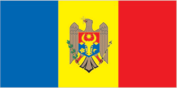
same color scheme as Romania - three equal vertical bands of blue (hoist side), yellow, and red; emblem in center of flag is of a Roman eagle of gold outlined in black with a red beak and talons carrying a yellow cross in its beak and a green olive branch in its right talons and a yellow scepter in its left talons; on its breast is a shield divided horizontally red over blue with a stylized ox head, star, rose, and crescent all in black-outlined yellow Moldova Economy
GDP
purchasing power parity - $11.3 billion (2000 est.)
GDP - composition by sector
agriculture: 31% industry: 35% services: 34% (1998)
GDP - per capita
purchasing power parity - $2,500 (2000 est.)
GDP - real growth rate
-1.5% (2000 est.)
Geographic coordinates
47 00 N, 29 00 E
Geography - note
landlocked Moldova People
Government type
republic
Highways
total: 20,000 km paved: 13,900 km (these roads are said to be hard-surfaced, and include, in addition to conventionally paved roads, some that are surfaced with gravel or other coarse aggregate, making them trafficable in all weather) unpaved: 6,100 km (these roads are made of unstabilized earth and are difficult to negotiate in wet weather) (1990)
HIV/AIDS - adult prevalence rate
0.2% (1999 est.)
HIV/AIDS - deaths
less than 100 (1999 est.)
HIV/AIDS - people living with HIV/AIDS
4,500 (1999 est.)
Household income or consumption by percentage share
lowest 10%: 2.7% highest 10%: 25.8% (1992)
Illicit drugs
limited cultivation of opium poppy and cannabis, mostly for CIS consumption; transshipment point for illicit drugs from Southwest Asia via Central Asia to Russia, Western Europe, and possibly the US
Imports
$761 million (f.o.b., 2000)
Imports - commodities
mineral products and fuel 38%, machinery and equipment, chemicals, textiles (1999)
Imports - partners
Russia 21%, Romania 16%, Ukraine 14%, Germany 12%, Italy 6%, Belarus (1999)
Independence
27 August 1991 (from Soviet Union)
Industrial production growth rate
3% (2000 est.)
Industries
food processing, agricultural machinery, foundry equipment, refrigerators and freezers, washing machines, hosiery, sugar, vegetable oil, shoes, textiles
Infant mortality rate
42.74 deaths/1,000 live births (2001 est.)
Inflation rate (consumer prices)
32% (2000 est.)
International organization participation
ACCT, BIS, BSEC, CCC, CE, CEI, CIS, EAPC, EBRD, ECE, FAO, IAEA, IBRD, ICAO, ICFTU, IDA, IFAD, IFC, ILO, IMF, Intelsat (nonsignatory user), Interpol, IOC, IOM (observer), ISO (correspondent), ITU, OPCW, OSCE, PFP, UN, UNCTAD, UNESCO, UNIDO, UPU, WHO, WIPO, WMO, WToO, WTrO (observer)
Internet country code
.md
Internet Service Providers (ISPs)
2 (1999)
Internet users
15,000 (2000) Moldova Transportation
Irrigated land
3,110 sq km (1993 est.)
Judicial branch
Supreme Court; Constitutional Court (the sole authority for constitutional judicature)
Labor force
1.7 million (1998)
Labor force - by occupation
agriculture 40%, industry 14%, other 46% (1998)
Land boundaries
total: 1,389 km border countries: Romania 450 km, Ukraine 939 km
Land use
arable land: 53% permanent crops: 14% permanent pastures: 13% forests and woodland: 13% other: 7% (1993 est.)
Languages
Moldovan (official, virtually the same as the Romanian language), Russian, Gagauz (a Turkish dialect)
Legal system
based on civil law system; Constitutional Court reviews legality of legislative acts and governmental decisions of resolution; it is unclear if Moldova accepts compulsory ICJ jurisdiction but accepts many UN and Organization for Security and Cooperation in Europe (OSCE) documents
Legislative branch
unicameral Parliament or Parlamentul (101 seats; parties and electoral blocs, as well as independent candidates, elected by popular vote to serve four-year terms) elections: last held 25 February 2001 (next to be held NA 2005) election results: percent of vote by party - PCM 50.1%, Braghis Alliance 13.4%, PPCD 8.2%, other parties 28.3%; seats by party - PCM 71, Braghis Alliance 19, PPCD 11
Life expectancy at birth
total population: 64.6 years male: 60.15 years female: 69.26 years (2001 est.)
Literacy
definition: age 15 and over can read and write total population: 96% male: 99% female: 94% (1989 est.) Moldova Government
Location
Eastern Europe, northeast of Romania
Map references
Commonwealth of Independent States
Maritime claims
none (landlocked)
Military branches
Ground Forces, Air and Air Defense Forces, Republic Security Forces (internal and border troops)
Military expenditures - dollar figure
$6 million (FY99)
Military expenditures - percent of GDP
1% (FY99) Moldova Transnational Issues
Military manpower - availability
males age 15-49: 1,164,018 (2001 est.)
Military manpower - fit for military service
males age 15-49: 921,210 (2001 est.)
Military manpower - military age
18 years of age
Military manpower - reaching military age annually
males: 42,268 (2001 est.)
National holiday
Independence Day, 27 August (1991)
Nationality
noun: Moldovan(s) adjective: Moldovan
Natural hazards
landslides (57 cases in 1998)
Natural resources
lignite, phosphorites, gypsum, arable land
Net migration rate
-0.3 migrant(s)/1,000 population (2001 est.)
Pipelines
natural gas 310 km (1992)
Political parties and leaders
Braghis Alliance [Dumitru BRAGHIS]; Popular Christian Democratic Party or PPCD [Iurie ROSCA]; Communist Party or PCM [Vladimir VORONIN, first chairman]
Political pressure groups and leaders
NA
Population
4,431,570 (July 2001 est.)
Population below poverty line
75% (1999 est.)
Population growth rate
0.05% (2001 est.)
Ports and harbors
none
Radio broadcast stations
AM 7, FM 50, shortwave 3 (1998)
Radios
3.22 million (1997)
Railways
total: 1,328 km broad gauge: 1,328 km 1.520-m gauge (1992)
Religions
Eastern Orthodox 98.5%, Jewish 1.5%, Baptist (only about 1,000 members) (1991)
Sex ratio
at birth: 1.05 male(s)/female under 15 years: 1.04 male(s)/female 15-64 years: 0.92 male(s)/female 65 years and over: 0.59 male(s)/female total population: 0.91 male(s)/female (2001 est.)
Suffrage
18 years of age; universal
Telephone system
general assessment: inadequate, outmoded, poor service outside Chisinau, some effort to modernize is under way domestic: new subscribers face long wait for service; mobile cellular telephone service being introduced international: service through Romania and Russia via landline; satellite earth stations - Intelsat, Eutelsat, and Intersputnik
Telephones - main lines in use
627,000 (1997)
Telephones - mobile cellular
2,200 (1997)
Television broadcast stations
1 (plus 30 repeaters) (1995)
Televisions
1.26 million (1997)
Terrain
rolling steppe, gradual slope south to Black Sea
Total fertility rate
1.67 children born/woman (2001 est.)
Unemployment rate
1.9% (includes only officially registered unemployed; large numbers of underemployed workers) (November 2000)
Waterways
424 km (1994)