1993 Edition
CIA World Factbook 1993 (Project Gutenberg)
Geography
Area
total area: 33,700 km2 land area: 33,700 km2 comparative area: slightly more than twice the size of Hawaii
Climate
mild winters, warm summers
Coastline
0 km (landlocked)
Environment
heavy use of agricultural chemicals, including banned pesticides such as DDT, has contaminated soil and groundwater; extensive erosion from poor farming methods
International disputes
potential dispute with Ukraine over former southern Bessarabian areas; northern Bukovina ceded to Ukraine upon Moldova's incorporation into USSR
Irrigated land
2,920 km2 (1990)
Land boundaries
total 1,389 km, Romania 450 km, Ukraine 939 km
Land use
arable land: 50% permanent crops: 0% meadows and pastures: 9% forest and woodland: 0% other: 41%
Location
Eastern Europe, between Ukraine and Romania
Map references
Asia, Europe, Standard Time Zones of the World
Maritime claims
none; landlocked
Natural resources
lignite, phosphorites, gypsum
Note
landlocked
Terrain
rolling steppe, gradual slope south to Black Sea
People and Society
Birth rate
16.15 births/1,000 population (1993 est.)
Death rate
10.01 deaths/1,000 population (1993 est.)
Ethnic divisions
Moldovan/Romanian 64.5%, Ukrainian 13.8%, Russian 13%, Gagauz 3.5%, Jewish 1.5%, Bulgarian 2%, other 1.7% (1989 figures) note: internal disputes with ethnic Russians and Ukrainians in the Dniester region and Gagauz Turks in the south
Infant mortality rate
30.8 deaths/1,000 live births (1993 est.)
Labor force
2.095 million by occupation: agriculture 34.4%, industry 20.1%, other 45.5% (1985 figures)
Languages
Moldovan (official); note - virtually the same as the Romanian language, Russian
Life expectancy at birth
total population: 67.92 years male: 64.49 years female: 71.53 years (1993 est.)
Literacy
age 9-49 can read and write (1970) total population: 100% male: 100% female: 99%
Nationality
noun: Moldovan(s) adjective: Moldovan
Net migration rate
-2.15 migrant(s)/1,000 population (1993 est.)
Population
4,455,645 (July 1993 est.)
Population growth rate
0.4% (1993 est.)
Religions
Eastern Orthodox 98.5%, Jewish 1.5%, Baptist (only about 1,000 members) (1991) note: almost all churchgoers are ethnic Moldovan; the Slavic population are not churchgoers
Total fertility rate
2.2 children born/woman (1993 est.)
Government
Administrative divisions
previously divided into 40 rayons; to be divided into fewer, larger districts at some future point
Capital
Chisinau (Kishinev)
Chief of State
President Mircea Ivanovich SNEGUR (since 3 September 1990)
Constitution
as of mid-1993 the new constitution had not been adopted; old constitution (adopted NA 1979) is still in effect but has been heavily amended during the past few years
Digraph
MD
Diplomatic representation in US
chief of mission: Permanent Representative to the UN Tudor PANTIRU (also acts as representative to US) chancery: NA telephone: NA
Executive branch
president, prime minister, Cabinet of Ministers
FAX
7-0422-23-34-94
Flag
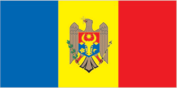
same color scheme as Romania - 3 equal vertical bands of blue (hoist side), yellow, and red; emblem in center of flag is of a Roman eagle of gold outlined in black with a red beak and talons carrying a yellow cross in its beak and a green olive branch in its right talons and a yellow scepter in its left talons; on its breast is a shield divided horizontally red over blue with a stylized ox head, star, rose, and crescent all in black-outlined yellow
Head of Legislature
Chairman of the Parliament Petru LUCINSCHI (since 4 February 1993); Prime Minister Andrei SANGHELI (since 1 July 1992)
Independence
27 August 1991 (from Soviet Union)
Judicial branch
Supreme Court
Legal system
based on civil law system; no judicial review of legislative acts; does not accept compulsory ICJ jurisdiction but accepts many UN and CSCE documents
Legislative branch
unicameral Parliament
Member of
BSEC, CIS, CSCE, EBRD, ECE, IBRD, ICAO, ILO, IMF, NACC, UN, UNCTAD, UNESCO, WHO
Names
conventional long form: Republic of Moldova conventional short form: Moldova local long form: Republica Moldoveneasca local short form: none former: Soviet Socialist Republic of Moldova; Moldavia
National holiday
Independence Day, 27 August 1991
Other political or pressure groups
United Council of Labor Collectives (UCLC), Igor SMIRNOV, chairman; The Ecology Movement of Moldova (EMM), G. MALARCHUK, chairman; The Christian Democratic League of Women of Moldova (CDLWM), L. LARI, chairman; National Christian Party of Moldova (NCPM), D. TODIKE, M. BARAGA, V. NIKU, leaders; The Peoples Movement Gagauz Khalky (GKh), S. GULGAR, leader; The Democratic Party of Gagauzia (DPG), G. SAVOSTIN, chairman; The Alliance of Working People of Moldova (AWPM), G. POLOGOV, president; Christian Alliance for Greater Romania; Women's League; Stefan the Great Movement
Parliament
last held 25 February 1990 (next to be held NA 1995); results - percent of vote by party NA; seats - (350 total) Christian Democratic Popular Front 50; Club of Independent Deputies 25; Agrarian Club 90; Social Democrats 60-70; Russian Conciliation Club 50; 60-70 seats belong to Dniester region deputies who usually boycott Moldovan legislative proceedings; the remaining seats filled by independents; note - until May 1991 was called Supreme Soviet
Political parties and leaders
Christian Democratic Popular Front (formerly Moldovan Popular Front), Ivrie ROSCA, chairman; Yedinstvo Intermovement, V. YAKOVLEV, chairman; Social Democratic Party, Oazul NANTOI, chairman, two other chairmen; Agrarian Democratic Party, Valery CHEBOTARV, leader; Democratic Party, Gheorghe GHIMPU, chairman; Democratic Labor Party, Alexandru ARSENI, chairman
President
last held 8 December 1991 (next to be held NA1996); results - Mircea SNEGUR ran unopposed and won 98.17% of vote
Suffrage
18 years of age; universal
Type
republic
US diplomatic representation
chief of mission: Ambassador Mary C. PENDLETON embassy: Strada Alexei Mateevich #103, Chisinau mailing address: APO AE 09862 telephone: 7-0422-23-37-72 or 23-34-94
Economy
Agriculture
- Moldova's principal economic activity; products (shown in share of total
- sunflower seed (4.4%), vegetables (4.4%), fruits and berries (9.7%), grapes (20.1%), meat (1.7%), milk (1.4%), eggs (1.4%)
- output of the former Soviet republics)
- Grain (1.6%), sugar beets (2.6%),
Budget
revenues $NA; expenditures $NA, including capital expenditures of $NA
Currency
plans to introduce the Moldovan lei in 1993 or 1994, until then retaining Russian ruble as currency
Economic aid
IMF credit, $18.5 million (1992); EC agricultural credit, $30 million (1992); US commitments, $10 million for grain (1992); World Bank credit, $31 million
Electricity
3,115,000 kW capacity; 11,100 million kWh produced, 2,491 kWh per capita (1992)
Exchange rates
rubles per US$1 - 415 (24 December 1992) but subject to wide fluctuations
Exports
100 million to outside the successor states of the former USSR (1992) commodities: foodstuffs, wine, tobacco, textiles and footwear, machinery, chemicals (1991) partners: Russia, Kazakhstan, Ukraine, Romania
External debt
$100 million (1993 est.)
Fiscal year
calendar year
Illicit drugs
illicit producer of opium and cannabis; mostly for CIS consumption; transshipment point for illicit drugs to Western Europe
Imports
100 million from outside the successor states of the former USSR (1992) commodities: oil, gas, coal, steel machinery, foodstuffs, automobiles, and other consumer durables partners: Russia, Ukraine, Uzbekistan, Romania
Industrial production
growth rate -22% (1992)
Industries
- key products (with share of total former Soviet output in parentheses where
- freezers (2.7%), washing machines (5.0%), hosiery (2.0%), refined sugar (3.1%), vegetable oil (3.7%), canned food (8.6%), shoes, textiles
- known)
- agricultural machinery, foundry equipment, refrigerators and
Inflation rate (consumer prices)
27% per month (first quarter 1993)
National product
GDP $NA
National product per capita
$NA
National product real growth rate
-26% (1992)
Overview
Moldova, the next-to-smallest of the former Soviet republics in area, is the most densely inhabited. Moldova has a little more than 1% of the population, labor force, capital stock, and output of the former Soviet Union. Living standards have been below average for the European USSR. The country enjoys a favorable climate, and economic development has been primarily based on agriculture, featuring fruits, vegetables, wine, and tobacco. Industry accounts for 20% of the labor force, whereas agriculture employs more than one-third. Moldova has no major mineral resources and has depended on other former Soviet republics for coal, oil, gas, steel, most electronic equipment, machine tools, and major consumer durables such as automobiles. Its industrial and agricultural products, in turn, have been exported to the other republics. Moldova has freed prices on most goods and has legalized private ownership of property. Moldova's near-term economic prospects are dimmed, however, by the difficulties of moving toward a market economy, the political problems of redefining ties to the other former Soviet republics and Romania, and the ongoing separatist movements in the Dniester and Gagauz regions. In 1992, national output fell substantially for the second consecutive year - down 22% in the industrial sector and 20% in agriculture. The decline is mainly attributable to the drop in energy supplies.
Unemployment rate
0.7% (includes only officially registered unemployed; also large numbers of underemployed workers)
Communications
Airports
total: 26 useable: 15 with permanent-surface runways: 6 with runways over 3,659 m: with runways 2,440-3,659 m: 5 with runways 1,220-2,439 m: 8
Highways
20,000 km total; 13,900 km hard-surfaced, 6,100 km earth (1990)
Pipelines
natural gas 310 km (1992)
Ports
none; landlocked
Railroads
1,150 km; does not include industrial lines (1990)
Telecommunications
poorly supplied with telephones (as of 1991, 494,000 telephones total, with a density of 111 lines per 1000 persons); 215,000 unsatisfied applications for telephone installations (31 January 1990); connected to Ukraine by landline and to countries beyond the former USSR through the international gateway switch in Moscow
Military and Security
Branches
Ground Forces, Air and Air Defence Force, Security Forces (internal and border troops)
Defense expenditures
exchange rate conversion - $NA, NA% of GDP
Manpower availability
males age 15-49 1,082,562; fit for military service 859,948; reach military age (18) annually 35,769 (1993 est.)