1999 Edition
CIA World Factbook 1999 (Internet Archive)
Geography
Area
total: 702 sq km land: 702 sq km water: 0 sq km note: includes Pohnpei (Ponape), Truk (Chuuk) Islands, Yap Islands, and Kosrae
Area--comparative
four times the size of Washington, DC
Climate
tropical; heavy year-round rainfall, especially in the eastern islands; located on southern edge of the typhoon belt with occasionally severe damage
Coastline
6,112 km
Elevation extremes
lowest point: Pacific Ocean 0 m highest point: Totolom 791 m
Environment--current issues
NA
Environment--international agreements
party to: Biodiversity, Climate Change, Desertification, Hazardous Wastes, Law of the Sea, Ozone Layer Protection signed, but not ratified: Climate Change-Kyoto Protocol
Geographic coordinates
6 55 N, 158 15 E
Geography--note
four major island groups totaling 607 islands
Irrigated land
NA sq km
Land boundaries
0 km
Land use
arable land: NA% permanent crops: NA% permanent pastures: NA% forests and woodland: NA% other: NA%
Location
Oceania, island group in the North Pacific Ocean, about three-quarters of the way from Hawaii to Indonesia
Map references
Oceania
Maritime claims
exclusive economic zone: 200 nm territorial sea: 12 nm
Natural hazards
typhoons (June to December)
Natural resources
forests, marine products, deep-seabed minerals
Terrain
islands vary geologically from high mountainous islands to low, coral atolls; volcanic outcroppings on Pohnpei, Kosrae, and Truk
People and Society
Age structure
0-14 years: NA 15-64 years: NA 65 years and over: NA
Birth rate
27.32 births/1,000 population (1999 est.)
Death rate
6.01 deaths/1,000 population (1999 est.)
Ethnic groups
nine ethnic Micronesian and Polynesian groups
Infant mortality rate
33.99 deaths/1,000 live births (1999 est.)
Languages
English (official and common language), Trukese, Pohnpeian, Yapese, Kosrean
Life expectancy at birth
total population: 68.48 years male: 66.52 years female: 70.48 years (1999 est.)
Literacy
definition: age 15 and over can read and write total population: 89% male: 91% female: 88% (1980 est.)
Nationality
noun: Micronesian(s) adjective: Micronesian; Kosrae(s), Pohnpeian(s), Trukese, Yapese
Net migration rate
11.65 migrant(s)/1,000 population (1999 est.)
Population
131,500 (July 1999 est.)
Population growth rate
3.3% (1999 est.)
Religions
Roman Catholic 50%, Protestant 47%, other and none 3%
Total fertility rate
3.87 children born/woman (1999 est.)
Government
Administrative divisions
4 states; Chuuk (Truk), Kosrae, Pohnpei, Yap
Capital
Palikir
Constitution
10 May 1979
Country name
conventional long form: Federated States of Micronesia conventional short form: none former: Kosrae, Ponape, Truk, and Yap Districts (Trust Territory of the Pacific Islands) abbreviation: FSM
Data code
FM
Executive branch
chief of state: President Jacob NENA (acting president since NA July 1996, president since 9 May 1997); Vice President Leo A. FALCAM (since 9 May 1997); note--the president is both the chief of state and head of government; Vice President Jacob NENA became acting president in July 1996 after President Bailey OLTER suffered a stroke; OLTER was declared incapacitated in November 1996; as provided for by the constitution, 180 days later, with OLTER still unable to resume his duties, NENA was sworn in as the new president; he will serve for the remaining two years of OLTER's term head of government: President Jacob NENA (acting president since NA July 1996, president since 9 May 1997); Vice President Leo A. FALCAM (since 9 May 1997); note--the president is both the chief of state and head of government; Vice President Jacob NENA became acting president in July 1996 after President Bailey OLTER suffered a stroke; OLTER was declared incapacitated in November 1996; as provided for by the constitution, 180 days later, with OLTER still unable to resume his duties, NENA was sworn in as the new president; he will serve for the remaining two years of OLTER's term cabinet: Cabinet elections: president and vice president elected by Congress from among the four senators-at-large for four-year terms; election last held 11 May 1995 (next to be held NA May 1999); note--because of the vacancy to the post of vice president created after NENA left to become acting president, a new election to fill the position of vice president for the remaining two years of the term was held on 9 May 1997 (next to be held NA May 1999) election results: Bailey OLTER reelected president; percent of Congress vote--NA; Leo A. FALCAM elected vice president; percent of Congress vote--NA
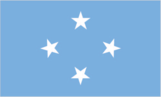
Flag description
light blue with four white five-pointed stars centered; the stars are arranged in a diamond pattern
Government type
constitutional government in free association with the US; the Compact of Free Association entered into force 3 November 1986
Independence
3 November 1986 (from the US-administered UN Trusteeship)
International organization participation
AsDB, ESCAP, G-77, IBRD, ICAO, IDA, IFC, IMF, Intelsat, ITU, OPCW, Sparteca, SPC, SPF, UN, UNCTAD, WHO, WMO Diplomatic representation in the US: chief of mission: Ambassador Jesse Bibiano MAREHALAU chancery: 1725 N Street NW, Washington, DC 20036 consulate(s) general: Honolulu and Tamuning (Guam) Diplomatic representation from the US: chief of mission: Ambassador (vacant); Charge d'Affaires Ann WRIGHT embassy: address NA, Kolonia mailing address: P. O. Box 1286, Pohnpei, Federated States of Micronesia 96941
Judicial branch
Supreme Court Political parties and leaders: no formal parties
Legal system
based on adapted Trust Territory laws, acts of the legislature, municipal, common, and customary laws
Legislative branch
unicameral Congress (14 seats; members elected by popular vote; four--one elected from each of state--to serve four-year terms and 10--elected from single-member districts delineated by population--to serve two-year terms) elections: elections for four-year term seats last held 7 March 1995 (next to be held 2 March 1999); elections for two-year term seats last held 3 March 1997 (next to be held NA March 1999) election results: percent of vote--NA; seats--independents 14
National holiday
Proclamation of the Federated States of Micronesia, 10 May (1979)
Suffrage
18 years of age; universal
Economy
Agriculture--products
black pepper, tropical fruits and vegetables, coconuts, cassava (tapioca), sweet potatoes; pigs, chickens
Budget
revenues: $58 million expenditures: $52 million, including capital expenditures of $4.7 million (FY95/96 est.)
Currency
1 United States dollar (US$) = 100 cents
Debt--external
$129 million
Economic aid--recipient
$77.4 million (1995); note?under terms of the Compact of Free Association, the US will provide $1.3 billion in grant aid during the period 1986-2001
Economy--overview
Economic activity consists primarily of subsistence farming and fishing. The islands have few mineral deposits worth exploiting, except for high-grade phosphate. The potential for a tourist industry exists, but the remoteness of the location and a lack of adequate facilities hinder development. Financial assistance from the US is the primary source of revenue, with the US pledged to spend $1 billion in the islands in the 1990s. Geographical isolation and a poorly developed infrastructure are major impediments to long-term growth.
Electricity--consumption
NA kWh
Electricity--exports
NA kWh
Electricity--imports
NA kWh
Electricity--production
NA kWh
Electricity--production by source
fossil fuel: NA% hydro: NA% nuclear: NA% other: NA%
Exchange rates
US currency is used
Exports
$73 million (f.o.b., 1996 est.)
Exports--commodities
fish, garments, bananas, black pepper
Exports--partners
Japan, US, Guam
Fiscal year
1 October--30 September
GDP
purchasing power parity--$220 million (1996 est.) note: GDP is supplemented by grant aid, averaging perhaps $100 million annually
GDP--composition by sector
agriculture: NA% industry: NA% services: NA%
GDP--per capita
purchasing power parity?$1,760 (1996 est.)
GDP--real growth rate
1% (1996 est.)
Household income or consumption by percentage share
lowest 10%: NA% highest 10%: NA%
Imports
$168 million (c.i.f., 1996 est.)
Imports--commodities
food, manufactured goods, machinery and equipment, beverages
Imports--partners
US, Japan, Australia
Industrial production growth rate
NA%
Industries
tourism, construction, fish processing, craft items from shell, wood, and pearls
Inflation rate (consumer prices)
4% (1996 est.)
Labor force
NA
Labor force--by occupation
two-thirds are government employees
Population below poverty line
NA%
Unemployment rate
27% (1989)
Communications
Radio broadcast stations
AM 5, FM 1, shortwave 1
Radios
17,000 (1993 est.)
Telephone system
domestic: islands interconnected by shortwave radiotelephone (used mostly for government purposes) international: satellite earth stations--4 Intelsat (Pacific Ocean)
Telephones
960
Television broadcast stations
2 (1997)
Televisions
1,290 (1993 est.)
Transportation
Airports
6 (1998 est.) Airports--with paved runways: total: 5 1,524 to 2,437 m: 4 914 to 1,523 m: 1 (1998 est.) Airports--with unpaved runways: total: 1 914 to 1,523 m: 1 (1998 est.)
Highways
total: 240 km paved: 42 km unpaved: 198 km (1996 est.) Ports and harbors: Colonia (Yap), Kolonia (Pohnpei), Lele, Moen
Merchant marine
none
Railways
0 km
Military and Security
Military--note
Federated States of Micronesia (FSM) is a sovereign, self-governing state in free association with the US; FSM is totally dependent on the US for its defense
Transnational Issues
Disputes--international
none