2022 Edition
CIA World Factbook 2022 (factbook.json @ 61dadec0c9c9)
Introduction
Background
Although known to Arab and European sailors since at least the early 1500s, the island of Mauritius was uninhabited until 1638 when the Dutch established a settlement named in honor of Prince Maurits van NASSAU. Their presence led to the rapid disappearance of the flightless dodo bird that has since become one of the most well-known examples of extinction in modern times. The Dutch abandoned their financially distressed settlement in 1710, although a number of formerly enslaved people remained. In 1722, the French established what would become a highly profitable settlement focused on sugar cane plantations that were reliant on the labor of enslaved people brought to Mauritius from other parts of Africa. In the 1790s, the island had a brief period of autonomous rule when plantation owners rejected French control because of laws ending slavery that were temporarily in effect during the French Revolution. Britain captured the Island in 1810 as part of the Napoleonic Wars but kept most of the French administrative structure, which remains to this day in the form of the country’s legal codes and widespread use of the French Creole language. The abolition of slavery in 1835 - later than most other British colonies - led to increased reliance on contracted laborers from the Indian subcontinent to work on plantations. Today their descendants form the majority of the population. Mauritius remained a strategically important British naval base, and later an air station, playing a role during World War II for anti-submarine and convoy operations, as well as for the collection of signals intelligence. Mauritius gained independence from the UK in 1968 as a Parliamentary Republic and has remained a stable democracy with regular free elections and a positive human rights record. The country also attracted considerable foreign investment and now has one of Africa's highest per capita incomes. Mauritius’ often fractious coalition politics has been dominated by two prominent families each of which has had father-son pairs who have been prime minister over multiple, often nonconsecutive, terms. Seewoosagur RAMGOOLAM (1968-76) was Mauritius’ first prime minister and he was succeeded by Anerood JUGNAUTH (1982-95, 2000-03, 2014-17); his son Navin RAMGOOLAM (1995-2000, 2005-14); and Paul Raymond BERENGER (2003-05), the only non-Hindu prime minister of post-independence Mauritius. In 2017, Pravind JUGNAUTH became prime minister after his father stepped down short of completing his term, and he was elected in his own right in 2019. Mauritius claims the French island of Tromelin and the British Chagos Archipelago (British Indian Ocean Territory). Since 2017, Mauritius has secured favorable UN General Assembly resolutions and an International Court of Justice advisory opinion relating to its sovereignty dispute with the UK.
Geography
Area
- land
- 2,030 sq km
- note
- note: includes Agalega Islands, Cargados Carajos Shoals (Saint Brandon), and Rodrigues
- total
- 2,040 sq km
- water
- 10 sq km
Area - comparative
almost 11 times the size of Washington, DC
Climate
tropical, modified by southeast trade winds; warm, dry winter (May to November); hot, wet, humid summer (November to May)
Coastline
177 km
Elevation
- highest point
- Mont Piton 828 m
- lowest point
- Indian Ocean 0 m
Geographic coordinates
20 17 S, 57 33 E
Geography - note
the main island, from which the country derives its name, is of volcanic origin and is almost entirely surrounded by coral reefs; former home of the dodo, a large flightless bird related to pigeons, driven to extinction by the end of the 17th century through a combination of hunting and the introduction of predatory species
Irrigated land
158 sq km (2020)
Land boundaries
- total
- 0 km
Land use
- agricultural land
- 43.8% (2018 est.)
- agricultural land: arable land
- arable land: 38.4% (2018 est.)
- agricultural land: permanent crops
- permanent crops: 2% (2018 est.)
- agricultural land: permanent pasture
- permanent pasture: 3.4% (2018 est.)
- forest
- 17.3% (2018 est.)
- other
- 38.9% (2018 est.)
Location
Southern Africa, island in the Indian Ocean, about 800 km (500 mi) east of Madagascar
Map references
Africa
Maritime claims
- continental shelf
- 200 nm or to the edge of the continental margin
- exclusive economic zone
- 200 nm
- note
- measured from claimed archipelagic straight baselines
- territorial sea
- 12 nm
Natural hazards
cyclones (November to April); almost completely surrounded by reefs that may pose maritime hazards
Natural resources
arable land, fish
Population distribution
population density is one of the highest in the world; urban clusters are found throughout the main island, with a greater density in and around Port Luis; population on Rodrigues Island is spread across the island with a slightly denser cluster on the north coast as shown in this population distribution map
Terrain
small coastal plain rising to discontinuous mountains encircling central plateau
People and Society
Age structure
- 0-14 years
- 19.44% (male 137,010/female 131,113)
- 15-24 years
- 14.06% (male 98,480/female 95,472)
- 25-54 years
- 43.11% (male 297,527/female 297,158)
- 55-64 years
- 12.31% (male 80,952/female 88,785)
- 65 years and over
- 11.08% (male 63,230/female 89,638) (2020 est.)
Alcohol consumption per capita
- beer
- 1.94 liters of pure alcohol (2019 est.)
- other alcohols
- 0.03 liters of pure alcohol (2019 est.)
- spirits
- 0.88 liters of pure alcohol (2019 est.)
- total
- 3.39 liters of pure alcohol (2019 est.)
- wine
- 0.23 liters of pure alcohol (2019 est.)
Birth rate
9.86 births/1,000 population (2022 est.)
Children under the age of 5 years underweight
NA
Contraceptive prevalence rate
63.8% (2014)
Current health expenditure
6.2% of GDP (2019)
Death rate
8.86 deaths/1,000 population (2022 est.)
Demographic profile
Mauritius has transitioned from a country of high fertility and high mortality rates in the 1950s and mid-1960s to one with among the lowest population growth rates in the developing world today. After World War II, Mauritius’ population began to expand quickly due to increased fertility and a dramatic drop in mortality rates as a result of improved health care and the eradication of malaria. This period of heightened population growth – reaching about 3% a year – was followed by one of the world’s most rapid birth rate declines. The total fertility rate fell from 6.2 children per women in 1963 to 3.2 in 1972 – largely the result of improved educational attainment, especially among young women, accompanied by later marriage and the adoption of family planning methods. The family planning programs’ success was due to support from the government and eventually the traditionally pronatalist religious communities, which both recognized that controlling population growth was necessary because of Mauritius’ small size and limited resources. Mauritius’ fertility rate has consistently been below replacement level since the late 1990s, a rate that is substantially lower than nearby countries in southern Africa. With no indigenous population, Mauritius’ ethnic mix is a product of more than two centuries of European colonialism and continued international labor migration. Sugar production relied on slave labor mainly from Madagascar, Mozambique, and East Africa from the early 18th century until its abolition in 1835, when slaves were replaced with indentured Indians. Most of the influx of indentured labor – peaking between the late 1830s and early 1860s – settled permanently creating massive population growth of more than 7% a year and reshaping the island’s social and cultural composition. While Indians represented about 12% of Mauritius’ population in 1837, they and their descendants accounted for roughly two-thirds by the end of the 19th century. Most were Hindus, but the majority of the free Indian traders were Muslims. Mauritius again turned to overseas labor when its success in clothing and textile exports led to a labor shortage in the mid-1980s. Clothing manufacturers brought in contract workers (increasingly women) from China, India, and, to a lesser extent Bangladesh and Madagascar, who worked longer hours for lower wages under poor conditions and were viewed as more productive than locals. Downturns in the sugar and textile industries in the mid-2000s and a lack of highly qualified domestic workers for Mauritius’ growing services sector led to the emigration of low-skilled workers and a reliance on skilled foreign labor. Since 2007, Mauritius has pursued a circular migration program to enable citizens to acquire new skills and savings abroad and then return home to start businesses and to invest in the country’s development.
Dependency ratios
- elderly dependency ratio
- 17.3
- potential support ratio
- 5.8 (2021 est.)
- total dependency ratio
- 40.7
- youth dependency ratio
- 23.4
Drinking water source
- improved: rural
- rural: 99.8% of population
- improved: total
- total: 99.9% of population
- improved: urban
- urban: 99.9% of population
- unimproved: rural
- rural: 0.2% of population
- unimproved: total
- total: 0.1% of population (2020 est.)
- unimproved: urban
- urban: 0.1% of population
Education expenditures
4.9% of GDP (2021 est.)
Ethnic groups
- Indo-Mauritian (compose approximately two thirds of the total population), Creole, Sino-Mauritian, Franco-Mauritian
- note
- note: Mauritius has not had a question on ethnicity on its national census since 1972
HIV/AIDS - adult prevalence rate
1.4% (2021 est.)
Hospital bed density
3.7 beds/1,000 population (2020)
Infant mortality rate
- female
- 10.43 deaths/1,000 live births (2022 est.)
- male
- 13.63 deaths/1,000 live births
- total
- 12.08 deaths/1,000 live births
Languages
Creole 86.5%, Bhojpuri 5.3%, French 4.1%, two languages 1.4%, other 2.6% (includes English, one of the two official languages of the National Assembly, which is spoken by less than 1% of the population), unspecified 0.1% (2011 est.)
Life expectancy at birth
- female
- 77.88 years (2022 est.)
- male
- 72.04 years
- total population
- 74.86 years
Literacy
- definition
- age 15 and over can read and write
- female
- 89.4% (2018)
- male
- 93.4%
- total population
- 91.3%
Major urban areas - population
149,000 PORT LOUIS (capital) (2018)
Maternal mortality ratio
61 deaths/100,000 live births (2017 est.)
Median age
- female
- 37.6 years (2020 est.)
- male
- 35 years
- total
- 36.3 years
Nationality
- adjective
- Mauritian
- noun
- Mauritian(s)
Net migration rate
0 migrant(s)/1,000 population (2022 est.)
Obesity - adult prevalence rate
10.8% (2016)
Physicians density
2.71 physicians/1,000 population (2020)
Population
1,308,222 (2022 est.)
Population distribution
population density is one of the highest in the world; urban clusters are found throughout the main island, with a greater density in and around Port Luis; population on Rodrigues Island is spread across the island with a slightly denser cluster on the north coast as shown in this population distribution map
Population growth rate
0.1% (2022 est.)
Religions
Hindu 48.5%, Roman Catholic 26.3%, Muslim 17.3%, other Christian 6.4%, other 0.6%, none 0.7%, unspecified 0.1% (2011 est.)
Sanitation facility access
- improved: rural
- rural: NA
- improved: total
- total: NA
- improved: urban
- urban: 99.9% of population
- unimproved: rural
- rural: NA
- unimproved: total
- total: (2020 est.) NA
- unimproved: urban
- urban: 0.1% of population
School life expectancy (primary to tertiary education)
- female
- 16 years (2017)
- male
- 14 years
- total
- 15 years
Sex ratio
- 0-14 years
- 1.05 male(s)/female
- 15-24 years
- 1.03 male(s)/female
- 25-54 years
- 1 male(s)/female
- 55-64 years
- 0.9 male(s)/female
- 65 years and over
- 0.47 male(s)/female
- at birth
- 1.07 male(s)/female
- total population
- 0.95 male(s)/female (2022 est.)
Tobacco use
- female
- 3% (2020 est.)
- male
- 37.3% (2020 est.)
- total
- 20.2% (2020 est.)
Total fertility rate
1.35 children born/woman (2022 est.)
Urbanization
- rate of urbanization
- 0.28% annual rate of change (2020-25 est.)
- urban population
- 40.9% of total population (2023)
Youth unemployment rate (ages 15-24)
- female
- 28% (2020 est.)
- male
- 21.7%
- total
- 24.5%
Government
Administrative divisions
9 districts and 3 dependencies*; Agalega Islands*, Black River, Cargados Carajos Shoals*, Flacq, Grand Port, Moka, Pamplemousses, Plaines Wilhems, Port Louis, Riviere du Rempart, Rodrigues*, Savanne
Capital
- etymology
- named after LOUIS XV, who was king of France in 1736 when the port became the administrative center of Mauritius and a major reprovisioning stop for French ships traveling between Europe and Asia
- geographic coordinates
- 20 09 S, 57 29 E
- name
- Port Louis
- time difference
- UTC+4 (9 hours ahead of Washington, DC, during Standard Time)
Citizenship
- citizenship by birth
- yes
- citizenship by descent only
- yes
- dual citizenship recognized
- yes
- residency requirement for naturalization
- 5 out of the previous 7 years including the last 12 months
Constitution
- amendments
- proposed by the National Assembly; passage of amendments affecting constitutional articles, including the sovereignty of the state, fundamental rights and freedoms, citizenship, or the branches of government, requires approval in a referendum by at least three-fourths majority of voters followed by a unanimous vote by the Assembly; passage of other amendments requires only two-thirds majority vote by the Assembly; amended many times, last in 2016
- history
- several previous; latest adopted 12 March 1968
Country name
- conventional long form
- Republic of Mauritius
- conventional short form
- Mauritius
- etymology
- island named after Prince Maurice VAN NASSAU, stadtholder of the Dutch Republic, in 1598
- local long form
- Republic of Mauritius
- local short form
- Mauritius
- note
- note: pronounced mah-rish-us
Diplomatic representation from the US
- chief of mission
- Ambassador (vacant); Charge d'Affaires Judes E. DEBAERE (since June 2019); note - also accredited to Seychelles
- email address and website
- PTLConsular@state.govhttps://mu.usembassy.gov/
- embassy
- 4th Floor, Rogers House, John Kennedy Avenue, Port Louis
- FAX
- [230] 208-9534
- mailing address
- 2450 Port Louis Place, Washington, DC 20521-2450
- telephone
- [230] 202-4400
Diplomatic representation in the US
- chancery
- 1709 N Street NW, Washington, DC 20036; administrative offices at 3201 Connecticut Avenue NW, Suite 441, Washington, DC 20036
- chief of mission
- Ambassador Purmanund JHUGROO (since 7 July 2021)
- email address and website
- mauritius.embassy@verizon.net; washingtonemb@govmu.orghttps://mauritius-washington.govmu.org/Pages/index.aspx
- FAX
- [1] (202) 966-0983
- telephone
- [1] (202) 244-1491; [1] (202) 244-1492
Executive branch
- cabinet
- Cabinet of Ministers (Council of Ministers) appointed by the president on the recommendation of the prime minister
- chief of state
- President Pritivirajsing ROOPUN (since 2 December 2019); Vice President Marie Cyril EDDY Boissézon (since 2 December 2019); note - President Ameenah GURIB-FAKIM, the country's first female president, resigned on 23 March 2018 amid a credit card scandal; Acting Presidents served from March 2018 until ROOPUN's appointment in 2019
- election results
- 2019: Pritivirajsing ROOPUN (MSM) elected president by the National Assembly - unanimous vote; note - GURIB-FAKIM resigned on 23 March 20182015: Ameenah GURIB-FAKIM (independent) elected president by the National Assembly - unanimous vote; note - GURIB-FAKIM was Mauritius' first female president
- elections/appointments
- president and vice president indirectly elected by the National Assembly for 5-year renewable terms; election last held on 7 November 2019 (next to be held in 2024); the president appoints the prime minister and deputy prime minister who have the majority support in the National Assembly
- head of government
- Prime Minister Pravind JUGNAUTH (since 23 January 2017); note - Prime Minister Sir Anerood JUGNAUTH stepped down on 23 January 2017 in favor of his son, Pravind Kumar JUGNAUTH, who was then appointed prime minister; following 7 November 2019 parliamentary elections, Pravind JUGNAUTH remained prime minister and home affairs minister and also became defense minister
Flag description
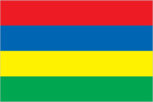
- four equal horizontal bands of red (top), blue, yellow, and green; red represents self-determination and independence, blue the Indian Ocean surrounding the island, yellow has been interpreted as the new light of independence, golden sunshine, or the bright future, and green can symbolize either agriculture or the lush vegetation of the island
- note
- note: while many national flags consist of three - and in some cases five - horizontal bands of color, the flag of Mauritius is the world's only national flag to consist of four horizontal color bands
Government type
parliamentary republic
Independence
12 March 1968 (from the UK)
International law organization participation
accepts compulsory ICJ jurisdiction with reservations; accepts ICCt jurisdiction
International organization participation
ACP, AfDB, AOSIS, AU, C, CD, COMESA, CPLP (associate), FAO, G-77, IAEA, IBRD, ICAO, ICC (NGOs), ICCt, ICRM, IDA, IFAD, IFC, IFRCS, IHO, ILO, IMF, IMO, IMSO, InOC, Interpol, IOC, IOM, IPU, ISO, ITSO, ITU, ITUC (NGOs), MIGA, NAM, OIF, OPCW, PCA, SAARC (observer), SADC, UN, UNCTAD, UNESCO, UNIDO, UNWTO, UPU, WCO, WFTU (NGOs), WHO, WIPO, WMO, WTO
Judicial branch
- highest court(s)
- Supreme Court of Mauritius (consists of the chief justice, a senior puisne judge, and 24 puisne judges); note - the Judicial Committee of the Privy Council (in London) serves as the final court of appeal
- judge selection and term of office
- chief justice appointed by the president after consultation with the prime minister; senior puisne judge appointed by the president with the advice of the chief justice; other puisne judges appointed by the president with the advice of the Judicial and Legal Commission, a 4-member body of judicial officials including the chief justice; all judges serve until retirement at age 67
- subordinate courts
- lower regional courts known as District Courts, Court of Civil Appeal; Court of Criminal Appeal; Public Bodies Appeal Tribunal
Legal system
civil legal system based on French civil law with some elements of English common law
Legislative branch
- description
- unicameral National Assembly or Assemblee Nationale (70 seats maximum; 62 members directly elected multi-seat constituencies by simple majority vote and up to 8 seats allocated to non-elected party candidates by the Office of Electoral Commissioner; members serve a 5-year term)
- election results
- percent of vote by party - Mauritian Alliance 2019 (MSM, ML, MAG, and PM) 37.7%, National Alliance (PTR, PMSD, and MJCB) 32.8%, MMM 20.6%, OPR 1%, Other 7.9%; elected seats by party as of November 2019 - the Militant Socialist Movement (MSM) 38 seats, the Mauritius Labour Party (PTR) or (MLP) 14, Mauritian Militant Movement (MMM) 8, and the Rodrigues People's Organization (OPR) 2; composition as of July 2022 - men 56, women 14, percent of women 20% (2019)
- elections
- last held on 7 November 2019 (next to be held by late 2024)
National anthem
- lyrics/music
- Jean Georges PROSPER/Philippe GENTIL
- name
- "Motherland"
- note
- note: adopted 1968
National heritage
- selected World Heritage Site locales
- Aapravasi Ghat; Le Morne Cultural Landscape
- total World Heritage Sites
- 2 (both cultural)
National holiday
Independence and Republic Day, 12 March (1968 & 1992); note - became independent and a republic on the same date in 1968 and 1992 respectively
National symbol(s)
dodo bird, Trochetia Boutoniana flower; national colors: red, blue, yellow, green
Political parties and leaders
Alliance Morisien (Mauritian Alliance 2019; coalition includes PM, MSM, ML, and MAG) [Pravind JUGNAUTH] Jean-Claude Barbier Movement (Mouvement Jean-Claude Barbier) or MJCB [Jean-Claude Barbier]Mauritian Militant Movement (Mouvement Militant Mauricien) or MMM [Paul BERENGER]Mauritian Social Democratic Party (Parti Mauricien Social Democrate) or PMSD [Xavier Luc DUVAL]Mauritius Labor Party (Parti Travailliste) or PTR or MLP [Navinchandra RAMGOOLAM]Militant Platform or PM (Plateforme Militante) [Steven OBEEGADOO]Militant Socialist Movement (Mouvement Socialist Mauricien) or MSM [Pravind JUGNAUTH]Muvman Liberater or ML [Ivan COLLENDAVELLOO]National Alliance (coalition includes PTR, PMSD, and MJCB) [Navinchandra RAMGOOLAM]Patriotic Movement (Mouvement Patriotique) or MAG [Alan GANOO]Rodrigues Peoples Organization (Organisation du Peuple Rodriguais) or OPR [Serge CLAIR] note: only parties with seats in the National Assembly listed
Suffrage
18 years of age; universal
Economy
Agricultural products
sugar cane, poultry, pumpkins, gourds, potatoes, eggs, tomatoes, pineapples, bananas, fruit
Budget
- expenditures
- 3.038 billion (2017 est.)
- revenues
- 2.994 billion (2017 est.)
Budget surplus (+) or deficit (-)
-0.3% (of GDP) (2017 est.)
Credit ratings
- Moody's rating
- Baa1 (2012)
- note
- note: The year refers to the year in which the current credit rating was first obtained.
Current account balance
- Current account balance 2016
- -$531 million (2016 est.)
- Current account balance 2017
- -$875 million (2017 est.)
Debt - external
- Debt - external 2018
- $232.17 billion (2018 est.)
- Debt - external 2019
- $226.799 billion (2019 est.)
Economic overview
Since independence in 1968, Mauritius has undergone a remarkable economic transformation from a low-income, agriculturally based economy to a diversified, upper middle-income economy with growing industrial, financial, and tourist sectors. Mauritius has achieved steady growth over the last several decades, resulting in more equitable income distribution, increased life expectancy, lowered infant mortality, and a much-improved infrastructure. The economy currently depends on sugar, tourism, textiles and apparel, and financial services, but is expanding into fish processing, information and communications technology, education, and hospitality and property development. Sugarcane is grown on about 90% of the cultivated land area but sugar makes up only around 3-4% of national GDP. Authorities plan to emphasize services and innovation in the coming years. After several years of slow growth, government policies now seek to stimulate economic growth in five areas: serving as a gateway for international investment into Africa; increasing the use of renewable energy; developing smart cities; growing the ocean economy; and upgrading and modernizing infrastructure, including public transportation, the port, and the airport. Mauritius has attracted more than 32,000 offshore entities, many aimed at commerce in India, South Africa, and China. The Mauritius International Financial Center is under scrutiny by international bodies promoting fair tax competition and Mauritius has been cooperating with the European Union and the United states in the automatic exchange of account information. Mauritius is also a member of the OECD/G20’s Inclusive Framework on Base Erosion and Profit Shifting and is under pressure to review its Double Taxation Avoidance Agreements. The offshore sector is vulnerable to changes in the tax framework and authorities have been working on a Financial Services Sector Blueprint to enable Mauritius to transition to a jurisdiction of higher value added. Mauritius’ textile sector has taken advantage of the Africa Growth and Opportunity Act, a preferential trade program that allows duty free access to the US market, with Mauritian exports to the US growing by 35.6 % from 2000 to 2014. However, lack of local labor as well as rising labor costs eroding the competitiveness of textile firms in Mauritius. Mauritius' sound economic policies and prudent banking practices helped mitigate negative effects of the global financial crisis in 2008-09. GDP grew in the 3-4% per year range in 2010-17, and the country continues to expand its trade and investment outreach around the globe. Growth in the US and Europe fostered goods and services exports, including tourism, while lower oil prices kept inflation low. Mauritius continues to rank as one of the most business-friendly environments on the continent and passed a Business Facilitation Act to improve competitiveness and long-term growth prospects. A new National Economic Development Board was set up in 2017-2018 to spearhead efforts to promote exports and attract inward investment.
Exchange rates
- Currency
- Mauritian rupees (MUR) per US dollar -
- Exchange rates 2013
- 30.622 (2013 est.)
- Exchange rates 2014
- 35.057 (2014 est.)
- Exchange rates 2018
- 34.4 (2018 est.)
- Exchange rates 2019
- 36.51 (2019 est.)
- Exchange rates 2020
- 39.65 (2020 est.)
Exports
- Exports 2018
- $5.59 billion (2018 est.) note: data are in current year dollars
- Exports 2019
- $5.17 billion (2019 est.) note: data are in current year dollars
Exports - commodities
fish products, raw sugar, clothing and apparel, diamonds, refined petroleum (2019)
Exports - partners
France 10%, South Africa 10%, United States 10%, United Kingdom 8%, Zambia 7%, Madagascar 6% (2019)
Fiscal year
1 July - 30 June
GDP - composition, by end use
- exports of goods and services
- 42.1% (2017 est.)
- government consumption
- 15.1% (2017 est.)
- household consumption
- 81% (2017 est.)
- imports of goods and services
- -55.1% (2017 est.)
- investment in fixed capital
- 17.3% (2017 est.)
- investment in inventories
- -0.4% (2017 est.)
GDP - composition, by sector of origin
- agriculture
- 4% (2017 est.)
- industry
- 21.8% (2017 est.)
- services
- 74.1% (2017 est.)
GDP (official exchange rate)
$14.004 billion (2019 est.)
Gini Index coefficient - distribution of family income
- Gini Index coefficient - distribution of family income 2006
- 39 (2006 est.)
- Gini Index coefficient - distribution of family income 2017
- 36.8 (2017 est.)
Household income or consumption by percentage share
- highest 10%
- NA
- lowest 10%
- NA
Imports
- Imports 2018
- $7.53 billion (2018 est.) note: data are in current year dollars
- Imports 2019
- $7.41 billion (2019 est.) note: data are in current year dollars
Imports - commodities
refined petroleum, cars, fish products, aircraft, packaged medicines (2019)
Imports - partners
China 15%, India 13%, France 10%, South Africa 8%, United Arab Emirates 7% (2019)
Industrial production growth rate
3.2% (2017 est.)
Industries
food processing (largely sugar milling), textiles, clothing, mining, chemicals, metal products, transport equipment, nonelectrical machinery, tourism
Inflation rate (consumer prices)
- Inflation rate (consumer prices) 2017
- 3.6% (2017 est.)
- Inflation rate (consumer prices) 2018
- 3.2% (2018 est.)
- Inflation rate (consumer prices) 2019
- 0.4% (2019 est.)
Labor force
554,000 (2020 est.)
Labor force - by occupation
- agriculture
- 8%
- industry
- 29.8%
- services
- 62.2% (2014 est.)
Population below poverty line
10.3% (2017 est.)
Public debt
- Public debt 2016
- 66.1% of GDP (2016 est.)
- Public debt 2017
- 64% of GDP (2017 est.)
Real GDP (purchasing power parity)
- note
- note: data are in 2017 dollars
- Real GDP (purchasing power parity) 2018
- $28.1 billion (2018 est.)
- Real GDP (purchasing power parity) 2019
- $28.95 billion (2019 est.)
- Real GDP (purchasing power parity) 2020
- $24.64 billion (2020 est.)
Real GDP growth rate
- Real GDP growth rate 2015
- 3.6% (2015 est.)
- Real GDP growth rate 2016
- 3.8% (2016 est.)
- Real GDP growth rate 2017
- 3.8% (2017 est.)
Real GDP per capita
- note
- note: data are in 2017 dollars
- Real GDP per capita 2018
- $22,200 (2018 est.)
- Real GDP per capita 2019
- $22,900 (2019 est.)
- Real GDP per capita 2020
- $19,500 (2020 est.)
Reserves of foreign exchange and gold
- Reserves of foreign exchange and gold 31 December 2016
- $4.967 billion (31 December 2016 est.)
- Reserves of foreign exchange and gold 31 December 2017
- $5.984 billion (31 December 2017 est.)
Taxes and other revenues
22.5% (of GDP) (2017 est.)
Unemployment rate
- Unemployment rate 2018
- 6.84% (2018 est.)
- Unemployment rate 2019
- 6.65% (2019 est.)
Youth unemployment rate (ages 15-24)
- female
- 28% (2020 est.)
- male
- 21.7%
- total
- 24.5%
Energy
Carbon dioxide emissions
- from coal and metallurgical coke
- 1.595 million metric tonnes of CO2 (2019 est.)
- from consumed natural gas
- 0 metric tonnes of CO2 (2019 est.)
- from petroleum and other liquids
- 5.596 million metric tonnes of CO2 (2019 est.)
- total emissions
- 7.191 million metric tonnes of CO2 (2019 est.)
Coal
- consumption
- 661,000 metric tons (2020 est.)
- exports
- 0 metric tons (2020 est.)
- imports
- 1.189 million metric tons (2020 est.)
- production
- 0 metric tons (2020 est.)
- proven reserves
- 0 metric tons (2019 est.)
Electricity
- consumption
- 2,904,500,000 kWh (2019 est.)
- exports
- 0 kWh (2019 est.)
- imports
- 0 kWh (2019 est.)
- installed generating capacity
- 936,000 kW (2020 est.)
- transmission/distribution losses
- 182.4 million kWh (2019 est.)
Electricity access
- electrification - total population
- 100% (2020)
Electricity generation sources
- biomass and waste
- 15% of total installed capacity (2020 est.)
- fossil fuels
- 75.4% of total installed capacity (2020 est.)
- geothermal
- 0% of total installed capacity (2020 est.)
- hydroelectricity
- 3.7% of total installed capacity (2020 est.)
- nuclear
- 0% of total installed capacity (2020 est.)
- solar
- 5.3% of total installed capacity (2020 est.)
- tide and wave
- 0% of total installed capacity (2020 est.)
- wind
- 0.7% of total installed capacity (2020 est.)
Energy consumption per capita
- Total energy consumption per capita 2019
- 79.448 million Btu/person (2019 est.)
Natural gas
- consumption
- 0 cubic meters (2021 est.)
- exports
- 0 cubic meters (2021 est.)
- imports
- 0 cubic meters (2021 est.)
- production
- 0 cubic meters (2021 est.)
- proven reserves
- 0 cubic meters (2021 est.)
Petroleum
- crude oil and lease condensate exports
- 0 bbl/day (2018 est.)
- crude oil and lease condensate imports
- 0 bbl/day (2018 est.)
- crude oil estimated reserves
- 0 barrels (2021 est.)
- refined petroleum consumption
- 36,700 bbl/day (2019 est.)
- total petroleum production
- 0 bbl/day (2021 est.)
Refined petroleum products - exports
0 bbl/day (2015 est.)
Refined petroleum products - imports
26,960 bbl/day (2015 est.)
Refined petroleum products - production
0 bbl/day (2017 est.)
Communications
Broadband - fixed subscriptions
- subscriptions per 100 inhabitants
- 25 (2020 est.)
- total
- 323,200 (2020 est.)
Broadcast media
the Mauritius Broadcasting Corporation is the national public television and radio broadcaster; it broadcasts programming in French, English, Hindi, Creole and Chinese, it provides 17 television channels in Mauritius; there are nine Mauritian FM radio stations and two operating on the AM band (2022)
Internet country code
.mu
Internet users
- percent of population
- 65% (2020 est.)
- total
- 822,731 (2020 est.)
Telecommunication systems
- domestic
- fixed-line teledensity over 37 per 100 persons and mobile-cellular services teledensity roughly 150 per 100 persons (2020)
- general assessment
- the telecom sector in Mauritius has long been supported by the varied needs of tourists; this has stimulated the mobile market, leading to a particularly high penetration rate; the response of the country’s telcos to tourist requirements also contributed to the country being among the first in the region to provide services based on 3G and WiMAX technologies; the incumbent telco provides comprehensive LTE and fiber broadband coverage, and in late 2021 it launched a gigabit fiber-based broadband service; the country has seen improved international internet capacity in recent years, with direct cables linking to India, Madagascar, and South Africa, as well as other connections to Rodrigues and Reunion; mobile subscribers in Mauritius secured 5G services in mid-2021; this followed the regulator’s award of spectrum in two bands to the MNOs (2022)
- international
- country code - 230; landing points for the SAFE, MARS, IOX Cable System, METISS and LION submarine cable system that provides links to Asia, Africa, Southeast Asia, Indian Ocean Islands of Reunion, Madagascar, and Mauritius; satellite earth station - 1 Intelsat (Indian Ocean); new microwave link to Reunion; HF radiotelephone links to several countries (2019)
- note
- note: the COVID-19 pandemic continues to have a significant impact on production and supply chains globally; since 2020, some aspects of the telecom sector have experienced a downturn, particularly in mobile device production; progress toward 5G implementation has resumed, as well as upgrades to infrastructure; consumer spending on telecom services has increased due to the surge in demand for capacity and bandwidth; the crucial nature of telecom services as a tool for work and school from home is still evident, and the spike in this area has seen growth opportunities for development of new tools and increased services
Telephones - fixed lines
- subscriptions per 100 inhabitants
- 38 (2020 est.)
- total subscriptions
- 478,700 (2020 est.)
Telephones - mobile cellular
- subscriptions per 100 inhabitants
- 150 (2020 est.)
- total subscriptions
- 1,912,900 (2020 est.)
Transportation
Airports
- total
- 5 (2021)
Airports - with paved runways
- 914 to 1,523 m
- 1 (2021)
- over 3,047 m
- 1
- total
- 2
Airports - with unpaved runways
- 914 to 1,523 m
- 2
- total
- 3
- under 914 m
- 1 (2021)
Civil aircraft registration country code prefix
3B
Merchant marine
- by type
- general cargo 1, oil tanker 4, other 24 (2021)
- total
- 29
National air transport system
- annual freight traffic on registered air carriers
- 233.72 million (2018) mt-km
- annual passenger traffic on registered air carriers
- 1,745,291 (2018)
- inventory of registered aircraft operated by air carriers
- 13
- number of registered air carriers
- 1 (2020)
Ports and terminals
- major seaport(s)
- Port Louis
Roadways
- paved
- 2,379 km (2015) (includes 99 km of expressways)
- total
- 2,428 km (2015)
- unpaved
- 49 km (2015)
Military and Security
Military - note
as of 2022, the country’s primary security partner was India, and Indian naval vessels often patrol Mauritian waters; the MPF has also received assistance and training from France, the UK, and the US; the MPF’s chief security concerns were piracy and narcotics traffickingthe Special Mobile Force was created in 1960 following the withdrawal of the British garrison (2022)
Military and security forces
no regular military forces; the Mauritius Police Force (MPF) under the Ministry of Defense includes a paramilitary unit known as the Special Mobile Force, which includes some motorized infantry and light armored units; the MPF also has a Police Helicopter Squadron, a Special Support Unit (riot police), and the National Coast Guard (also includes an air squadron) (2022)
Military and security service personnel strengths
approximately 1,700 Special Mobile Force; approximately 800 National Coast Guard (2022)
Military equipment inventories and acquisitions
the MPF's inventory is comprised of mostly second-hand equipment from Western European countries and India; since 2010, India has been the primary supplier (2022)
Military expenditures
- Military Expenditures 2017
- 0.3% of GDP (2017 est.) (approximately $80 million)
- Military Expenditures 2018
- 0.3% of GDP (2018 est.) (approximately $80 million)
- Military Expenditures 2019
- 0.3% of GDP (2019 est.) (approximately $80 million)
- Military Expenditures 2020
- 0.2% of GDP (2020 est.)
- Military Expenditures 2021
- 0.2% of GDP (2021 est.)
Military service age and obligation
service is voluntary (2022)
Transnational Issues
Disputes - international
Mauritius and Seychelles claim the Chagos Islands (UK-administered British Indian Ocean Territory); claims French-administered Tromelin Island Mauritius-France: Mauritius has claimed French-administered Tromelin Island (part of the French Southern and Antarctic Lands) since 1976Mauritius-UK: Mauritius and Seychelles claim the Chagos Islands (UK-administered British Indian Ocean Territory)
Illicit drugs
consumer and transshipment point for heroin from South Asia; small amounts of cannabis produced and consumed locally; significant offshore financial industry creates potential for money laundering
Environment
Air pollutants
- carbon dioxide emissions
- 4.35 megatons (2016 est.)
- methane emissions
- 2.06 megatons (2020 est.)
- particulate matter emissions
- 13.54 micrograms per cubic meter (2016 est.)
Climate
tropical, modified by southeast trade winds; warm, dry winter (May to November); hot, wet, humid summer (November to May)
Environment - current issues
water pollution, degradation of coral reefs; soil erosion; wildlife preservation; solid waste disposal
Environment - international agreements
- party to
- Antarctic-Marine Living Resources, Biodiversity, Climate Change, Climate Change-Kyoto Protocol, Climate Change-Paris Agreement, Desertification, Endangered Species, Environmental Modification, Hazardous Wastes, Law of the Sea, Marine Life Conservation, Nuclear Test Ban, Ozone Layer Protection, Ship Pollution, Wetlands
- signed, but not ratified
- none of the selected agreements
Land use
- agricultural land
- 43.8% (2018 est.)
- agricultural land: arable land
- arable land: 38.4% (2018 est.)
- agricultural land: permanent crops
- permanent crops: 2% (2018 est.)
- agricultural land: permanent pasture
- permanent pasture: 3.4% (2018 est.)
- forest
- 17.3% (2018 est.)
- other
- 38.9% (2018 est.)
Revenue from coal
- coal revenues
- 0% of GDP (2018 est.)
Revenue from forest resources
- forest revenues
- 0% of GDP (2018 est.)
Total renewable water resources
2.751 billion cubic meters (2017 est.)
Total water withdrawal
- agricultural
- 344 million cubic meters (2017 est.)
- industrial
- 12 million cubic meters (2017 est.)
- municipal
- 260 million cubic meters (2017 est.)
Urbanization
- rate of urbanization
- 0.28% annual rate of change (2020-25 est.)
- urban population
- 40.9% of total population (2023)
Waste and recycling
- municipal solid waste generated annually
- 438,000 tons (2016 est.)