1995 Edition
CIA World Factbook 1995 (Project Gutenberg)
Geography
Area
total area: 1,860 sq km land area: 1,850 sq km comparative area: slightly less than 10.5 times the size of Washington, DC note: includes Agalega Islands, Cargados Carajos Shoals (Saint Brandon), and Rodrigues
Climate
tropical, modified by southeast trade winds; warm, dry winter (May to November); hot, wet, humid summer (November to May)
Coastline
177 km
Environment
current issues: water pollution natural hazards: cyclones (November to April); almost completely surrounded by reefs that may pose maritime hazards international agreements: party to - Biodiversity, Climate Change, Endangered Species, Environmental Modification, Hazardous Wastes, Law of the Sea, Marine Life Conservation, Nuclear Test Ban, Ozone Layer Protection
International disputes
claims UK-administered Chagos Archipelago, which includes the island of Diego Garcia in UK-administered British Indian Ocean Territory; claims French-administered Tromelin Island
Irrigated land
170 sq km (1989 est.)
Land boundaries
0 km
Land use
arable land: 54% permanent crops: 4% meadows and pastures: 4% forest and woodland: 31% other: 7%
Location
Southern Africa, island in the Indian Ocean, east of Madagascar
Map references
World
Maritime claims
continental shelf: 200 nm or to the edge of the continental margin exclusive economic zone: 200 nm territorial sea: 12 nm
Natural resources
arable land, fish
Terrain
small coastal plain rising to discontinuous mountains encircling central plateau
People and Society
Age structure
0-14 years: 28% (female 152,892; male 158,891) 15-64 years: 66% (female 376,049; male 372,910) 65 years and over: 6% (female 39,088; male 27,238) (July 1995 est.)
Birth rate
18.91 births/1,000 population (1995 est.)
Death rate
6.38 deaths/1,000 population (1995 est.)
Ethnic divisions
Indo-Mauritian 68%, Creole 27%, Sino-Mauritian 3%, Franco-Mauritian 2%
Infant mortality rate
17.8 deaths/1,000 live births (1995 est.)
Labor force
335,000 by occupation: government services 29%, agriculture and fishing 27%, manufacturing 22%, other 22%
Languages
English (official), Creole, French, Hindi, Urdu, Hakka, Bojpoori
Life expectancy at birth
total population: 70.84 years male: 66.9 years female: 74.95 years (1995 est.)
Literacy
age 15 and over can read and write (1990) total population: 80% male: 85% female: 75%
Nationality
noun: Mauritian(s) adjective: Mauritian
Net migration rate
-3.64 migrant(s)/1,000 population (1995 est.)
Population
1,127,068 (July 1995 est.)
Population growth rate
0.89% (1995 est.)
Religions
Hindu 52%, Christian 28.3% (Roman Catholic 26%, Protestant 2.3%), Muslim 16.6%, other 3.1%
Total fertility rate
2.2 children born/woman (1995 est.)
Government
Administrative divisions
9 districts and 3 dependencies*; Agalega Islands*, Black River, Cargados Carajos*, Flacq, Grand Port, Moka, Pamplemousses, Plaines Wilhems, Port Louis, Riviere du Rempart, Rodrigues*, Savanne
Capital
Port Louis
Constitution
12 March 1968; amended 12 March 1992
Digraph
MP
Diplomatic representation in US
chief of mission: Ambassador Anund Priyay NEEWOOR chancery: Suite 441, 4301 Connecticut Avenue NW, Washington, DC 20008 telephone: [1] (202) 244-1491, 1492
Executive branch
chief of state: President Cassam UTEEM (since 1 July 1992); Vice President Rabindranath GHURBURRON (since 1 July 1992) head of government: Prime Minister Sir Anerood JUGNAUTH (since 12 June 1982); Deputy Prime Minister Prem NABABSING (since 26 September 1990) cabinet: Council of Ministers; appointed by the president on recommendation of the prime minister
FAX
- [1] (202) 966-0983
- [230] 208-9534
Flag
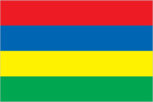
four equal horizontal bands of red (top), blue, yellow, and green
Independence
12 March 1968 (from UK)
Judicial branch
Supreme Court
Legal system
based on French civil law system with elements of English common law in certain areas
Legislative Assembly
elections last held on 15 September 1991 (next to be held by 15 September 1996); results - MSM/MMM 53%, MLP/PMSD 38%; seats - (66 total) MSM/MMM alliance 59 (MSM 29, MMM 26, OPR 2, MTD 2), MLP/PMSD 4 (MLP 3, PMSD 1); note - the Supreme Court denied the assignment of 3 seats to the MSM
Legislative branch
unicameral
Member of
ACCT, ACP, AfDB, C, CCC, ECA, FAO, G-77, GATT, IAEA, IBRD, ICAO, ICFTU, ICRM, IDA, IFAD, IFC, IFRCS, ILO, IMF, IMO, INMARSAT, INTELSAT, INTERPOL, IOC, ISO (correspondent), ITU, NAM, OAU, PCA, UN, UNCTAD, UNESCO, UNIDO, UPU, WCL, WFTU, WHO, WIPO, WMO, WTO
Names
conventional long form: Republic of Mauritius conventional short form: Mauritius
National holiday
Independence Day, 12 March (1968)
Other political or pressure groups
various labor unions
Political parties and leaders
government coalition: Militant Socialist Movement (MSM), A. JUGNAUTH; Mauritian Militant Resurgence (RMM), Prem NABABSING (less 10 legislators under the leadership of Paul BERENGER, now voting with the opposition); Mauritian Social Democratic Party (PMSD), X. DUVAL; Organization of the People of Rodrigues (OPR), Louis Serge CLAIR; Democratic Labor Movement (MTD), Anil BAICHOO opposition: Mauritian Labor Party (MLP), Navin RAMGOOLMAN; MMM-Berenger Faction, Paul BERENGER; Socialist Workers Front, Sylvio MICHEL
Suffrage
18 years of age; universal
Type
parliamentary democracy
US diplomatic representation
chief of mission: Ambassador Leslie M. ALEXANDER embassy: 4th Floor, Rogers House, John Kennedy Street, Port Louis mailing address: use embassy street address telephone: [230] 208-9763 through 9767
Economy
Agriculture
accounts for 10% of GDP; about 90% of cultivated land in sugarcane; other products - tea, corn, potatoes, bananas, pulses, cattle, goats, fish; net food importer, especially rice and fish
Budget
revenues: $653 million expenditures: $567 million, including capital expenditures of $143 million (FY92/93 est.)
Currency
1 Mauritian rupee (MauR) = 100 cents
Economic aid
recipient: US commitments, including Ex-Im (FY70-89), $76 million; Western (non-US) countries (1970-89), $709 million; Communist countries (1970-89), $54 million
Electricity
capacity: 340,000 kW production: 920 million kWh consumption per capita: 777 kWh (1993)
Exchange rates
Mauritian rupees (MauRs) per US$1 - 17.755 (January 1995), 17.960 (1994), 17.648 (1993), 15.563 (1992), 15.652 (1991), 14.839 (1990)
Exports
$1.32 billion (f.o.b., 1993 est.) commodities: textiles 44%, sugar 40%, light manufactures 10% partners: EC and US have preferential treatment, EC 77%, US 15%
External debt
$996.8 million (1993 est.)
Fiscal year
1 July - 30 June
Illicit drugs
illicit producer of cannabis for the international drug trade; heroin consumption and transshipment are growing problems
Imports
$1.7 billion (f.o.b., 1993 est.) commodities: manufactured goods 50%, capital equipment 17%, foodstuffs 13%, petroleum products 8%, chemicals 7% partners: EC, US, South Africa, Japan
Industrial production
growth rate 5.8% (1992); accounts for 25% of GDP
Industries
food processing (largely sugar milling), textiles, wearing apparel, chemicals, metal products, transport equipment, nonelectrical machinery, tourism
Inflation rate (consumer prices)
9.4% (1993 est.)
National product
GDP - purchasing power parity - $9.3 billion (1993 est.)
National product per capita
$8,600 (1994 est.)
National product real growth rate
4.7% (1993 est.)
Overview
Since independence in 1968, Mauritius has developed from a low income, agriculturally based economy to middle income diversified economy with growing industrial and tourist sectors. For most of the period annual growth has been of the order of 5% to 6%. This remarkable achievement has been reflected in increased life expectancy, lowered infant mortality, and a much improved infrastructure. Sugarcane is grown on about 90% of the cultivated land area and accounts for 40% of export earnings. The government's development strategy centers on industrialization (with a view to modernization and to exports), agricultural diversification, and tourism. Economic performance in 1991-93 continued strong with solid real growth and low unemployment.
Unemployment rate
2.4% (1991 est.)
Communications
Radio
broadcast stations: AM 2, FM 0, shortwave 0 radios: NA
Telephone system
over 48,000 telephones; small system with good service local: NA intercity: utilizes primarily microwave radio relay international: 1 INTELSAT (Indian Ocean) earth station; new microwave link to Reunion; high-frequency radio links to several countries
Television
broadcast stations: 4 televisions: NA
Transportation
Airports
total: 5 with paved runways 2,438 to 3,047 m: 1 with paved runways 914 to 1,523 m: 1 with paved runways under 914 m: 2 with unpaved runways 914 to 1,523 m: 1
Highways
total: 1,800 km paved: 1,640 km unpaved: earth 160 km
Merchant marine
total: 16 ships (1,000 GRT or over) totaling 191,703 GRT/297,347 DWT ships by type: bulk 5, cargo 8, liquefied gas tanker 1, oil tanker 1, passenger-cargo 1
Ports
Port Louis
Railroads
0 km
Military and Security
Branches
National Police Force (includes the paramilitary Special Mobile Force or SMF, Special Support Units or SSU, and National Coast Guard)
Defense expenditures
exchange rate conversion - $11.2 million, 0.4% of GDP (FY92/93) ________________________________________________________________________ MAYOTTE (territorial collectivity of France)
Manpower availability
males age 15-49 321,947; males fit for military service 163,904 (1995 est.)