1982 Edition
CIA World Factbook 1982 (Wikisource)
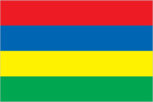
Geography
Area
1,856 km2 (excluding dependencies); 50% agricultural, intensely cultivated; 39% forests, woodlands, mountains, river, and natural reserves; 3% built-up areas; 5% water bodies, 2% roads and tracks, 1% permanent wastelands WATER
Coastline
177 km
Limits of territorial waters (claimed)
12 nm (fishing 200 nm; exclusive economic zone 200 nm)
People and Society
Ethnic divisions
67% Indians, 29% Creoles, 3.5% Chinese, 0.5% English and French
Labor force
335,000; 30% agriculture, 24% industry; 20% government services; 14% are unemployed, 12% other
Language
English official language; Hindi, Chinese, French, Creole
Literacy
estimated 60% for those over 21 and 90% for those of school age
Nationality
noun—Mauritian(s); adjective—Mauritian
Organized labor
about 35% of labor force, forming over 270 unions
Population
990,000 (July 1982), average annual growth rate 1.7%
Religion
51% Hindu, 30% Christian (mostly Catholic with a few Anglican Protestants), 17% Muslim
Government
Branches
executive power exercised by Prime Minister and 21-man Council of Ministers; unicameral legislature (National Assembly) with 62 members elected by direct suffrage, 8 specially elected
Capital
Port Louis
Communists
may be 2,000 sympathizers; several Communist organizations; Mauritius Lenin Youth Organization, Mauritius Women's Committee, Mauritius Communist Party, Mauritius People's Progressive Party, Mauritius Young Communist League,Mauritius Liberation Front, Chinese Middle School Friendly Association, Mauritius/USSR Friendship Society
Elections
legislative elections held in December 1976; municipal elections held in 1977 Political parties and leaders: the government is presently controlled by the Mauritian Labor Party (S. Ramgoolam) and supported by several dissident members of the Mauritian Social Democratic Party (G. Duval); the main opposition parties are the Mauritian Militant Movement (P. Berenger) and the Mauritian Socialist Party (H. Boodhoo); there are also several minor parties
Government leader
Prime Minister Dr. Seewoosagur RAMGOOLAM
Legal system
based on French civil law system with elements of English common law in certain areas; constitution adopted 6 March 1968 National holiday: Independence Day, 12 March
Member of
Commonwealth, FAO, G-77, GATT, IAEA, IBRD, ICAO, IDA, IFAD, IFC, ILO, IMCO, IMF, ISO, ITU, IWC—International Wheat Council, NAM, OAU, OCAM, UN, UNESCO, UPU, WHO, WIPO, WMO, WTO
Official name
Mauritius
Other political or pressure groups
various labor unions
Political subdivisions
5 organized municipalities and various island dependencies
Suffrage
universal over age 18
Type
independent state since 1968, recognizing Elizabeth II as Chief of State
Voting strength
the Mauritian Labor Party, supported by dissident members of the Mauritian Social Democratic Party, had a majority in the National Assembly before it was dissolved in December 1981, in preparation for parliamentary elections in 1982
Economy
Agriculture
sugar crop is major economic asset; about 40% of land area is planted to sugar; most food imported—rice is the staple food—and since cultivation is already intense and expansion of cultivable areas is unlikely, heavy reliance on food imports except sugar and tea will continue
Aid
economic commitments—Western (non-US) countries (1970-79), $137.0 million; Communist countries (1970-79), $40.2 million; US authorizations (FY70-80), $22.2 million
Budget
(1981) revenues $235 million, current expenditures $381 million, development expenditures $120 million
Electric power
180,000 kW capacity (1980); 370 million kWh produced (1980), 385 kWh per capita
Exports
$318 million (f.o.b., 1981); $187 million sugar, $4 million tea, $5 million molasses
Fiscal year
1 July-30 June
GNP
$890 million (1980), $890 per capita; real growth -9% in 1980
Imports
$456 million (f.o.b., 1981); foodstuffs 30%, manufactured goods about 25%
Industries
mainly confined to processing sugarcane, tea; some small-scale, simple manufactures; tobacco fiber; some fishing; tourism, diamond cutting, weaving and textiles, electronics
Major trade partners
all EC-nine countries and US have preferential treatment, UK buys over 50% of Mauritius's sugar export at heavily subsidized prices; small amount of sugar exported to Canada, US, and Italy; imports from UK and EC primarily, also from South Africa, Australia, and Burma; some minor trade with China
Monetary conversion rate
8.88 Mauritian rupees=US$1 1981 (floating with pound sterling)
Shortage
land
Communications
Airfields
5 total, 4 usable; 1 with permanent surface runways; 1 with runways 2,440-3,659 m
Civil air
1 major transport aircraft, leased in
Highways
1,786 km total; 1,636 km paved, 150 km earth
Ports
1 major (Port Louis)
Telecommunications
small system with good service; HF radio links to several countries; 1 AM, no FM, and 4 TV stations; 36,400 telephones (4.0 per 100 popl.); 1 Indian Ocean INTELSAT station
Military and Security
Military budget
for fiscal year ending 30 June 1981, $4.5 million
Military manpower
males 15-49, 259,000; 135,000 fit for military service