1999 Edition
CIA World Factbook 1999 (Internet Archive)
Geography
Area
total: 1,030,700 sq km land: 1,030,400 sq km water: 300 sq km
Area--comparative
slightly larger than three times the size of New Mexico
Climate
desert; constantly hot, dry, dusty
Coastline
754 km
Elevation extremes
lowest point: Sebkha de Ndrhamcha -3 m highest point: Kediet Ijill 910 m
Environment--current issues
overgrazing, deforestation, and soil erosion aggravated by drought are contributing to desertification; very limited natural fresh water resources away from the Senegal which is the only perennial river
Environment--international agreements
party to: Biodiversity, Climate Change, Desertification, Hazardous Wastes, Law of the Sea, Nuclear Test Ban, Ozone Layer Protection, Ship Pollution, Wetlands signed, but not ratified: none of the selected agreements
Geographic coordinates
20 00 N, 12 00 W
Geography--note
most of the population concentrated in the cities of Nouakchott and Nouadhibou and along the Senegal River in the southern part of the country
Irrigated land
490 sq km (1993 est.)
Land boundaries
total: 5,074 km border countries: Algeria 463 km, Mali 2,237 km, Senegal 813 km, Western Sahara 1,561 km
Land use
arable land: 0% permanent crops: 0% permanent pastures: 38% forests and woodland: 4% other: 58% (1993 est.)
Location
Northern Africa, bordering the North Atlantic Ocean, between Senegal and Western Sahara
Map references
Africa
Maritime claims
contiguous zone: 24 nm continental shelf: 200 nm or to the edge of the continental margin exclusive economic zone: 200 nm territorial sea: 12 nm
Natural hazards
hot, dry, dust/sand-laden sirocco wind blows primarily in March and April; periodic droughts
Natural resources
iron ore, gypsum, fish, copper, phosphate
Terrain
mostly barren, flat plains of the Sahara; some central hills
People and Society
Age structure
0-14 years: 47% (male 600,901; female 600,225) 15-64 years: 51% (male 641,481; female 678,951) 65 years and over: 2% (male 25,156; female 35,024) (1999 est.)
Birth rate
44.1 births/1,000 population (1999 est.)
Death rate
14.2 deaths/1,000 population (1999 est.)
Ethnic groups
mixed Maur/black 40%, Maur 30%, black 30%
Infant mortality rate
76.46 deaths/1,000 live births (1999 est.)
Languages
Hasaniya Arabic (official), Pular, Soninke, Wolof (official), French
Life expectancy at birth
total population: 50.48 years male: 47.39 years female: 53.65 years (1999 est.)
Literacy
definition: age 15 and over can read and write total population: 37.7% male: 49.6% female: 26.3% (1995 est.)
Nationality
noun: Mauritanian(s) adjective: Mauritanian
Net migration rate
0 migrant(s)/1,000 population (1999 est.)
Population
2,581,738 (July 1999 est.)
Population growth rate
2.99% (1999 est.)
Religions
Muslim 100%
Sex ratio
at birth: 1.03 male(s)/female under 15 years: 1 male(s)/female 15-64 years: 0.94 male(s)/female 65 years and over: 0.72 male(s)/female total population: 0.96 male(s)/female (1999 est.)
Total fertility rate
6.35 children born/woman (1999 est.)
Government
Administrative divisions
12 regions (regions, singular--region) and 1 capital district*; Adrar, Assaba, Brakna, Dakhlet Nouadhibou, Gorgol, Guidimaka, Hodh Ech Chargui, Hodh El Gharbi, Inchiri, Nouakchott*, Tagant, Tiris Zemmour, Trarza
Capital
Nouakchott
Constitution
12 July 1991
Country name
conventional long form: Islamic Republic of Mauritania conventional short form: Mauritania local long form: Al Jumhuriyah al Islamiyah al Muritaniyah local short form: Muritaniyah
Data code
MR
Executive branch
chief of state: President Col. Maaouya Ould Sid Ahmed TAYA (since 12 December 1984) head of government: Prime Minister Cheikel Afia Ould Mohamed KHOUNA (since 16 November 1998) cabinet: Council of Ministers elections: president elected by popular vote for a six-year term; election last held 12 December 1997 (next to be held NA December 2003); prime minister appointed by the president election results: President Col. Maaouya Ould Sid Ahmed TAYA reelected with 90% of the vote
Flag description
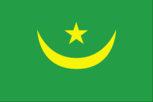
green with a yellow five-pointed star above a yellow, horizontal crescent; the closed side of the crescent is down; the crescent, star, and color green are traditional symbols of Islam
Government type
republic
Independence
28 November 1960 (from France)
International organization participation
ABEDA, ACCT (associate), ACP, AfDB, AFESD, AL, AMF, AMU, CAEU, CCC, ECA, ECOWAS, FAO, G-77, IBRD, ICAO, ICRM, IDA, IDB, IFAD, IFC, IFRCS, IHO (pending member), ILO, IMF, IMO, Intelsat, Interpol, IOC, ITU, NAM, OAU, OIC, OPCW, UN, UNCTAD, UNESCO, UNIDO, UPU, WHO, WIPO, WMO, WToO, WTrO Diplomatic representation in the US: chief of mission: Ambassador-designate Ahmed Ould Khalifa OULD JIDDOU chancery: 2129 Leroy Place NW, Washington, DC 20008 Diplomatic representation from the US: chief of mission: Ambassador Timberlake FOSTER embassy: Rue Abdallahi Ould Oubeid, Nouakchott mailing address: B. P. 222, Nouakchott
Judicial branch
three-tier system: lower, appeals, and Supreme Court (Cour Supreme) Political parties and leaders: legalized by constitution passed 12 July 1991, however, politics continue to be tribally based; emerging parties include Democratic and Social Republican Party or Political pressure groups and leaders: Mauritanian Workers Union MOHAMED, secretary general]
Legal system
a combination of Shari'a (Islamic law) and modern law
Legislative branch
bicameral legislature consists of the Senate or Majlis al-Shuyukh (56 seats; 17 up for election every two years; members elected by municipal leaders to serve six-year terms) and the National Assembly or Majlis al-Watani (79 seats; members elected by popular vote to serve five-year terms) elections: Senate--last held 17 April 1998 (next to be held NA 2000); National Assembly--last held 11 and 18 October 1996 (next to be held NA 2001) election results: Senate--percent of vote by party--NA; seats by party--NA; National Assembly--percent of vote by party--NA; seats by party--PRDS 71, AC 1, independents and other 7
National holiday
Independence Day, 28 November (1960)
Suffrage
18 years of age; universal
Economy
Agriculture--products
dates, millet, sorghum, root crops; cattle, sheep; fish products
Budget
revenues: $329 million expenditures: $265 million, including capital expenditures of $75 million (1996 est.)
Currency
1 ouguiya (UM) = 5 khoums
Debt--external
$2.5 billion (1995)
Economic aid--recipient
$227.9 million (1995)
Economy--overview
A majority of the population still depends on agriculture and livestock for a livelihood, even though most of the nomads and many subsistence farmers were forced into the cities by recurrent droughts in the 1970s and 1980s. Mauritania has extensive deposits of iron ore, which account for almost 50% of total exports. The decline in world demand for this ore, however, has led to cutbacks in production. The nation's coastal waters are among the richest fishing areas in the world, but overexploitation by foreigners threatens this key source of revenue. The country's first deepwater port opened near Nouakchott in 1986. In recent years, drought and economic mismanagement have resulted in a substantial buildup of foreign debt. The government has begun the second stage of an economic reform program in consultation with the World Bank, the IMF, and major donor countries. Short-term growth prospects are uncertain because of the heavy debt service burden, rapid population growth, and vulnerability to climatic conditions.
Electricity--consumption
150 million kWh (1996
Electricity--exports
0 kWh (1996)
Electricity--imports
0 kWh (1996)
Electricity--production
150 million kWh (1996)
Electricity--production by source
fossil fuel: 80% hydro: 20% nuclear: 0% other: 0% (1996)
Exchange rates
ouguiyas (UM) per US$1--204.600 (January 1999), 151.853 (1997), 137.222 (1996), 129.768 (1995), 123.575 (1994)
Exports
$562 million (f.o.b., 1997)
Exports--commodities
fish and fish products, iron ore, gold
Exports--partners
Japan 22%, Italy 16%, France 14%
Fiscal year
calendar year
GDP
purchasing power parity--$4.7 billion (1998 est.)
GDP--composition by sector
agriculture: 26% industry: 31% services: 43% (1996)
GDP--per capita
purchasing power parity?$1,890 (1998 est.)
GDP--real growth rate
4.2% (1998 est.)
Household income or consumption by percentage share
lowest 10%: 0.7% highest 10%: 30.4% (1988)
Imports
$552 million (f.o.b., 1997)
Imports--commodities
foodstuffs, consumer goods, petroleum products, capital goods
Imports--partners
France 30%, Algeria 10%, Spain 7%, China 6%, US 3%
Industrial production growth rate
7.2% (1994)
Industries
fish processing, mining of iron ore and gypsum
Inflation rate (consumer prices)
4.7% (1996)
Labor force
465,000 (1981 est.); 45,000 wage earners (1980)
Labor force--by occupation
agriculture 47%, services 29%, industry and commerce 14%, government 10%
Population below poverty line
57% (1990 est.)
Unemployment rate
23% (1995 est.)
Communications
Radio broadcast stations
AM 1, FM 2, shortwave 1 (1998 est.)
Radios
1 million (1998 est.)
Telephone system
poor system of cable and open-wire lines, minor microwave radio relay links, and radiotelephone communications stations (improvements being made) domestic: mostly cable and open-wire lines; a recently completed domestic satellite telecommunications system links Nouakchott with regional capitals international: satellite earth stations--1 Intelsat (Atlantic Ocean) and 2 Arabsat
Telephones
17,000 (1991 est.)
Television broadcast stations
1 (1997)
Televisions
50,000 (1995 est.)
Transportation
Airports
26 (1998 est.) Airports--with paved runways: total: 8 2,438 to 3,047 m: 3 1,524 to 2,437 m: 4 914 to 1,523 m: 1 (1998 est.) Airports--with unpaved runways: total: 18 2,438 to 3,047 m: 2 1,524 to 2,437 m: 5 914 to 1,523 m: 9 under 914 m: 2 (1998 est.)
Highways
total: 7,660 km paved: 866 km unpaved: 6,794 km (1996 est.)
Merchant marine
none
Railways
total: 704 km (single track); note--owned and operated by government mining company standard gauge: 704 km 1.435-m gauge (1995)
Waterways
mostly ferry traffic on the Senegal River Ports and harbors: Bogue, Kaedi, Nouadhibou, Nouakchott, Rosso
Military and Security
Military branches
Army, Navy, Air Force, National Gendarmerie, National Guard, National Police, Presidential Guard
Military expenditures--dollar figure
$30 million (1996)
Military expenditures--percent of GDP
2.5% (1996)
Military manpower--availability
males age 15-49: 571,521 (1999 est.) Military manpower--fit for military service: males age 15-49: 277,620 (1999 est.)
Transnational Issues
Disputes--international
none