2019 Edition
CIA World Factbook 2019 Archive (Wayback Machine)
Introduction
Background
The Sudanese Republic and Senegal became independent of France in 1960 as the Mali Federation. When Senegal withdrew after only a few months, what formerly made up the Sudanese Republic was renamed Mali. Rule by dictatorship was brought to a close in 1991 by a military coup that ushered in a period of democratic rule. President Alpha Oumar KONARE won Mali's first two democratic presidential elections in 1992 and 1997. In keeping with Mali's two-term constitutional limit, he stepped down in 2002 and was succeeded by Amadou Toumani TOURE, who was elected to a second term in a 2007 election that was widely judged to be free and fair. Malian returnees from Libya in 2011 exacerbated tensions in northern Mali, and Tuareg ethnic militias rebelled in January 2012. Low- and mid-level soldiers, frustrated with the poor handling of the rebellion, overthrew TOURE on 22 March. Intensive mediation efforts led by the Economic Community of West African States (ECOWAS) returned power to a civilian administration in April with the appointment of Interim President Dioncounda TRAORE. The post-coup chaos led to rebels expelling the Malian military from the country's three northern regions and allowed Islamic militants to set up strongholds. Hundreds of thousands of northern Malians fled the violence to southern Mali and neighboring countries, exacerbating regional food shortages in host communities. A French-led international military intervention to retake the three northern regions began in January 2013 and within a month, most of the north had been retaken. In a democratic presidential election conducted in July and August of 2013, Ibrahim Boubacar KEITA was elected president. The Malian Government and northern armed groups signed an internationally mediated peace accord in June 2015, however, the parties to the peace accord have made little progress in the accord's implementation, despite a June 2017 target for its completion. Furthermore, extremist groups outside the peace process made steady inroads into rural areas of central Mali following the consolidation of three major terrorist organizations in March 2017. In central and northern Mali, terrorist groups have exploited age-old ethnic rivalries between pastoralists and sedentary communities and inflicted serious losses on the Malian military. Intercommunal violence incidents such as targeted killings occur with increasing regularity. KEITA was reelected president in 2018 in an election that was deemed credible by international observers, despite some security and logistic shortfalls.
Geography
Area
- Land
- 1,220,190 sq km
- Total
- 1,240,192 sq km
- Water
- 20,002 sq km
Area Comparative
slightly less than twice the size of Texas
Climate
subtropical to arid; hot and dry (February to June); rainy, humid, and mild (June to November); cool and dry (November to February)
Coastline
0 km (landlocked)
Elevation
- Highest Point
- Hombori Tondo 1,155 m
- Lowest Point
- Senegal River 23 m
- Mean Elevation
- 343 m
Environment Current Issues
deforestation; soil erosion; desertification; loss of pasture land; inadequate supplies of potable water
Environment International Agreements
- Party To
- Biodiversity, Climate Change, Climate Change-Kyoto Protocol, Desertification, Endangered Species, Hazardous Wastes, Law of the Sea, Ozone Layer Protection, Wetlands, Whaling
- Signed But Not Ratified
- none of the selected agreements
Geographic Coordinates
17 00 N, 4 00 W
Geography Note
landlocked; divided into three natural zones: the southern, cultivated Sudanese; the central, semiarid Sahelian; and the northern, arid Saharan
Irrigated Land
3,780 sq km (2012)
Land Boundaries
- Border Countries
- Algeria 1359 km, Burkina Faso 1325 km, Cote d'Ivoire 599 km, Guinea 1062 km, Mauritania 2236 km, Niger 838 km, Senegal 489 km
- Total
- 7,908 km
Land Use
- Agricultural Land
- 34.1% (2011 est.)
- Agricultural Land Arable Land
- 5.6% (2011 est.)
- Agricultural Land Permanent Crops
- 0.1% (2011 est.)
- Agricultural Land Permanent Pasture
- 28.4% (2011 est.)
- Forest
- 10.2% (2011 est.)
- Other
- 55.7% (2011 est.)
Location
interior Western Africa, southwest of Algeria, north of Guinea, Cote d'Ivoire, and Burkina Faso, west of Niger
Map References
Africa
Maritime Claims
none (landlocked)
Natural Hazards
hot, dust-laden harmattan haze common during dry seasons; recurring droughts; occasional Niger River flooding
Natural Resources
gold, phosphates, kaolin, salt, limestone, uranium, gypsum, granite, hydropower, note, bauxite, iron ore, manganese, tin, and copper deposits are known but not exploited
Population Distribution
the overwhelming majority of the population lives in the southern half of the country, with greater density along the border with Burkina Faso
Terrain
mostly flat to rolling northern plains covered by sand; savanna in south, rugged hills in northeast
People and Society
Age Structure
- 0 14 Years
- 48.03% (male 4,449,790 /female 4,402,076)
- 15 24 Years
- 18.89% (male 1,657,609 /female 1,823,453)
- 25 54 Years
- 26.36% (male 2,243,158 /female 2,615,695)
- 55 64 Years
- 3.7% (male 346,003 /female 335,733)
- 65 Years And Over
- 3.02% (male 277,834 /female 278,542) (2018 est.)
Birth Rate
43.2 births/1,000 population (2018 est.)
Children Under The Age Of 5 Years Underweight
25% (2015)
Contraceptive Prevalence Rate
15.6% (2015)
Current Health Expenditure
3.8% (2016)
Death Rate
9.6 deaths/1,000 population (2018 est.)
Demographic Profile
Mali’s total population is expected to double by 2035; its capital Bamako is one of the fastest-growing cities in Africa. A young age structure, a declining mortality rate, and a sustained high total fertility rate of 6 children per woman – the third highest in the world – ensure continued rapid population growth for the foreseeable future. Significant outmigration only marginally tempers this growth. Despite decreases, Mali’s infant, child, and maternal mortality rates remain among the highest in sub-Saharan Africa because of limited access to and adoption of family planning, early childbearing, short birth intervals, the prevalence of female genital cutting, infrequent use of skilled birth attendants, and a lack of emergency obstetrical and neonatal care.Mali’s high total fertility rate has been virtually unchanged for decades, as a result of the ongoing preference for large families, early childbearing, the lack of female education and empowerment, poverty, and extremely low contraceptive use. Slowing Mali’s population growth by lowering its birth rate will be essential for poverty reduction, improving food security, and developing human capital and the economy.Mali has a long history of seasonal migration and emigration driven by poverty, conflict, demographic pressure, unemployment, food insecurity, and droughts. Many Malians from rural areas migrate during the dry period to nearby villages and towns to do odd jobs or to adjoining countries to work in agriculture or mining. Pastoralists and nomads move seasonally to southern Mali or nearby coastal states. Others migrate long term to Mali’s urban areas, Cote d’Ivoire, other neighboring countries, and in smaller numbers to France, Mali’s former colonial ruler. Since the early 1990s, Mali’s role has grown as a transit country for regional migration flows and illegal migration to Europe. Human smugglers and traffickers exploit the same regional routes used for moving contraband drugs, arms, and cigarettes.Between early 2012 and 2013, renewed fighting in northern Mali between government forces and Tuareg secessionists and their Islamist allies, a French-led international military intervention, as well as chronic food shortages, caused the displacement of hundreds of thousands of Malians. Most of those displaced domestically sought shelter in urban areas of southern Mali, except for pastoralist and nomadic groups, who abandoned their traditional routes, gave away or sold their livestock, and dispersed into the deserts of northern Mali or crossed into neighboring countries. Almost all Malians who took refuge abroad (mostly Tuareg and Maure pastoralists) stayed in the region, largely in Mauritania, Niger, and Burkina Faso.
Dependency Ratios
- Elderly Dependency Ratio
- 5.1 (2015 est.)
- Potential Support Ratio
- 19.5 (2015 est.)
- Total Dependency Ratio
- 101.9 (2015 est.)
- Youth Dependency Ratio
- 96.8 (2015 est.)
Drinking Water Source
- Improved Rural
- 64.1% of population
- Improved Total
- 77% of population
- Improved Urban
- 96.5% of population
- Unimproved Rural
- 35.9% of population
- Unimproved Total
- 23% of population (2015 est.)
- Unimproved Urban
- 3.5% of population
Education Expenditures
3.1% of GDP (2016)
Ethnic Groups
Bambara 33.3%, Fulani (Peuhl) 13.3%, Sarakole/Soninke/Marka 9.8%, Senufo/Manianka 9.6%, Malinke 8.8%, Dogon 8.7%, Sonrai 5.9%, Bobo 2.1%, Tuareg/Bella 1.7%, other Malian 6%, from member of Economic Community of West Africa .4%, other .3% (2018 est.)
HIV/AIDS Adult Prevalence Rate
1.4% (2018 est.)
HIV/AIDS Deaths
6,500 (2018 est.)
HIV/AIDS People Living With HIV/AIDS
150,000 (2018 est.)
Hospital Bed Density
0.1 beds/1,000 population (2010)
Infant Mortality Rate
- Female
- 61.7 deaths/1,000 live births
- Male
- 73.3 deaths/1,000 live births
- Total
- 67.6 deaths/1,000 live births (2018 est.)
Languages
French (official), Bambara 46.3%, Peuhl/Foulfoulbe 9.4%, Dogon 7.2%, Maraka/Soninke 6.4%, Malinke 5.6%, Sonrhai/Djerma 5.6%, Minianka 4.3%, Tamacheq 3.5%, Senoufo 2.6%, Bobo 2.1%, unspecified 0.7%, other 6.3% (2009 est.)
Life Expectancy at Birth
- Female
- 63 years
- Male
- 58.6 years
- Total Population
- 60.8 years (2018 est.)
Literacy
- Definition
- age 15 and over can read and write
- Female
- 22.2% (2015)
- Male
- 45.1%
- Total Population
- 33.1%
Major Infectious Diseases
- Animal Contact Diseases
- rabies (2016)
- Degree Of Risk
- very high (2016)
- Food Or Waterborne Diseases
- bacterial and protozoal diarrhea, hepatitis A, and typhoid fever (2016)
- Respiratory Diseases
- meningococcal meningitis (2016)
- Vectorborne Diseases
- malaria and dengue fever (2016)
- Water Contact Diseases
- schistosomiasis (2016)
Major Urban Areas Population
2.529 million BAMAKO (capital) (2019)
Maternal Mortality Rate
562 deaths/100,000 live births (2017 est.)
Median Age
- Female
- 16.5 years
- Male
- 15.2 years
- Total
- 15.8 years (2018 est.)
Mother's Mean Age at First Birth
18.9 years (2018 est.)
Nationality
- Adjective
- Malian
- Noun
- Malian(s)
Net Migration Rate
-3.9 migrant(s)/1,000 population (2018 est.)
Obesity Adult Prevalence Rate
8.6% (2016)
Physicians Density
0.14 physicians/1,000 population (2016)
Population
18,429,893 (July 2018 est.)
Population Growth Rate
2.98% (2018 est.)
Religions
Muslim 93.9%, Christian 2.8%, Animist .7%, none 2.5% (2018 est.)
Sanitation Facility Access
- Improved Rural
- 16.1% of population (2015 est.)
- Improved Total
- 24.7% of population (2015 est.)
- Improved Urban
- 37.5% of population (2015 est.)
- Unimproved Rural
- 83.9% of population (2015 est.)
- Unimproved Total
- 75.3% of population (2015 est.)
- Unimproved Urban
- 62.5% of population (2015 est.)
School Life Expectancy Primary To Tertiary Education
- Female
- 7 years (2015)
- Male
- 8 years
- Total
- 7 years
Sex Ratio
- 0 14 Years
- 1.01 male(s)/female
- 15 24 Years
- 0.91 male(s)/female
- 25 54 Years
- 0.86 male(s)/female
- 55 64 Years
- 1.03 male(s)/female
- 65 Years And Over
- 1 male(s)/female
- At Birth
- 1.03 male(s)/female
- Total Population
- 0.95 male(s)/female (2018 est.)
Total Fertility Rate
5.9 children born/woman (2018 est.)
Unemployment Youth Ages 15 24
- Female
- 2.2% (2016 est.)
- Male
- 2.5%
- Total
- 2.3%
Urbanization
- Rate Of Urbanization
- 4.86% annual rate of change (2015-20 est.)
- Urban Population
- 43.1% of total population (2019)
Government
Administrative Divisions
10 regions (regions, singular - region), 1 district*; District de Bamako*, Gao, Kayes, Kidal, Koulikoro, Menaka, Mopti, Segou, Sikasso, Taoudenni, Tombouctou (Timbuktu); note - Menaka and Taoudenni were legislated in 2016, but implementation has not been confirmed by the US Board on Geographic Names
Capital
- Geographic Coordinates
- 12 39 N, 8 00 W
- Name
- Bamako
- Time Difference
- UTC 0 (5 hours ahead of Washington, DC, during Standard Time)
Citizenship
- Citizenship By Birth
- no
- Citizenship By Descent Only
- at least one parent must be a citizen of Mali
- Dual Citizenship Recognized
- yes
- Residency Requirement For Naturalization
- 5 years
Constitution
- Amendments
- proposed by the president of the republic or by members of the National Assembly; passage requires two-thirds majority vote by the Assembly and approval in a referendum; constitutional sections on the integrity of the state, its republican and secular form of government, and its multiparty system cannot be amended; amended 1999 (2017)
- History
- several previous; latest drafted August 1991, approved by referendum 12 January 1992, effective 25 February 1992, suspended briefly in 2012
Country Name
- Conventional Long Form
- Republic of Mali
- Conventional Short Form
- Mali
- Etymology
- name derives from the West African Mali Empire of the 13th to 16th centuries A.D.
- Former
- French Sudan and Sudanese Republic
- Local Long Form
- Republique de Mali
- Local Short Form
- Mali
Diplomatic Representation From The Us
- Chief Of Mission
- Ambassador Dennis B. HANKINS (since 15 March 2019)
- Embassy
- located off the Roi Bin Fahad Aziz Bridge west of the Bamako central district; ACI 2000, Rue 243, Porte 297
- Fax
- [223] 2070-2479
- Mailing Address
- ACI 2000, Rue 243, Porte 297, Bamako
- Telephone
- [223] 2070-2300
Diplomatic Representation In The Us
- Chancery
- 2130 R Street NW, Washington, DC 20008
- Chief Of Mission
- Ambassador Mahamadou NIMAGA (since 22 June 2018)
- Fax
- [1] (202) 332-6603
- Telephone
- [1] (202) 332-2249, 939-8950
Executive Branch
- Cabinet
- Council of Ministers appointed by the prime minister
- Chief Of State
- President Ibrahim Boubacar KEITA (since 4 September 2013)
- Election Results
- Ibrahim Boubacar KEITA elected president in second round; percent of vote - Ibrahim Boubacar KEITA (RPM) 77.6%, Soumaila CISSE (URD) 22.4%
- Elections Appointments
- president directly elected by absolute majority popular vote in 2 rounds if needed for a 5-year term (eligible for a second term); election last held on 29 July 2018 with a runoff on 12 August 2018; prime minister appointed by the president
- Head Of Government
- Prime Minister Boubou CISSE (since 23 April 2019)
Flag Description
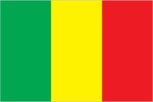
three equal vertical bands of green (hoist side), yellow, and red
Government Type
semi-presidential republic
Independence
22 September 1960 (from France)
International Law Organization Participation
has not submitted an ICJ jurisdiction declaration; accepts ICCt jurisdiction
International Organization Participation
ACP, AfDB, AU, CD, ECOWAS, EITI (compliant country), FAO, FZ, G-77, IAEA, IBRD, ICAO, ICCt, ICRM, IDA, IDB, IFAD, IFC, IFRCS, ILO, IMF, Interpol, IOC, IOM, IPU, ISO, ITSO, ITU, ITUC (NGOs), MIGA, MONUSCO, NAM, OIC, OIF, OPCW, UN, UNAMID, UNCTAD, UNESCO, UNIDO, UNISFA, UNMISS, UNWTO, UPU, WADB (regional), WAEMU, WCO, WFTU (NGOs), WHO, WIPO, WMO, WTO
Judicial Branch
- Highest Courts
- Supreme Court or Cour Supreme (consists of 19 members organized into 3 civil chambers and a criminal chamber); Constitutional Court (consists of 9 members)
- Judge Selection And Term Of Office
- Supreme Court members appointed by the Ministry of Justice to serve 5-year terms; Constitutional Court members selected - 3 each by the president, the National Assembly, and the Supreme Council of the Magistracy; members serve single renewable 7-year terms
- Subordinate Courts
- Court of Appeal; High Court of Justice (jurisdiction limited to cases of high treason or criminal offenses by the president or ministers while in office); magistrate courts; first instance courts; labor dispute courts; special court of state security
Legal System
civil law system based on the French civil law model and influenced by customary law; judicial review of legislative acts in the Constitutional Court
Legislative Branch
- Description
- unicameral National Assembly or Assemblee Nationale (147 seats; members directly elected in single and multi-seat constituencies by absolute majority vote in 2 rounds if needed; 13 seats reserved for citizens living abroad; members serve 5-year terms)
- Election Results
- percent of vote by party - RPM 29.4%, URD 22.6%, ADEMA 11.5, other 36.5%; seats by party - RPM 66, URD 17, ADEMA 16, FARE 6, CODEM 5, SADI 5, CNID 4, other 24, independent 4; composition - men 133, women 14, percent of women 9.5%
- Elections
- last held on 24 November and 15 December 2013 (next originally scheduled for 25 November 2018, but postponed to 2019)
National Anthem
- Lyrics Music
- Seydou Badian KOUYATE/Banzoumana SISSOKO
- Name
- "Le Mali" (Mali)
National Holiday
Independence Day, 22 September (1960)
National Symbol S
Great Mosque of Djenne; national colors: green, yellow, red
Political Parties And Leaders
African Solidarity for Democracy and Independence or SADI [Oumar MARIKO] Alliance for Democracy in Mali-Pan-African Party for Liberty, Solidarity, and Justice or ADEMA-PASJ [Tiemoko SANGARE] Alliance for Democracy and Progress or ADP-Maliba [Amadou THIAM] Alliance for the Solidarity of Mali-Convergence of Patriotic Forces or ASMA-CFP [Soumeylou Boubeye MAIGA] Alternative Forces for Renewal and Emergence or FARE [Modibo SIDIBE] Convergence for the Development of Mali or CODEM [Housseyni Amion GUINDO] Economic and Social Development Party or PDES [Jamille BITTAR] Front for Democracy and the Republic or FDR (coalition of smaller opposition parties) National Congress for Democratic Initiative or CNID [Mountaga TALL] Party for National Renewal or PARENA [Tiebile DRAME] Patriotic Movement for Renewal or MPR [Choguel Kokalla MAIGA] Rally for Mali or RPM [Boucary TRETA] Union for Republic and Democracy or URD [Younoussi TOURE]
Suffrage
18 years of age; universal
Economy
Agriculture Products
cotton, millet, rice, corn, vegetables, peanuts; cattle, sheep, goats
Budget
- Expenditures
- 3.513 billion (2017 est.)
- Revenues
- 3.075 billion (2017 est.)
Budget Surplus Or Deficit
-2.9% (of GDP) (2017 est.)
Central Bank Discount Rate
- 31 December 2009
- 4.25%
- 31 December 2010
- 16%
Commercial Bank Prime Lending Rate
- 31 December 2016
- 5.3%
- 31 December 2017
- 5.2%
Current Account Balance
- 2016
- -$1.015 billion
- 2017
- -$886 million
Debt External
- 31 December 2016
- $3.981 billion
- 31 December 2017
- $4.192 billion
Distribution Of Family Income Gini Index
- 1994
- 50.5
- 2001
- 40.1
Economy Overview
Among the 25 poorest countries in the world, landlocked Mali depends on gold mining and agricultural exports for revenue. The country's fiscal status fluctuates with gold and agricultural commodity prices and the harvest; cotton and gold exports make up around 80% of export earnings. Mali remains dependent on foreign aid.Economic activity is largely confined to the riverine area irrigated by the Niger River; about 65% of Mali’s land area is desert or semidesert. About 10% of the population is nomadic and about 80% of the labor force is engaged in farming and fishing. Industrial activity is concentrated on processing farm commodities. The government subsidizes the production of cereals to decrease the country’s dependence on imported foodstuffs and to reduce its vulnerability to food price shocks.Mali is developing its iron ore extraction industry to diversify foreign exchange earnings away from gold, but the pace will depend on global price trends. Although the political coup in 2012 slowed Mali’s growth, the economy has since bounced back, with GDP growth above 5% in 2014-17, although physical insecurity, high population growth, corruption, weak infrastructure, and low levels of human capital continue to constrain economic development. Higher rainfall helped to boost cotton output in 2017, and the country’s 2017 budget increased spending more than 10%, much of which was devoted to infrastructure and agriculture. Corruption and political turmoil are strong downside risks in 2018 and beyond.
Exchange Rates
- 2013
- 494.42
- 2014
- 591.45
- 2015
- 593.01
- 2016
- 593.01
- 2017
- 605.3
- Currency
- Communaute Financiere Africaine francs (XOF) per US dollar -
Exports
- 2016
- $2.803 billion
- 2017
- $3.06 billion
Exports Commodities
cotton, gold, livestock
Exports Partners
Switzerland 31.8%, UAE 15.4%, Burkina Faso 7.8%, Cote d'Ivoire 7.3%, South Africa 5%, Bangladesh 4.6% (2017)
Fiscal Year
calendar year
GDP Composition By End Use
- Exports Of Goods And Services
- 22.1% (2017 est.)
- Government Consumption
- 17.4% (2017 est.)
- Household Consumption
- 82.9% (2017 est.)
- Imports Of Goods And Services
- -41.1% (2017 est.)
- Investment In Fixed Capital
- 19.3% (2017 est.)
- Investment In Inventories
- -0.7% (2017 est.)
GDP Composition By Sector Of Origin
- Agriculture
- 41.8% (2017 est.)
- Industry
- 18.1% (2017 est.)
- Services
- 40.5% (2017 est.)
GDP Official Exchange Rate
$15.37 billion (2017 est.)
GDP Per Capita Ppp
- 2015
- $2,100
- 2016
- $2,100
- 2017
- $2,200
GDP Purchasing Power Parity
- 2015
- $36.97 billion
- 2016
- $39.1 billion
- 2017
- $41.22 billion
GDP Real Growth Rate
- 2015
- 6.2%
- 2016
- 5.8%
- 2017
- 5.4%
Gross National Saving
- 2015
- 15.4% of GDP
- 2016
- 15.5% of GDP
- 2017
- 16.5% of GDP
Household Income Or Consumption By Percentage Share
- Highest 10
- 25.8% (2010 est.)
- Lowest 10
- 3.5%
Imports
- 2016
- $3.403 billion
- 2017
- $3.644 billion
Imports Commodities
petroleum, machinery and equipment, construction materials, foodstuffs, textiles
Imports Partners
Senegal 24.4%, China 13.2%, Cote d'Ivoire 9%, France 7.3% (2017)
Industrial Production Growth Rate
6.3% (2017 est.)
Industries
food processing; construction; phosphate and gold mining
Inflation Rate Consumer Prices
- 2016
- -1.8%
- 2017
- 1.8%
Labor Force
6.447 million (2017 est.)
Labor Force By Occupation
- Agriculture
- 80%
- Industry And Services
- 20% (2005 est.)
Market Value Of Publicly Traded Shares
NA
Population Below Poverty Line
36.1% (2005 est.)
Public Debt
- 2016
- 36% of GDP
- 2017
- 35.4% of GDP
Reserves Of Foreign Exchange And Gold
- 31 December 2016
- $395.7 million
- 31 December 2017
- $647.8 million
Stock Of Broad Money
- 31 December 2016
- $2.553 billion
- 31 December 2017
- $3.04 billion
Stock Of Direct Foreign Investment Abroad
- 31 December 2016
- $62.2 million
- 31 December 2017
- $286.2 million
Stock Of Direct Foreign Investment at Home
- 31 December 2016
- $3.266 billion
- 31 December 2017
- $3.845 billion
Stock Of Domestic Credit
- 31 December 2016
- $4.891 billion
- 31 December 2017
- $5.972 billion
Stock Of Narrow Money
- 31 December 2016
- $2.553 billion
- 31 December 2017
- $3.04 billion
Taxes And Other Revenues
20% (of GDP) (2017 est.)
Unemployment Rate
- 2016
- 7.8%
- 2017
- 7.9%
Energy
Carbon Dioxide Emissions From Consumption Of Energy
3.388 million Mt (2017 est.)
Crude Oil Exports
0 bbl/day (2015 est.)
Crude Oil Imports
0 bbl/day (2015 est.)
Crude Oil Production
0 bbl/day (2018 est.)
Crude Oil Proved Reserves
0 bbl (1 January 2018 est.)
Electricity Access
- Electrification Rural Areas
- 1.8% (2016)
- Electrification Total Population
- 35.1% (2016)
- Electrification Urban Areas
- 83.6% (2016)
- Population Without Electricity
- 11 million (2017)
Electricity Consumption
2.982 billion kWh (2016 est.)
Electricity Exports
0 kWh (2016 est.)
Electricity From Fossil Fuels
68% of total installed capacity (2016 est.)
Electricity From Hydroelectric Plants
31% of total installed capacity (2017 est.)
Electricity From Nuclear Fuels
0% of total installed capacity (2017 est.)
Electricity From Other Renewable Sources
1% of total installed capacity (2017 est.)
Electricity Imports
800 million kWh (2016 est.)
Electricity Installed Generating Capacity
590,000 kW (2016 est.)
Electricity Production
2.489 billion kWh (2016 est.)
Natural Gas Consumption
0 cu m (2017 est.)
Natural Gas Exports
0 cu m (2017 est.)
Natural Gas Imports
0 cu m (2017 est.)
Natural Gas Production
0 cu m (2017 est.)
Natural Gas Proved Reserves
0 cu m (1 January 2014 est.)
Refined Petroleum Products Consumption
22,000 bbl/day (2016 est.)
Refined Petroleum Products Exports
0 bbl/day (2015 est.)
Refined Petroleum Products Imports
20,610 bbl/day (2015 est.)
Refined Petroleum Products Production
0 bbl/day (2015 est.)
Communications
Broadband Fixed Subscriptions
- Subscriptions Per 100 Inhabitants
- less than 1 (2017 est.)
- Total
- 21,444
Broadcast Media
national public TV broadcaster; 2 privately owned companies provide subscription services to foreign multi-channel TV packages; national public radio broadcaster supplemented by a large number of privately owned and community broadcast stations; transmissions of multiple international broadcasters are available (2019)
Internet Country Code
.ml
Internet Users
- Percent Of Population
- 11.1% (July 2016 est.)
- Total
- 1,940,978
Telephone System
- Domestic
- fixed-line subscribership remains less than 1 per 100 persons; mobile-cellular subscribership has increased sharply to over 113 per 100 persons (2018)
- General Assessment
- domestic system improving; increasing use of local radio loops to extend network coverage to remote areas; geography a challenge for telecommunications; poverty, security, high illiteracy and low PC use has taken its toll; 4 mobile operators in market; potential for mobile broadband services; local plans for Internet Exchange Point (2018)
- International
- country code - 223; satellite communications center and fiber-optic links to neighboring countries; satellite earth stations - 2 Intelsat (1 Atlantic Ocean, 1 Indian Ocean); new competition with submarine fiber optic cables in the region
Telephones Fixed Lines
- Subscriptions Per 100 Inhabitants
- 1 (July 2016 est.)
- Total Subscriptions
- 200,812
Telephones Mobile Cellular
- Subscriptions Per 100 Inhabitants
- 113 (July 2016 est.)
- Total Subscriptions
- 20,217,697
Transportation
Airports
25 (2013)
Airports With Paved Runways
- 1 524 To 2 437 M
- 2 (2017)
- 2 438 To 3 047 M
- 4 (2017)
- 914 To 1 523 M
- 1 (2017)
- Over 3 047 M
- 1 (2017)
- Total
- 8 (2017)
Airports With Unpaved Runways
- 1 524 To 2 437 M
- 3 (2013)
- 914 To 1 523 M
- 9 (2013)
- Total
- 17 (2013)
- Under 914 M
- 5 (2013)
Civil Aircraft Registration Country Code Prefix
TZ, TT (2016)
Heliports
2 (2013)
National Air Transport System
- Inventory Of Registered Aircraft Operated By Air Carriers
- 2 (2015)
- Number Of Registered Air Carriers
- 1 (2015)
Ports And Terminals
Koulikoro (Niger)
Railways
- Narrow Gauge
- 593 km 1.000-m gauge (2014)
- Total
- 593 km (2014)
Roadways
139,107 km (2018)
Waterways
1,800 km (downstream of Koulikoro; low water levels on the River Niger cause problems in dry years; in the months before the rainy season the river is not navigable by commercial vessels) (2011)
Military and Security
Military And Security Forces
Malian Armed Forces (FAMa): Army (Armee de Terre), Republic of Mali Air Force (Force Aerienne de la Republique du Mali, FARM), National Guard (Garde National du Mali), Gendarmerie (2019)
Military Expenditures
- 2014
- 1.52% of GDP
- 2015
- 2.36% of GDP
- 2016
- 2.58% of GDP
- 2017
- 3.01% of GDP
- 2018
- 2.87% of GDP
Military Note
the United Nations Multidimensional Integrated Stabilization Mission in Mali (MINUSMA) has operated in the country since 2013; the Mission's responsibilities include providing security, rebuilding Malian security forces, supporting national political dialogue, and assisting in the reestablishment of Malian government authority; as of July 2019, MINUSMA had more than 16,000 military, police, and civilian personnel deployed (2019)
Military Service Age And Obligation
18 years of age for selective compulsory and voluntary military service (men and women); 2-year conscript service obligation (2014)
Transnational Issues
Disputes International
demarcation is underway with Burkina Faso
Refugees And Internally Displaced Persons
- Idps
- 199,385 (Tuareg rebellion since 2012) (2019)
- Refugees Country Of Origin
- 15,319 (Mauritania), 8,457 (Burkina Faso) (2019)
Trafficking In Persons
- Current Situation
- Mali is a source, transit, and destination country for men, women, and children subjected to forced labor and sex trafficking; internal trafficking is more prevalent than transnational trafficking, but foreign women and girls are forced into domestic servitude, agricultural labor, and support roles in gold mines, as well as subjected to sex trafficking; Malian boys are forced to work in agricultural settings, gold mines, the informal commercial sector and to beg within Mali and neighboring countries; Malians and other Africans who travel through Mali to Mauritania, Algeria, or Libya in hopes of reaching Europe are particularly at risk of becoming victims of human trafficking; men and boys, primarily of Songhai ethnicity, are subjected to debt bondage in the salt mines of Taoudenni in northern Mali; some members of Mali's Tamachek community are subjected to hereditary slavery-related practices; Malian women and girls are victims of sex trafficking in Gabon, Libya, Lebanon, and Tunisia; the recruitment of child soldiers by armed groups in northern Mali decreased
- Tier Rating
- Tier 2 Watch List - Mali does not fully comply with the minimum standards for the elimination of trafficking; however, it is making significant efforts to do so; in 2014, Mali was granted a waiver from an otherwise required downgrade to Tier 3 because its government has a written plan that, if implemented would constitute making significant efforts to bring itself into compliance with the minimum standards for the elimination of trafficking; officials failed to distribute the 2012 anti-trafficking law to judicial and law enforcement personnel, perpetuating a lack of understanding and awareness of the legislation; anti-trafficking law enforcement efforts decreased in 2014, with only one case investigated and no prosecutions or convictions; fewer victims were identified, and the government did not support the privately funded NGOs and international organizations it relied upon to provide victims with services; the government did not conduct any awareness-raising campaigns, workshops, or training sessions (2015)
Terrorism
Terrorist Groups Home Based
- Al Mulathamun Battalion
- aim(s): implement ISIS's strict interpretation of Sharia; replace the Malian Government with an Islamic state area(s) of operation: headquartered in the north; targets primarily international interests, especially Westerners and Western entities (2018)
- Al Qa Ida Affiliated Jama at Nusrat Al Islam Wal Muslimin Jnim
- aim(s): establish an Islamic state centered in Mali area(s) of operation: primarily based in northern and central Mali; targets Western and local interests in West Africa and Sahel; has claimed responsibility for attacks in Mali, Niger and Burkina Faso note: pledged allegiance to al-Qa'ida and AQIM; holds Western hostages; wages attacks against security and peacekeeping forces in Mali ( 2018)
- Islamic State Of Iraq And Ash Sham Networks In The Greater Sahara Isgs
- aim(s): replace regional governments with an Islamic state area(s) of operation: mostly concentrated along the Mali-Niger border region; targets primarily security forces (2018)