1989 Edition
CIA World Factbook 1989 (Internet Archive)
Geography
Climate
subtropical to arid; hot and dry February to June; rainy, humid, and mild June to November; cool and dry November to February
Coastline
none — landlocked
Comparative area
slightly less than twice the size of Texas
Disputes
the disputed international boundary between Burkina and Mali was submitted to the International Court of Justice (ICJ) in October 1983 and the ICJ issued its final ruling in December 1986, which both sides agreed to accept; Burkina and Mali are proceeding with boundary demarcation, including the tripoint with Niger
Environment
hot, dust-laden harmattan haze common during dry seasons; desertification
Flag
red with a large green rectangle in the center bearing a vertical white crescent; the closed side of the crescent is on the hoist side of the flag
Land boundaries
7,243 km total; Algeria 1,376 km, Burkina 1,000 km, Guinea 858 km. Ivory Coast 532 km, Mauritania 2,237 km, Niger 821 km, Senegal 419 km
Land use
2% arable land; NEGL% permanent crops; 25% meadows and pastures; 7% forest and woodland; 66% other; includes NEGL% irrigated
Maritime claims
none — landlocked
Natural resources
gold, phosphates, kaolin, salt, limestone, uranium; bauxite, iron ore, manganese, tin, and copper deposits are known but not exploited
Note
landlocked
Terrain
mostly flat to rolling northern plains covered by sand; savanna in south, rugged hills in northeast
Total area
1,240,000 km2; land area: 1 ,220,000 km2
Total area
telephone 258 1
People and Society
Birth rate
51 births/ 1,000 population (1990)
Death rate
21 deaths/ 1,000 population (1990)
Ethnic divisions
50% Mande (Bambara, Malinke, Sarakole), 17% Peul, 12% Voltaic, 6% Songhai, 5% Tuareg and Moor, 10% other
Infant mortality rate
116 deaths/ 1,000 live births (1990)
Labor force
2,666,000 (1986 est.); 80% agriculture, 19% services, 1% industry and commerce (1981); 50% of population of working age (1985)
Language
French (official); Bambara spoken by about 80% of the population; numerous African languages
Life expectancy at birth
45 years male, 47 years female (1990)
Literacy
18%
Nationality
noun — Malian(s); adjective — Malian
Net migration rate
— 7 migrants/ 1 ,000 population (1990)
Organized labor
National Union of Malian Workers (UNTM) is umbrella organization for over 1 3 national unions
Population
8,142,373 (July 1990), growth rate 2.3% (1990)
Religion
90% Muslim, 9% indigenous beliefs, 1% Christian
Total fertility rate
7.1 children born/ woman (1990)
Government
Administrative divisions
7 regions (regions, singular — region); Gao, Kayes, Koulikoro, Mopti, Segou, Sikasso, Tombouctou; note — there may be a new capital district of Bamako
Capital
Bamako
Communists
a few Communists and some sympathizers (no legal Communist party)
Constitution
2 June 1974, effective 19 June 1979; amended September 1981 and March 1985
Diplomatic representation
Ambassador Alhousseyni TOURE; Chancery at 2130 R Street NW, Washington DC 20008; telephone (202) 332-2249 or 939-8950; US— Ambassador Robert M. PRINGLE; Embassy at Rue Testard and Rue Mohamed V., Bamako (mailing address is B. P. 34, Bamako); telephone 225834
Elections
President — last held on 9 June 1985 (next to be held June 1991); results — General Moussa Traore was reelected without opposition; National Assembly — last held on 26 June 1988 (next to be held June 1991); results — UDPM is the only party; seats — (82 total) UDPM 82
Executive branch
president, Council of Ministers (cabinet)
Flag
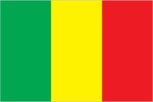
three equal vertical bands of green (hoist side), yellow, and red; uses the popular pan-African colors of Ethiopia
Independence
22 September 1960 (from France; formerly French Sudan)
Judicial branch
Supreme Court (C'our Supreme)
Leaders
Chief of State and Head of Government— President Gen. Moussa TRAORE (since 6 December 1968) Political parties and leaders: only party — Democratic Union of Malian People (UDPM)
Legal system
based on French civil law system and customary law; judicial review of legislative acts in Constitutional Section of Court of State; has not accepted compulsory ICJ jurisdiction
Legislative branch
unicameral National Assembly (Assemble Nationale)
Long-form name
Republic of Mali
Member of
ACP, AfDB, CEAO, ECA, ECOWAS, FAO, G-77, GATT (de facto), IAEA, IBRD, ICAO, IDA, IDB— Islamic Development Bank, IFAD, IFC, ILO, IMF, INTELSAT, INTERPOL, IPU, IRC, ITU, NAM, Niger River Commision, OAU, QIC, OMVS (Organization for the Development of the Senegal River Valley), UN, UNESCO, UPU, WHO, WMO, WTO,
National holiday
Anniversary of the Proclamation of the Republic, 22 September (1960)
Suffrage
universal at age 21
Type
republic; single-party constitutional government
Economy
Agriculture
- accounts for almost 30% of GDP (including fishing); fishing more important than farming; limited production of coconuts, corn, sweet potatoes; most staple foods must be imported
- accounts for 50% of GDP; most production based on small subsistence farms; cotton and livestock products account for over 70% of exports; other crops — millet, rice, corn, vegetables, peanuts; livestock — cattle, sheep, and goats
Aid
- US commitments, including Ex-Im (FY70-88), $28 million; Western (non-US) countries, ODA and OOF bilateral commitments (1970-87), $84 million; OPEC bilateral aid (1979-89), $14 million
- US commitments, including Ex-Im (FY70-88), $313 million; Western (nonUS) countries, ODA and OOF bilateral commitments (1970-87), $2.4 billion; OPEC bilateral aid (1979-89), $92 million; Communist countries (1970-88), $190 million
Budget
- revenues $51 million; expenditures $50 million, including capital expenditures of $25 million (1988 est.)
- revenues $338 million; expenditures $559 million, including capital expenditures of $NA (1987)
Currency
- rufiyaa (plural — rufiyaa); I rufiyaa (Rf) = 100 laaris
- Communaute Financiere Africaine franc (plural — francs); 1 CFA franc (CFAF) = 100 centimes
Electricity
- 5,000 kW capacity; 10 million kWh produced, 50 kWh per capita (1989)
- 92,000 kW capacity; 165 million kWh produced, 20 kWh per capita (1989)
Exchange rates
- rufiyaa (Rf) per US$1 — 9.3043 (January 1990), 9.0408 (1989), 8.7846 (1988), 9.2230 (1987), 7.1507 (1986), 7.0981 (1985)
- Communaute Financiere Africaine francs (CFAF) per US$1 — 287.99 (January 1990), 319.01 (1989), 297.85 (1988), 300.54 (1987), 346.30 (1986),449.26(1985)
Exports
- $47.0 million (f.o.b., 1988 est.); commodities — fish 57%, clothing 39%; partners — Thailand, Western Europe, Sri Lanka
- $260 million (f.o.b., 1987); commodities— livestock, peanuts, dried fish, cotton, skins; partners — mostly franc zone and Western Europe
External debt
- $70 million (December 1988)
- $2.1 billion (December 1988 est.)
Fiscal year
- calendar year
- calendar year
GDP
- $136 million, per capita $670; real growth rate 9.2% (1988)
- $1.94 billion, per capita $220; real growth rate -0.9% (1988 est.)
Imports
- $90.0 million (c.i.f., 1988 est.); commodities — intermediate and capital goods 47%, consumer goods 42%, petroleum products 1 1 %; partners — Japan, Western Europe, Thailand
- $493 million (f.o.b., 1987); commodities— textiles, vehicles, petroleum products, machinery, sugar, cereals; partners— mostly franc zone and Western Europe
Industrial production
- growth rate 3.9% (1988 est.)
- growth rate NA%
Industries
- fishing and fish processing, tourism, shipping, boat building, some coconut processing, garments, woven mats, coir (rope), handicrafts
- small local consumer goods and processing, construction, phosphate, gold, fishing
Inflation rate (consumer prices)
- 14% (1988 est.)
- NA% (1987)
Overview
- The economy is based on fishing, tourism, and shipping. Agriculture is limited to the production of a few subsistence crops that provide only 10% of food requirements. Fishing is the largest industry, employing 80% of the work force and accounting for over 60% of exports; it is also an important source of government revenue. During the 1980s tourism has become one of the most important and highest growth sectors of the economy. In 1988 industry accounted for about 14% of GDP. Real GDP is officially estimated to have increased by about 10% annually during the period 1974-86, and GDP estimates for 1988 show a further growth of 9% on the strength of a record fish catch and an improved tourist season.
- Mali is among the poorest countries in the world, with about 80% of its land area desert or semidesert. Economic activity is largely confined to the riverine area irrigated by the Niger. About 10% of the population lives as nomads and some 80% of the labor force is engaged in agriculture and fishing. Industrial activity is concentrated on processing farm commodities.
Unemployment rate
- NA%
- NA%
Communications
Airports
- 2 with permanent-surface runways 2,440-3,659 m
- 37 total, 29 usable; 8 with permanent-surface runways; none with runways over 3,659 m; 7 with runways 2,440-3,659 m; 9 with runways 1,220-2,439 m
Branches
- no military force
- Army, Air Force; paramilitary, Gendarmerie, Republican Guard, National Guard
Civil air
- I major transport aircraft
- no major transport aircraft
Defense expenditures
- $1.8 million (1984 est.) Boundary representation is not necessarily authoritative See rtflonil map VII
- 2.5% of GDP (1987)
Highways
- Male has 9.6 km of coral highways within the city
- about 15,700 km total; 1,670 km bituminous, 3,670 km gravel and improved earth, 10,360 km unimproved earth
Inland waterways
1,815 km navigable
Merchant marine
16 ships (1,000 CRT or over) totaling 70,066 GRT/1 12,480 DWT; includes 1 2 cargo, 1 container, 1 petroleum, oils, and lubricants (POL) tanker, 2 bulk
Military manpower
- males 15-49, 49,261; 27,519 fit for military service
- males 15-49, 1,585,878; 913,000 fit for military service; no conscription
Ports
Male, Can
Railroads
642 km 1.000-meter gauge; linked to Senegal's rail system through Kayes
Telecommunications
- minimal domestic and international facilities; 2,325 telephones; stations — 2 AM, 1 FM, 1 TV; 1 Indian Ocean INTELSAT earth station Defense Forces
- domestic system poor but improving; provides only minimal service with radio relay, wire, and radio communications stations; expansion of radio relay in progress; 1 1 ,000 telephones; stations— 2 AM, 2 FM, 2 TV; satellite earth stations— 1 Atlantic Ocean INTELSAT and 1 Indian Ocean INTELSAT Defense Forces