2016 Edition
CIA World Factbook 2016 Archive (HTML)
Introduction
Background
A sultanate since the 12th century, the Maldives became a British protectorate in 1887. It became a republic in 1968, three years after independence. President Maumoon Abdul GAYOOM dominated the islands' political scene for 30 years, elected to six successive terms by single-party referendums. Following political demonstrations in the capital Male in August 2003, the president and his government pledged to embark upon a process of liberalization and democratic reforms, including a more representative political system and expanded political freedoms. Progress was sluggish, however, and many promised reforms were slow to be realized. Nonetheless, political parties were legalized in 2005. In June 2008, a constituent assembly - termed the "Special Majlis" - finalized a new constitution, which was ratified by the president in August. The first-ever presidential elections under a multi-candidate, multi-party system were held in October 2008. GAYOOM was defeated in a runoff poll by Mohamed NASHEED, a political activist who had been jailed several years earlier by the former regime. President NASHEED faced a number of challenges including strengthening democracy and combating poverty and drug abuse. In early February 2012, after several weeks of street protests following his sacking of a top judge, NASHEED resigned the presidency and handed over power to Vice President Mohammed WAHEED Hassan Maniku. In mid-2012, a Commission of National Inquiry was set by the government to probe events leading up to NASHEED's resignation. Though the commission found no evidence of a coup, the report recommended the need to strengthen the country's democratic institutions to avert similar events in the future, and to further investigate alleged police misconduct during the crisis. Maldivian officials have played a prominent role in international climate change discussions (due to the islands' vulnerability to rising sea-level) on the UN Human Rights Council and in other international forums, as well as in encouraging regional cooperation, especially between India and Pakistan.
Geography
Area
- 298 sq km 298 sq km 0 sq km
- land
- 298 sq km
- total
- 298 sq km
- water
- 0 sq km
Area - comparative
about 1.7 times the size of Washington, DC
Climate
tropical; hot, humid; dry, northeast monsoon (November to March); rainy, southwest monsoon (June to August)
Coastline
644 km
Elevation
- 1.8 m lowest point: Indian Ocean 0 m highest point: unnamed location on Viligili in the Addu Atholhu 2.4 m
- elevation extremes
- lowest point: Indian Ocean 0 m
- highest point
- unnamed location on Viligili in the Addu Atholhu 2.4 m
- mean elevation
- 1.8 m
Environment - current issues
depletion of freshwater aquifers threatens water supplies; coral reef bleaching
Environment - international agreements
- Biodiversity, Climate Change, Climate Change-Kyoto Protocol, Desertification, Hazardous Wastes, Law of the Sea, Ozone Layer Protection, Ship Pollution none of the selected agreements
- party to
- Biodiversity, Climate Change, Climate Change-Kyoto Protocol, Desertification, Hazardous Wastes, Law of the Sea, Ozone Layer Protection, Ship Pollution
- signed, but not ratified
- none of the selected agreements
Geographic coordinates
3 15 N, 73 00 E
Geography - note
smallest Asian country; archipelago of 1,190 coral islands grouped into 26 atolls (200 inhabited islands, plus 80 islands with tourist resorts); strategic location astride and along major sea lanes in Indian Ocean
Irrigated land
0 sq km (2012)
Land boundaries
0 km
Land use
- 23.3% arable land 10%; permanent crops 10%; permanent pasture 3.3% 3% 73.7% (2011 est.)
- agricultural land
- 23.3%
- forest
- 3%
- other
- 73.7% (2011 est.)
Location
Southern Asia, group of atolls in the Indian Ocean, south-southwest of India
Map references
Asia
Maritime claims
- measured from claimed archipelagic straight baselines 12 nm 24 nm 200 nm
- contiguous zone
- 24 nm
- exclusive economic zone
- 200 nm
- territorial sea
- 12 nm
Natural hazards
tsunamis; low elevation of islands makes them sensitive to sea level rise
Natural resources
fish
Terrain
flat, with white sandy beaches
People and Society
Age structure
- 21.21% (male 42,513/female 40,824) 21.29% (male 48,319/female 35,360) 47.63% (male 107,152/female 80,031) 5.48% (male 10,749/female 10,799) 4.38% (male 8,012/female 9,201) (2016 est.)
- 0-14 years
- 21.21% (male 42,513/female 40,824)
- 15-24 years
- 21.29% (male 48,319/female 35,360)
- 25-54 years
- 47.63% (male 107,152/female 80,031)
- 55-64 years
- 5.48% (male 10,749/female 10,799)
- 65 years and over
- 4.38% (male 8,012/female 9,201) (2016 est.)
Birth rate
16 births/1,000 population (2016 est.)
Children under the age of 5 years underweight
17.8% (2009)
Contraceptive prevalence rate
34.7% (2009)
Death rate
3.9 deaths/1,000 population (2016 est.)
Dependency ratios
- 47.4% 40.5% 6.9% 14.4% (2015 est.)
- elderly dependency ratio
- 6.9%
- potential support ratio
- 14.4% (2015 est.)
- total dependency ratio
- 47.4%
- youth dependency ratio
- 40.5%
Drinking water source
- urban: 99.5% of population rural: 97.9% of population total: 98.6% of population urban: 0.5% of population rural: 2.1% of population total: 1.4% of population (2015 est.)
- rural
- 2.1% of population
- total
- 1.4% of population (2015 est.)
- urban
- 0.5% of population
Education expenditures
5.2% of GDP (2012)
Ethnic groups
South Indians, Sinhalese, Arabs
Health expenditures
13.7% of GDP (2014)
HIV/AIDS - adult prevalence rate
0.01% (2013 est.)
HIV/AIDS - deaths
fewer than 100 (2013 est.)
HIV/AIDS - people living with HIV/AIDS
fewer than 100 (2013 est.)
Hospital bed density
4.3 beds/1,000 population (2009)
Infant mortality rate
- 22.9 deaths/1,000 live births 25.2 deaths/1,000 live births 20.4 deaths/1,000 live births (2016 est.)
- female
- 20.4 deaths/1,000 live births (2016 est.)
- male
- 25.2 deaths/1,000 live births
- total
- 22.9 deaths/1,000 live births
Languages
Dhivehi (official, dialect of Sinhala, script derived from Arabic), English (spoken by most government officials)
Life expectancy at birth
- 75.6 years 73.3 years 78 years (2016 est.)
- female
- 78 years (2016 est.)
- male
- 73.3 years
- total population
- 75.6 years
Literacy
- age 15 and over can read and write 99.3% 99.8% 98.8% (2015 est.)
- definition
- age 15 and over can read and write
- female
- 98.8% (2015 est.)
- male
- 99.8%
- total population
- 99.3%
Major urban areas - population
MALE (capital) 156,000 (2014)
Maternal mortality rate
68 deaths/100,000 live births (2015 est.)
Median age
- 27.8 years 27.8 years 27.8 years (2016 est.)
- female
- 27.8 years (2016 est.)
- male
- 27.8 years
- total
- 27.8 years
Mother's mean age at first birth
- 23.9 median age at first birth among women 25-29 (2009 est.)
- note
- median age at first birth among women 25-29 (2009 est.)
Nationality
- Maldivian(s) Maldivian
- adjective
- Maldivian
- noun
- Maldivian(s)
Net migration rate
-12.7 migrant(s)/1,000 population (2016 est.)
Obesity - adult prevalence rate
7% (2014)
Physicians density
1.42 physicians/1,000 population (2010)
Population
392,960 (July 2016 est.)
Population growth rate
-0.07% (2016 est.)
Religions
Sunni Muslim (official)
Sanitation facility access
- urban: 97.5% of population rural: 98.3% of population total: 97.9% of population urban: 2.5% of population rural: 1.7% of population total: 2.1% of population (2015 est.)
- rural
- 1.7% of population
- total
- 2.1% of population (2015 est.)
- urban
- 2.5% of population
Sex ratio
- 1.05 male(s)/female 1.04 male(s)/female 1.37 male(s)/female 1.34 male(s)/female 1 male(s)/female 0.89 male(s)/female 1.23 male(s)/female (2016 est.)
- 0-14 years
- 1.04 male(s)/female
- 15-24 years
- 1.37 male(s)/female
- 25-54 years
- 1.34 male(s)/female
- 55-64 years
- 1 male(s)/female
- 65 years and over
- 0.89 male(s)/female
- at birth
- 1.05 male(s)/female
- total population
- 1.23 male(s)/female (2016 est.)
Total fertility rate
1.73 children born/woman (2016 est.)
Unemployment, youth ages 15-24
- 25.4% 29.1% 21.4% (2010 est.)
- female
- 21.4% (2010 est.)
- male
- 29.1%
- total
- 25.4%
Urbanization
- 45.5% of total population (2015) 4.49% annual rate of change (2010-15 est.)
- rate of urbanization
- 4.49% annual rate of change (2010-15 est.)
- urban population
- 45.5% of total population (2015)
Government
Administrative divisions
7 provinces and 1 municipality*; Dhekunu (South), Maale*, Mathi Dhekunu (Upper South), Mathi Uthuru (Upper North), Medhu (Central), Medhu Dhekunu (South Central), Medhu Uthuru (North Central), Uthuru (North)
Capital
- Male 4 10 N, 73 30 E UTC+5 (10 hours ahead of Washington, DC, during Standard Time)
- geographic coordinates
- 4 10 N, 73 30 E
- name
- Male
- time difference
- UTC+5 (10 hours ahead of Washington, DC, during Standard Time)
Citizenship
- no at least one parent must be a citizen of the Maldives yes unknown
- citizenship by birth
- no
- citizenship by descent only
- at least one parent must be a citizen of the Maldives
- dual citizenship recognized
- yes
- residency requirement for naturalization
- unknown
Constitution
many previous; latest ratified 7 August 2008; amended 2015 (2016)
Country name
- Republic of Maldives Maldives Dhivehi Raajjeyge Jumhooriyyaa Dhivehi Raajje archipelago apparently named after the main island (and capital) of Male; the word "Maldives" means "the islands (dives) of Male"; alternatively, the name may derive from the Sanskrit word "maladvipa" meaning "garland of islands"; Dhivehi Raajje in Maldivian means "Kingdom of the Dhivehi people"
- conventional long form
- Republic of Maldives
- conventional short form
- Maldives
- etymology
- archipelago apparently named after the main island (and capital) of Male; the word "Maldives" means "the islands (dives) of Male"; alternatively, the name may derive from the Sanskrit word "maladvipa" meaning "garland of islands"; Dhivehi Raajje in Maldivian means "Kingdom of the Dhivehi people"
- local long form
- Dhivehi Raajjeyge Jumhooriyyaa
- local short form
- Dhivehi Raajje
Diplomatic representation from the US
the US does not have an embassy in Maldives; the US Ambassador to Sri Lanka is accredited to Maldives and makes periodic visits
Diplomatic representation in the US
- Ambassador Ahmed SAREER (since 11 January 2013) 800 2nd Avenue, Suite 400E, New York, NY 10017 [1] (212) 599-6195 [1] (212) 661-6405
- chancery
- 800 2nd Avenue, Suite 400E, New York, NY 10017
- chief of mission
- Ambassador Ahmed SAREER (since 11 January 2013)
- FAX
- [1] (212) 661-6405
- telephone
- [1] (212) 599-6195
Executive branch
- President Abdulla YAMEEN Abdul Gayoom (since 17 November 2013); Vice President Abdulla JIHAD (since 21 June 2016); note - the president is both chief of state and head of government; Vice President Ahmed ADHEEB Abdul Ghafoor (since 22 July 2015) was removed from office 5 November 2015 President Abdulla YAMEEN Abdul Gayoom (since 17 November 2013); Vice President Abdulla JIHAD (since 22 June 2016); note - Vice President Ahmed ADHEEB Abdul Ghafoor (since 22 July 2015) was removed from office 5 November 2015 Cabinet of Ministers appointed by the president president directly elected by absolute majority popular vote in 2 rounds if needed for a 5-year term (eligible for a second term); the election held on 7 September 2013 was annulled by the Supreme Court; rerun of first round held on 9 November 2013 and a runoff held on 16 November (next election to be held in 2018) first round - percent of vote - Mohamed NASHEED (MDP) 46.9%, Abdulla YAMEEN Abdul Gayoom (PPM) 29.7%, Qasim IBRAHIM (JP) 23.3%; runoff second round - percent of vote - Abdulla YAMEEN Abdul Gayoom elected president 51.4%, Mohamed NASHEED 48.6%
- cabinet
- Cabinet of Ministers appointed by the president
- chief of state
- President Abdulla YAMEEN Abdul Gayoom (since 17 November 2013); Vice President Abdulla JIHAD (since 21 June 2016); note - the president is both chief of state and head of government; Vice President Ahmed ADHEEB Abdul Ghafoor (since 22 July 2015) was removed from office 5 November 2015
- election results
- first round - percent of vote - Mohamed NASHEED (MDP) 46.9%, Abdulla YAMEEN Abdul Gayoom (PPM) 29.7%, Qasim IBRAHIM (JP) 23.3%; runoff second round - percent of vote - Abdulla YAMEEN Abdul Gayoom elected president 51.4%, Mohamed NASHEED 48.6%
- elections/appointments
- president directly elected by absolute majority popular vote in 2 rounds if needed for a 5-year term (eligible for a second term); the election held on 7 September 2013 was annulled by the Supreme Court; rerun of first round held on 9 November 2013 and a runoff held on 16 November (next election to be held in 2018)
- head of government
- President Abdulla YAMEEN Abdul Gayoom (since 17 November 2013); Vice President Abdulla JIHAD (since 22 June 2016); note - Vice President Ahmed ADHEEB Abdul Ghafoor (since 22 July 2015) was removed from office 5 November 2015
Flag description
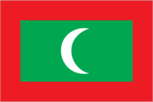
red with a large green rectangle in the center bearing a vertical white crescent moon; the closed side of the crescent is on the hoist side of the flag; red recalls those who have sacrificed their lives in defense of their country, the green rectangle represents peace and prosperity, and the white crescent signifies Islam
Government type
presidential republic
Independence
26 July 1965 (from the UK)
International law organization participation
has not submitted an ICJ jurisdiction declaration; accepts ICCt jurisdiction
International organization participation
ADB, AOSIS, C, CP, FAO, G-77, IBRD, ICAO, ICC (NGOs), ICCt, IDA, IDB, IFAD, IFC, IFRCS, ILO, IMF, IMO, Interpol, IOC, IOM, IPU, ITU, MIGA, NAM, OIC, OPCW, SAARC, SACEP, UN, UNCTAD, UNESCO, UNIDO, UNWTO, UPU, WCO, WHO, WIPO, WMO, WTO
Judicial branch
- Supreme Court (consists of the chief justice and 6 judges) Supreme Court judges appointed by the president in consultation with the Judicial Service Commission - a separate 10-member body of selected high government officials and the public - and upon confirmation by voting members of the People's Majlis; judges serve until mandatory retirement at age 70 High Court; Criminal, Civil, Family, Juvenile, and Drug Courts; Magistrate Courts (on each of the inhabited islands)
- highest court(s)
- Supreme Court (consists of the chief justice and 6 judges)
- judge selection and term of office
- Supreme Court judges appointed by the president in consultation with the Judicial Service Commission - a separate 10-member body of selected high government officials and the public - and upon confirmation by voting members of the People's Majlis; judges serve until mandatory retirement at age 70
- subordinate courts
- High Court; Criminal, Civil, Family, Juvenile, and Drug Courts; Magistrate Courts (on each of the inhabited islands)
Legal system
Islamic religious legal system with English common law influences, primarily in commercial matters
Legislative branch
- unicameral Parliament or People's Majlis (85 seats; members directly elected in multi-seat constituencies by simple majority vote to serve 5-year terms) last held on 22 March 2014 (next to be held in 2019) percent of vote - MDP 40.8%, MDP 27.7%, JP 13.6%, MDA 4.0%, AP 2.7% other 0.3%, independent 10.9%; seats by party - PPM 33, MDP 26, JP 15, MDA 5, AP 1, independent 5
- description
- unicameral Parliament or People's Majlis (85 seats; members directly elected in multi-seat constituencies by simple majority vote to serve 5-year terms)
- election results
- percent of vote - MDP 40.8%, MDP 27.7%, JP 13.6%, MDA 4.0%, AP 2.7% other 0.3%, independent 10.9%; seats by party - PPM 33, MDP 26, JP 15, MDA 5, AP 1, independent 5
- elections
- last held on 22 March 2014 (next to be held in 2019)
National anthem
- "Gaumee Salaam" (National Salute) Mohamed Jameel DIDI/Wannakuwattawaduge DON AMARADEVA lyrics adopted 1948, music adopted 1972; between 1948 and 1972, the lyrics were sung to the tune of "Auld Lang Syne"
- lyrics/music
- Mohamed Jameel DIDI/Wannakuwattawaduge DON AMARADEVA
- name
- "Gaumee Salaam" (National Salute)
- note
- lyrics adopted 1948, music adopted 1972; between 1948 and 1972, the lyrics were sung to the tune of "Auld Lang Syne"
National holiday
Independence Day, 26 July (1965)
National symbol(s)
- coconut palm, yellowfin tuna; national colors: red, green, white
- coconut palm, yellowfin tuna; national colors
- red, green, white
Political parties and leaders
Adhaalath (Justice) Party or AP [Sheikh Imran ABDULLA] Maldives Development Alliance or MDA [Ahmed Shiyam Mohamed] Maldavian Democratic Party or MDP [Ali WAHEED] Progressive Party of Maldives or PPM [Maumoon Abdul GAYOOM] Republican (Jumhooree) Party or JP [Qasim IBRAHIM]
Political pressure groups and leaders
- various unregistered political parties
- other
- various unregistered political parties
Suffrage
18 years of age; universal
Economy
Agriculture - products
coconuts, corn, sweet potatoes; fish
Budget
- $960 million $1.148 billion (2014 est.)
- expenditures
- $1.148 billion (2014 est.)
- revenues
- $960 million
Budget surplus (+) or deficit (-)
-6% of GDP (2014 est.)
Central bank discount rate
7% (31 December 2013) 6.96% (31 December 2011)
Commercial bank prime lending rate
10.5% (31 December 2012 est.) 10.2% (31 December 2011 est.)
Current account balance
-$251 million (2015 est.) -$125 million (2014 est.)
Debt - external
$741.6 million (2014 est.) $792.2 million (2013 est.)
Distribution of family income - Gini index
37.4 (2004 est.)
Economy - overview
Maldives has rapidly grown into a middle-income country, driven by tourism development. In 2015, the economy’s growth slowed to 4.8%, mainly due to lower tourism sector growth as tourist arrivals from China declined. However, the slowdown is expected to reverse in 2016. Tourism, construction, transport, and the communications sector accounted for 50% of the output on average. Tourism-related tax receipts increased by 13% in 2015 due to higher tax rates. This increase in dollar tax receipts directly led to higher usable reserves in 2015. The current account deficit widened to $400 million in 2015 due to increases in construction related imports. A large and growing fiscal deficit remains an ongoing economic challenge. In July 2015, Maldives’ Parliament passed a constitutional amendment legalizing foreign ownership of land; foreign land-buyers must reclaim at least 70% of the desired land from the ocean and invest at least $1 billion in a construction project approved by Parliament. Diversifying the economy beyond tourism and fishing, reforming public finance, increasing employment opportunities, and combating corruption, cronyism, and a growing drug problem are near-term challenges facing the government. Over the longer term Maldivian authorities worry about the impact of erosion and possible global warming on their low-lying country; 80% of the area is 1 meter or less above sea level.
Exchange rates
rufiyaa (MVR) per US dollar - 15.25 (2016) 15.365 (2015)
Exports
$300.9 million (2014 est.) $331 million (2013 est.)
Exports - commodities
fish
Exports - partners
Thailand 18%, France 12.1%, Germany 10.7%, US 9.6%, Italy 6.8%, UK 6.4%, Sri Lanka 5.9%, Japan 4.6% (2015)
Fiscal year
calendar year
GDP - composition, by end use
- NA% NA% NA% NA% 108.2% 89.3% (2014 est.)
- exports of goods and services
- 108.2%
- government consumption
- NA%
- household consumption
- NA%
- imports of goods and services
- 89.3% (2014 est.)
- investment in fixed capital
- NA%
- investment in inventories
- NA%
GDP - composition, by sector of origin
- 3.5% 19.3% 77.2% (2014 est.)
- agriculture
- 3.5%
- industry
- 19.3%
- services
- 77.2% (2014 est.)
GDP - per capita (PPP)
- $14,900 (2015 est.) $14,900 (2014 est.) $14,200 (2013 est.) data are in 2015 US dollars
- note
- data are in 2015 US dollars
GDP - real growth rate
1.9% (2015 est.) 6.5% (2014 est.) 4.7% (2013 est.)
GDP (official exchange rate)
$3.13 billion (2015 est.)
GDP (purchasing power parity)
- $5.191 billion (2015 est.) $5.094 billion (2014 est.) $4.784 billion (2013 est.) data are in 2015 US dollars
- note
- data are in 2015 US dollars
Gross national saving
12% of GDP (2015 est.) 15.9% of GDP (2014 est.) 15.7% of GDP (2013 est.)
Household income or consumption by percentage share
- 1.2% 33.3% (FY09/10)
- highest 10%
- 33.3% (FY09/10)
- lowest 10%
- 1.2%
Imports
$1.993 billion (2014 est.) $1.733 billion (2013 est.)
Imports - commodities
petroleum products, clothing, intermediate and capital goods
Imports - partners
UAE 18.4%, Singapore 13.8%, China 10.6%, India 10.4%, Malaysia 7%, Sri Lanka 5.6%, Thailand 5% (2015)
Industrial production growth rate
14% (2012 est.)
Industries
tourism, fish processing, shipping, boat building, coconut processing, woven mats, rope, handicrafts, coral and sand mining
Inflation rate (consumer prices)
1.4% (2015 est.) 2.5% (2014 est.)
Labor force
195,100 (2014)
Labor force - by occupation
- 15% 15% 70% (2010 est.)
- agriculture
- 15%
- industry
- 15%
- services
- 70% (2010 est.)
Market value of publicly traded shares
$555 million (31 December 2011 est.)
Population below poverty line
16% (2008 est.)
Public debt
72.8% of GDP (2014) 66.7% of GDP (2013)
Reserves of foreign exchange and gold
$627.4 million (31 December 2014 est.) $381.9 million (31 December 2013 est.)
Stock of broad money
$1.538 billion (31 December 2013 est.) $1.298 billion (31 December 2012 est.)
Stock of domestic credit
$1.559 billion (31 December 2012 est.) $1.601 billion (31 December 2011 est.)
Stock of narrow money
$623 million (31 December 2013 est.) $547.1 million (31 December 2012 est.)
Taxes and other revenues
30.7% of GDP (2014 est.)
Unemployment rate
11.6% (2013 est.) 11% (2012 est.)
Energy
Carbon dioxide emissions from consumption of energy
1.2 million Mt (2013 est.)
Crude oil - exports
0 bbl/day (2013 est.)
Crude oil - imports
0 bbl/day (2013 est.)
Crude oil - production
0 bbl/day (2015 est.)
Crude oil - proved reserves
0 bbl (1 January 2016 es)
Electricity - consumption
300 million kWh (2014 est.)
Electricity - exports
0 kWh (2013 est.)
Electricity - from fossil fuels
100% of total installed capacity (2012 est.)
Electricity - from hydroelectric plants
0% of total installed capacity (2012 est.)
Electricity - from nuclear fuels
0% of total installed capacity (2012 est.)
Electricity - from other renewable sources
0% of total installed capacity (2012 est.)
Electricity - imports
0 kWh (2013 est.)
Electricity - installed generating capacity
82,000 kW (2014 est.)
Electricity - production
300 million kWh (2014 est.)
Electricity access
- 100% (2016)
- electrification - total population
- 100% (2016)
Natural gas - consumption
0 cu m (2013 est.)
Natural gas - exports
0 cu m (2013 est.)
Natural gas - imports
0 cu m (2013 est.)
Natural gas - production
0 cu m (2013 est.)
Natural gas - proved reserves
0 cu m (1 January 2014 es)
Refined petroleum products - consumption
7,000 bbl/day (2014 est.)
Refined petroleum products - exports
0 bbl/day (2013 est.)
Refined petroleum products - imports
10,760 bbl/day (2013 est.)
Refined petroleum products - production
0 bbl/day (2013 est.)
Communications
Broadcast media
state-owned radio and TV monopoly until recently; state-owned TV operates 2 channels; 3 privately owned TV stations; state owns Voice of Maldives and operates both an entertainment and a music-based station; 5 privately owned radio stations (2012)
Internet country code
.mv
Internet users
- 214,000 54.5% (July 2015 est.)
- percent of population
- 54.5% (July 2015 est.)
- total
- 214,000
Telephone system
- telephone services have improved; inter-atoll communication through microwave links; all inhabited islands and resorts are connected with telephone and fax service each island now has at least 1 public telephone, and there are mobile-cellular networks with a rapidly expanding subscribership that has reached over 180 per 100 persons country code - 960; linked to international submarine cable Fiber-Optic Link Around the Globe (FLAG); satellite earth station - 3 Intelsat (Indian Ocean) (2015)
- domestic
- each island now has at least 1 public telephone, and there are mobile-cellular networks with a rapidly expanding subscribership that has reached over 180 per 100 persons
- general assessment
- telephone services have improved; inter-atoll communication through microwave links; all inhabited islands and resorts are connected with telephone and fax service
- international
- country code - 960; linked to international submarine cable Fiber-Optic Link Around the Globe (FLAG); satellite earth station - 3 Intelsat (Indian Ocean) (2015)
Telephones - fixed lines
- 21,911 6 (July 2015 est.)
- subscriptions per 100 inhabitants
- 6 (July 2015 est.)
- total subscriptions
- 21,911
Telephones - mobile cellular
- 740,000 188 (July 2015 est.)
- subscriptions per 100 inhabitants
- 188 (July 2015 est.)
- total
- 740,000
Transportation
Airports
9 (2013)
Airports - with paved runways
- 4 (2013)
- 1,524 to 2,437 m
- 1
- 2,438 to 3,047 m
- 1
- 914 to 1,523 m
- 4 (2013)
- over 3,047 m
- 1
- total
- 7
Airports - with unpaved runways
- 2 (2013)
- 914 to 1,523 m
- 2 (2013)
- total
- 2
Civil aircraft registration country code prefix
8Q (2016)
Merchant marine
- bulk carrier 1, cargo 14, petroleum tanker 1, refrigerated cargo 2 4 (Singapore 4) 4 (Panama 2, Tuvalu 1, unknown 1) (2010)
- by type
- bulk carrier 1, cargo 14, petroleum tanker 1, refrigerated cargo 2
- foreign-owned
- 4 (Singapore 4)
- registered in other countries
- 4 (Panama 2, Tuvalu 1, unknown 1) (2010)
- total
- 18
National air transport system
- 15 (2015)
- inventory of registered aircraft operated by air carriers
- 15 (2015)
- number of registered air carriers
- 3
Ports and terminals
- Male
- major seaport(s)
- Male
Roadways
- 88 km 88 km - 60 km in Male; 14 km on Addu Atolis; 14 km on Laamu island roads are mainly compacted coral (2013)
- note
- island roads are mainly compacted coral (2013)
- paved roads
- 88 km - 60 km in Male; 14 km on Addu Atolis; 14 km on Laamu
- total
- 88 km
Military and Security
Military - note
the Maldives National Defense Force (MNDF), with its small size and with little serviceable equipment, is inadequate to prevent external aggression and is primarily tasked to reinforce the Maldives Police Service (MPS) and ensure security in the exclusive economic zone (2008)
Military branches
- Maldives National Defense Force (MNDF): Marine Corps, Security Protection Group, Coast Guard (2010)
- Maldives National Defense Force (MNDF)
- Marine Corps, Security Protection Group, Coast Guard (2010)
Military service age and obligation
18-28 years of age for voluntary service; no conscription; 10th grade or equivalent education required; must not be a member of a political party (2012)
Transnational Issues
Disputes - international
none
Trafficking in persons
- Maldives is a destination country for men, women, and children subjected to forced labor and sex trafficking and a source country for women and children subjected to labor and sex trafficking; primarily Bangladeshi and Indian migrants working both legally and illegally in the construction and service sectors face conditions of forced labor, including fraudulent recruitment, confiscation of identity and travel documents, nonpayment and withholding of wages, and debt bondage; a small number of women from Asia, Eastern Europe, and former Soviet states are trafficked to Maldives for sexual exploitation; Maldivian women may be subjected to sex trafficking domestically or in Sri Lanka; some Maldivian children are transported to the capital for domestic service, where they may also be victims of sexual abuse and forced labor Tier 2 Watch List – Maldives does not fully comply with the minimum standards for the elimination of trafficking; however, it is making significant efforts to do so; the government adopted a national action plan for 2015-2019 and is continuing to develop victim identification, protection, and referral procedures, but overall its anti-trafficking efforts did not increase; only five trafficking investigations were conducted, no new prosecutions were initiated for the second consecutive year, and no convictions were made, down from one in 2013; some officials warned businesses in advanced of planned raids for suspected trafficking offenses; victim protection deteriorated when the state-run shelter for female victims barred access to victims shortly after opening in January 2014, in part because of bureaucratic disputes, which dissuaded victims from pursuing charges against perpetrators; the government did not prosecute or hold accountable any employers or government officials for withholding passports (2015)
- current situation
- Maldives is a destination country for men, women, and children subjected to forced labor and sex trafficking and a source country for women and children subjected to labor and sex trafficking; primarily Bangladeshi and Indian migrants working both legally and illegally in the construction and service sectors face conditions of forced labor, including fraudulent recruitment, confiscation of identity and travel documents, nonpayment and withholding of wages, and debt bondage; a small number of women from Asia, Eastern Europe, and former Soviet states are trafficked to Maldives for sexual exploitation; Maldivian women may be subjected to sex trafficking domestically or in Sri Lanka; some Maldivian children are transported to the capital for domestic service, where they may also be victims of sexual abuse and forced labor
- tier rating
- Tier 2 Watch List – Maldives does not fully comply with the minimum standards for the elimination of trafficking; however, it is making significant efforts to do so; the government adopted a national action plan for 2015-2019 and is continuing to develop victim identification, protection, and referral procedures, but overall its anti-trafficking efforts did not increase; only five trafficking investigations were conducted, no new prosecutions were initiated for the second consecutive year, and no convictions were made, down from one in 2013; some officials warned businesses in advanced of planned raids for suspected trafficking offenses; victim protection deteriorated when the state-run shelter for female victims barred access to victims shortly after opening in January 2014, in part because of bureaucratic disputes, which dissuaded victims from pursuing charges against perpetrators; the government did not prosecute or hold accountable any employers or government officials for withholding passports (2015)