2011 Edition
CIA World Factbook 2011 Archive (HTML)
Introduction
Background
Maldives was long a sultanate, first under Dutch and then under British protection. It became a republic in 1968, three years after independence. President Maumoon Abdul GAYOOM dominated the islands' political scene for 30 years, elected to six successive terms by single-party referendums. Following riots in the capital Male in August 2003, the president and his government pledged to embark upon democratic reforms including a more representative political system and expanded political freedoms. Progress was sluggish, however, and many promised reforms were slow to be realized. Nonetheless, political parties were legalized in 2005. In June 2008, a constituent assembly - termed the "Special Majlis" - finalized a new constitution, which was ratified by the president in August. The first-ever presidential elections under a multi-candidate, multi-party system were held in October 2008. GAYOOM was defeated in a runoff poll by Mohamed NASHEED, a political activist who had been jailed several years earlier by the former regime. Challenges facing President NASHEED include strengthening democracy and combating poverty and drug abuse. Maldives officials have played a prominent role in international climate change discussions (due to the islands' low elevation and the threat from sea-level rise) on the United Nations Human Rights Council, and in encouraging regional cooperation, especially between India and Pakistan.
Geography
Area
- 298 sq km 298 sq km 0 sq km
- total
- 298 sq km
- water
- 0 sq km
Area - comparative
about 1.7 times the size of Washington, DC
Climate
tropical; hot, humid; dry, northeast monsoon (November to March); rainy, southwest monsoon (June to August)
Coastline
644 km
Elevation extremes
- Indian Ocean 0 m unnamed location on Viligili in the Addu Atholhu 2.4 m
- highest point
- unnamed location on Viligili in the Addu Atholhu 2.4 m
- lowest point
- Indian Ocean 0 m
Environment - current issues
depletion of freshwater aquifers threatens water supplies; global warming and sea level rise; coral reef bleaching
Environment - international agreements
- Biodiversity, Climate Change, Climate Change-Kyoto Protocol, Desertification, Hazardous Wastes, Law of the Sea, Ozone Layer Protection, Ship Pollution none of the selected agreements
- party to
- Biodiversity, Climate Change, Climate Change-Kyoto Protocol, Desertification, Hazardous Wastes, Law of the Sea, Ozone Layer Protection, Ship Pollution
- signed, but not ratified
- none of the selected agreements
Freshwater withdrawal (domestic/industrial/agricultural)
- 0.003 cu km/yr (98%/2%/0%) 9 cu m/yr (1987)
- per capita
- 9 cu m/yr (1987)
- total
- 0.003 cu km/yr (98%/2%/0%)
Geographic coordinates
3 15 N, 73 00 E
Geography - note
1,190 coral islands grouped into 26 atolls (200 inhabited islands, plus 80 islands with tourist resorts); archipelago with strategic location astride and along major sea lanes in Indian Ocean
Irrigated land
NA
Land boundaries
0 km
Land use
- 13.33% 30% 56.67% (2005)
- arable land
- 13.33%
- other
- 56.67% (2005)
- permanent crops
- 30%
Location
Southern Asia, group of atolls in the Indian Ocean, south-southwest of India
Map references
Asia
Maritime claims
- measured from claimed archipelagic straight baselines 12 nm 24 nm 200 nm
- contiguous zone
- 24 nm
- exclusive economic zone
- 200 nm
- territorial sea
- 12 nm
Natural hazards
tsunamis; low elevation of islands makes them sensitive to sea level rise
Natural resources
fish
Terrain
flat, with white sandy beaches
Total renewable water resources
0.03 cu km (1999)
People and Society
Age structure
- 21.5% (male 43,332/female 41,642) 74.4% (male 177,365/female 116,552) 4.1% (male 7,888/female 8,220) (2011 est.)
- 0-14 years
- 21.5% (male 43,332/female 41,642)
- 15-64 years
- 74.4% (male 177,365/female 116,552)
- 65 years and over
- 4.1% (male 7,888/female 8,220) (2011 est.)
Birth rate
14.83 births/1,000 population (2011 est.)
Children under the age of 5 years underweight
25.7% (2001)
Death rate
3.71 deaths/1,000 population (July 2011 est.)
Drinking water source
- urban: 99% of population rural: 86% of population total: 91% of population urban: 1% of population rural: 14% of population total: 9% of population (2008)
- rural
- 14% of population
- total
- 9% of population (2008)
- urban
- 1% of population
Education expenditures
11.2% of GDP (2009)
Ethnic groups
South Indians, Sinhalese, Arabs
Health expenditures
5.6% of GDP (2009)
HIV/AIDS - adult prevalence rate
less than 0.1% (2009 est.)
HIV/AIDS - deaths
fewer than 100 (2009 est.)
HIV/AIDS - people living with HIV/AIDS
fewer than 100 (2009 est.)
Hospital bed density
2.6 beds/1,000 population (2005)
Infant mortality rate
- 27.45 deaths/1,000 live births 29.93 deaths/1,000 live births 24.84 deaths/1,000 live births (2011 est.)
- female
- 24.84 deaths/1,000 live births (2011 est.)
- total
- 27.45 deaths/1,000 live births
Languages
Dhivehi (official, dialect of Sinhala, script derived from Arabic), English (spoken by most government officials)
Life expectancy at birth
- 74.45 years 72.22 years 76.8 years (2011 est.)
- female
- 76.8 years (2011 est.)
- total population
- 74.45 years
Literacy
- age 15 and over can read and write 93.8% 93% 94.7% (2006 Census)
- definition
- age 15 and over can read and write
- female
- 94.7% (2006 Census)
- male
- 93%
- total population
- 93.8%
Major cities - population
MALE (capital) 120,000 (2009)
Maternal mortality rate
37 deaths/100,000 live births (2008)
Median age
- 26.2 years 26.8 years 25.2 years (2011 est.)
- female
- 25.2 years (2011 est.)
- male
- 26.8 years
- total
- 26.2 years
Nationality
- Maldivian(s) Maldivian
- adjective
- Maldivian
- noun
- Maldivian(s)
Net migration rate
-12.62 migrant(s)/1,000 population (2011 est.)
Physicians density
1.595 physicians/1,000 population (2007)
Population
394,999 (July 2011 est.)
Population growth rate
-0.151% (2011 est.)
Religions
Sunni Muslim (official)
Sanitation facility access
- urban: 100% of population rural: 96% of population total: 98% of population urban: 0% of population rural: 4% of population total: 2% of population (2008)
- rural
- 4% of population
- total
- 2% of population (2008)
- urban
- 0% of population
School life expectancy (primary to tertiary education)
- 12 years 13 years 12 years (2006)
- female
- 12 years (2006)
- male
- 13 years
- total
- 12 years
Sex ratio
- 1.05 male(s)/female 1.04 male(s)/female 1.57 male(s)/female 0.98 male(s)/female 1.4 male(s)/female (2011 est.)
- 15-64 years
- 1.57 male(s)/female
- 65 years and over
- 0.98 male(s)/female
- at birth
- 1.05 male(s)/female
- total population
- 1.4 male(s)/female (2011 est.)
- under 15 years
- 1.04 male(s)/female
Total fertility rate
1.81 children born/woman (2011 est.)
Unemployment, youth ages 15-24
- 22.2% 15.5% 30.5% (2006)
- female
- 30.5% (2006)
- total
- 22.2%
Urbanization
- 40% of total population (2010) 4.2% annual rate of change (2010-15 est.)
- rate of urbanization
- 4.2% annual rate of change (2010-15 est.)
- urban population
- 40% of total population (2010)
Government
Administrative divisions
7 provinces and 1 municipality*; Dhekunu (South), Maale*, Mathi Dhekunu (Upper South), Mathi Uthuru (Upper North), Medhu (Central), Medhu Dhekunu (South Central), Medhu Uthuru (North Central), Uthuru (North)
Capital
- Male 4 10 N, 73 30 E UTC+5 (10 hours ahead of Washington, DC during Standard Time)
- geographic coordinates
- 4 10 N, 73 30 E
- name
- Male
- time difference
- UTC+5 (10 hours ahead of Washington, DC during Standard Time)
Constitution
new constitution ratified 7 August 2008
Country name
- Republic of Maldives Maldives Dhivehi Raajjeyge Jumhooriyyaa Dhivehi Raajje
- conventional long form
- Republic of Maldives
- conventional short form
- Maldives
- local long form
- Dhivehi Raajjeyge Jumhooriyyaa
- local short form
- Dhivehi Raajje
Diplomatic representation from the US
the US does not have an embassy in Maldives; the US Ambassador to Sri Lanka, Ambassador Patricia A. BUTENIS, is accredited to Maldives and makes periodic visits
Diplomatic representation in the US
- Ambassador Abdul GHAFOOR Mohamed 800 2nd Avenue, Suite 400E, New York, NY 10017 [1] (212) 599-6195 [1] (212) 661-6405
- chancery
- 800 2nd Avenue, Suite 400E, New York, NY 10017
- chief of mission
- Ambassador Abdul GHAFOOR Mohamed
- FAX
- [1] (212) 661-6405
- telephone
- [1] (212) 599-6195
Executive branch
- President Mohamed "Anni" NASHEED (since 11 November 2008); Vice President Mohamed WAHEED Hassan Maniku (since 11 November 2008); note - the president is both the chief of state and head of government President Mohamed "Anni" NASHEED (since 11 November 2008); Vice President Mohamed WAHEED Hassan Maniku (since 11 November 2008) Cabinet of Ministers is appointed by the president under the new constitution, the president elected by direct vote; president elected for a five-year term (eligible for a second term); election last held on 8 and 28 October 2008 (next to be held in 2013) Mohamed NASHEED elected president; percent of vote - Mohamed NASHEED 54.3%, Maumoon Abdul GAYOOM 45.7%
- cabinet
- Cabinet of Ministers is appointed by the president
- chief of state
- President Mohamed "Anni" NASHEED (since 11 November 2008); Vice President Mohamed WAHEED Hassan Maniku (since 11 November 2008); note - the president is both the chief of state and head of government
- election results
- Mohamed NASHEED elected president; percent of vote - Mohamed NASHEED 54.3%, Maumoon Abdul GAYOOM 45.7%
- elections
- under the new constitution, the president elected by direct vote; president elected for a five-year term (eligible for a second term); election last held on 8 and 28 October 2008 (next to be held in 2013)
- head of government
- President Mohamed "Anni" NASHEED (since 11 November 2008); Vice President Mohamed WAHEED Hassan Maniku (since 11 November 2008)
Flag description
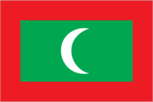
red with a large green rectangle in the center bearing a vertical white crescent moon; the closed side of the crescent is on the hoist side of the flag; red recalls those who have sacrificed their lives in defense of their country, the green rectangle represents peace and prosperity, and the white crescent signifies Islam
Government type
republic
Independence
26 July 1965 (from the UK)
International law organization participation
has not submitted an ICJ jurisdiction declaration; non-party state to the ICCt
International organization participation
ADB, AOSIS, C, CP, FAO, G-77, IBRD, ICAO, IDA, IDB, IFAD, IFC, IFRCS (observer), ILO, IMF, IMO, Interpol, IOC, IPU, ITU, MIGA, NAM, OIC, OPCW, SAARC, SACEP, UN, UNCTAD, UNESCO, UNIDO, UNWTO, UPU, WCO, WHO, WIPO, WMO, WTO
Judicial branch
Supreme Court; Supreme Court judges are appointed by the president with approval of voting members of the People's Council; High Court; Trial Courts; all lower court judges are appointed by the Judicial Service Commission
Legal system
Islamic religious legal system with English common law influences, primarily in commercial matters
Legislative branch
- unicameral People's Council or People's Majlis (77 seats; members elected by direct vote to serve five-year terms); note - the Majlis in February 2009 passed legislation that increased the number of seats to 77 from 50 last held on 9 May 2009 (next to be held in 2014) percent of vote - DRP 36.4%, MDP 33.8 %, PA 9.1%, DQP 2.6% Republican Party 1.2%, independents 16.9%; seats by party as of October 2011 - MDP 35, DRP 17, PPM 15, JP 2, PA 2, Meedhu DHAAIRA 1, independents 5
- election results
- percent of vote - DRP 36.4%, MDP 33.8 %, PA 9.1%, DQP 2.6% Republican Party 1.2%, independents 16.9%; seats by party as of October 2011 - MDP 35, DRP 17, PPM 15, JP 2, PA 2, Meedhu DHAAIRA 1, independents 5
- elections
- last held on 9 May 2009 (next to be held in 2014)
National anthem
- "Gaumee Salaam" (National Salute) Mohamed Jameel DIDI/Wannakuwattawaduge DON AMARADEVA lyrics adopted 1948, music adopted 1972; between 1948 and 1972, the lyrics were sung to the tune of "Auld Lang Syne"
- lyrics/music
- Mohamed Jameel DIDI/Wannakuwattawaduge DON AMARADEVA
- name
- "Gaumee Salaam" (National Salute)
National holiday
Independence Day, 26 July (1965)
National symbol(s)
crescent moon
Political parties and leaders
Adhaalath (Justice) Party or AP [Shaykh Hussein RASHEED Ahmed]; Dhivehi Qaumee Party or DQP [Hassan SAEED]; Dhivehi Rayyithunge Party (Maldivian People's Party) or DRP [Ahmed THASMEEN Ali]; Gaumee Itthihaad (National Alliance) or GI [Mohamed WAHEED]; Islamic Democratic Party or IDP; Maldivian Democratic Party or MDP [Ibrahim DIDI]; Maldives National Congress or MNC; Maldives Social Democratic Party or MSDP; Meedhu Dhaaira; People's Alliance or PA [Abdullah YAMEEN]; People's Party or PP; Poverty Alleviation Party or PAP; Progressive Party of Maldives or PPM [Maumoon Abdul GAYOOM]; Republican (Jumhooree) Party or JP [Gasim IBRAHIM]; Social Liberal Party or SLP [Mazian RASHEED]
Political pressure groups and leaders
- various unregistered political parties
- other
- various unregistered political parties
Suffrage
18 years of age; universal
Economy
Agriculture - products
coconuts, corn, sweet potatoes; fish
Budget
- $476 million $758 million (2010 est.)
- expenditures
- $758 million (2010 est.)
- revenues
- $476 million
Budget surplus (+) or deficit (-)
-15.1% of GDP (2010 est.)
Central bank discount rate
2.75% (31 December 2010 est.) 16% (31 December 2009 est.)
Commercial bank prime lending rate
10.38% (31 December 2010 est.) 13% (31 December 2009 est.)
Current account balance
-$463 million (2010 est.) -$419 million (2009 est.)
Debt - external
$943 million (2010 est.) $933 million (2009 est.)
Economy - overview
Tourism, Maldives' largest economic activity, accounts for 28% of GDP and more than 60% of foreign exchange receipts. Over 90% of government tax revenue comes from import duties and tourism-related taxes. Fishing is the second leading sector, but the fish catch has dropped sharply in recent years. Agriculture and manufacturing continue to play a lesser role in the economy, constrained by the limited availability of cultivable land and the shortage of domestic labor. Most staple foods must be imported. In the last decade, real GDP growth averaged around 6% per year except for 2005, when GDP declined following the Indian Ocean tsunami, and in 2009, when GDP shrank by 3% as tourist arrivals declined and capital flows plunged in the wake of the global financial crisis. Falling tourist arrivals and fish exports, combined with high government spending on social needs, subsidies, and civil servant salaries contributed to a balance of payments crisis, which was eased with a December 2009, $79.3 million dollar IMF standby agreement. However, after the first two disbursements, the IMF withheld subsequent disbursements due to concerns over Maldives' growing budget deficit. Maldives has had chronic budget deficits in recent years and the government's plans to cut expenditures have not progressed well. A new Goods and Services Tax on Tourism (GST) was introduced in January 2011 and a new Business Profit Tax is to be introduced during the year. These taxes are expected to increase government revenue by about 25%. The government has privatized the main airport and is partially privatizing the energy sector. Tourism will remain the engine of the economy. The Government of the Maldives has aggressively promoted building new island resorts. Due to increasing tourist arrivals, the government expects GDP growth around 4.0% in 2011. Diversifying the economy beyond tourism and fishing, reforming public finance, and increasing employment opportunities are major challenges facing the government. Over the longer term Maldivian authorities worry about the impact of erosion and possible global warming on their low-lying country; 80% of the area is 1 meter or less above sea level.
Electricity - consumption
542 million kWh (2009 est.)
Electricity - exports
0 kWh (2009 est.)
Electricity - imports
0 kWh (2009 est.)
Electricity - production
542 million kWh (2009 est.)
Exchange rates
rufiyaa (MVR) per US dollar - 12.8 (2010) 12.8 (2008) 12.8 (2007) 12.8 (2006)
Exports
$163 million (2009 est.) $331 million (2008 est.)
Exports - commodities
fish
Exports - partners
Thailand 17.9%, Sri Lanka 16.9%, France 14.2%, UK 12.1%, Italy 9.2%, Tanzania 4.9% (2010)
GDP - composition by sector
- 5.6% 16.9% 77.5% (2009 est.)
- agriculture
- 5.6%
- industry
- 16.9%
- services
- 77.5% (2009 est.)
GDP - per capita (PPP)
$6,900 (2010 est.) $6,400 (2009 est.) $6,900 (2008 est.) data are in 2010 US dollars
GDP - real growth rate
8% (2010 est.) -4.8% (2009 est.) 12.8% (2008 est.)
GDP (official exchange rate)
$1.87 billion (2010 est.)
GDP (purchasing power parity)
$2.734 billion (2010 est.) $2.532 billion (2009 est.) $2.658 billion (2008 est.) data are in 2010 US dollars
Household income or consumption by percentage share
- NA% NA%
- highest 10%
- NA%
- lowest 10%
- NA%
Imports
$967 million (2009 est.) $1.388 billion (2008 est.)
Imports - commodities
petroleum products, ships, foodstuffs, clothing, intermediate and capital goods
Imports - partners
Singapore 24.7%, UAE 17.2%, India 8.6%, Malaysia 8.1%, Sri Lanka 5.7%, Thailand 5.7%, China 5.6% (2010)
Industrial production growth rate
-0.9% (2004 est.)
Industries
tourism, fish processing, shipping, boat building, coconut processing, garments, woven mats, rope, handicrafts, coral and sand mining
Inflation rate (consumer prices)
6% (2010 est.) 7.3% (2009 est.)
Labor force
110,000 (2010)
Labor force - by occupation
- 11% 23% 65% (2006 est.)
- agriculture
- 11%
- industry
- 23%
- services
- 65% (2006 est.)
Market value of publicly traded shares
$NA
Natural gas - consumption
0 cu m (2010 est.)
Natural gas - exports
0 cu m (2010 est.)
Natural gas - imports
0 cu m (2010 est.)
Natural gas - production
0 cu m (2009 est.)
Natural gas - proved reserves
0 cu m (1 January 2011 est.)
Oil - consumption
6,000 bbl/day (2010 est.)
Oil - exports
0 bbl/day (2009 est.)
Oil - imports
6,088 bbl/day (2009 est.)
Oil - production
0 bbl/day (2010 est.)
Oil - proved reserves
0 bbl (1 January 2011 est.)
Population below poverty line
16% (2008)
Stock of broad money
$1.239 billion (31 December 2010 est.) $1.064 billion (31 December 2009 est.)
Stock of domestic credit
$1.548 billion (31 December 2008 est.) $1.08 billion (31 December 2007 est.)
Stock of narrow money
$588 million (31 December 2010) $581 million (31 December 2009)
Taxes and other revenues
25.5% of GDP (2010 est.)
Unemployment rate
14.5% (2010 est.) 14.4% (2006 est.)
Communications
Broadcast media
state-owned radio and television monopoly until recently; state-owned TV operates 2 channels; 2 privately-owned TV stations; state owns Voice of Maldives and operates both an entertainment and a music-based station; there are 5 privately-owned radio broadcast stations operating (2009)
Internet country code
.mv
Internet hosts
2,164 (2010)
Internet users
86,400 (2009)
Telephone system
- telephone services have improved; interatoll communication through microwave links; all inhabited islands and resorts are connected with telephone and fax service each island now has at least 1 public telephone, and there are mobile-cellular networks with a rapidly expanding subscribership that exceeds 100 per 100 persons country code - 960; linked to international submarine cable Fiber-Optic Link Around the Globe (FLAG); satellite earth station - 3 Intelsat (Indian Ocean) (2009)
- domestic
- each island now has at least 1 public telephone, and there are mobile-cellular networks with a rapidly expanding subscribership that exceeds 100 per 100 persons
- general assessment
- telephone services have improved; interatoll communication through microwave links; all inhabited islands and resorts are connected with telephone and fax service
- international
- country code - 960; linked to international submarine cable Fiber-Optic Link Around the Globe (FLAG); satellite earth station - 3 Intelsat (Indian Ocean) (2009)
Telephones - main lines in use
48,000 (2010)
Telephones - mobile cellular
494,400 (2010)
Transportation
Airports
5 (2010)
Airports - with paved runways
- 1 (2010)
- 2,438 to 3,047 m
- 1
- 914 to 1,523 m
- 1 (2010)
- over 3,047 m
- 1
- total
- 3
Airports - with unpaved runways
- 2 (2010)
- 914 to 1,523 m
- 2 (2010)
- total
- 2
Merchant marine
- bulk carrier 1, cargo 20, petroleum tanker 1, refrigerated cargo 2 4 (Panama 3, Tuvalu 1) (2010)
- registered in other countries
- 4 (Panama 3, Tuvalu 1) (2010)
- total
- 24
Ports and terminals
Male
Roadways
- 88 km 88 km - 60 km in Male; 14 km on Addu Atolis; 14 km on Laamu village roads are mainly compacted coral (2006)
- total
- 88 km
Military and Security
Manpower available for military service
- 156,319 98,815 (2010 est.)
- females age 16-49
- 98,815 (2010 est.)
- males age 16-49
- 156,319
Manpower fit for military service
- 135,374 85,181 (2010 est.)
- females age 16-49
- 85,181 (2010 est.)
- males age 16-49
- 135,374
Manpower reaching militarily significant age annually
- 4,167 3,595 (2010 est.)
- female
- 3,595 (2010 est.)
- male
- 4,167
Military - note
the Maldives National Defense Force (MNDF), with its small size and with little serviceable equipment, is inadequate to prevent external aggression and is primarily tasked to reinforce the Maldives Police Service (MPS) and ensure security in the exclusive economic zone (2008)
Military branches
- Maldives National Defense Force (MNDF): Marine Corps, Security Protection Group, Coast Guard (2010)
- Maldives National Defense Force (MNDF)
- Marine Corps, Security Protection Group, Coast Guard (2010)
Military expenditures
5.5% of GDP (2005 est.)
Military service age and obligation
18-28 years of age for voluntary military service; no conscription (2010)
Transnational Issues
Disputes - international
none
Refugees and internally displaced persons
- 1,000-10,000 (December 2004 tsunami victims) (2007)
- IDPs
- 1,000-10,000 (December 2004 tsunami victims) (2007)
Trafficking in persons
- The Maldives is primarily a destination country for migrant workers from Bangladesh and, to a lesser extent, India, some of whom are subjected to forced labor primarily in the construction and service sectors; some women and girls also are subjected to sex trafficking; some underage Maldivian children are transported to Male from other islands for forced domestic service, and a small number were reportedly sexually abused Tier 2 Watch List - the government has not demonstrated increased efforts to address human trafficking and lacks systematic procedures for identifying victims of trafficking among vulnerable populations, and it did not investigate or prosecute trafficking-related offenses or take concrete actions to protect trafficking victims and prevent trafficking; counter-trafficking efforts are impeded by the lack of understanding of the issue, a legal structure, and a legal definition of trafficking (2011)
- current situation
- The Maldives is primarily a destination country for migrant workers from Bangladesh and, to a lesser extent, India, some of whom are subjected to forced labor primarily in the construction and service sectors; some women and girls also are subjected to sex trafficking; some underage Maldivian children are transported to Male from other islands for forced domestic service, and a small number were reportedly sexually abused
- tier rating
- Tier 2 Watch List - the government has not demonstrated increased efforts to address human trafficking and lacks systematic procedures for identifying victims of trafficking among vulnerable populations, and it did not investigate or prosecute trafficking-related offenses or take concrete actions to protect trafficking victims and prevent trafficking; counter-trafficking efforts are impeded by the lack of understanding of the issue, a legal structure, and a legal definition of trafficking (2011)