1991 Edition
CIA World Factbook 1991 (Project Gutenberg)
Geography
Climate
tropical; hot, humid; dry, northeast monsoon (November to March); rainy, southwest monsoon (June to August)
Coastline
644 km
Comparative area
slightly more than 1.5 times the size of Washington, DC
Environment
1,200 coral islands grouped into 19 atolls
Land boundaries
none
Land use
arable land 10%; permanent crops 0%; meadows and pastures 3%; forest and woodland 3%; other 84%
Maritime claims
Exclusive economic zone: 35-310 nm (defined by geographic coordinates; segment of zone coincides with maritime boundary with India); Territorial sea: 12 nm
Natural resources
fish
Note
archipelago of strategic location astride and along major sea lanes in Indian Ocean
Terrain
flat with elevations only as high as 2.5 meters
Total area
300 km2; land area: 300 km2
People and Society
Birth rate
46 births/1,000 population (1991)
Death rate
9 deaths/1,000 population (1991)
Ethnic divisions
admixtures of Sinhalese, Dravidian, Arab, and black
Infant mortality rate
72 deaths/1,000 live births (1991)
Labor force
66,000 (est.); 25% engaged in fishing industry
Language
Divehi (dialect of Sinhala; script derived from Arabic); English spoken by most government officials
Life expectancy at birth
61 years male, 65 years female (1991)
Literacy
92% (male 92%, female 92%) age 15 and over can read and write (1985)
Nationality
noun--Maldivian(s); adjective--Maldivian
Net migration rate
0 migrants/1,000 population (1991)
Organized labor
none
Population
226,200 (July 1991), growth rate 3.7% (1991)
Religion
Sunni Muslim
Total fertility rate
6.5 children born/woman (1991)
Government
Administrative divisions
19 district (atolls); Aliff, Baa, Daalu, Faafu, Gaafu Aliff, Gaafu Daalu, Haa Aliff, Haa Daalu, Kaafu, Laamu, Laviyani, Meemu, Naviyani, Noonu, Raa, Seenu, Shaviyani, Thaa, Waavu
Capital
Male
Communists
negligible
Constitution
4 June 1964
Diplomatic representation
Maldives does not maintain an embassy in the US, but does have a UN mission in New York; US--the US Ambassador to Sri Lanka is accredited to Maldives and makes periodic visits there; US Consular Agency, Midhath Hilmy, Male; telephone 2581
Elections
President--last held 23 September 1988 (next to be held September 1994); results--President Maumoon Abdul GAYOOM reelected; Citizens' Council--last held on 7 December 1989 (next to be held 7 December 1994); results--percent of vote NA; seats--(48 total, 40 elected)
Executive branch
president, Cabinet
Flag
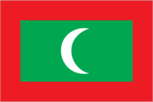
red with a large green rectangle in the center bearing a vertical white crescent; the closed side of the crescent is on the hoist side of the flag
Independence
26 July 1965 (from UK)
Judicial branch
High Court
Leaders
Chief of State and Head of Government--President Maumoon Abdul GAYOOM (since 11 November 1978)
Legal system
based on Islamic law with admixtures of English common law primarily in commercial matters; has not accepted compulsory ICJ jurisdiction
Legislative branch
unicameral Citizens' Council (Majlis)
Long-form name
Republic of Maldives
Member of
AsDB, C, CP, ESCAP, FAO, G-77, GATT, IBRD, ICAO, IDA, IDB, IFAD, IFC, IMF, IMO, INTERPOL, IOC, ITU, NAM, OIC, SAARC, UN, UNCTAD, UNESCO, UNIDO, UPU, WHO, WMO, WTO
National holiday
Independence Day, 26 July (1965)
Political parties and leaders
no organized political parties; country governed by the Didi clan for the past eight centuries
Suffrage
universal at age 21
Type
republic
Economy
Agriculture
accounts for almost 30% of GDP (including fishing); fishing more important than farming; limited production of coconuts, corn, sweet potatoes; most staple foods must be imported; fish catch of 63,000 tons (1988 est.)
Budget
revenues $51 million; expenditures $50 million, including capital expenditures of $25 million (1988 est.)
Currency
rufiyaa (plural--rufiyaa); 1 rufiyaa (Rf) = 100 laaris
Economic aid
US commitments, including Ex-Im (FY70-88), $28 million; Western (non-US) countries, ODA and OOF bilateral commitments (1970-88), $105 million; OPEC bilateral aid (1979-89), $14 million
Electricity
5,000 kW capacity; 11 million kWh produced, 50 kWh per capita (1990)
Exchange rates
rufiyaa (Rf) per US$1--9.937 (January 1991), 9.509 (1990), 9.0408 (1989), 8.7846 (1988), 9.2230 (1987), 7.1507 (1986), 7.0981 (1985)
Exports
$39.4 million (f.o.b., 1988); commodities--fish 57%, clothing 39%; partners--Thailand, Western Europe, Sri Lanka
External debt
$70 million (December 1989)
Fiscal year
calendar year
GDP
$136 million, per capita $670; real growth rate 9.2% (1988)
Imports
$105.7 million (c.i.f., 1988); commodities--intermediate and capital goods 47%, consumer goods 42%, petroleum products 11%; partners--Japan, Western Europe, Thailand
Industrial production
growth rate - 5.0% (1988); accounts for 5% of GDP
Industries
fishing and fish processing, tourism, shipping, boat building, some coconut processing, garments, woven mats, coir (rope), handicrafts
Inflation rate (consumer prices)
14% (1988 est.)
Overview
The economy is based on fishing, tourism, and shipping. Agriculture is limited to the production of a few subsistence crops that provide only 10% of food requirements. Fishing is the largest industry, employing 25% of the work force and accounting for over 60% of exports; it is also an important source of government revenue. During the 1980s tourism has become one of the most important and highest growth sectors of the economy. In 1988 industry accounted for about 5% of GDP. Real GDP is officially estimated to have increased by about 10% annually during the period 1974-87, and GDP estimates for 1988 show a further growth of 9% on the strength of a record fish catch and an improved tourist season.
Unemployment rate
NEGL%
Communications
Airports
2 with permanent-surface runways 2,440-3,659 m
Civil air
1 major transport aircraft
Highways
Male has 9.6 km of coral highways within the city
Merchant marine
17 ships (1,000 GRT or over) totaling 53,131 GRT/85,770 DWT; includes 14 cargo, 1 container, 1 petroleum, oils, and lubricants (POL) tanker, 1 bulk
Ports
Male, Gan
Telecommunications
minimal domestic and international facilities; 2,804 telephones; stations--2 AM, 1 FM, 1 TV; 1 Indian Ocean INTELSAT earth station
Military and Security
Branches
National Security Service (paramilitary police force)
Defense expenditures
$1.8 million, NA% of GDP (1984 est.) _%_
Manpower availability
males 15-49, 50,788; 28,378 fit for military service