1995 Edition
CIA World Factbook 1995 (Project Gutenberg)
Geography
Area
total area: 329,750 sq km land area: 328,550 sq km comparative area: slightly larger than New Mexico
Climate
tropical; annual southwest (April to October) and northeast (October to February) monsoons
Coastline
4,675 km (Peninsular Malaysia 2,068 km, East Malaysia 2,607 km)
Environment
current issues: air pollution from industrial and vehicular emissions; water pollution from raw sewage; deforestation natural hazards: flooding international agreements: party to - Biodiversity, Climate Change, Endangered Species, Hazardous Wastes, Marine Life Conservation, Nuclear Test Ban, Ozone Layer Protection, Tropical Timber 83; signed, but not ratified - Law of the Sea
International disputes
involved in a complex dispute over the Spratly Islands with China, Philippines, Taiwan, Vietnam, and possibly Brunei; State of Sabah claimed by the Philippines; Brunei may wish to purchase the Malaysian salient that divides Brunei into two parts; two islands in dispute with Singapore; two islands in dispute with Indonesia
Irrigated land
3,420 sq km (1989 est.)
Land boundaries
total 2,669 km, Brunei 381 km, Indonesia 1,782 km, Thailand 506 km
Land use
arable land: 3% permanent crops: 10% meadows and pastures: 0% forest and woodland: 63% other: 24%
Location
Southeastern Asia, peninsula and northern one-third of the island of Borneo bordering the Java Sea and the South China Sea, south of Vietnam
Map references
Southeast Asia
Maritime claims
continental shelf: 200-m depth or to depth of exploitation; specified boundary in the South China Sea exclusive fishing zone: 200 nm exclusive economic zone: 200 nm territorial sea: 12 nm
Natural resources
tin, petroleum, timber, copper, iron ore, natural gas, bauxite
Note
strategic location along Strait of Malacca and southern South China Sea
Terrain
coastal plains rising to hills and mountains
People and Society
Age structure
0-14 years: 37% (female 3,559,434; male 3,690,310) 15-64 years: 59% (female 5,871,131; male 5,844,568) 65 years and over: 4% (female 423,539; male 334,605) (July 1995 est.)
Birth rate
27.95 births/1,000 population (1995 est.)
Death rate
5.56 deaths/1,000 population (1995 est.)
Ethnic divisions
Malay and other indigenous 59%, Chinese 32%, Indian 9%
Infant mortality rate
24.7 deaths/1,000 live births (1995 est.)
Labor force
7.627 million (1993)
Life expectancy at birth
total population: 69.48 years male: 66.55 years female: 72.56 years (1995 est.)
Literacy
age 15 and over can read and write (1990 est.) total population: 78% male: 86% female: 70%
Nationality
noun: Malaysian(s) adjective: Malaysian
Net migration rate
0 migrant(s)/1,000 population (1995 est.)
Peninsular Malaysia
- Muslim (Malays), Buddhist (Chinese), Hindu (Indians)
- Malay (official), English, Chinese dialects, Tamil
Population
19,723,587 (July 1995 est.)
Population growth rate
2.24% (1995 est.)
Sabah
- Muslim 38%, Christian 17%, other 45%
- English, Malay, numerous tribal dialects, Chinese (Mandarin and Hakka dialects predominate)
Sarawak
- tribal religion 35%, Buddhist and Confucianist 24%, Muslim 20%, Christian 16%, other 5%
- English, Malay, Mandarin, numerous tribal languages *** No data for this item ***
Total fertility rate
3.47 children born/woman (1995 est.)
Government
Administrative divisions
13 states (negeri-negeri, singular - negeri) and 2 federal territories* (wilayah-wilayah persekutuan, singular - wilayah persekutuan); Johor, Kedah, Kelantan, Labuan*, Melaka, Negeri Sembilan, Pahang, Perak, Perlis, Pulau Pinang, Sabah, Sarawak, Selangor, Terengganu, Wilayah Persekutuan*
Capital
Kuala Lumpur
Constitution
31 August 1957, amended 16 September 1963
Digraph
MY
Diplomatic representation in US
chief of mission: Ambassador Abdul MAJID bin Mohamed chancery: 2401 Massachusetts Avenue NW, Washington, DC 20008 telephone: [1] (202) 328-2700
Executive branch
chief of state: Paramount Ruler JA'AFAR ibni Abdul Rahman (since 26 April 1994); Deputy Paramount Ruler SALAHUDDIN ibni Hisammuddin Alam Shah (since 26 April 1994) head of government: Prime Minister Dr. MAHATHIR bin Mohamad (since 16 July 1981); Deputy Prime Minister ANWAR bin Ibrahim (since 1 December 1993) cabinet: Cabinet; appointed by the Paramount Ruler from members of parliament
FAX
- [1] (202) 483-7661 consulate(s) general: Los Angeles and New York
- [60] (3) 2422207
Flag
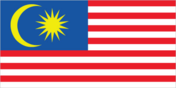
fourteen equal horizontal stripes of red (top) alternating with white (bottom); there is a blue rectangle in the upper hoist-side corner bearing a yellow crescent and a yellow fourteen-pointed star; the crescent and the star are traditional symbols of Islam; the design was based on the flag of the US
House of Representatives (Dewan Rakyat)
consists of 180 members, elected for five-year terms; elections last held 21 October 1990 (next to be held by December 1995); results - National Front 52%, other 48%; seats - (180 total) National Front 127, DAP 20, PAS 7, independents 4, other 22; note - within the National Front, UMNO won 71 seats and MCA won 18 seats
Independence
31 August 1957 (from UK)
Judicial branch
Supreme Court
Legal system
based on English common law; judicial review of legislative acts in the Supreme Court at request of supreme head of the federation; has not accepted compulsory ICJ jurisdiction
Legislative branch
bicameral Parliament (Parlimen)
Member of
APEC, AsDB, ASEAN, C, CCC, CP, ESCAP, FAO, G-15, G-77, GATT, IAEA, IBRD, ICAO, ICFTU, ICRM, IDA, IDB, IFAD, IFC, IFRCS, ILO, IMF, IMO, INMARSAT, INTELSAT, INTERPOL, IOC, ISO, ITU, MINURSO, NAM, OIC, UN, UNAVEM II, UNCTAD, UNESCO, UNIDO, UNIKOM, UNOMIL, UNOMOZ, UNOSOM, UNPROFOR, UPU, WCL, WFTU, WHO, WIPO, WMO, WTO
Names
conventional long form: none conventional short form: Malaysia former: Malayan Union
National holiday
National Day, 31 August (1957)
Peninsular Malaysia
National Front, a confederation of 13 political parties dominated by United Malays National Organization Baru (UMNO Baru), MAHATHIR bin Mohamad; Malaysian Chinese Association (MCA), LING Liong Sik; Gerakan Rakyat Malaysia, LIM Keng Yaik; Malaysian Indian Congress (MIC), S. Samy VELLU
Sabah
National Front, SALLEH Said Keruak, Sabah Chief Minister, Sakaran DANDAI, head of Sabah State; United Sabah National Organizaton (USNO), leader NA
Sarawak
coalition Sarawak National Front composed of the Party Pesaka Bumiputra Bersatu (PBB), Datuk Patinggi Amar Haji Abdul TAIB Mahmud; Sarawak United People's Party (SUPP), Datuk Amar James WONG Soon Kai; Sarawak National Party (SNAP), Datuk Amar James WONG; Parti Bansa Dayak Sarawak (PBDS), Datuk Leo MOGGIE; major opposition parties are Democratic Action Party (DAP), LIM Kit Siang and Pan-Malaysian Islamic Party (PAS), Fadzil NOOR
Senate (Dewan Negara)
consists of 58 members, 32 appointed by the paramount ruler and 26 elected by the state legislatures (2 from each state) for six-year terms; elections last held NA (next to be held NA); results - NA
Suffrage
21 years of age; universal
Type
constitutional monarchy note: Federation of Malaysia formed 9 July 1963; nominally headed by the paramount ruler (king) and a bicameral Parliament; Peninsular Malaysian states - hereditary rulers in all but Melaka, where governors are appointed by Malaysian Pulau Pinang Government; powers of state governments are limited by federal Constitution; Sabah - self-governing state, holds 20 seats in House of Representatives, with foreign affairs, defense, internal security, and other powers delegated to federal government; Sarawak - self-governing state, holds 27 seats in House of Representatives, with foreign affairs, defense, internal security, and other powers delegated to federal government
US diplomatic representation
chief of mission: Ambassador John S. WOLF embassy: 376 Jalan Tun Razak, 50400 Kuala Lumpur mailing address: P. O. Box No. 10035, 50700 Kuala Lumpur; APO AP 96535-8152 telephone: [60] (3) 2489011
Economy
Agriculture
accounts for 16% of GDP (1993 est.)
Budget
revenues: $18.7 billion expenditures: $19.1 billion, including capital expenditures of $4.8 billion (1994)
Currency
1 ringgit (M$) = 100 sen
Economic aid
recipient: US commitments, including Ex-Im (FY70-84), $170 million; Western (non-US) countries, ODA and OOF bilateral commitments (1970-89), $4.7 million; OPEC bilateral aid (1979-89), $42 million
Electricity
capacity: 6,700,000 kW production: 31 billion kWh consumption per capita: 1,528 kWh (1993)
Exchange rates
ringgits (M$) per US$1 - 2.5542 (January 1995), 2.6242 (1994), 2.5741 (1993), 2.5474 (1992), 2.7501 (1991), 1.7048 (1990)
Exports
$56.6 billion (f.o.b., 1994) commodities: electronic equipment, petroleum and petroleum products, palm oil, wood and wood products, rubber, textiles partners: Singapore 22%, US 20%, Japan 13%, UK 4%, Germany 4%, Thailand 4% (1993)
External debt
$35.5 billion (1994 est.)
Fiscal year
calendar year
Illicit drugs
transit point for Golden Triangle heroin going to the US, Western Europe, and the Third World despite severe penalties for drug trafficking; increasing indigenous abuse of methamphetamine
Imports
$55.2 billion (c.i.f., 1994) commodities: machinery and equipment, chemicals, food, petroleum products partners: Japan 27%, US 17%, Singapore 15%, Taiwan 5%, Germany 4%, UK 3%, South Korea 3% (1993)
Industrial production
growth rate 12% (1994); accounts for 38% of GDP (1993 est.)
Inflation rate (consumer prices)
3.7% (1994)
National product
GDP - purchasing power parity - $166.8 billion (1994 est.)
National product per capita
$8,650 (1994 est.)
National product real growth rate
8.7% (1994)
Overview
The Malaysian economy, a mixture of private enterprise and a soundly managed public sector, has posted a remarkable record of 9% average annual growth in 1988-94. The official growth target for 1995 is 8.5%. This growth has resulted in a substantial reduction in poverty and a marked rise in real wages. Manufactured goods exports expanded rapidly, and foreign investors continued to commit large sums in the economy. The government is aware of the inflationary potential of this rapid development and is closely monitoring fiscal and monetary policies.
Peninsular Malaysia
- rubber and oil palm processing and manufacturing, light manufacturing industry, electronics, tin mining and smelting, logging and processing timber
- natural rubber, palm oil, rice
Sabah
- logging, petroleum production
- mainly subsistence, but also rubber, timber, coconut, rice
Sarawak
- agriculture processing, petroleum production and refining, logging
- rubber, timber, pepper; deficit of rice in all areas
Unemployment rate
2.9% (1994)
Communications
Radio
broadcast stations: AM 28, FM 3, shortwave 0 radios: NA
Telephone system
994,860 telephones (1984); international service good local: NA intercity: good intercity service provided on Peninsular Malaysia mainly by microwave radio relay; adequate intercity microwave radio relay network between Sabah and Sarawak via Brunei; 2 domestic satellite links international: submarine cables extend to India and Sarawak; SEACOM submarine cable links to Hong Kong and Singapore; satellite earth stations - 2 INTELSAT (1 Indian Ocean and 1 Pacific Ocean)
Television
broadcast stations: 33 televisions: NA
Transportation
Airports
total: 115 with paved runways over 3,047 m: 3 with paved runways 2,438 to 3,047 m: 5 with paved runways 1,524 to 2,437 m: 11 with paved runways 914 to 1,523 m: 6 with paved runways under 914 m: 82 with unpaved runways 1,524 to 2,438 m: 1 with unpaved runways 914 to 1,523 m: 7
Highways
total: 29,028 km (Peninsular Malaysia 23,602 km, Sabah 3,782 km, Sarawak 1,644 km) paved: NA (Peninsular Malaysia 19,354 km mostly bituminous treated) unpaved: NA (Peninsular Malaysia 4,248 km)
Merchant marine
total: 213 ships (1,000 GRT or over) totaling 2,410,823 GRT/3,635,966 DWT ships by type: bulk 34, cargo 73, chemical tanker 11, container 27, liquefied gas tanker 9, livestock carrier 1, oil tanker 50, roll-on/roll-off cargo 4, short-sea passenger 1, vehicle carrier 3
Peninsular Malaysia
3,209 km
Pipelines
crude oil 1,307 km; natural gas 379 km
Ports
Kota Kinabalu, Kuantan, Kuching, Kudat, Lahad Datu, Labuan, Lumut, Miri, Pasir Gudang, Penang, Port Dickson, Port Kelang, Sandakan, Sibu, Tanjong Berhala, Tanjong Kidurong, Tawau
Railroads
total: 1,801 km (Peninsular Malaysia 1,665 km; Sabah 136 km; Sarawak 0 km) narrow gauge: 1,801 km 1.000-m gauge (Peninsular Malaysia 1,665 km; Sabah 136 km)
Sabah
1,569 km
Sarawak
2,518 km
Military and Security
Branches
Malaysian Army, Royal Malaysian Navy, Royal Malaysian Air Force, Royal Malaysian Police Force, Marine Police, Sarawak Border Scouts
Defense expenditures
exchange rate conversion - $2.1 billion, 2.9% of GDP (1994) ________________________________________________________________________ MALDIVES
Manpower availability
males age 15-49 5,041,003; males fit for military service 3,058,445; males reach military age (21) annually 183,760 (1995 est.)