1988 Edition
CIA World Factbook 1988 (Internet Archive)
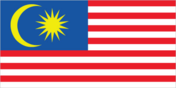
Geography
Administrative divisions
14 states (including Sabah and Sarawak)
Branches
nine state rulers alternate as Paramount Ruler for five-year terms; locus of executive power vested in Prime Minister and Cabinet, who are responsible to bicameral Parliament (Senate, House of Representatives); Peninsular Malaysia — executive branches of 11 states vary in detail but are similar in design with a Chief Minister, appointed by hereditary ruler or Governor, heads an executive council (cabinet), which is responsible to an elected, unicameral legislature; Sarawak and Sabah — executive branch headed by Governor appointed by central government, largely ceremonial role; executive power exercised by Chief Minister who heads parliamentary cabinet responsible to unicameral legislature; judiciary part of Malaysian judicial system
Capital
Kuala Lumpur
Communists
Peninsular Malaysia — about 2,000 armed insurgents on Thailand side of international boundary; about 200 full-time inside Malaysia; Sarawak — less than 100, North Kalimantan Communist Party; Sabah — insignificant
Elections
minimum of every five years; last elections August 1986 Political parties and leaders: Peninsular Malaysia — National Front, a confederation of 11 political parties dominated by United Malays National Organization (UMNO), Mahathir bin Mohamad; major opposition party is Democratic Action Party (DAP), Lim Kit Siang; Sabah— Berjaya Party, Datuk Haji Mohamad Noor Haji Mansodr; Bersatu Sabah (PBS), Joseph Pairin Kitingan; United Sabah National Organization (USNO), Tun Datuk Mustapha; Sarawak — coalition Sarawak National Front composed of the Party Pesaka Bumipatra Bersatu (PBB), Datuk Abdul Taib; the United People's Party (SUPP), Wong Soon Kai; and the Sarawak National Party (SNAP), Datuk James Wong; opposition is Parti Bansa Dayak Sarawak (PBDS), Leo Moggie
Government leader
Dr. MAHATHIR bin Mohamad, Prime Minister (since July 1981)
Legal system
based on English common law; constitution came into force 1963; judicial review of legislative acts in the Supreme Court at request of Supreme Head of the Federation; has not accepted compulsory ICJ jurisdiction
Member of
ADB, ANRPC, ASEAN, Association of Tin Producing Countries, Colombo Plan, Commonwealth, ESCAP, FAO, G-T7, GATT, IAEA, IBRD, ICAO, IDA, IDE — Islamic Development Bank, IFC, ILO, IMF, IMO, INTELSAT, INTERPOL, IPU, IRC, ITC, ITU, NAM, OIC, UN, UNESCO, UPU, WHO, WMO, WTO
National holiday
31 August, Independence Day
Suffrage
universal over age 21
Total area
state, holds 16 seats in House of Representatives with foreign affairs, defense, internal security, and other powers delegated to federal government; Sarawak — selfgoverning state within Malaysia in which it holds 24 seats in House of Representatives with foreign affairs, defense, and internal security, and other powers delegated to federal government
Voting strength
Peninsular Malaysia — (1986 parliamentary election, lower house of parliament) National Front, 148 seats; DAP, 24 seats; PAS, 1 seat; independents, 4 seats; Sabah — (April 1985 state election, State Assembly) Berjaya Party, 6 seats; USNO, 16 seats; PBS, 26 seats; Sarawak— (December 1983 state election) State Assembly National Front controlled nearly two-thirds of 46 seats
Economy
Agriculture
Peninsular Malaysia — natural rubber, palm oil, rice; 10-15% of rice requirements imported; Sabah — mainly subsistence, main crops are rubber, timber, coconut, rice (rice is also a food deficit); Sarawak — main crops are rubber, timber, pepper with rice a food deficit
Budget
operating expenditures, $7.4 billion; development expenditures, $2.9 billion; deficit, $3.5 billion (1986)
Electric power
Peninsular Malaysia — 2,821,000 kW capacity, 10,700 million kWh produced, 820 kWh per capita; Sabah— 430,000 kW capacity, 1,250 million kWh produced, 970 kWh per capita; Sarawak— 350,000 kW capacity, 1,020 million kWh produced, 670 kWh per capita (1986)
Exports
$15.4 billion (f.o.b., 1985); natural rubber, palm oil, tin, timber, petroleum, light manufactures
Fiscal year
calendar year
Fishing
catch 741,000 metric tons (1983)
GNP
$29.0 billion, $1,870 per capita; annual growth -3.2% (1985); converted at August 1986 exchange rate 2.61 Malaysian ringgit (M$)=US$1; inflation rate less than 1% (1985)
Imports
$12.3 billion (c.i.f., 1985)
Major industries
Peninsular Malaysia — rubber and oil palm processing and manufacturing, light manufacturing industry, electronics, tin mining and smelting, logging and processing timber; Sabah — logging, petroleum production; Sarawak — agriculture processing, petroleum production and refining, logging
Major trade partners
exports — 25% Japan, 20% Singapore, 14% EC, 13% US; imports— 23% Japan, 16% Singapore, 15% US, 14% EC (1985)
Monetary conversion rate
2.61 Malaysian ringgits (M$)=US$1 (November 1986)
Natural resources
tin, petroleum, timber, copper, iron, liquefied natural gas
Communications
Highways
Peninsular Malaysia — 23,600 km (19,352 km hard surfaced, mostly bituminous surface treatment and 4,248 km unpaved); Sabah — 3,782 km; Sarawak — 1,644 km
Inland waterways
Peninsular Malaysia — 3,209 km; Sabah— 1,569 km; Sarawak— 2,518 km
Railroads
Peninsular Malaysia — 1,665 km 1.04-meter gauge; 13 km double track, government owned; Sabah — 136 km 1.000meter gauge