1983 Edition
CIA World Factbook 1983 (Internet Archive)
Geography
Branches
- nine state rulers alternate as Paramount Ruler for five-year terms; locus of executive power vested in Prime Minister and Cabinet, who are responsible to bicameral Parliament (Senate, House of Representatives); following communal rioting in May 1969, government imposed state of emergency and suspended constitutional rights of all parliamentary bodies; parliamentary democracy resumed in February
- Royal Malaysian Army, Royal Malaysian Navy, Royal Malaysian Air Force, Royal Malaysian Police Force
Budget
1982 revenue and grants, $4 billion; current expenditure $7.7 billion, capital expenditures $6.5 billion; deficit $2 billion; $2.2 billion military, 80% civilian
Civil air
approximately 28 major transport aircraft
East Malaysia
- 136 km 1.000-meter gauge in Sabah
- about 5,426 km total (1,644 km in Sarawak, 3,782 km in Sabah); 819 km hard surfaced (mostly bituminous surface treatment), 2,936 km gravel or crushed stone, 1,671 km earth
- 4,200 km (1,569 km in Sabah, 2,518 km in Sarawak)
- 3 major, 12 minor (2 major, 3 minor in Sabah; 1 major, 9 minor in Sarawak)
Elections
minimum of every five years; last elections April 1982 Political parties and leaders:
Exports
$11.3 billion (f.o.b., 1982); natural rubber, palm oil, tin, timber, petroleum, light manufactures
Fiscal year
calendar year Communications
Fishing
catch 698,000 metric tons (1979)
Government leader
Dr. MAHATHIR bin Mohamad, Prime Minister
Imports
$12.4 billion (f.o.b., 1982)
Legal system
based on English common law; constitution came into force 1963; judicial review of legislative acts in the Supreme Court at request of Supreme Head of the Federation; has not accepted compulsory ICJ jurisdiction
Major trade partners
exports — 23% Japan, 17% Singapore, 17% US, 14% EEC; imports—23% Japan, 15% US, 11% EEC (1979)
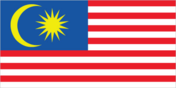
Malaysia
- constitutional monarchy nominally headed by Paramount Ruler (King); a bicameral Parliament consisting of a 58member Senate and a 154-member House of Representatives
- $25.1 billion (1981), $1,750 per capita; annual growth 5.6% (1983)
Member of
ADB, ANRPC, ASEAN, Association of Tin Producting Countries, Colombo Plan, Commonwealth, FAO, G-77, GATT, IAEA, IBRD, ICAO, IDA, IDE— Islamic Development Bank, IFC, ILO, IMF, IMO, INTELSAT, INTERPOL, IPU, IRC, ITC, ITU, NAM, QIC, UN, UNESCO, UPU, WHO, WMO, WTO Economy
Military budget
for fiscal year ending 31 December 1984, $1.892 million; about 23.4% of central government budget
Monetary conversion rate
2.345 ringgits= US$1 (October 1983)
National holiday
31 August
Official name
Malaysia
Organized labor
562,000 (May 1980), about 1 1% of total labor force; unemployment about 6.1% of total labor force (1979), but higher in urban areas Government
Peninsular Mala ysia
2,405,000 kW capacity (1982); 9.771 billion kWh produced (1982), 807 kWh per capita
Peninsular Malaysia
- Kuala Lumpur
- executive branches of 1 1 states vary in detail but are similar in design; a Chief Minister, appointed by hereditary ruler or Governor, heads an executive council (cabinet), which is responsible to an elected, unicameral legislature Sarawak and Sabah: executive branch headed by Governor appointed by central government, largely ceremonial role; executive power exercised by Chief Minister who heads parliamentary cabinet responsible to unicameral legislature; judiciary part of Malaysian judicial system
- National Front, a confederation of 11 political parties dominated by United Malay National Organization (UMNO), Mahathir bin Mohamad; opposition parties are Democratic Action Party (DAP) and Islamic Party (PAS)
- (1982 election) lower house of parliament; National Front, 132 seats; Democratic Action Party, 9 seats; Islamic Party, 5 seats; independents, 8 seats
- approximately 3,000 armed insurgents on Thailand side of Thai/Malaysia border; approximately 300 full-time inside Peninsular Malaysia
- natural rubber, oil palm, rice; 10-15% of rice requirements imported
- rubber and oil palm processing and manufacturing, light manufacturing industry, electronics, tin mining and smelting, logging and processing timber
- 1,665km 1.04-meter gauge; 13 km double track; government owned
- 19,753 km total; 15,900 km hard surfaced (mostly bituminous surface treatment), 3,000 km crushed stone/gravel, 883 km improved or unimproved earth
- 3,209 km
- 3 major, 14 minor
- 61 total, 61 usable; 17 with permanent-surface runways; 3 with runways 2,440-3,659 m, 1 1 with runways 1,220-2,439 m
- good intercity service provided mainly by microwave relay; international service good; good coverage by radio and television broadcasts; 609,288 telephones (5. 13 per 100 popl.); 26 AM, 1 FM, and 20 TV stations; IOCON submarine cables extend to India; connected to SEACOM submarine cable terminal at Singapore by microwave relay; 2 international ground satellite stations; 1 domestic ground satellite station
- males 15-49, 3,201,000; 2,052,000 fit for military service; 141,000 reach military age (21) annually
Peninsular Malaysian states
hereditary rulers in all but Penang and Malacca where Governors appointed by Malaysian Government; powers of state governments limited by federal constitution
Pipelines
crude oil, 650 km; natural gas, 340 km
Political subdivisions
13states(including Sabah and Sarawak)
Sabah
- self-governing state within Malaysia in which it holds 16 seats in House of Representatives; foreign affairs, defense, internal security, and other powers delegated to federal government
- Kota Kinabalu
- Berjaya Party, Datuk Harris Salleh; United Sabah National Organization (USNO), Tun Datuk Mustapha; Sabah Chinese Consolidated Party (SCCP); opposition Parti Bersatu Rakyat Bumiputra Sabah (Perkasa), Datuk Pengiran Othman Rauf
- (March 1981 election) State Assembly— Berjaya Party, 43 seats; USNO, 3 seats; SCCP, 1 seat; 1 seat vacant
- insignificant
- mainly subsistence; main crops — rubber, timber, coconut, rice; food deficit —
- logging, petroleum production
- 205,000 kW capacity (1982); 602 million kWh produced (1982), 530 kWh per capita
- 35 total, 35 usable; 6 with permanentsurface runways; 1 with runway 2,440-3,659 m; 4 with runways 1,220-2,439 m k 47 total, 47 usable; 5 with permanent-surface runways; 1 with runways 2,440-3,659 m, 4 with runways 1,2202,439 m
- adequate intercity radio-relay network extends to Sarawak via Brunei; 43,000 telephones (3.94 per 100 popl.); 14 AM, 1 FM, 7 TV stations; SEACOM submarine cable links to Hong Kong and Singapore; 1 ground satellite station
- males 15-49, 304,000; 183,000 fit for military service; 14,000 reach military age (21) annually
Saraicak
agriculture processing, petroleum production and refining, logging
Sarawak
- 455,000(1980); 80% agriculture, forestry, and fishing; 13% trade, transportation, and services; 6% manufacturing and construction; 1% other
- self-governing state within Malaysia in which it holds 24 seats in House of Representatives; foreign affairs, defense, and internal security, and other powers are delegated to federal government
- Kuching
- coalition Sarawak National Front composed of the Party Pesaka Bumipatra Bersatu (PPBB), Datuk Abdul Taib; the United People's Party (SUPP), Wong Soon Kai; and the Sarawak National Party (SNAP), Datuk James Wong; opposition is Parti Bansa Dayak Sarawak (PBDS), Leo Maggie
- (1979 election) State AssemblyNational Front controls 45 of 48 seats
- 125 armed insurgents in Sarawak
- main crops — rubber, timber, pepper; food deficit — rice
- 153,000 kW capacity (1982); 383 million kWh produced (1982), 269 kWh per capita
- adequate intercity radio-relay network extends to Sabah via Brunei; 64,512 telephones (4. 65 per 100 popl.);5 AM stations, no FM, and 6 TV stations Defense Forces
- males 15-49, 378,000; 228,000 fit for military service; 15,000 reach military age (21) annually Jixternal defense dependent on loose Five Power Defense Agreement (FPDA), which replaced Anglo-Malayan Defense Agreement of 1957 as amended in 1963
Suffrage
universal over age 20