2017 Edition
CIA World Factbook 2017 Archive (HTML)
Introduction
Background
Established in 1891, the British protectorate of Nyasaland became the independent nation of Malawi in 1964. After three decades of one-party rule under President Hastings Kamuzu BANDA, the country held multiparty presidential and parliamentary elections in 1994, under a provisional constitution that came into full effect the following year. President Bingu wa MUTHARIKA, elected in 2004 after a failed attempt by the previous president to amend the constitution to permit another term, struggled to assert his authority against his predecessor and subsequently started his own party, the Democratic Progressive Party in 2005. MUTHARIKA was reelected to a second term in 2009. He oversaw some economic improvement in his first term, but was accused of economic mismanagement and poor governance in his second term. He died abruptly in 2012 and was succeeded by vice president, Joyce BANDA, who had earlier started her own party, the People's Party. MUTHARIKA's brother, Peter MUTHARIKA, defeated BANDA in the 2014 election. Population growth, increasing pressure on agricultural lands, corruption, and the scourge of HIV/AIDS pose major problems for Malawi.
Geography
Area
- 118,484 sq km 94,080 sq km 24,404 sq km
- land
- 94,080 sq km
- total
- 118,484 sq km
- water
- 24,404 sq km
Area - comparative
slightly smaller than Pennsylvania
Climate
sub-tropical; rainy season (November to May); dry season (May to November)
Coastline
0 km (landlocked)
Elevation
- 779 m lowest point: junction of the Shire River and international boundary with Mozambique 37 m highest point: Sapitwa (Mount Mlanje) 3,002 m
- elevation extremes
- lowest point: junction of the Shire River and international boundary with Mozambique 37 m
- highest point
- Sapitwa (Mount Mlanje) 3,002 m
- mean elevation
- 779 m
Environment - current issues
deforestation; land degradation; water pollution from agricultural runoff, sewage, industrial wastes; siltation of spawning grounds endangers fish populations
Environment - international agreements
- Biodiversity, Climate Change, Climate Change-Kyoto Protocol, Desertification, Endangered Species, Environmental Modification, Hazardous Wastes, Marine Life Conservation, Ozone Layer Protection, Ship Pollution, Wetlands Law of the Sea
- party to
- Biodiversity, Climate Change, Climate Change-Kyoto Protocol, Desertification, Endangered Species, Environmental Modification, Hazardous Wastes, Marine Life Conservation, Ozone Layer Protection, Ship Pollution, Wetlands
- signed, but not ratified
- Law of the Sea
Geographic coordinates
13 30 S, 34 00 E
Geography - note
landlocked; Lake Nyasa, some 580 km long, is the country's most prominent physical feature; it contains more fish species than any other lake on earth
Irrigated land
740 sq km (2012)
Land boundaries
- 2,857 km Mozambique 1,498 km, Tanzania 512 km, Zambia 847 km
- border countries (3)
- Mozambique 1,498 km, Tanzania 512 km, Zambia 847 km
- total
- 2,857 km
Land use
- 59.2% arable land 38.2%; permanent crops 1.4%; permanent pasture 19.6% 34% 6.8% (2011 est.)
- agricultural land
- 59.2%
- forest
- 34%
- other
- 6.8% (2011 est.)
Location
Southern Africa, east of Zambia, west and north of Mozambique
Map references
Africa
Maritime claims
none (landlocked)
Natural hazards
flooding; droughts; earthquakes
Natural resources
limestone, arable land, hydropower, unexploited deposits of uranium, coal, and bauxite
Population - distribution
population density is highest south of Lake Nyasa
Terrain
narrow elongated plateau with rolling plains, rounded hills, some mountains
People and Society
Age structure
- 46.34% (male 4,427,403/female 4,468,120) 20.55% (male 1,956,360/female 1,988,123) 27.41% (male 2,612,840/female 2,648,997) 3.01% (male 275,998/female 302,286) 2.69% (male 227,582/female 288,537) (2017 est.)
- 0-14 years
- 46.34% (male 4,427,403/female 4,468,120)
- 15-24 years
- 20.55% (male 1,956,360/female 1,988,123)
- 25-54 years
- 27.41% (male 2,612,840/female 2,648,997)
- 55-64 years
- 3.01% (male 275,998/female 302,286)
- 65 years and over
- 2.69% (male 227,582/female 288,537) (2017 est.)
Birth rate
41 births/1,000 population (2017 est.)
Children under the age of 5 years underweight
16.7% (2014)
Contraceptive prevalence rate
59.2% (2015/16)
Death rate
7.9 deaths/1,000 population (2017 est.)
Demographic profile
Malawi has made great improvements in maternal and child health, but has made less progress in reducing its high fertility rate. In both rural and urban areas, very high proportions of mothers are receiving prenatal care and skilled birth assistance, and most children are being vaccinated. Malawi’s fertility rate, however, has only declined slowly, decreasing from more than 7 children per woman in the 1980s to about 5.5 today. Nonetheless, Malawians prefer smaller families than in the past, and women are increasingly using contraceptives to prevent or space pregnancies. Rapid population growth and high population density is putting pressure on Malawi’s land, water, and forest resources. Reduced plot sizes and increasing vulnerability to climate change, further threaten the sustainability of Malawi’s agriculturally based economy and will worsen food shortages. About 80% of the population is employed in agriculture. Historically, Malawians migrated abroad in search of work, primarily to South Africa and present-day Zimbabwe, but international migration became uncommon after the 1970s, and most migration in recent years has been internal. During the colonial period, Malawians regularly migrated to southern Africa as contract farm laborers, miners, and domestic servants. In the decade and a half after independence in 1964, the Malawian Government sought to transform its economy from one dependent on small-scale farms to one based on estate agriculture. The resulting demand for wage labor induced more than 300,000 Malawians to return home between the mid-1960s and the mid-1970s. In recent times, internal migration has generally been local, motivated more by marriage than economic reasons.
Dependency ratios
- 85.3 5.7 17.4 (2015 est.)
- elderly dependency ratio
- 5.7
- potential support ratio
- 17.4 (2015 est.)
- total dependency ratio
- 91
- youth dependency ratio
- 85.3
Drinking water source
- urban: 95.7% of population rural: 89.1% of population total: 90.2% of population urban: 4.3% of population rural: 10.9% of population total: 9.8% of population (2015 est.)
- rural
- 10.9% of population
- total
- 9.8% of population (2015 est.)
- urban
- 4.3% of population
Education expenditures
5.6% of GDP (2015)
Ethnic groups
Chewa 35.1%, Lomwe 18.9%, Yao 13.1%, Ngoni 12%, Tumbuka 9.4%, Sena 3.5%, Tonga 1.8%, Nyanja 1%, Nkhonde 0.9%, other 1.8% (2015-16 est.)
Health expenditures
11.4% of GDP (2014)
HIV/AIDS - adult prevalence rate
9.2% (2016 est.)
HIV/AIDS - deaths
24,000 (2016 est.)
HIV/AIDS - people living with HIV/AIDS
1 million (2016 est.)
Hospital bed density
1.3 beds/1,000 population (2011)
Infant mortality rate
- 43.4 deaths/1,000 live births 50 deaths/1,000 live births 36.7 deaths/1,000 live births (2017 est.)
- female
- 36.7 deaths/1,000 live births (2017 est.)
- male
- 50 deaths/1,000 live births
- total
- 43.4 deaths/1,000 live births
Languages
English (official), Chichewa (common), Chinyanja, Chiyao, Chitumbuka, Chilomwe, Chinkhonde, Chingoni, Chisena, Chitonga, Chinyakyusa, Chilambya
Life expectancy at birth
- 61.7 years 59.7 years 63.8 years (2017 est.)
- female
- 63.8 years (2017 est.)
- male
- 59.7 years
- total population
- 61.7 years
Literacy
- age 15 and over can read and write 62.1% 69.8% 55.2% (2015 est.)
- definition
- age 15 and over can read and write
- female
- 55.2% (2015 est.)
- male
- 69.8%
- total population
- 62.1%
Major infectious diseases
- very high bacterial and protozoal diarrhea, hepatitis A, and typhoid fever malaria and dengue fever schistosomiasis rabies (2016)
- animal contact disease
- rabies (2016)
- degree of risk
- very high
- food or waterborne diseases
- bacterial and protozoal diarrhea, hepatitis A, and typhoid fever
- vectorborne diseases
- malaria and dengue fever
- water contact disease
- schistosomiasis
Major urban areas - population
LILONGWE (capital) 905,000; Blantyre-Limbe 808,000 (2015)
Maternal mortality ratio
634 deaths/100,000 live births (2015 est.)
Median age
- 16.5 years 16.4 years 16.7 years (2017 est.)
- female
- 16.7 years (2017 est.)
- male
- 16.4 years
- total
- 16.5 years
Mother's mean age at first birth
- 18.9 years median age at first birth among women 25-29 (2015/16 est.)
- note
- median age at first birth among women 25-29 (2015/16 est.)
Nationality
- Malawian(s) Malawian
- adjective
- Malawian
- noun
- Malawian(s)
Net migration rate
0 migrant(s)/1,000 population (2017 est.)
Obesity - adult prevalence rate
5.8% (2016)
Physicians density
0.02 physicians/1,000 population (2009)
Population
- 19,196,246 estimates for this country explicitly take into account the effects of excess mortality due to AIDS; this can result in lower life expectancy, higher infant mortality, higher death rates, lower population growth rates, and changes in the distribution of population by age and sex than would otherwise be expected (July 2017 est.)
- note
- estimates for this country explicitly take into account the effects of excess mortality due to AIDS; this can result in lower life expectancy, higher infant mortality, higher death rates, lower population growth rates, and changes in the distribution of population by age and sex than would otherwise be expected (July 2017 est.)
Population distribution
population density is highest south of Lake Nyasa
Population growth rate
3.31% (2017 est.)
Religions
Protestant 26.9%, Catholic 18.1%, other Christian 41.9%, Muslim 12.5%, other 0.1%, none 0.5% (2015 est.)
Sanitation facility access
- urban: 47.3% of population rural: 39.8% of population total: 41% of population urban: 52.7% of population rural: 60.2% of population total: 59% of population (2015 est.)
- rural
- 60.2% of population
- total
- 59% of population (2015 est.)
- urban
- 52.7% of population
School life expectancy (primary to tertiary education)
- 11 years 11 years 11 years (2011)
- female
- 11 years (2011)
- male
- 11 years
- total
- 11 years
Sex ratio
- 1.02 male(s)/female 0.99 male(s)/female 0.99 male(s)/female 0.99 male(s)/female 0.91 male(s)/female 0.79 male(s)/female 0.98 male(s)/female (2016 est.)
- 0-14 years
- 0.99 male(s)/female
- 15-24 years
- 0.99 male(s)/female
- 25-54 years
- 0.99 male(s)/female
- 55-64 years
- 0.91 male(s)/female
- 65 years and over
- 0.79 male(s)/female
- at birth
- 1.02 male(s)/female
- total population
- 0.98 male(s)/female (2016 est.)
Total fertility rate
5.49 children born/woman (2017 est.)
Unemployment, youth ages 15-24
- 8.6% 9.1% 8.2% (2013 est.)
- female
- 8.2% (2013 est.)
- male
- 9.1%
- total
- 8.6%
Urbanization
- 16.6% of total population (2017) 4.02% annual rate of change (2015-20 est.)
- rate of urbanization
- 4.02% annual rate of change (2015-20 est.)
- urban population
- 16.6% of total population (2017)
Government
Administrative divisions
28 districts; Balaka, Blantyre, Chikwawa, Chiradzulu, Chitipa, Dedza, Dowa, Karonga, Kasungu, Likoma, Lilongwe, Machinga, Mangochi, Mchinji, Mulanje, Mwanza, Mzimba, Neno, Ntcheu, Nkhata Bay, Nkhotakota, Nsanje, Ntchisi, Phalombe, Rumphi, Salima, Thyolo, Zomba
Capital
- Lilongwe 13 58 S, 33 47 E UTC+2 (7 hours ahead of Washington, DC, during Standard Time)
- geographic coordinates
- 13 58 S, 33 47 E
- name
- Lilongwe
- time difference
- UTC+2 (7 hours ahead of Washington, DC, during Standard Time)
Citizenship
- no at least one parent must be a citizen of Malawi no 7 years
- citizenship by birth
- no
- citizenship by descent only
- at least one parent must be a citizen of Malawi
- dual citizenship recognized
- no
- residency requirement for naturalization
- 7 years
Constitution
- previous 1953 (preindependence), 1966; latest drafted January to May 1994, approved 16 May 1994, entered into force 18 May 1995 proposed by the National Assembly; passage of amendments affecting constitutional articles including the sovereignty and territory of the state, fundamental constitutional principles, human rights, voting rights, and the judiciary requires majority approval in a referendum and majority approval by the Assembly; passage of other amendments requires at least two-thirds majority vote of the Assembly; amended several times, last in 2013 (2017)
- amendments
- proposed by the National Assembly; passage of amendments affecting constitutional articles including the sovereignty and territory of the state, fundamental constitutional principles, human rights, voting rights, and the judiciary requires majority approval in a referendum and majority approval by the Assembly; passage of other amendments requires at least two-thirds majority vote of the Assembly; amended several times, last in 2013 (2017)
- history
- previous 1953 (preindependence), 1966; latest drafted January to May 1994, approved 16 May 1994, entered into force 18 May 1995
Country name
- Republic of Malawi Malawi Dziko la Malawi Malawi British Central African Protectorate, Nyasaland Protectorate, Nyasaland named for the East African Maravi Kingdom of the 16th century; the word "maravi" means "fire flames"
- conventional long form
- Republic of Malawi
- conventional short form
- Malawi
- etymology
- named for the East African Maravi Kingdom of the 16th century; the word "maravi" means "fire flames"
- former
- British Central African Protectorate, Nyasaland Protectorate, Nyasaland
- local long form
- Dziko la Malawi
- local short form
- Malawi
Diplomatic representation from the US
- Ambassador Virginia E. PALMER (since 5 February 2015) 16 Jomo Kenyatta Road, Lilongwe 3 P.O. Box 30016, Lilongwe 3, Malawi [265] (1) 773-166 [265] (1) 770-471
- chief of mission
- Ambassador Virginia E. PALMER (since 5 February 2015)
- embassy
- 16 Jomo Kenyatta Road, Lilongwe 3
- FAX
- [265] (1) 770-471
- mailing address
- P.O. Box 30016, Lilongwe 3, Malawi
- telephone
- [265] (1) 773-166
Diplomatic representation in the US
- Ambassador Edward Yakobe SAWERENGERA (since 16 September 2016) 2408 Massachusetts Avenue NW, Washington, DC 20008 [1] (202) 721-0270 [1] (202) 721-0288
- chancery
- 2408 Massachusetts Avenue NW, Washington, DC 20008
- chief of mission
- Ambassador Edward Yakobe SAWERENGERA (since 16 September 2016)
- FAX
- [1] (202) 721-0288
- telephone
- [1] (202) 721-0270
Executive branch
- President Arthur Peter MUTHARIKA (since 31 May 2014); Vice President Saulos CHILIMA (since 31 May 2014); note - the president is both chief of state and head of government President Arthur Peter MUTHARIKA (since 31 May 2014); Vice President Saulos CHILIMA (since 31 May 2014) Cabinet named by the president president directly elected by simple majority popular vote for a 5-year term (eligible for a second term); election last held on 20 May 2014 (next to be held in May 2019) Peter MUTHARIKA elected president; percent of vote - Peter MUTHARIKA (DPP) 36.4%, Lazarus CHAKWERA (MCP) 27.8%, Joyce BANDA (PP) 20.2%, Atupele MULUZI (UDF) 13.7%, other 1.9%
- cabinet
- Cabinet named by the president
- chief of state
- President Arthur Peter MUTHARIKA (since 31 May 2014); Vice President Saulos CHILIMA (since 31 May 2014); note - the president is both chief of state and head of government
- election results
- Peter MUTHARIKA elected president; percent of vote - Peter MUTHARIKA (DPP) 36.4%, Lazarus CHAKWERA (MCP) 27.8%, Joyce BANDA (PP) 20.2%, Atupele MULUZI (UDF) 13.7%, other 1.9%
- elections/appointments
- president directly elected by simple majority popular vote for a 5-year term (eligible for a second term); election last held on 20 May 2014 (next to be held in May 2019)
- head of government
- President Arthur Peter MUTHARIKA (since 31 May 2014); Vice President Saulos CHILIMA (since 31 May 2014)
Flag description
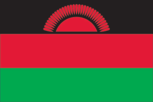
three equal horizontal bands of black (top), red, and green with a radiant, rising, red sun centered on the black band; black represents the native peoples, red the blood shed in their struggle for freedom, and green the color of nature; the rising sun represents the hope of freedom for the continent of Africa
Government type
presidential republic
Independence
6 July 1964 (from the UK)
International law organization participation
accepts compulsory ICJ jurisdiction with reservations; accepts ICCt jurisdiction
International organization participation
ACP, AfDB, AU, C, CD, COMESA, FAO, G-77, IAEA, IBRD, ICAO, ICCt, ICRM, IDA, IFAD, IFC, IFRCS, ILO, IMF, IMO, Interpol, IOC, IOM, IPU, ISO (correspondent), ITSO, ITU, ITUC (NGOs), MIGA, MINURSO, MONUSCO, NAM, OPCW, SADC, UN, UNCTAD, UNESCO, UNIDO, UNISFA, UNOCI, UNWTO, UPU, WCO, WFTU (NGOs), WHO, WIPO, WMO, WTO
Judicial branch
- Supreme Court of Appeal (consists of the chief justice and at least 3 judges) Supreme Court chief justice appointed by the president and confirmed by the National Assembly; other judges appointed by the president upon recommendation of the Judicial Service Commission, which regulates judicial officers; judges serve until age 65 High Court; magistrate courts; Industrial Relations Court; district and city traditional or local courts
- highest court(s)
- Supreme Court of Appeal (consists of the chief justice and at least 3 judges)
- judge selection and term of office
- Supreme Court chief justice appointed by the president and confirmed by the National Assembly; other judges appointed by the president upon recommendation of the Judicial Service Commission, which regulates judicial officers; judges serve until age 65
- subordinate courts
- High Court; magistrate courts; Industrial Relations Court; district and city traditional or local courts
Legal system
mixed legal system of English common law and customary law; judicial review of legislative acts in the Supreme Court of Appeal
Legislative branch
- unicameral National Assembly (193 seats; members directly elected in single-seat constituencies by simple majority vote to serve 5-year terms) last held on 20-22 May 2014 (next to be held in May 2019) percent of vote by party - DPP 22.0%, MCP 17.4%, PP 18.5%, UDF 9.6%, other 2.8%, independent 29.7%; seats by party - DPP 51, MCP 48, PP 26, UDF 14, other 2, independent 52
- description
- unicameral National Assembly (193 seats; members directly elected in single-seat constituencies by simple majority vote to serve 5-year terms)
- election results
- percent of vote by party - DPP 22.0%, MCP 17.4%, PP 18.5%, UDF 9.6%, other 2.8%, independent 29.7%; seats by party - DPP 51, MCP 48, PP 26, UDF 14, other 2, independent 52
- elections
- last held on 20-22 May 2014 (next to be held in May 2019)
National anthem
- "Mulungu dalitsa Malawi" (Oh God Bless Our Land of Malawi) Michael-Fredrick Paul SAUKA adopted 1964
- lyrics/music
- Michael-Fredrick Paul SAUKA
- name
- "Mulungu dalitsa Malawi" (Oh God Bless Our Land of Malawi)
- note
- adopted 1964
National holiday
Independence Day (Republic Day), 6 July (1964)
National symbol(s)
- lion; national colors: black, red, green
- lion; national colors
- black, red, green
Political parties and leaders
Alliance for Democracy or AFORD [Godfrey SHAWA] Democratic Progressive Party or DPP [Peter MUTHARIKA] Malawi Congress Party or MCP [Lazarus CHAKWERA] People's Party or PP [Joyce BANDA] United Democratic Front or UDF [Atupele MULUZI]
Political pressure groups and leaders
Council for NGOs in Malawi or CONGOMA (human rights, democracy, development) Human Rights Consultative Committee or HRCC (human rights) Malawi Economic Justice Network or MEJN (pro-economic growth, development, government accountability) Malawi Law Society (an umbrella organization of all lawyers in Malawi) Public Affairs Committee or PAC (promotes democracy, development, peace, unity)
Suffrage
18 years of age; universal
Economy
Agriculture - products
tobacco, sugarcane, tea, corn, potatoes, sweet potatoes, cassava (manioc, tapioca), sorghum, pulses, cotton, groundnuts, macadamia nuts, coffee; cattle, goats
Budget
- $1.109 billion $1.409 billion (2016 est.)
- expenditures
- $1.409 billion (2016 est.)
- revenues
- $1.109 billion
Budget surplus (+) or deficit (-)
-5.5% of GDP (2016 est.)
Central bank discount rate
24% (25 November 2016) 27% (July 2016)
Commercial bank prime lending rate
44.1% (31 December 2016 est.) 44.39% (31 December 2015 est.)
Current account balance
$-739 million (2016 est.) $-714.9 million (2015 est.)
Debt - external
$1.985 billion (31 December 2016 est.) $1.766 billion (31 December 2015 est.)
Distribution of family income - Gini index
46.1 (2010) 39.9 (2004)
Economy - overview
Landlocked Malawi ranks among the world's most densely populated and least developed countries. The country’s economic performance has historically been constrained by policy inconsistency, macroeconomic instability, limited connectivity to the region and the world, poor infrastructure, rampant corruption, high population growth, and poor health and education outcomes that limit labor productivity. The economy is predominately agricultural with about 80% of the population living in rural areas. Agriculture accounts for about one-third of GDP and 80% of export revenues. The performance of the tobacco sector is key to short-term growth as tobacco accounts for more than half of exports. The economy depends on substantial inflows of economic assistance from the IMF, the World Bank, and individual donor nations. In 2006, Malawi was approved for relief under the Heavily Indebted Poor Countries (HIPC) program but recent increases in domestic borrowing mean that debt servicing in 2016 exceeded the levels prior to HIPC debt relief. President MUTHARIKA launched the Public Financial Management and Public Sector reform programs upon taking office in 2014 to increase accountability following the 2013 “Cashgate” scandal. Heavily dependent on rain-fed agriculture, with corn being the staple crop, Malawi’s economy was hit hard by the El Nino-driven drought in 2015 and 2016. The drought also slowed economic activity, led to two consecutive years of declining economic growth, and contributed to high inflation rates. Following a successful humanitarian response in 2016 and 2017 providing food assistance to 6.7 million people - 40% of the population - and increased transparency by agricultural parastatals, the economy has stabilized and inflation is dropping.
Exchange rates
Malawian kwachas (MWK) per US dollar - 713.85 (2016 est.) 713.85 (2015 est.) 499.6 (2014 est.) 424.9 (2013 est.) 249.11 (2012 est.)
Exports
$1.361 billion (2016 est.) $1.438 billion (2015 est.)
Exports - commodities
tobacco 55%, dried legumes (8.8%), sugar (6.7%), tea (5.7%), cotton (2%), peanuts, coffee, soy (2015 est.)
Exports - partners
Zimbabwe 12.9%, Mozambique 11%, Belgium 8.2%, South Africa 7.2%, US 6%, China 4.6%, Germany 4.3%, UK 4.2% (2016)
Fiscal year
1 July - 30 June
GDP - composition, by end use
- 81% 16.2% 11.9% 2.9% 33.3% -45.2% (2016 est.)
- exports of goods and services
- 33.3%
- government consumption
- 16.2%
- household consumption
- 81%
- imports of goods and services
- -45.2% (2016 est.)
- investment in fixed capital
- 11.9%
- investment in inventories
- 2.9%
GDP - composition, by sector of origin
- 28.3% 16% 55.8% (2016 est.)
- agriculture
- 28.3%
- industry
- 16%
- services
- 55.8% (2016 est.)
GDP - per capita (PPP)
- $1,100 (2016 est.) $1,100 (2015 est.) $1,100 (2014 est.) data are in 2016 dollars
- note
- data are in 2016 dollars
GDP - real growth rate
2.3% (2016 est.) 3% (2015 est.) 5.7% (2014 est.)
GDP (official exchange rate)
$5.489 billion (2016 est.)
GDP (purchasing power parity)
- $21.13 billion (2016 est.) $20.4 billion (2015 est.) $19.61 billion (2014 est.) data are in 2016 dollars
- note
- data are in 2016 dollars
Gross national saving
-3.3% of GDP (2016 est.) 2.7% of GDP (2015 est.) 3.6% of GDP (2014 est.)
Household income or consumption by percentage share
- 2.2% 37.5% (2010 est.)
- highest 10%
- 37.5% (2010 est.)
- lowest 10%
- 2.2%
Imports
$2.318 billion (2016 est.) $2.146 billion (2015 est.)
Imports - commodities
food, petroleum products, semi-manufactures, consumer goods, transportation equipment
Imports - partners
South Africa 20.2%, China 13.8%, India 10.8%, UAE 9.7%, Zambia 5.7% (2016)
Industrial production growth rate
2.4% (2016 est.)
Industries
tobacco, tea, sugar, sawmill products, cement, consumer goods
Inflation rate (consumer prices)
21.7% (2016 est.) 21.9% (2015 est.)
Labor force
7 million (2013 est.)
Labor force - by occupation
- 64.1% 6.7% 29.2% (2013 est.)
- agriculture
- 64.1%
- industry
- 6.7%
- services
- 29.2% (2013 est.)
Market value of publicly traded shares
$796.2 million (31 December 2016 est.) $936.3 million (31 December 2015 est.) $1.341 billion (31 December 2014 est.)
Population below poverty line
50.7% (2010 est.)
Public debt
56.1% of GDP (2016 est.) 40.5% of GDP (2015 est.)
Reserves of foreign exchange and gold
$563.1 million (31 December 2016 est.) $701.5 million (31 December 2015 est.)
Stock of broad money
$1.238 billion (31 December 2016 est.) $1.172 billion (31 December 2015 est.)
Stock of direct foreign investment - abroad
$NA
Stock of direct foreign investment - at home
$800 million (2015)
Stock of domestic credit
$1.054 billion (31 December 2016 est.) $812.4 million (31 December 2015 est.)
Stock of narrow money
$536.6 million (31 December 2016 est.) $478.4 million (31 December 2015 est.)
Taxes and other revenues
20.2% of GDP (2016 est.)
Unemployment rate
20.4% (2013 est.)
Energy
Carbon dioxide emissions from consumption of energy
1.9 million Mt (2013 est.)
Crude oil - exports
0 bbl/day (2014 est.)
Crude oil - imports
0 bbl/day (2014 est.)
Crude oil - production
0 bbl/day (2016 est.)
Crude oil - proved reserves
0 bbl (1 January 2017 es)
Electricity - consumption
1.972 billion kWh (2015 est.)
Electricity - exports
0 kWh (2016 est.)
Electricity - from fossil fuels
0.5% of total installed capacity (2015 est.)
Electricity - from hydroelectric plants
93.3% of total installed capacity (2015 est.)
Electricity - from nuclear fuels
0% of total installed capacity (2015 est.)
Electricity - from other renewable sources
6.1% of total installed capacity (2015 est.)
Electricity - imports
0 kWh (2016 est.)
Electricity - installed generating capacity
353,100 kW (2017 est.)
Electricity - production
2.12 billion kWh (2015 est.)
Electricity access
- 14,900,000 9% 32% 4% (2013)
- electrification - rural areas
- 4% (2013)
- electrification - total population
- 9%
- electrification - urban areas
- 32%
- population without electricity
- 14,900,000
Natural gas - consumption
0 cu m (2017 est.)
Natural gas - exports
0 cu m (2017 est.)
Natural gas - imports
0 cu m (2017 est.)
Natural gas - production
0 cu m (2017 est.)
Natural gas - proved reserves
0 cu m (2017 est.)
Refined petroleum products - consumption
7,000 bbl/day (2015 est.)
Refined petroleum products - exports
0 bbl/day (2014 est.)
Refined petroleum products - imports
6,843 bbl/day (2014 est.)
Refined petroleum products - production
0 bbl/day (2014 est.)
Communications
Broadcast media
radio is the main broadcast medium; privately owned Zodiak radio has the widest national broadcasting reach, followed by state-run radio; numerous private and community radio stations broadcast in cities and towns around the country; the largest TV network is government-owned, but at least 4 private TV networks broadcast in urban areas; relays of multiple international broadcasters are available (2017)
Internet country code
.mw
Internet users
- 1,785,369 9.6% (July 2016 est.)
- percent of population
- 9.6% (July 2016 est.)
- total
- 1,785,369
Telephone system
- rudimentary; one fixed-line and two mobile-cellular operators govern the market limited fixed-line subscribership of about 1 per 100 households; mobile-cellular services are expanding but network coverage is limited and is based around the main urban areas; mobile-cellular subscribership approaching 40 per 100 households country code - 265; satellite earth stations - 2 Intelsat (1 Indian Ocean, 1 Atlantic Ocean) (2016)
- domestic
- limited fixed-line subscribership of about 1 per 100 households; mobile-cellular services are expanding but network coverage is limited and is based around the main urban areas; mobile-cellular subscribership approaching 40 per 100 households
- general assessment
- rudimentary; one fixed-line and two mobile-cellular operators govern the market
- international
- country code - 265; satellite earth stations - 2 Intelsat (1 Indian Ocean, 1 Atlantic Ocean) (2016)
Telephones - fixed lines
- 11,234 less than 1 (July 2016 est.)
- subscriptions per 100 inhabitants
- less than 1 (July 2016 est.)
- total subscriptions
- 11,234
Telephones - mobile cellular
- 7,178,384 39 (July 2016 est.)
- subscriptions per 100 inhabitants
- 39 (July 2016 est.)
- total
- 7,178,384
Transportation
Airports
32 (2013)
Airports - with paved runways
- 4 (2017)
- 1,524 to 2,437 m
- 2
- 914 to 1,523 m
- 4 (2017)
- over 3,047 m
- 1
- total
- 7
Airports - with unpaved runways
- 13 (2013)
- 1,524 to 2,437 m
- 1
- 914 to 1,523 m
- 11
- total
- 25
- under 914 m
- 13 (2013)
Civil aircraft registration country code prefix
7Q (2016)
National air transport system
- 6,010 5,467 mt-km (2015)
- annual freight traffic on registered air carriers
- 5,467 mt-km (2015)
- annual passenger traffic on registered air carriers
- 6,010
- inventory of registered aircraft operated by air carriers
- 2
- number of registered air carriers
- 1
Ports and terminals
- Chipoka, Monkey Bay, Nkhata Bay, Nkhotakota, Chilumba (Lake Nyasa)
- lake port(s)
- Chipoka, Monkey Bay, Nkhata Bay, Nkhotakota, Chilumba (Lake Nyasa)
Railways
- 767 km 767 km 1.067-m gauge (2014)
- narrow gauge
- 767 km 1.067-m gauge (2014)
- total
- 767 km
Roadways
- 15,450 km 6,951 km 8,499 km (2011)
- paved
- 6,951 km
- total
- 15,450 km
- unpaved
- 8,499 km (2011)
Waterways
700 km (on Lake Nyasa [Lake Malawi] and Shire River) (2010)
Military and Security
Military branches
- Malawi Defense Forces (MDF): Army (includes Air Wing, Marine Unit) (2012)
- Malawi Defense Forces (MDF)
- Army (includes Air Wing, Marine Unit) (2012)
Military expenditures
0.61% of GDP (2016) 0.7% of GDP (2015) 0.89% of GDP (2014) 1.24% of GDP (2013) 0.82% of GDP (2012)
Military service age and obligation
18 years of age for voluntary military service; high school equivalent required for enlisted recruits and college equivalent for officer recruits; initial engagement is 7 years for enlisted personnel and 10 years for officers (2014)
Transnational Issues
Disputes - international
dispute with Tanzania over the boundary in Lake Nyasa (Lake Malawi) and the meandering Songwe River; Malawi contends that the entire lake up to the Tanzanian shoreline is its territory, while Tanzania claims the border is in the center of the lake; the conflict was reignited in 2012 when Malawi awarded a license to a British company for oil exploration in the lake
Refugees and internally displaced persons
- 5,444 (Democratic Republic of the Congo) (2016) 8,463 (floods in 2015) (2016)
- IDPs
- 8,463 (floods in 2015) (2016)
- refugees (country of origin)
- 5,444 (Democratic Republic of the Congo) (2016)