2015 Edition
CIA World Factbook 2015 Archive (Wayback Machine ZIP)
Introduction
Background
Established in 1891, the British protectorate of Nyasaland became the independent nation of Malawi in 1964. After three decades of one-party rule under President Hastings Kamuzu BANDA, the country held multiparty presidential and parliamentary elections in 1994, under a provisional constitution that came into full effect the following year. President Bingu wa MUTHARIKA, elected in May 2004 after a failed attempt by the previous president to amend the constitution to permit another term, struggled to assert his authority against his predecessor and subsequently started his own party, the Democratic Progressive Party in 2005. MUTHARIKA was reelected to a second term in May 2009. He oversaw some economic improvement in his first term, but was accused of economic mismanagement and poor governance in his second term. He died abruptly in April 2012 and was succeeded by vice president, Joyce BANDA, who had earlier started her own party, the People's Party. MUTHARIKA’s brother, Peter MUTHARIKA, defeated BANDA in the May 2014 election. Population growth, increasing pressure on agricultural lands, corruption, and the scourge of HIV/AIDS pose major problems for Malawi.
Geography
Area
- land
- 94,080 sq km
- total
- 118,484 sq km
- water
- 24,404 sq km
Area - comparative
slightly smaller than Pennsylvania
Climate
sub-tropical; rainy season (November to May); dry season (May to November)
Coastline
0 km (landlocked)
Elevation extremes
- highest point
- Sapitwa (Mount Mlanje) 3,002 m
- lowest point
- junction of the Shire River and international boundary with Mozambique 37 m
Environment - current issues
deforestation; land degradation; water pollution from agricultural runoff, sewage, industrial wastes; siltation of spawning grounds endangers fish populations
Environment - international agreements
- party to
- Biodiversity, Climate Change, Climate Change-Kyoto Protocol, Desertification, Endangered Species, Environmental Modification, Hazardous Wastes, Marine Life Conservation, Ozone Layer Protection, Ship Pollution, Wetlands
- signed, but not ratified
- Law of the Sea
Freshwater withdrawal (domestic/industrial/agricultural)
- per capita
- 99.86 cu m/yr (2005)
- total
- 1.36 cu km/yr (11%/4%/86%)
Geographic coordinates
13 30 S, 34 00 E
Geography - note
landlocked; Lake Nyasa, some 580 km long, is the country's most prominent physical feature; it contains more fish species than any other lake on earth
Irrigated land
735 sq km (2006)
Land boundaries
- border countries (3)
- Mozambique 1,498 km, Tanzania 512 km, Zambia 847 km
- total
- 2,857 km
Land use
- arable land 38.2%; permanent crops 1.4%; permanent pasture 19.6%
- agricultural land
- 59.2%
- forest
- 34%
- other
- 6.8% (2011 est.)
Location
Southern Africa, east of Zambia, west and north of Mozambique
Map references
Africa
Maritime claims
none (landlocked)
Natural hazards
NA
Natural resources
limestone, arable land, hydropower, unexploited deposits of uranium, coal, and bauxite
Terrain
narrow elongated plateau with rolling plains, rounded hills, some mountains
Total renewable water resources
17.28 cu km (2011)
People and Society
Age structure
- 0-14 years
- 46.73% (male 4,175,706/female 4,218,955)
- 15-24 years
- 20.38% (male 1,820,047/female 1,841,331)
- 25-54 years
- 27.14% (male 2,418,126/female 2,457,419)
- 55-64 years
- 3.06% (male 262,067/female 287,637)
- 65 years and over
- 2.69% (male 213,735/female 269,674) (2015 est.)
Birth rate
41.56 births/1,000 population (2015 est.)
Child labor - children ages 5-14
- percentage
- 26% (2006 est.)
- total number
- 993,318
Children under the age of 5 years underweight
13.8% (2010)
Contraceptive prevalence rate
46.1% (2010)
Death rate
8.41 deaths/1,000 population (2015 est.)
Dependency ratios
- elderly dependency ratio
- 6.7%
- potential support ratio
- 14.9% (2015 est.)
- total dependency ratio
- 94.5%
- youth dependency ratio
- 87.9%
Drinking water source
- urban: 95.7% of population
- rural: 89.1% of population
- total: 90.2% of population
- urban: 4.3% of population
- rural: 10.9% of population
- total: 9.8% of population (2015 est.)
Education expenditures
5.4% of GDP (2011)
Ethnic groups
Chewa 32.6%, Lomwe 17.6%, Yao 13.5%, Ngoni 11.5%, Tumbuka 8.8%, Nyanja 5.8%, Sena 3.6%, Tonga 2.1%, Ngonde 1%, other 3.5%
Health expenditures
8.3% of GDP (2013)
HIV/AIDS - adult prevalence rate
10.04% (2014 est.)
HIV/AIDS - deaths
32,600 (2014 est.)
HIV/AIDS - people living with HIV/AIDS
1,063,900 (2014 est.)
Hospital bed density
1.3 beds/1,000 population (2011)
Infant mortality rate
- female
- 39.35 deaths/1,000 live births (2015 est.)
- male
- 53.07 deaths/1,000 live births
- total
- 46.26 deaths/1,000 live births
Languages
English (official), Chichewa (common), Chinyanja, Chiyao, Chitumbuka, Chilomwe, Chinkhonde, Chingoni, Chisena, Chitonga, Chinyakyusa, Chilambya
Life expectancy at birth
- female
- 62.69 years (2015 est.)
- male
- 58.67 years
- total population
- 60.66 years
Literacy
- definition
- age 15 and over can read and write
- female
- 58.6% (2015 est.)
- male
- 73%
- total population
- 65.8%
Major infectious diseases
- animal contact disease
- rabies (2013)
- degree of risk
- very high
- food or waterborne diseases
- bacterial and protozoal diarrhea, hepatitis A, and typhoid fever
- vectorborne diseases
- malaria and dengue fever
- water contact disease
- schistosomiasis
Major urban areas - population
LILONGWE (capital) 905,000; Blantyre-Limbe 808,000 (2015)
Median age
- female
- 16.5 years (2015 est.)
- male
- 16.3 years
- total
- 16.4 years
Nationality
- adjective
- Malawian
- noun
- Malawian(s)
Net migration rate
0 migrant(s)/1,000 population (2015 est.)
Obesity - adult prevalence rate
4.3% (2014)
Physicians density
0.02 physicians/1,000 population (2009)
Population
- 17,964,697
- note
- estimates for this country explicitly take into account the effects of excess mortality due to AIDS; this can result in lower life expectancy, higher infant mortality, higher death rates, lower population growth rates, and changes in the distribution of population by age and sex than would otherwise be expected (July 2015 est.)
Population growth rate
3.32% (2015 est.)
Religions
Christian 82.6%, Muslim 13%, other 1.9%, none 2.5% (2008 est.)
Sanitation facility access
- urban: 47.3% of population
- rural: 39.8% of population
- total: 41% of population
- urban: 52.7% of population
- rural: 60.2% of population
- total: 59% of population (2015 est.)
School life expectancy (primary to tertiary education)
- female
- 11 years (2011)
- male
- 11 years
- total
- 11 years
Sex ratio
- 0-14 years
- 0.99 male(s)/female
- 15-24 years
- 0.99 male(s)/female
- 25-54 years
- 0.98 male(s)/female
- 55-64 years
- 0.91 male(s)/female
- 65 years and over
- 0.79 male(s)/female
- at birth
- 1.02 male(s)/female
- total population
- 0.98 male(s)/female (2015 est.)
Total fertility rate
5.6 children born/woman (2015 est.)
Urbanization
- rate of urbanization
- 3.77% annual rate of change (2010-15 est.)
- urban population
- 16.3% of total population (2015)
Government
Administrative divisions
28 districts; Balaka, Blantyre, Chikwawa, Chiradzulu, Chitipa, Dedza, Dowa, Karonga, Kasungu, Likoma, Lilongwe, Machinga, Mangochi, Mchinji, Mulanje, Mwanza, Mzimba, Neno, Ntcheu, Nkhata Bay, Nkhotakota, Nsanje, Ntchisi, Phalombe, Rumphi, Salima, Thyolo, Zomba
Capital
- geographic coordinates
- 13 58 S, 33 47 E
- name
- Lilongwe
- time difference
- UTC+2 (7 hours ahead of Washington, DC, during Standard Time)
Constitution
previous 1953 (preindependence), 1966; latest drafted January to May 1994, approved 16 May 1994, entered into force 18 May 1995; amended several times, last in 2013 (2013)
Country name
- conventional long form
- Republic of Malawi
- conventional short form
- Malawi
- former
- British Central African Protectorate, Nyasaland Protectorate, Nyasaland
- local long form
- Dziko la Malawi
- local short form
- Malawi
Diplomatic representation from the US
- chief of mission
- Ambassador Virginia E. PALMER (since 5 February 2015)
- embassy
- 16 Jomo Kenyatta Road, Lilongwe 3
- FAX
- [265] (1) 770-471
- mailing address
- P. O. Box 30016, Lilongwe 3, Malawi
- telephone
- [265] (1) 773-166
Diplomatic representation in the US
- chancery
- 2408 Massachusetts Avenue NW, Washington, DC 20008
- chief of mission
- Ambassador Necton Darlington MHURA (since 18 May 2015)
- FAX
- [1] (202) 721-0288
- telephone
- [1] (202) 721-0270
Executive branch
- cabinet
- Cabinet named by the president
- chief of state
- President Arthur Peter MUTHARIKA (since 31 May 2014); Vice President Saulos CHILIMA (since 31 May 2014); note - the president is both chief of state and head of government
- election results
- Peter MUTHARIKA elected president; percent of vote - Peter MUTHARIKA (DPP) 36.4%, Lazarus CHAKWERA (MCP) 27.8%, Joyce BANDA (PP) 20.2%, Atupele MULUZI (UDF) 13.7%, other 1.9%
- elections/appointments
- president directly elected by simple majority popular vote for a 5-year term (eligible for a second term); election last held on 20 May 2014 (next to be held in May 2019)
- head of government
- President Arthur Peter MUTHARIKA (since 31 May 2014); Vice President Saulos CHILIMA (since 31 May 2014)
Flag description
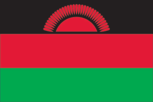
three equal horizontal bands of black (top), red, and green with a radiant, rising, red sun centered on the black band; black represents the native peoples, red the blood shed in their struggle for freedom, and green the color of nature; the rising sun represents the hope of freedom for the continent of Africa
Government type
multiparty democracy
Independence
6 July 1964 (from the UK)
International law organization participation
accepts compulsory ICJ jurisdiction with reservations; accepts ICCt jurisdiction
International organization participation
ACP, AfDB, AU, C, CD, COMESA, FAO, G-77, IAEA, IBRD, ICAO, ICCt, ICRM, IDA, IFAD, IFC, IFRCS, ILO, IMF, IMO, Interpol, IOC, IOM, IPU, ISO (correspondent), ITSO, ITU, ITUC (NGOs), MIGA, MINURSO, MONUSCO, NAM, OPCW, SADC, UN, UNCTAD, UNESCO, UNIDO, UNISFA, UNOCI, UNWTO, UPU, WCO, WFTU (NGOs), WHO, WIPO, WMO, WTO
Judicial branch
- highest court(s)
- Supreme Court of Appeal (consists of the chief justice and at least 3 judges)
- judge selection and term of office
- Supreme Court chief justice appointed by the president and confirmed by the National Assembly; other judges appointed by the president upon recommendation of the Judicial Service Commission, which regulates judicial officers; judges serve until age 65
- subordinate courts
- High Court; magistrate courts; Industrial Relations Court; district and city traditional or local courts
Legal system
mixed legal system of English common law and customary law; judicial review of legislative acts in the Supreme Court of Appeal
Legislative branch
- description
- unicameral National Assembly (193 seats; members directly elected in single-seat constituencies by simple majority vote to serve 5-year terms)
- election results
- percent of vote by party - NA; seats by party - DPP 50, MCP 48, PP 26, UDF 14, other 2, independent 52; note - voting in one electoral constituency to be rescheduled due to death of candidate
- elections
- last held on 20-22 May 2014 (next to be held in May 2019)
National anthem
- lyrics/music
- Michael-Fredrick Paul SAUKA
- name
- "Mulungu dalitsa Malawi" (Oh God Bless Our Land of Malawi)
- note
- adopted 1964
National holiday
Independence Day (Republic Day), 6 July (1964)
National symbol(s)
lion; national colors: black, red, green
Political parties and leaders
- Alliance for Democracy or AFORD [Godfrey SHAWA]
- Chipani Cha Fuko or CCP [Davis KATSONGA PHIRI]
- Democratic Progressive Party or DPP [Peter MUTHARIKA]
- Malawi Congress Party or MCP [Lazarus CHAKWERA]
- People's Party or PP [Joyce BANDA]
- United Democratic Front or UDF [Atupele MULUZI]
Political pressure groups and leaders
- Council for NGOs in Malawi or CONGOMA (human rights, democracy, and development)
- Human Rights Consultative Committee or HRCC (human rights)
- Malawi Economic Justice Network or MEJN (pro economic growth, development, government accountability)
- Malawi Law Society (an umbrella organization of all lawyers in Malawi)
- Public Affairs Committee or PAC (promotes democracy, development, peace and unity)
Suffrage
18 years of age; universal
Economy
Agriculture - products
tobacco, sugarcane, cotton, tea, corn, potatoes, cassava (manioc, tapioca), sorghum, pulses, groundnuts, Macadamia nuts; cattle, goats
Budget
- expenditures
- $1.573 billion (2014 est.)
- revenues
- $1.264 billion
Budget surplus (+) or deficit (-)
-7% of GDP (2014 est.)
Central bank discount rate
- 15% (31 December 2009)
- 15% (31 December 2008)
Commercial bank prime lending rate
- 44% (31 December 2014 est.)
- 46% (31 December 2013 est.)
Current account balance
- -$216 million (2014 est.)
- -$958.4 million (2013 est.)
Debt - external
- $1.729 billion (31 December 2014 est.)
- $1.487 billion (31 December 2013 est.)
Distribution of family income - Gini index
39 (2004)
Economy - overview
- Landlocked Malawi ranks among the world's most densely populated and least developed countries. The country’s economic performance has historically been constrained by policy inconsistency, macroeconomic instability, limited connectivity to the region and the world, and poor health and education outcomes that limit labor productivity. The economy is predominately agricultural with about 80% of the population living in rural areas. Agriculture accounts for about one-third of GDP and 90% of export revenues. The performance of the tobacco sector is key to short-term growth as tobacco accounts for more than half of exports.
- The economy depends on substantial inflows of economic assistance from the IMF, the World Bank, and individual donor nations. In 2006, Malawi was approved for relief under the Heavily Indebted Poor Countries program. Between 2005 and 2009 Malawi’s government exhibited improved financial discipline under the guidance of Finance Minister Goodall GONDWE and signed a three year IMF Poverty Reduction and Growth Facility worth $56 million. The government announced infrastructure projects that could yield improvements, such as a new oil pipeline for better fuel access, and the potential for a waterway link through Mozambican rivers to the ocean for better transportation options.
- The government faces many challenges, including developing a market economy, improving educational facilities, addressing environmental problems, dealing with HIV/AIDS, and satisfying foreign donors on anti-corruption efforts.
- Since 2009, however, Malawi has experienced some setbacks, including a general shortage of foreign exchange, which has damaged its ability to pay for imports, and fuel shortages that hinder transportation and productivity. In October 2013, the African Development Bank, the IMF, several European countries, and the US indefinitely froze $150 million in direct budgetary support in response to a high level corruption scandal, called “Cashgate,” citing a lack of trust in the government’s financial management system and civil service. Most of the frozen donor funds—which accounted for 40% of the budget—have been channeled through non-governmental organizations in the country. The government has failed to address barriers to investment such as unreliable power, water shortages, poor telecommunications infrastructure, and the high costs of services. Investment had fallen continuously for several years, but rose 4 percentage points in 2014 to 17% of GDP.
Exchange rates
- Malawian kwachas (MWK) per US dollar -
- 412.1 (2014 est.)
- 364.41 (2013 est.)
- 249.11 (2012 est.)
- 156.93 (2011 est.)
- 150.49 (2010 est.)
Exports
- $1.332 billion (2014 est.)
- $1.374 billion (2013 est.)
Exports - commodities
tobacco 53%, tea, sugar, cotton, coffee, peanuts, wood products, apparel (2010 est.)
Exports - partners
Belgium 12.4%, Zimbabwe 10.4%, South Africa 6.8%, Germany 6.8%, Russia 6.6%, Canada 6.1%, US 6% (2014)
Fiscal year
1 July - 30 June
GDP - composition, by end use
- (2014 est.)
- exports of goods and services
- 28.1%
- government consumption
- 11%
- household consumption
- 95%
- imports of goods and services
- -57.1%
- investment in fixed capital
- 16.5%
- investment in inventories
- 6.6%
GDP - composition, by sector of origin
- agriculture
- 30.1%
- industry
- 18.5%
- services
- 51.3% (2014 est.)
GDP - per capita (PPP)
- $800 (2014 est.)
- $700 (2013 est.)
- $700 (2012 est.)
- note
- data are in 2014 US dollars
GDP - real growth rate
- 5.7% (2014 est.)
- 5.2% (2013 est.)
- 1.9% (2012 est.)
GDP (official exchange rate)
$4.263 billion (2014 est.)
GDP (purchasing power parity)
- $13.73 billion (2014 est.)
- $12.98 billion (2013 est.)
- $12.34 billion (2012 est.)
- note
- data are in 2014 US dollars
Gross national saving
- 10.3% of GDP (2014 est.)
- 14.2% of GDP (2013 est.)
- 13.4% of GDP (2012 est.)
Household income or consumption by percentage share
- highest 10%
- 31.9% (2004)
- lowest 10%
- 3%
Imports
- $2.498 billion (2014 est.)
- $2.52 billion (2013 est.)
Imports - commodities
food, petroleum products, semi-manufactures, consumer goods, transportation equipment
Imports - partners
South Africa 26.2%, India 15.5%, China 10%, Zambia 9.8%, Tanzania 5.4% (2014)
Industrial production growth rate
-1.7% (2014 est.)
Industries
tobacco, tea, sugar, sawmill products, cement, consumer goods
Inflation rate (consumer prices)
- 23.8% (2014 est.)
- 27.3% (2013 est.)
Labor force
5.747 million (2007 est.)
Labor force - by occupation
- agriculture
- 90%
- industry and services
- 10% (2003 est.)
Market value of publicly traded shares
- $753.6 million (31 December 2012 est.)
- $1.384 billion (31 December 2011)
- $1.363 billion (31 December 2010 est.)
Population below poverty line
53% (2004 est.)
Public debt
- 48% of GDP (2014 est.)
- 49.6% of GDP (2013 est.)
Reserves of foreign exchange and gold
- $469.7 million (31 December 2014 est.)
- $435.9 million (31 December 2013 est.)
Stock of broad money
- $1.481 billion (31 December 2014 est.)
- $1.2 billion (31 December 2013 est.)
Stock of direct foreign investment - abroad
$NA
Stock of direct foreign investment - at home
$NA
Stock of domestic credit
- $1.176 billion (31 December 2014 est.)
- $969.2 million (31 December 2013 est.)
Stock of narrow money
- $578.5 million (31 December 2014 est.)
- $454.7 million (31 December 2013 est.)
Taxes and other revenues
28.7% of GDP (2014 est.)
Unemployment rate
NA%
Energy
Carbon dioxide emissions from consumption of energy
1.91 million Mt (2012 est.)
Crude oil - exports
0 bbl/day (2010 est.)
Crude oil - imports
0 bbl/day (2010 est.)
Crude oil - production
200 bbl/day (2013 est.)
Crude oil - proved reserves
0 bbl (1 January 2014 est.)
Electricity - consumption
1.924 billion kWh (2011 est.)
Electricity - exports
0 kWh (2013 est.)
Electricity - from fossil fuels
0.3% of total installed capacity (2011 est.)
Electricity - from hydroelectric plants
99.7% of total installed capacity (2011 est.)
Electricity - from nuclear fuels
0% of total installed capacity (2011 est.)
Electricity - from other renewable sources
0% of total installed capacity (2011 est.)
Electricity - imports
0 kWh (2013 est.)
Electricity - installed generating capacity
301,000 kW (2011 est.)
Electricity - production
2.069 billion kWh (2011 est.)
Natural gas - consumption
0 cu m (2012 est.)
Natural gas - exports
0 cu m (2012 est.)
Natural gas - imports
0 cu m (2012 est.)
Natural gas - production
0 cu m (2012 est.)
Natural gas - proved reserves
0 cu m (1 January 2014 est.)
Refined petroleum products - consumption
13,040 bbl/day (2013 est.)
Refined petroleum products - exports
0 bbl/day (2010 est.)
Refined petroleum products - imports
6,059 bbl/day (2010 est.)
Refined petroleum products - production
0 bbl/day (2010 est.)
Communications
Broadcast media
radio is the main broadcast medium; privately owned Zodiac radio has the widest national broadcasting reach, followed by state-run radio; about a dozen private and community radio stations broadcast in cities and towns around the country; the largest TV network is government-owned, but two private TV networks now broadcast in urban areas and more plan to begin broadcasting in 2014; relays of multiple international broadcasters are available (2014)
Internet country code
.mw
Internet users
- percent of population
- 2.2% (2014 est.)
- total
- 387,500
Radio broadcast stations
AM 9, FM 5 (plus 15 repeater stations), shortwave 2 (plus one shortwave station on standby) (2001)
Telephone system
- domestic
- limited fixed-line subscribership of about 1 per 100 persons; mobile-cellular services are expanding but network coverage is limited and is based around the main urban areas; mobile-cellular subscribership about 25 per 100 persons
- general assessment
- rudimentary; privatization of Malawi Telecommunications (MTL), a necessary step in bringing improvement to telecommunications services, completed in 2006
- international
- country code - 265; satellite earth stations - 2 Intelsat (1 Indian Ocean, 1 Atlantic Ocean) (2010)
Telephones - fixed lines
- subscriptions per 100 inhabitants
- less than 1 (2014 est.)
- total subscriptions
- 64,200
Telephones - mobile cellular
- subscriptions per 100 inhabitants
- 30 (2014 est.)
- total
- 5.1 million
Television broadcast stations
1 (2001)
Transportation
Airports
32 (2013)
Airports - with paved runways
- 1,524 to 2,437 m
- 2
- 914 to 1,523 m
- 4 (2013)
- over 3,047 m
- 1
- total
- 7
Airports - with unpaved runways
- 13 (2013)
- 1,524 to 2,437 m
- 1
- 914 to 1,523 m
- 11
- total
- 25
Ports and terminals
- lake port(s)
- Chipoka, Monkey Bay, Nkhata Bay, Nkhotakota, Chilumba (Lake Nyasa)
Railways
- narrow gauge
- 767 km 1.067-m gauge (2014)
- total
- 767 km
Roadways
- paved
- 6,951 km
- total
- 15,450 km
- unpaved
- 8,499 km (2011)
Waterways
700 km (on Lake Nyasa [Lake Malawi] and Shire River) (2010)
Military and Security
Manpower available for military service
- males age 16-49
- 3,514,809 (2010 est.)
Manpower fit for military service
- females age 16-49
- 2,043,925 (2010 est.)
- males age 16-49
- 2,132,909
Manpower reaching militarily significant age annually
- female
- 183,028 (2010 est.)
- male
- 183,683
Military branches
Malawi Defense Forces (MDF): Army (includes Air Wing, Marine Unit) (2012)
Military expenditures
- 0.93% of GDP (2012)
- 0.79% of GDP (2011)
- 0.93% of GDP (2010)
Military service age and obligation
18 years of age for voluntary military service; high school equivalent required for enlisted recruits and college equivalent for officer recruits; initial engagement is 7 years for enlisted personnel and 10 years for officers (2014)
Transnational Issues
Disputes - international
dispute with Tanzania over the boundary in Lake Nyasa (Lake Malawi) and the meandering Songwe River; Malawi contends that the entire lake up to the Tanzanian shoreline is its territory, while Tanzania claims the border is in the center of the lake; the conflict was reignited in 2012 when Malawi awarded a license to a British company for oil exploration in the lake
Refugees and internally displaced persons
- IDPs
- 107,000 (floods in 2015) (2015)