2007 Edition
CIA World Factbook 2007 (Project Gutenberg)
Introduction
Administrative divisions
27 districts; Balaka, Blantyre, Chikwawa, Chiradzulu, Chitipa, Dedza, Dowa, Karonga, Kasungu, Likoma, Lilongwe, Machinga (Kasupe), Mangochi, Mchinji, Mulanje, Mwanza, Mzimba, Ntcheu, Nkhata Bay, Nkhotakota, Nsanje, Ntchisi, Phalombe, Rumphi, Salima, Thyolo, Zomba
Age structure
0-14 years: 46.5% (male 3,056,522/female 3,000,493) 15-64 years: 50.8% (male 3,277,573/female 3,332,907) 65 years and over: 2.7% (male 139,953/female 206,478) (2006 est.)
Area
- land
- 94,080 sq km
- total
- 118,480 sq km
- water
- 24,400 sq km
Area - comparative
slightly smaller than Pennsylvania
Background
Established in 1891, the British protectorate of Nyasaland became the independent nation of Malawi in 1964. After three decades of one-party rule under President Hastings Kamuzu BANDA the country held multiparty elections in 1994, under a provisional constitution which came into full effect the following year. Current President Bingu wa MUTHARIKA, elected in May 2004 after a failed attempt by the previous president to amend the constitution to permit another term, has struggled to assert his authority against his predecessor, who still leads their shared political party. MUTHARIKA's anti-corruption efforts have led to several high-level arrests and one prominent conviction. Increasing corruption, population growth, increasing pressure on agricultural lands, and the spread of HIV/AIDS pose major problems for the country. Geography Malawi
Birth rate
43.13 births/1,000 population (2006 est.)
Capital
- geographic coordinates
- 13 59 S, 33 44 E
- name
- Lilongwe
- time difference
- UTC+2 (7 hours ahead of Washington, DC during Standard Time)
Climate
sub-tropical; rainy season (November to May); dry season (May to November)
Coastline
0 km (landlocked)
Constitution
18 May 1994
Country name
- conventional long form
- Republic of Malawi
- conventional short form
- Malawi
- former
- British Central African Protectorate, Nyasaland Protectorate, Nyasaland
- local long form
- Dziko la Malawi
- local short form
- Malawi
Death rate
19.33 deaths/1,000 population (2006 est.)
Elevation extremes
- highest point
- Sapitwa (Mount Mlanje) 3,002 m
- lowest point
- junction of the Shire River and international boundary with Mozambique 37 m
Environment - current issues
deforestation; land degradation; water pollution from agricultural runoff, sewage, industrial wastes; siltation of spawning grounds endangers fish populations
Environment - international agreements
- party to
- Biodiversity, Climate Change, Climate Change-Kyoto Protocol, Desertification, Endangered Species, Environmental Modification, Hazardous Wastes, Marine Life Conservation, Ozone Layer Protection, Ship Pollution, Wetlands
- signed, but not ratified
- Law of the Sea
Ethnic groups
Chewa, Nyanja, Tumbuka, Yao, Lomwe, Sena, Tonga, Ngoni, Ngonde, Asian, European
Executive branch
- chief of state
- President Bingu wa MUTHARIKA (since 24 May 2004); note - the president is both the chief of state and head of
Geographic coordinates
13 30 S, 34 00 E
Geography - note
landlocked; Lake Nyasa, some 580 km long, is the country's most prominent physical feature People Malawi
Government type
multiparty democracy
HIV/AIDS - adult prevalence rate
14.2% (2003 est.)
HIV/AIDS - deaths
84,000 (2003 est.)
HIV/AIDS - people living with HIV/AIDS
900,000 (2003 est.)
Independence
6 July 1964 (from UK)
Infant mortality rate
- female
- 89.96 deaths/1,000 live births (2006 est.)
- male
- 98.66 deaths/1,000 live births
- total
- 94.37 deaths/1,000 live births
Irrigated land
560 sq km (2003)
Land boundaries
- border countries
- Mozambique 1,569 km, Tanzania 475 km, Zambia 837 km
- total
- 2,881 km
Land use
- arable land
- 20.68%
- other
- 78.14% (2005)
- permanent crops
- 1.18%
Languages
Chichewa 57.2% (official), Chinyanja 12.8%, Chiyao 10.1%, Chitumbuka 9.5%, Chisena 2.7%, Chilomwe 2.4%, Chitonga 1.7%, other 3.6% (1998 census)
Legal system
based on English common law and customary law; judicial review of legislative acts in the Supreme Court of Appeal; accepts compulsory ICJ jurisdiction, with reservations
Life expectancy at birth
- female
- 41.45 years (2006 est.)
- male
- 41.93 years
- total population
- 41.7 years
Literacy
- definition
- age 15 and over can read and write
- female
- 49.8% (2003 est.) Government Malawi
- male
- 76.1%
- total population
- 62.7%
Location
Southern Africa, east of Zambia
Major infectious diseases
- degree of risk
- very high
- food or waterborne diseases
- bacterial and protozoal diarrhea, hepatitis A, and typhoid fever
- vectorborne diseases
- malaria and plague are high risks in some locations
- water contact disease
- schistosomiasis (2007)
Map references
Africa
Maritime claims
none (landlocked)
Median age
- female
- 16.8 years (2006 est.)
- male
- 16.2 years
- total
- 16.5 years
National holiday
Independence Day (Republic Day), 6 July (1964)
Nationality
- adjective
- Malawian
- noun
- Malawian(s)
Natural hazards
NA
Natural resources
limestone, arable land, hydropower, unexploited deposits of uranium, coal, and bauxite
Net migration rate
0 migrant(s)/1,000 population (2006 est.)
Population
- 13,013,926
- note
- estimates for this country explicitly take into account the effects of excess mortality due to AIDS; this can result in lower life expectancy, higher infant mortality and death rates, lower population and growth rates, and changes in the distribution of population by age and sex than would otherwise be expected (July 2006 est.)
Population growth rate
2.38% (2006 est.)
Religions
Christian 79.9%, Muslim 12.8%, other 3%, none 4.3% (1998 census)
Sex ratio
- at birth
- 1.03 male(s)/female
- total population
- 0.99 male(s)/female (2006 est.)
- under 15 years
- 1.02 male(s)/female 15-64 years: 0.98 male(s)/female 65 years and over: 0.68 male(s)/female
Suffrage
18 years of age; universal
Terrain
narrow elongated plateau with rolling plains, rounded hills, some mountains
Total fertility rate
5.92 children born/woman (2006 est.)
Government
Agriculture - products
tobacco, sugarcane, cotton, tea, corn, potatoes, cassava (tapioca), sorghum, pulses, groundnuts, Macadamia nuts; cattle, goats
Airports
42 (2006)
Airports - with paved runways
- over 3,047 m
- 1 1,524 to 2,437 m: 1 914 to 1,523 m: 4 (2006)
- total
- 6
Airports - with unpaved runways
- total
- 36 1,524 to 2,437 m: 1 914 to 1,523 m: 15
- under 914 m
- 20 (2006)
Budget
- expenditures
- $895.9 million; including capital expenditures of $NA (2006 est.)
- revenues
- $818.4 million
Currency (code)
Malawian kwacha (MWK)
Currency code
MWK
Current account balance
$-186 million (2006 est.)
Debt - external
$982.4 million (2006 est.)
Diplomatic representation from the US
- chief of mission
- Ambassador (vacant); Charge d'Affaires David GILMOUR
- embassy
- Area 40, Plot 24, Kenyatta Road
- mailing address
- P. O. Box 30016, Lilongwe 3, Malawi
- telephone
- [265] (1) 773 166
Diplomatic representation in the US
- chancery
- 1156 15th Street, NW, Suite 320, Washington, DC 20005
- chief of mission
- Ambassador Bernard Herbert SANDE
- telephone
- [1] (202) 721-0270
Disputes - international
disputes with Tanzania over the boundary in Lake Nyasa (Lake Malawi) and the meandering Songwe River remain dormant This page was last updated on 8 February, 2007
Distribution of family income - Gini index
50.3 (1997)
Economic aid - recipient
$401.5 million (2001)
Economy - overview
Landlocked Malawi ranks among the world's least developed countries. The economy is predominately agricultural, with about 90% of the population living in rural areas. Agriculture accounted for nearly 36% of GDP and 80% of export revenues in 2005. The performance of the tobacco sector is key to short-term growth as tobacco accounts for over 60% of exports. The economy depends on substantial inflows of economic assistance from the IMF, the World Bank, and individual donor nations. In late 2000, Malawi was approved for relief under the Heavily Indebted Poor Countries (HIPC) program. The government faces strong challenges, including developing a market economy, improving educational facilities, facing up to environmental problems, dealing with the rapidly growing problem of HIV/AIDS, and satisfying foreign donors that fiscal discipline is being tightened. In 2005, President MUTHARIKA championed an anticorruption campaign. Malawi's recent fiscal policy performance has been very strong, but a serious drought in 2005 and 2006 heightened pressure on the government to increase spending.
Electricity - consumption
1.202 billion kWh (2004)
Electricity - exports
0 kWh (2004)
Electricity - imports
0 kWh (2004)
Electricity - production
1.293 billion kWh (2004)
Electricity - production by source
- fossil fuel
- 3.3%
- hydro
- 96.7%
- nuclear
- 0%
- other
- 0% (2001)
Exchange rates
Malawian kwachas per US dollar - 139.786 (2006), 108.894 (2005), 108.898 (2004), 97.433 (2003), 76.687 (2002)
Exports
$513.1 million f.o.b. (2006 est.)
Exports - commodities
tobacco 60%, tea, sugar, cotton, coffee, peanuts, wood products, apparel
Exports - partners
US 17.9%, South Africa 11.2%, Egypt 7.6%, Germany 7%, Netherlands 6.9%, Japan 4.8%, Russia 4.6%, Mozambique 4.3%, UK 4.2% (2005)
FAX
- [1] (202) 721-0288
- [265] (1) 770 471
Fiscal year
1 July - 30 June Communications Malawi
Flag description
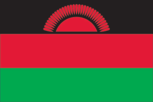
three equal horizontal bands of black (top), red, and green with a radiant, rising, red sun centered in the black band
GDP - composition by sector
- agriculture
- 35.4%
- industry
- 17.6%
- services
- 47% (2006 est.)
GDP - per capita (PPP)
$600 (2006 est.)
GDP - real growth rate
7% (2006 est.)
GDP (official exchange rate)
$2.172 billion (2006 est.)
GDP (purchasing power parity)
$8.038 billion (2006 est.)
Government - note
the executive exerts considerable influence over the legislature Economy Malawi
Household income or consumption by percentage share
- highest 10%
- NA%
- lowest 10%
- NA%
Imports
$767.9 million f.o.b. (2006 est.)
Imports - commodities
food, petroleum products, semimanufactures, consumer goods, transportation equipment
Imports - partners
South Africa 36.9%, Zambia 9.2%, Zimbabwe 7.7%, Mozambique 7.1%, India 6.8%, Tanzania 4.9%, US 4% (2005)
Industrial production growth rate
6.4% (2006 est.)
Industries
tobacco, tea, sugar, sawmill products, cement, consumer goods
Inflation rate (consumer prices)
15.1% (2006 est.)
International organization participation
ACP, AfDB, AU, C, COMESA, FAO, G-77, IAEA, IBRD, ICAO, ICCt, ICRM, IDA, IFAD, IFC, IFRCS, ILO, IMF, IMO, Interpol, IOC, ISO (correspondent), ITU, ITUC, MIGA, MONUC, NAM, ONUB, OPCW, SADC, UN, UNCTAD, UNESCO, UNIDO, UNMIL, UNMIS, UNWTO, UPU, WCL, WCO, WFTU, WHO, WIPO, WMO, WTO
Internet country code
.mw
Internet hosts
377 (2006)
Internet Service Providers (ISPs)
3 (2002)
Internet users
52,500 (2005) Transportation Malawi
Investment (gross fixed)
9.2% of GDP (2006 est.)
Judicial branch
Supreme Court of Appeal; High Court (chief justice appointed by the president, puisne judges appointed on the advice of the Judicial Service Commission); magistrate's courts
Labor force
4.5 million (2001 est.)
Labor force - by occupation
- agriculture
- 90%
- industry and services
- 10% (2003 est.)
Legislative branch
- unicameral National Assembly (193 seats; members elected by popular vote to serve five-year terms)
- election results
- percent of vote by party - NA%; seats by party - UDF 74, MCP 60, Independents 24, RP 16, others 18, vacancies 1
- elections
- last held 20 May 2004 (next to be held May 2009)
Malawi Armed Forces
Army (includes Air Wing and Naval Detachment), Police (includes Mobile Force Unit)
Manpower available for military service
- males age 18-49
- 2,430,514 (2005 est.)
Manpower fit for military service
- males age 18-49
- 1,226,802 (2005 est.)
Military expenditures - dollar figure
$15.81 million (2005 est.)
Military expenditures - percent of GDP
0.8% (2005 est.) Transnational Issues Malawi
Military service age and obligation
18 years of age for voluntary military service; no conscription (2001)
Natural gas - consumption
0 cu m (2004 est.)
Natural gas - production
0 cu m (2004 est.)
Oil - consumption
5,500 bbl/day (2004 est.)
Oil - exports
NA bbl/day (2001)
Oil - imports
NA bbl/day (2001)
Oil - production
0 bbl/day (2004 est.)
Political parties and leaders
Alliance for Democracy or AFORD [Chakufwa CHIHANA]; Congress for National Unity or CONU; Democratic Progressive Party or DPP [Bingu wa MUTHARIKA]; Malawi Congress Party or MCP [John TEMBO]; Malawi Democratic Party or MDP [Kampelo KALUA]; Malawi Forum for Unity and Development or MAFUNDE [George MNESA]; Mgwirizano Coalition or MC [Gwandaguluwe CHAKUAMBA] (coalition of MAFUNDE, MDP, MGODE, NUP, PETRA, PPM, RP); Movement for Genuine Democratic Change or MGODE [Sam Kandodo BANDA]; National Democratic Alliance or NDA [Brown MPINGANJIRA]; National Unity Party or NUP [Harry CHIUME]; People's Progressive Movement or PPM [Aleke BANDA]; People's Transformation Movement or PETRA [Kamuzu CHIBAMBO]; Republican Party or RP [Gwandaguluwe CHAKUAMBA]; United Democratic Front or UDF
Political pressure groups and leaders
NA
Population below poverty line
55% (2004 est.)
Ports and terminals
Chipoka, Monkey Bay, Nkhata Bay, Nkhotakota, Chilumba Military Malawi
Public debt
68.4% of GDP (2006 est.)
Radio broadcast stations
AM 9, FM 5 (plus 15 repeater stations), shortwave 2 (plus a third station held in standby status) (2001)
Radios
2.6 million (1997)
Railways
- narrow gauge
- 797 km 1.067-m gauge (2005)
- total
- 797 km
Reserves of foreign exchange and gold
$175.5 million (2006 est.)
Roadways
- paved
- 6,956 km
- total
- 15,451 km
- unpaved
- 8,495 km (2003)
Telephone system
- domestic
- system employs open-wire lines, microwave radio relay links, and radiotelephone communications stations
- general assessment
- NA
- international
- country code - 265; satellite earth stations - 2 Intelsat (1 Indian Ocean and 1 Atlantic Ocean)
Telephones - main lines in use
102,700 (2005)
Telephones - mobile cellular
429,300 (2005)
Television broadcast stations
1 (2001)
Televisions
NA
Unemployment rate
NA%
Waterways
700 km (on Lake Nyasa (Lake Malawi) and Shire River) (2006)