2001 Edition
CIA World Factbook 2001 (Project Gutenberg)
Introduction
Administrative divisions
24 districts; Blantyre, Chikwawa, Chiradzulu, Chitipa, Dedza, Dowa, Karonga, Kasungu, Lilongwe, Machinga (Kasupe), Mangochi, Mchinji, Mulanje, Mwanza, Mzimba, Ntcheu, Nkhata Bay, Nkhotakota, Nsanje, Ntchisi, Rumphi, Salima, Thyolo, Zomba; note - there may be three new districts named Balaka, Likoma, and Phalombe
Age structure
0-14 years: 44.43% (male 2,348,940; female 2,337,290) 15-64 years: 52.78% (male 2,741,622; female 2,825,966) 65 years and over: 2.79% (male 119,283; female 175,149) (2001 est.)
Area
total: 118,480 sq km land: 94,080 sq km water: 24,400 sq km
Area - comparative
slightly smaller than Pennsylvania
Background
Established in 1891, the British protectorate of Nyasaland became the independent nation of Malawi in 1964. After three decades of one-party rule, the country held multiparty elections in 1994 under a provisional constitution, which took full effect the following year. National multiparty elections were held again in 1999. Malawi Geography
Birth rate
37.8 births/1,000 population (2001 est.)
Capital
Lilongwe
Climate
sub-tropical; rainy season (November to May); dry season (May to November)
Coastline
0 km (landlocked)
Constitution
18 May 1994
Country name
conventional long form: Republic of Malawi conventional short form: Malawi former: British Central African Protectorate, Nyasaland Protectorate, Nyasaland
Death rate
22.81 deaths/1,000 population (2001 est.)
Elevation extremes
lowest point: junction of the Shire River and international boundary with Mozambique 37 m highest point: Sapitwa 3,002 m
Environment - current issues
deforestation; land degradation; water pollution from agricultural runoff, sewage, industrial wastes; siltation of spawning grounds endangers fish populations
Environment - international agreements
party to: Biodiversity, Climate Change, Desertification, Endangered Species, Environmental Modification, Hazardous Wastes, Marine Life Conservation, Nuclear Test Ban, Ozone Layer Protection, Wetlands signed, but not ratified: Law of the Sea
Ethnic groups
Chewa, Nyanja, Tumbuko, Yao, Lomwe, Sena, Tonga, Ngoni, Ngonde, Asian, European
Executive branch
chief of state: President Bakili MULUZI (since 21 May 1994); note - the president is both the chief of state and head of government head of government: President Bakili MULUZI (since 21 May 1994); note - the president is both the chief of state and head of
Geographic coordinates
13 30 S, 34 00 E
Geography - note
landlocked Malawi People
Government type
multiparty democracy
HIV/AIDS - adult prevalence rate
15.96% (1999 est.)
HIV/AIDS - deaths
70,000 (1999 est.)
HIV/AIDS - people living with HIV/AIDS
800,000 (1999 est.)
Independence
6 July 1964 (from UK)
Infant mortality rate
121.12 deaths/1,000 live births (2001 est.)
Irrigated land
280 sq km (1993 est.)
Land boundaries
total: 2,881 km border countries: Mozambique 1,569 km, Tanzania 475 km, Zambia 837 km
Land use
arable land: 34% permanent crops: 0% permanent pastures: 20% forests and woodland: 39% other: 7% (1993 est.)
Languages
English (official), Chichewa (official), other languages important regionally
Legal system
based on English common law and customary law; judicial review of legislative acts in the Supreme Court of Appeal; has not accepted compulsory ICJ jurisdiction
Life expectancy at birth
total population: 37.08 years male: 36.61 years female: 37.55 years (2001 est.)
Literacy
definition: age 15 and over can read and write total population: 58% male: 72.8% female: 43.4% (1999 est.) Malawi Government
Location
Southern Africa, east of Zambia
Map references
Africa
Maritime claims
none (landlocked)
National holiday
Independence Day, 6 July (1964)
Nationality
noun: Malawian(s) adjective: Malawian
Natural hazards
NA
Natural resources
limestone, arable land, hydropower, unexploited deposits of uranium, coal, and bauxite
Net migration rate
0 migrant(s)/1,000 population (2001 est.)
Population
10,548,250 note: estimates for this country explicitly take into account the effects of excess mortality due to AIDS; this can result in lower life expectancy, higher infant mortality and death rates, lower population and growth rates, and changes in the distribution of population by age and sex than would otherwise be expected (July 2001 est.)
Population growth rate
1.5% (2001 est.)
Religions
Protestant 55%, Roman Catholic 20%, Muslim 20%, indigenous beliefs
Sex ratio
at birth: 1.03 male(s)/female under 15 years: 1 male(s)/female 15-64 years: 0.97 male(s)/female 65 years and over: 0.68 male(s)/female total population: 0.98 male(s)/female (2001 est.)
Suffrage
18 years of age; universal
Terrain
narrow elongated plateau with rolling plains, rounded hills, some mountains
Total fertility rate
5.18 children born/woman (2001 est.)
Government
Agriculture - products
tobacco, sugarcane, cotton, tea, corn, potatoes, cassava (tapioca), sorghum, pulses; cattle, goats
Airports
44 (2000 est.)
Airports - with paved runways
total: 6 over 3,047 m: 1 1,524 to 2,437 m: 1 914 to 1,523 m: 4 (2000 est.)
Airports - with unpaved runways
total: 38 1,524 to 2,437 m: 1 914 to 1,523 m: 14 under 914 m: 23 (2000 est.) Malawi Military
Budget
revenues: $490 million expenditures: $523 million, including capital expenditures of $NA (FY99/00 est.)
Currency
Malawian kwacha (MWK)
Currency code
MWK
Debt - external
$2.9 billion (2000 est.)
Diplomatic representation from the US
chief of mission: Ambassador Roger A. MEECE embassy: Area 40, Plot 24, Kenyatta Road mailing address: P. O. Box 30016, Lilongwe 3, Malawi telephone: [265] 773 166
Diplomatic representation in the US
chief of mission: Ambassador Paul Tony Steven KANDIERO chancery: 2408 Massachusetts Avenue NW, Washington, DC 20008 telephone: [1] (202) 797-1007
Disputes - international
dispute with Tanzania over the boundary in Lake Nyasa (Lake Malawi)
Economic aid - recipient
$427 million (1999)
Economy - overview
Landlocked Malawi ranks among the world's least developed countries. The economy is predominately agricultural, with about 90% of the population living in rural areas. Agriculture accounts for 37% of GDP and 85% of export revenues. The economy depends on substantial inflows of economic assistance from the IMF, the World Bank, and individual donor nations. In late 2000, Malawi was approved for relief under the Heavily Indebted Poor Countries (HIPC) program. The government faces strong challenges, e.g., to fully develop a market economy, to improve educational facilities, to face up to environmental problems, and to deal with the rapidly growing problem of HIV/AIDS.
Electricity - consumption
950 million kWh (1999)
Electricity - exports
3 million kWh (1999)
Electricity - imports
0 kWh (1999)
Electricity - production
1.025 billion kWh (1999)
Electricity - production by source
fossil fuel: 2.44% hydro: 97.56% nuclear: 0% other: 0% (1999)
Exchange rates
Malawian kwachas per US dollar - 80.0946 (December 2000), 59.5438 (2000), 44.0881 (1999), 31.0727 (1998), 16.4442 (1997), 15.3085 (1996)
Exports
$416 million (f.o.b., 2000)
Exports - commodities
tobacco, tea, sugar, cotton, coffee, peanuts, wood products
Exports - partners
South Africa 16%, Germany 16%, US 15%, Netherlands 7%, Japan (1999)
FAX
[265] 770 471
Fiscal year
1 July - 30 June Malawi Communications
Flag description
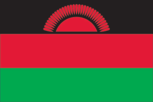
three equal horizontal bands of black (top), red, and green with a radiant, rising, red sun centered in the black band
GDP
purchasing power parity - $9.4 billion (2000 est.)
GDP - composition by sector
agriculture: 37% industry: 29% services: 34% (1998 est.)
GDP - per capita
purchasing power parity - $900 (2000 est.)
GDP - real growth rate
3% (2000 est.)
Government - note
the executive exerts considerable influence over the legislature Malawi Economy
Highways
total: 16,451 km paved: 3,126 km unpaved: 13,325 km (1997)
Household income or consumption by percentage share
lowest 10%: NA% highest 10%: NA%
Imports
$435 million (f.o.b., 2000)
Imports - commodities
food, petroleum products, semimanufactures, consumer goods, transportation equipment
Imports - partners
South Africa 43%, Zimbabwe 14%, UK 5%, Germany 5%, Zambia, Japan, US (1999)
Industrial production growth rate
NA%
Industries
tobacco, tea, sugar, sawmill products, cement, consumer goods
Inflation rate (consumer prices)
29.5% (2000)
International organization participation
ACP, AfDB, C, CCC, ECA, FAO, G-77, IBRD, ICAO, ICFTU, ICRM, IDA, IFAD, IFC, IFRCS, ILO, IMF, IMO, Intelsat, Interpol, IOC, ISO (correspondent), ITU, NAM, OAU, OPCW, SADC, UN, UNCTAD, UNESCO, UNIDO, UNMIK, UPU, WFTU, WHO, WIPO, WMO, WToO, WTrO
Internet country code
.mw
Internet Service Providers (ISPs)
8 (2001)
Internet users
10,000 (2000) Malawi Transportation
Judicial branch
Supreme Court of Appeal; High Court (chief justice appointed by the president, puisne judges appointed on the advice of the Judicial Service Commission); magistrate's courts
Labor force
3.5 million
Labor force - by occupation
agriculture 86% (1997 est.)
Legislative branch
unicameral National Assembly (193 seats; members elected by popular vote to serve five-year terms) elections: last held 15 June 1999 (next to be held NA 2004) election results: percent of vote by party - UDF 48%, MCP 34%, AFORD 15%, others 3%; seats by party - UDF 94, MCP 66, AFORD 29, others 4
Military branches
Army (includes Air Wing and Naval Detachment), Police (includes paramilitary Mobile Force Unit)
Military expenditures - dollar figure
$9.5 million (FY00/01)
Military expenditures - percent of GDP
0.76% (FY00/01) Malawi Transnational Issues
Military manpower - availability
males age 15-49: 2,466,708 (2001 est.)
Military manpower - fit for military service
males age 15-49: 1,265,893 (2001 est.)
Political parties and leaders
Alliance for Democracy or AFORD [Chakufwa CHIHANA, president]; Malawi Congress Party or MCP [Gwanda CHAKUAMBA, president, John TEMBO, vice president]; Malawi Democratic Party or MDP [Kampelo KALUA, president]; National Independence Party; Social Democratic Party or SDP [Eston KAKHOME, president]; United Democratic Front or UDF [Bakili MULUZI] - governing party
Political pressure groups and leaders
NA
Population below poverty line
54% (FY90/91 est.)
Ports and harbors
Chipoka, Monkey Bay, Nkhata Bay, Nkhotakota, Chilumba
Radio broadcast stations
AM 9, FM 4 (plus 15 repeater stations), shortwave 3 (1998)
Radios
2.6 million (1997)
Railways
total: 789 km narrow gauge: 789 km 1.067-m gauge
Telephone system
general assessment: NA domestic: fair system of open-wire lines, microwave radio relay links, and radiotelephone communications stations international: satellite earth stations - 2 Intelsat (1 Indian Ocean and 1 Atlantic Ocean)
Telephones - main lines in use
37,000 (1997)
Telephones - mobile cellular
7,000 (1997)
Television broadcast stations
1 (1999)
Televisions
0 (1999)
Unemployment rate
NA%
Waterways
144 km note: on Lake Nyasa (Lake Malawi) and Shire Riverall