2014 Edition
CIA World Factbook 2014 Archive (HTML)
Introduction
Background
Formerly an independent kingdom, Madagascar became a French colony in 1896 but regained independence in 1960. During 1992-93, free presidential and National Assembly elections were held ending 17 years of single-party rule. In 1997, in the second presidential race, Didier RATSIRAKA, the leader during the 1970s and 1980s, was returned to the presidency. The 2001 presidential election was contested between the followers of Didier RATSIRAKA and Marc RAVALOMANANA, nearly causing secession of half of the country. In April 2002, the High Constitutional Court announced RAVALOMANANA the winner. RAVALOMANANA achieved a second term following a landslide victory in the generally free and fair presidential elections of 2006. In early 2009, protests over increasing restrictions on opposition press and activities resulted in RAVALOMANANA handing over power to the military, which then conferred the presidency on the mayor of Antananarivo, Andry RAJOELINA, in what amounted to a coup d'etat. Following a lengthy mediation process led by the Southern African Development Community (SADC), Madagascar held UN-supported presidential and parliamentary elections in 2013. Former de facto finance minister Hery RAJAONARIMAMPIANINA defeated RAVALOMANANA's favored candidate Jean-Louis ROBINSON in a presidential runoff and was inaugurated in January 2014. Most international observers, while noting some irregularities, declared polls to be a credible reflection of the Malagasy public's will.
Geography
Area
- 587,041 sq km 581,540 sq km 5,501 sq km
- total
- 587,041 sq km
- water
- 5,501 sq km
Area - comparative
slightly less than twice the size of Arizona
Climate
tropical along coast, temperate inland, arid in south
Coastline
4,828 km
Elevation extremes
- Indian Ocean 0 m Maromokotro 2,876 m
- highest point
- Maromokotro 2,876 m
- lowest point
- Indian Ocean 0 m
Environment - current issues
soil erosion results from deforestation and overgrazing; desertification; surface water contaminated with raw sewage and other organic wastes; several endangered species of flora and fauna unique to the island
Environment - international agreements
- Biodiversity, Climate Change, Climate Change-Kyoto Protocol, Desertification, Endangered Species, Hazardous Wastes, Law of the Sea, Marine Life Conservation, Ozone Layer Protection, Ship Pollution, Wetlands none of the selected agreements
- party to
- Biodiversity, Climate Change, Climate Change-Kyoto Protocol, Desertification, Endangered Species, Hazardous Wastes, Law of the Sea, Marine Life Conservation, Ozone Layer Protection, Ship Pollution, Wetlands
- signed, but not ratified
- none of the selected agreements
Freshwater withdrawal (domestic/industrial/agricultural)
- 16.5 cu km/yr (2%/1%/97%) 1,010 cu m/yr (2005)
- per capita
- 1,010 cu m/yr (2005)
- total
- 16.5 cu km/yr (2%/1%/97%)
Geographic coordinates
20 00 S, 47 00 E
Geography - note
world's fourth-largest island; strategic location along Mozambique Channel
Irrigated land
10,860 sq km (2003)
Land boundaries
0 km
Land use
- 5.96% 1.02% 93.02% (2011)
- arable land
- 5.96%
- other
- 93.02% (2011)
- permanent crops
- 1.02%
Location
Southern Africa, island in the Indian Ocean, east of Mozambique
Map references
Africa
Maritime claims
- 12 nm 24 nm 200 nm 200 nm or 100 nm from the 2,500-m isobath
- contiguous zone
- 24 nm
- continental shelf
- 200 nm or 100 nm from the 2,500-m isobath
- exclusive economic zone
- 200 nm
- territorial sea
- 12 nm
Natural hazards
- periodic cyclones; drought; and locust infestation Madagascar's volcanoes have not erupted in historical times
- volcanism
- Madagascar's volcanoes have not erupted in historical times
Natural resources
graphite, chromite, coal, bauxite, rare earth elements, salt, quartz, tar sands, semiprecious stones, mica, fish, hydropower
Terrain
narrow coastal plain, high plateau and mountains in center
Total renewable water resources
337 cu km (2011)
People and Society
Age structure
- 40.7% (male 4,765,523/female 4,685,298) 20.6% (male 2,394,146/female 2,384,564) 31.3% (male 3,635,506/female 3,629,204) 4.2% (male 466,263/female 503,375) 3.1% (male 334,533/female 403,514) (2014 est.)
- 0-14 years
- 40.7% (male 4,765,523/female 4,685,298)
- 15-24 years
- 20.6% (male 2,394,146/female 2,384,564)
- 25-54 years
- 31.3% (male 3,635,506/female 3,629,204)
- 55-64 years
- 4.2% (male 466,263/female 503,375)
- 65 years and over
- 3.1% (male 334,533/female 403,514) (2014 est.)
Birth rate
33.12 births/1,000 population (2014 est.)
Child labor - children ages 5-14
- 1,827,423 28 % data represents children ages 5-17 (2007 est.)
- percentage
- 28 %
- total number
- 1,827,423
Children under the age of 5 years underweight
36.8% (2004)
Contraceptive prevalence rate
39.9% (2008/09)
Death rate
6.95 deaths/1,000 population (2014 est.)
Dependency ratios
- 81.4 % 76.3 % 5.1 % 19.6 (2014 est.)
- elderly dependency ratio
- 5.1 %
- potential support ratio
- 19.6 (2014 est.)
- total dependency ratio
- 81.4 %
- youth dependency ratio
- 76.3 %
Drinking water source
- urban: 78.2% of population rural: 35.4% of population total: 49.6% of population urban: 21.8% of population rural: 64.6% of population total: 50.4% of population (2012 est.)
- rural
- 64.6% of population
- total
- 50.4% of population (2012 est.)
- urban
- 21.8% of population
Education expenditures
2.7% of GDP (2012)
Ethnic groups
Malayo-Indonesian (Merina and related Betsileo), Cotiers (mixed African, Malayo-Indonesian, and Arab ancestry - Betsimisaraka, Tsimihety, Antaisaka, Sakalava), French, Indian, Creole, Comoran
Health expenditures
4.1% of GDP (2011)
HIV/AIDS - adult prevalence rate
0.5% (2012 est.)
HIV/AIDS - deaths
6,200 (2012 est.)
HIV/AIDS - people living with HIV/AIDS
58,800 (2012 est.)
Hospital bed density
0.2 beds/1,000 population (2010)
Infant mortality rate
- 44.88 deaths/1,000 live births 48.86 deaths/1,000 live births 40.78 deaths/1,000 live births (2014 est.)
- female
- 40.78 deaths/1,000 live births (2014 est.)
- total
- 44.88 deaths/1,000 live births
Languages
French (official), Malagasy (official), English
Life expectancy at birth
- 65.2 years 63.77 years 66.67 years (2014 est.)
- female
- 66.67 years (2014 est.)
- total population
- 65.2 years
Literacy
- age 15 and over can read and write 64.5% 67.4% 61.6% (2009 est.)
- definition
- age 15 and over can read and write
- female
- 61.6% (2009 est.)
- male
- 67.4%
- total population
- 64.5%
Major infectious diseases
- very high bacterial diarrhea, hepatitis A, and typhoid fever malaria and dengue fever schistosomiasis rabies (2013)
- animal contact disease
- rabies (2013)
- degree of risk
- very high
- food or waterborne diseases
- bacterial diarrhea, hepatitis A, and typhoid fever
- vectorborne diseases
- malaria and dengue fever
- water contact disease
- schistosomiasis
Major urban areas - population
ANTANANARIVO (capital) 1.987 million (2011)
Maternal mortality rate
240 deaths/100,000 live births (2010)
Median age
- 19.2 years 19 years 19.4 years (2014 est.)
- female
- 19.4 years (2014 est.)
- male
- 19 years
- total
- 19.2 years
Mother's mean age at first birth
19.5 median age at first birth among women 25-29 (2008-09 est.)
Nationality
- Malagasy (singular and plural) Malagasy
- adjective
- Malagasy
- noun
- Malagasy (singular and plural)
Net migration rate
0 migrant(s)/1,000 population (2014 est.)
Obesity - adult prevalence rate
1.6% (2008)
Physicians density
0.16 physicians/1,000 population (2007)
Population
23,201,926 (July 2014 est.)
Population growth rate
2.62% (2014 est.)
Religions
indigenous beliefs 52%, Christian 41%, Muslim 7%
Sanitation facility access
- urban: 19.2% of population rural: 11.3% of population total: 13.9% of population urban: 80.8% of population rural: 88.7% of population total: 86.1% of population (2012 est.)
- rural
- 88.7% of population
- total
- 86.1% of population (2012 est.)
- urban
- 80.8% of population
School life expectancy (primary to tertiary education)
- 10 years 11 years 10 years (2012)
- female
- 10 years (2012)
- male
- 11 years
- total
- 10 years
Sex ratio
- 1.03 male(s)/female 1.02 male(s)/female 1 male(s)/female 1 male(s)/female 1 male(s)/female 0.83 male(s)/female 1 male(s)/female (2014 est.)
- 0-14 years
- 1.02 male(s)/female
- 15-24 years
- 1 male(s)/female
- 25-54 years
- 1 male(s)/female
- 55-64 years
- 1 male(s)/female
- 65 years and over
- 0.83 male(s)/female
- at birth
- 1.03 male(s)/female
- total population
- 1 male(s)/female (2014 est.)
Total fertility rate
4.28 children born/woman (2014 est.)
Unemployment, youth ages 15-24
- 2.3% 1.7% 2.8% (2005)
- female
- 2.8% (2005)
- total
- 2.3%
Urbanization
- 32.6% of total population (2011) 4.73% annual rate of change (2010-15 est.)
- rate of urbanization
- 4.73% annual rate of change (2010-15 est.)
- urban population
- 32.6% of total population (2011)
Government
Administrative divisions
Hi Trent,6 provinces (faritany); Antananarivo, Antsiranana, Fianarantsoa, Mahajanga, Toamasina, Toliara
Capital
- Antananarivo 18 55 S, 47 31 E UTC+3 (8 hours ahead of Washington, DC, during Standard Time)
- geographic coordinates
- 18 55 S, 47 31 E
- name
- Antananarivo
- time difference
- UTC+3 (8 hours ahead of Washington, DC, during Standard Time)
Constitution
previous 1992; latest passed by referendum 17 November 2010, promulgated 11 December 2010 (2012)
Country name
- Republic of Madagascar Madagascar Republique de Madagascar/Repoblikan'i Madagasikara Madagascar/Madagasikara Malagasy Republic
- conventional long form
- Republic of Madagascar
- conventional short form
- Madagascar
- former
- Malagasy Republic
- local long form
- Republique de Madagascar/Repoblikan'i Madagasikara
- local short form
- Madagascar/Madagasikara
Diplomatic representation from the US
- Ambassador (vacant); Charge d'Affaires Eric WONG note - also accredited to Comoros Lot 207A, Point Liberty, Andranoro, Antehiroka, 105 Antananarivo B. P. 620, Antsahavola, Antananarivo [261] (23) 480 00/01 [261] (23) 480 35
- chief of mission
- Ambassador (vacant); Charge d'Affaires Eric WONG note - also accredited to Comoros
- embassy
- Lot 207A, Point Liberty, Andranoro, Antehiroka, 105 Antananarivo
- FAX
- [261] (23) 480 35
- mailing address
- B. P. 620, Antsahavola, Antananarivo
- telephone
- [261] (23) 480 00/01
Diplomatic representation in the US
- Ambassador (vacant); Charge d'Affaires Velotiana Rakotoanosy RAOBELINA (since 20 June 1011) 2374 Massachusetts Avenue NW, Washington, DC 20008 [1] (202) 265-5525 through 5526 [1] (202) 265-3034 New York
- chancery
- 2374 Massachusetts Avenue NW, Washington, DC 20008
- chief of mission
- Ambassador (vacant); Charge d'Affaires Velotiana Rakotoanosy RAOBELINA (since 20 June 1011)
- consulate(s) general
- New York
- FAX
- [1] (202) 265-3034
- telephone
- [1] (202) 265-5525 through 5526
Executive branch
- President Hery Martial RAJAONARIMAMPIANINA Rakotoarimana (since 25 January 2014) Prime Minister Roger Laurent Christophe KOLO, M.D. (since 11 April 2014) Council of Ministers appointed by the prime minister president elected by popular vote for a five-year term (eligible for a second term); election last held on 20 December 2013 (next to be held in 2018); prime minister nominated by the National Assembly and appointed by the president Hery RAJAONARIMAMPIANINA elected president in second round; percent of vote - Hery RAJAONARIMAMPIANINA 53.5%, Jean Louis ROBINSON 46.5% on 17 March 2009, democratically elected President Marc RAVALOMANANA stepped down handing the government over to the military, which in turn conferred the presidency on opposition leader and Antananarivo mayor Andry RAJOELINA; a power-sharing agreement established a 15-month transition period to conclude with a general election in 2010, which failed to occur; a subsequent agreement aimed for an early 2013 election - the first round was held on 25 October 2013 and the second on 20 December 2013
- cabinet
- Council of Ministers appointed by the prime minister
- chief of state
- President Hery Martial RAJAONARIMAMPIANINA Rakotoarimana (since 25 January 2014)
- election results
- Hery RAJAONARIMAMPIANINA elected president in second round; percent of vote - Hery RAJAONARIMAMPIANINA 53.5%, Jean Louis ROBINSON 46.5%
- elections
- president elected by popular vote for a five-year term (eligible for a second term); election last held on 20 December 2013 (next to be held in 2018); prime minister nominated by the National Assembly and appointed by the president
- head of government
- Prime Minister Roger Laurent Christophe KOLO, M.D. (since 11 April 2014)
Flag description
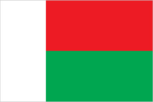
two equal horizontal bands of red (top) and green with a vertical white band of the same width on hoist side; by tradition, red stands for sovereignty, green for hope, white for purity
Government type
republic
Independence
26 June 1960 (from France)
International law organization participation
accepts compulsory ICJ jurisdiction with reservations; accepts ICCt jurisdiction
International organization participation
ACP, AfDB, AU, CD, COMESA, EITI (candidate country), FAO, G-77, IAEA, IBRD, ICAO, ICC (national committees), ICRM, IDA, IFAD, IFC, IFRCS, ILO, IMF, IMO, InOC, Interpol, IOC, IOM, ISO (correspondent), ITSO, ITU, ITUC (NGOs), MIGA, NAM, OIF, OPCW, PCA, SADC, UN, UNCTAD, UNESCO, UNHCR, UNIDO, UNWTO, UPU, WCO, WFTU (NGOs), WHO, WIPO, WMO, WTO
Judicial branch
- Supreme Court or Cour Supreme (consists of 11 members; addresses judicial administration issues only); High Constitutional Court or Haute Cour Constitutionnelle (consists of 9 members) note - the judiciary includes a High Court of Justice responsible for adjudicating crimes and misdemeanors by government officials including the president Supreme Court heads elected by the president and judiciary officials to serve single-renewable, 3-year terms; High Constitutional Court members appointed - 3 each by the president, by both legislative bodies, and by the Council of Magistrates; members serve single, 6-year terms Courts of Appeal; provincial and city tribunals
- highest court(s)
- Supreme Court or Cour Supreme (consists of 11 members; addresses judicial administration issues only); High Constitutional Court or Haute Cour Constitutionnelle (consists of 9 members)
- judge selection and term of office
- Supreme Court heads elected by the president and judiciary officials to serve single-renewable, 3-year terms; High Constitutional Court members appointed - 3 each by the president, by both legislative bodies, and by the Council of Magistrates; members serve single, 6-year terms
- subordinate courts
- Courts of Appeal; provincial and city tribunals
Legal system
civil law system based on the old French civil code and customary law in matters of marriage, family, and obligation
Legislative branch
- bicameral legislature consists of a Senate or Senat (33 seats; 22 elected from each of the 22 regions; the remaining 11 appointed by the president; members to serve six-year terms) and a National Assembly or Assemblee Nationale (151 seats in the December 2013 election; reduced from 160 seats to 127 seats by an April 2007 national referendum - never used; members elected by popular vote to serve four-year terms) National Assembly - last held on 20 December 2013 (next to be held in 2017); note - a power-sharing agreement in the summer of 2009 established a 15-month transition, concluding in general elections scheduled for late 2013 after repeated delays National Assembly - percent of vote by party - Party of Andry Rajoelina 17.3%, Ravalomannana Movement 10.8%, Vondrona Politika 8.2%, independents and others 63.7%; seats by party - Party of Andry Rajoelina 49, the Ravalomannana Movement 20, Malagasy Miara Mianinga 13, independents 25, seats with delayed elections 4, other 40
- election results
- National Assembly - percent of vote by party - Party of Andry Rajoelina 17.3%, Ravalomannana Movement 10.8%, Vondrona Politika 8.2%, independents and others 63.7%; seats by party - Party of Andry Rajoelina 49, the Ravalomannana Movement 20, Malagasy Miara Mianinga 13, independents 25, seats with delayed elections 4, other 40
- elections
- National Assembly - last held on 20 December 2013 (next to be held in 2017); note - a power-sharing agreement in the summer of 2009 established a 15-month transition, concluding in general elections scheduled for late 2013 after repeated delays
National anthem
- "Ry Tanindraza nay malala o" (Oh, Our Beloved Fatherland) Pasteur RAHAJASON/Norbert RAHARISOA adopted 1959
- lyrics/music
- Pasteur RAHAJASON/Norbert RAHARISOA
- name
- "Ry Tanindraza nay malala o" (Oh, Our Beloved Fatherland)
National holiday
Independence Day, 26 June (1960)
Political parties and leaders
AVANA Party [Jean-Louis ROBINSON] Economic Liberalism and Democratic Action for National Recovery or LEADER/Fanilo [Manasse ESOAVELOMANDROSO] Green Party or Parti Vert [Sarah Georget RABEHARISOA] I Love Madagascar or TIM [Marc RAVALOMANANA] Judged by Your Work or AVI [Norbert RATSIRAHONANA] Malagasy Miara-Miainga or MMM [Hajo ANDRIANAINARIVELO] Malagasy Tonga Saina or MTS [Roland RATSIRAKA] Movement for Democracy in Madagascar or MDM [Pierrot RAJAONARIVELO] New Force for Madagascar of FIDIO [Hery RAJAONARIMAMPIANINA] Renewal of the Social Democratic Party or RPSD [Evariste MARSON] Socialist and Democratic Party for the Unity of Madagascar or PSDUM [Jean LAHINIRIKO] Union Party or Tambatra [Pety RAKOTONIAINA] Young Malagasies Determined or TGV [Andry RAJOELINA]
Political pressure groups and leaders
Committee for the Defense of Truth and Justice or KMMR Committee for National Reconciliation or CRN [Albert Zafy] National Council of Christian Churches or FFKM
Suffrage
18 years of age; universal
Economy
Agriculture - products
coffee, vanilla, sugarcane, cloves, cocoa, rice, cassava (manioc, tapioca), beans, bananas, peanuts; livestock products
Budget
- $2.113 billion $2.356 billion (2013 est.)
- expenditures
- $2.356 billion (2013 est.)
- revenues
- $2.113 billion
Budget surplus (+) or deficit (-)
-2.3% of GDP (2013 est.)
Central bank discount rate
5% (31 December 2010 est.) NA% (31 December 2009 est.)
Commercial bank prime lending rate
44% (31 December 2013 est.) 56.25% (31 December 2012 est.)
Current account balance
-$1.945 billion (2013 est.) -$1.989 billion (2012 est.)
Debt - external
$3.361 billion (31 December 2013 est.) $3.116 billion (31 December 2012 est.)
Distribution of family income - Gini index
47.5 (2001) 38.1 (1999)
Economy - overview
After discarding socialist economic policies in the mid-1990s, Madagascar followed a World Bank- and IMF-led policy of privatization and liberalization that has been undermined since the start of the political crisis. This strategy placed the country on a slow and steady growth path from an extremely low level. Agriculture, including fishing and forestry, is a mainstay of the economy, accounting for more than one-fourth of GDP and employing 80% of the population. Exports of apparel boomed in recent years primarily due to duty-free access to the US; however, Madagascar's failure to comply with the requirements of the African Growth and Opportunity Act (AGOA) led to the termination of the country's duty-free access in January 2010 and a sharp fall in textile production. Deforestation and erosion, aggravated by the use of firewood as the primary source of fuel, are serious concerns. The current political crisis, which began in early 2009, has dealt additional blows to the economy. Tourism dropped more than 50% in 2009 compared with the previous year, and many investors are wary of entering the uncertain investment environment. Growth was slow during 2010 to 2013 although expansion in mining and agricultural sectors is expected to contribute to more growth in 2014. International organizations and foreign donors are expected to resume development aid to Madagascar once RAJAONARIMAMPIANINA appoints a new government.
Exchange rates
Malagasy ariary (MGA) per US dollar - 2,227.8 (2013 est.) 2,195 (2012 est.) 2,090 (2010 est.) 1,956.2 (2009) 1,654.78 (2008)
Exports
$644.4 million (2013 est.) $592.1 million (2012 est.)
Exports - commodities
coffee, vanilla, shellfish, sugar, cotton cloth, clothing, chromite, petroleum products
Exports - partners
France 23.4%, China 6.6%, US 6.6%, Singapore 5.9%, Canada 5.5%, Germany 5.4%, Indonesia 5.3%, India 5.2%, South Africa 4.5% (2012)
Fiscal year
calendar year
GDP - composition, by end use
- 84% 12.7% 14% 0% 24.7% -35.3% (2013 est.)
- exports of goods and services
- 24.7%
- government consumption
- 12.7%
- household consumption
- 84%
- imports of goods and services
- -35.3%
- investment in fixed capital
- 14%
- investment in inventories
- 0%
GDP - composition, by sector of origin
- 27.3% 16.4% 56.3% (2013 est.)
- agriculture
- 27.3%
- industry
- 16.4%
- services
- 56.3% (2013 est.)
GDP - per capita (PPP)
$1,000 (2013 est.) $1,000 (2012 est.) $1,000 (2011 est.) data are in 2013 US dollars
GDP - real growth rate
2.6% (2013 est.) 1.9% (2012 est.) 1.8% (2011 est.)
GDP (official exchange rate)
$10.53 billion (2013 est.)
GDP (purchasing power parity)
$22.03 billion (2013 est.) $21.47 billion (2012 est.) $21.06 billion (2011 est.) data are in 2013 US dollars
Gross national saving
-3.7% of GDP (2013 est.) -5.8% of GDP (2012 est.) -7.2% of GDP (2011 est.)
Household income or consumption by percentage share
- 2.2% 34.7% (2010 est.)
- highest 10%
- 34.7% (2010 est.)
- lowest 10%
- 2.2%
Imports
$2.794 billion (2013 est.) $2.755 billion (2012 est.)
Imports - commodities
capital goods, petroleum, consumer goods, food
Imports - partners
China 17.7%, France 12.4%, South Africa 5.3%, India 5.1%, Mauritius 5%, Bahrain 4.7%, Kuwait 4.6% (2012)
Industrial production growth rate
4% (2013 est.)
Industries
meat processing, seafood, soap, beer, leather, sugar, textiles, glassware, cement, automobile assembly plant, paper, petroleum, tourism
Inflation rate (consumer prices)
8.8% (2013 est.) 6.4% (2012 est.)
Labor force
9.504 million (2007)
Market value of publicly traded shares
$NA
Population below poverty line
50% (2004 est.)
Reserves of foreign exchange and gold
$1.249 billion (31 December 2013 est.) $1.191 billion (31 December 2012 est.)
Stock of broad money
$3.163 billion (31 December 2013 est.) $2.357 billion (31 December 2012 est.)
Stock of direct foreign investment - abroad
$NA
Stock of direct foreign investment - at home
$NA
Stock of domestic credit
$1.663 billion (31 December 2013 est.) $1.245 billion (31 December 2012 est.)
Stock of narrow money
$1.839 billion (31 December 2013 est.) $1.492 billion (31 December 2012 est.)
Taxes and other revenues
20.1% of GDP (2013 est.)
Energy
Carbon dioxide emissions from consumption of energy
1.843 million Mt (2011 est.)
Crude oil - exports
0 bbl/day (2010 est.)
Crude oil - imports
0 bbl/day (2010 est.)
Crude oil - production
0 bbl/day (2012 est.)
Crude oil - proved reserves
0 bbl (1 January 2013 est.)
Electricity - consumption
1.126 billion kWh (2010 est.)
Electricity - exports
0 kWh (2012 est.)
Electricity - from fossil fuels
65.6% of total installed capacity (2010 est.)
Electricity - from hydroelectric plants
34.4% of total installed capacity (2010 est.)
Electricity - from nuclear fuels
0% of total installed capacity (2010 est.)
Electricity - from other renewable sources
0% of total installed capacity (2010 est.)
Electricity - imports
0 kWh (2012 est.)
Electricity - installed generating capacity
430,000 kW (2010 est.)
Electricity - production
1.211 billion kWh (2010 est.)
Natural gas - consumption
0 cu m (2010 est.)
Natural gas - exports
0 cu m (2011 est.)
Natural gas - imports
0 cu m (2011 est.)
Natural gas - production
0 cu m (2011 est.)
Natural gas - proved reserves
2.01 billion cu m (1 January 2012 est.)
Refined petroleum products - consumption
17,480 bbl/day (2011 est.)
Refined petroleum products - exports
365 bbl/day (2010 est.)
Refined petroleum products - imports
12,120 bbl/day (2010 est.)
Refined petroleum products - production
0 bbl/day (2010 est.)
Communications
Broadcast media
state-owned Radio Nationale Malagasy (RNM) and Television Malagasy (TVM) have an extensive national network reach; privately owned radio and TV broadcasters in cities and major towns; state-run radio dominates in rural areas; relays of 2 international broadcasters are available in Antananarivo (2007)
Internet country code
.mg
Internet hosts
38,392 (2012)
Internet users
319,900 (2009)
Telephone system
- system is above average for the region; Antananarivo's main telephone exchange modernized in the late 1990s, but the rest of the analogue-based telephone system is poorly developed combined fixed-line and mobile-cellular teledensity about 40 per 100 persons country code - 261; landing point for the EASSy, SEACOM, and LION fiber-optic submarine cable systems; satellite earth stations - 2 (1 Intelsat - Indian Ocean, 1 Intersputnik - Atlantic Ocean region) (2010)
- domestic
- combined fixed-line and mobile-cellular teledensity about 40 per 100 persons
- general assessment
- system is above average for the region; Antananarivo's main telephone exchange modernized in the late 1990s, but the rest of the analogue-based telephone system is poorly developed
- international
- country code - 261; landing point for the EASSy, SEACOM, and LION fiber-optic submarine cable systems; satellite earth stations - 2 (1 Intelsat - Indian Ocean, 1 Intersputnik - Atlantic Ocean region) (2010)
Telephones - main lines in use
143,700 (2012)
Telephones - mobile cellular
8.564 million (2012)
Transportation
Airports
83 (2013)
Airports - with paved runways
- 1 (2013)
- 1,524 to 2,437 m
- 6
- 2,438 to 3,047 m
- 2
- 914 to 1,523 m
- 16
- over 3,047 m
- 1
- total
- 26
- under 914 m
- 1 (2013)
Airports - with unpaved runways
- 18 (2013)
- 1,524 to 2,437 m
- 1
- 914 to 1,523 m
- 38
- total
- 57
Merchant marine
- cargo 1 1 (unknown 1) (2010)
- registered in other countries
- 1 (unknown 1) (2010)
- total
- 1
Ports and terminals
- Antsiranana (Diego Suarez), Mahajanga, Toamasina, Toliara (Tulear)
- major seaport(s)
- Antsiranana (Diego Suarez), Mahajanga, Toamasina, Toliara (Tulear)
Railways
- 854 km 854 km 1.000-m gauge (2008)
- total
- 854 km
Roadways
- 34,476 km 5,613 km 2,886 km (2010)
- total
- 34,476 km
- unpaved
- 2,886 km (2010)
Waterways
600 km (432 km navigable) (2011)
Military and Security
Manpower available for military service
- 4,900,729 4,909,061 (2010 est.)
- females age 16-49
- 4,909,061 (2010 est.)
- males age 16-49
- 4,900,729
Manpower fit for military service
- 3,390,071 3,682,180 (2010 est.)
- females age 16-49
- 3,682,180 (2010 est.)
- males age 16-49
- 3,390,071
Manpower reaching militarily significant age annually
- 248,184 246,769 (2010 est.)
- female
- 246,769 (2010 est.)
- male
- 248,184
Military branches
- People's Armed Forces: Intervention Force, Development Force, and Aeronaval Force (navy and air); National Gendarmerie
- People's Armed Forces
- Intervention Force, Development Force, and Aeronaval Force (navy and air); National Gendarmerie
Military expenditures
0.69% of GDP (2012) 0.73% of GDP (2011) 0.69% of GDP (2010)
Military service age and obligation
18-25 years of age for male-only voluntary military service; no conscription; service obligation is 18 months for military or equivalent civil service; 20-30 years of age for National Gendarmerie recruits and 35 years of age for those with military experience (2012)
Transnational Issues
Disputes - international
claims Bassas da India, Europa Island, Glorioso Islands, and Juan de Nova Island (all administered by France); the vegetated drying cays of Banc du Geyser, which were claimed by Madagascar in 1976, also fall within the EEZ claims of the Comoros and France (Glorioso Islands, part of the French Southern and Antarctic Lands)
Illicit drugs
illicit producer of cannabis (cultivated and wild varieties) used mostly for domestic consumption; transshipment point for heroin
Trafficking in persons
- Madagascar is a source country for men, women, and children subjected to forced labor and women and children subjected to sex trafficking; poor Malagasy women hired as domestic workers in Lebanon and Kuwait are vulnerable to abuse by recruitment agencies and employers; an increasing number of Malagasy men were victimized by labor trafficking abroad in 2012; Malagasy children are subjected to domestic servitude, prostitution, forced begging, and forced labor within the country, often with the complicity of family members; coastal cities have child sex tourism trades, with Malagasy men being the main clients Tier 2 Watch List - Madagascar does not fully comply with the minimum standards for the elimination of trafficking; however, it is making significant efforts to do so; law enforcement authorities have made a significant increase in efforts in 2012, resulting in 30 trafficking-related prosecutions and two convictions; public officials complicity in human trafficking, however, remains a significant problem; the government has failed to identify and refer victims to protective services and has not supported NGO-run care facilities; the government also has not engaged any Middle Eastern governments regarding the protection of and legal remedies for Malagasy workers exploited abroad (2013)
- current situation
- Madagascar is a source country for men, women, and children subjected to forced labor and women and children subjected to sex trafficking; poor Malagasy women hired as domestic workers in Lebanon and Kuwait are vulnerable to abuse by recruitment agencies and employers; an increasing number of Malagasy men were victimized by labor trafficking abroad in 2012; Malagasy children are subjected to domestic servitude, prostitution, forced begging, and forced labor within the country, often with the complicity of family members; coastal cities have child sex tourism trades, with Malagasy men being the main clients
- tier rating
- Tier 2 Watch List - Madagascar does not fully comply with the minimum standards for the elimination of trafficking; however, it is making significant efforts to do so; law enforcement authorities have made a significant increase in efforts in 2012, resulting in 30 trafficking-related prosecutions and two convictions; public officials complicity in human trafficking, however, remains a significant problem; the government has failed to identify and refer victims to protective services and has not supported NGO-run care facilities; the government also has not engaged any Middle Eastern governments regarding the protection of and legal remedies for Malagasy workers exploited abroad (2013)