2000 Edition
CIA World Factbook 2000 (Project Gutenberg)
Introduction
Background
Formerly an independent kingdom, Madagascar became a French colony in 1886, but regained its independence in 1960. During 1992-93, free presidential and National Assembly elections were held, ending 17 years of single-party rule.
Geography
Area
- land
- 581,540 sq km
- total
- 587,040 sq km
- water
- 5,500 sq km
Area - comparative
slightly less than twice the size of Arizona
Climate
tropical along coast, temperate inland, arid in south
Coastline
4,828 km
Elevation extremes
- highest point
- Maromokotro 2,876 m
- lowest point
- Indian Ocean 0 m
Environment - current issues
soil erosion results from deforestation and overgrazing; desertification; surface water contaminated with raw sewage and other organic wastes; several species of flora and fauna unique to the island are endangered
Environment - international agreements
- party to
- Biodiversity, Climate Change, Desertification, Endangered Species, Hazardous Wastes, Marine Life Conservation, Nuclear Test Ban, Ozone Layer Protection, Wetlands signed, but not ratified: Law of the Sea
Geographic coordinates
20 00 S, 47 00 E
Geography - note
world's fourth-largest island; strategic location along Mozambique Channel
Irrigated land
10,870 sq km (1993 est.)
Land boundaries
0 km
Land use
- arable land
- 4%
- forests and woodland
- 40%
- other
- 14% (1993 est.)
- permanent crops
- 1%
- permanent pastures
- 41%
Location
Southern Africa, island in the Indian Ocean, east of Mozambique
Map references
Africa
Maritime claims
- contiguous zone
- 24 nm
- continental shelf
- 200 nm or 100 nm from the 2,500-m deep isobath
- exclusive economic zone
- 200 nm
- territorial sea
- 12 nm
Natural hazards
periodic cyclones
Natural resources
graphite, chromite, coal, bauxite, salt, quartz, tar sands, semiprecious stones, mica, fish, hydropower
Terrain
narrow coastal plain, high plateau and mountains in center
People and Society
Age structure
0-14 years: 45% (male 3,504,562; female 3,481,056) 15-64 years: 52% (male 3,964,564; female 4,052,056) 65 years and over: 3% (male 237,691; female 266,543) (2000 est.)
Birth rate
42.92 births/1,000 population (2000 est.)
Death rate
12.69 deaths/1,000 population (2000 est.)
Ethnic groups
Malayo-Indonesian (Merina and related Betsileo), Cotiers (mixed African, Malayo-Indonesian, and Arab ancestry - Betsimisaraka, Tsimihety, Antaisaka, Sakalava), French, Indian, Creole, Comoran
Infant mortality rate
85.26 deaths/1,000 live births (2000 est.)
Languages
French (official), Malagasy (official)
Life expectancy at birth
- female
- 57.26 years (2000 est.)
- male
- 52.71 years
- total population
- 54.95 years
Literacy
- definition
- age 15 and over can read and write
- female
- 73% (1990 est.)
- male
- 88%
- total population
- 80%
Nationality
- adjective
- Malagasy
- noun
- Malagasy (singular and plural)
Net migration rate
0 migrant(s)/1,000 population (2000 est.)
Population
15,506,472 (July 2000 est.)
Population growth rate
3.02% (2000 est.)
Religions
indigenous beliefs 52%, Christian 41%, Muslim 7%
Sex ratio
- at birth
- 1.03 male(s)/female under 15 years: 1.01 male(s)/female 15-64 years: 0.98 male(s)/female 65 years and over: 0.89 male(s)/female
- total population
- 0.99 male(s)/female (2000 est.)
Total fertility rate
5.84 children born/woman (2000 est.)
Government
Administrative divisions
6 provinces (faritany); Antananarivo, Antsiranana, Fianarantsoa, Mahajanga, Toamasina, Toliara
Capital
Antananarivo
Constitution
19 August 1992 by national referendum
Country name
- conventional long form
- Republic of Madagascar
- conventional short form
- Madagascar
- former
- Malagasy Republic
- local long form
- Republique de Madagascar
- local short form
- Madagascar
Data code
MA
Diplomatic representation from the US
- chief of mission
- Ambassador Shirley E. BARNES
- embassy
- 14-16 Rue Rainitovo, Antsahavola, Antananarivo
- mailing address
- B. P. 620, Antananarivo
- telephone
- (2) 212-57, 200-89, 207-18
Diplomatic representation in the US
- chancery
- 2374 Massachusetts Avenue NW, Washington, DC 20008
- chief of mission
- Ambassador (vacant); Charge d'Affaires Biclair Henri ANDRIANANTOANDRO
- consulate(s) general
- New York
- telephone
- (202) 265-5525, 5526
Executive branch
- cabinet
- Council of Ministers appointed by the prime minister
- chief of state
- President Didier RATSIRAKA (since 10 February 1997)
- election results
- Didier RATSIRAKA elected president; percent of vote - Didier RATSIRAKA (AREMA) 50.7%, Albert ZAFY (AFFA) 49.3%
- elections
- president elected by popular vote for a five-year term; election last held 29 December 1996 (next to be held NA 2002); prime minister appointed by the president from a list of candidates nominated by the National Assembly
- head of government
- Prime Minister Tantely Rene Gabriot ANDRIANARIVO (since NA 1998)
FAX
(2) 345-39
Flag description
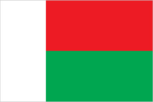
two equal horizontal bands of red (top) and green with a vertical white band of the same width on hoist side
Government type
republic
Independence
26 June 1960 (from France)
International organization participation
ACCT, ACP, AfDB, CCC, ECA, FAO, G-77, IAEA, IBRD, ICAO, ICC, ICFTU, ICRM, IDA, IFAD, IFC, IFRCS, ILO, IMF, IMO, InOC, Intelsat, Interpol, IOC, IOM (observer), ISO (correspondent), ITU, NAM, OAU, OPCW, UN, UNCTAD, UNESCO, UNHCR, UNIDO, UPU, WCL, WFTU, WHO, WIPO, WMO, WToO, WTrO
Judicial branch
Supreme Court or Cour Supreme; High Constitutional Court or Haute Cour Constitutionnelle
Legal system
based on French civil law system and traditional Malagasy law; has not accepted compulsory ICJ jurisdiction
Legislative branch
- unicameral National Assembly or Assemblee Nationale (150 seats; members are directly elected by popular vote to serve four-year terms); note - the legislature is scheduled to become a bicameral Parliament with the establishment of a Senate; two-thirds of the seats of this Senate will be filled by regional assemblies whose members will be elected by popular vote; the remaining one-third of the seats will be appointed by the president; the total number of seats will be determined by the National Assembly; all members will serve four-year terms
- election results
- National Assembly - percent of vote by party - NA; seats by party - AREMA 63, LEADER/Fanilo 16, AVI 14, RPSD 11, AFFA 6, MFM 3, AKFM/Fanavaozana 3, GRAD/Iloafo 1, Fihaonana 1, independents 32
- elections
- National Assembly - last held 17 May 1998 (next to be held NA 2002)
National holiday
Independence Day, 26 June (1960)
Political parties and leaders
Action, Truth, Development, and Harmony or AFFA ; Association for the Rebirth of Madagascar or AREMA ; Congress Party for Malagasy Independence or AKFM/Fanavaozana [Pastor Richard ANDRIAMANJATO]; Economic Liberalism and Democratic Action for National Recovery or LEADER/Fanilo ; Fihaonana Rally or Fihaonana ; Group of Reflection and Action for the Development of Madagascar or GRAD/Iloafo ; Judged by Your Work or AVI ; Movement for the Progress of Madagascar or MFM ; National Union for Development and Democracy or UNDD; Renewal of the Social Democratic Party or RPSD
Political pressure groups and leaders
Federalist Movement; National Council of Christian Churches or FFKM
Suffrage
18 years of age; universal
Economy
Agriculture - products
coffee, vanilla, sugarcane, cloves, cocoa, rice, cassava (tapioca), beans, bananas, peanuts; livestock products
Budget
- expenditures
- $735 million, including capital expenditures of $NA (1998 est.)
- revenues
- $553 million
Currency
1 Malagasy franc (FMG) = 100 centimes
Debt - external
$4.1 billion (1997 est.)
Economic aid - recipient
$838 million (1997)
Economy - overview
Madagascar faces problems of chronic malnutrition, underfunded health and education facilities, a roughly 3% annual population growth rate, and severe loss of forest cover, accompanied by erosion. Agriculture, including fishing and forestry, is the mainstay of the economy, accounting for 34% of GDP and contributing more than 70% to export earnings. Industry features textile manufacturing and the processing of agricultural products. Growth in output in 1992-97 averaged less than the growth rate of the population. Growth has been held back by antigovernment strikes and demonstrations, a decline in world coffee demand, and the erratic commitment of the government to economic reform. Formidable obstacles stand in the way of Madagascar's realizing its considerable growth potential; the extent of government reforms, outside financial aid, and foreign investment will be key determinants. Growth should be in the 5% range in 2000-01.
Electricity - consumption
698 million kWh (1998)
Electricity - exports
0 kWh (1998)
Electricity - imports
0 kWh (1998)
Electricity - production
750 million kWh (1998)
Electricity - production by source
- fossil fuel
- 33.33%
- hydro
- 66.67%
- nuclear
- 0%
- other
- 0% (1998)
Exchange rates
Malagasy francs (FMG) per US$1 - 6,302.9 (October 1999), 5,877.81 (1999), 5,441.4 (1998), 5,090.9 (1997), 4,061.3 (1996), 4,265.6 (1995)
Exports
$600 million (f.o.b., 1998 est.)
Exports - commodities
coffee 45%, vanilla 20%, cloves, shellfish, sugar, petroleum products (1995 est.)
Exports - partners
France 40%, US 9%, Germany 8%, Japan 6%, UK 6% (1997)
Fiscal year
calendar year
GDP
purchasing power parity - $11.5 billion (1999 est.)
GDP - composition by sector
- agriculture
- 34%
- industry
- 12%
- services
- 54% (1997 est.)
GDP - per capita
purchasing power parity - $780 (1999 est.)
GDP - real growth rate
4.5% (1999 est.)
Household income or consumption by percentage share
lowest 10%: 2.3% highest 10%: 34.9% (1993)
Imports
$881 million (c.i.f., 1998 est.)
Imports - commodities
intermediate manufactures 30%, capital goods 28%, petroleum 15%, consumer goods 14%, food 13% (1995 est.)
Imports - partners
France 39%, Hong Kong 5%, Japan 5%, China, Singapore (1997)
Industrial production growth rate
5% (1999 est.)
Industries
meat processing, soap, breweries, tanneries, sugar, textiles, glassware, cement, automobile assembly plant, paper, petroleum, tourism
Inflation rate (consumer prices)
9.5% (1999 est.)
Labor force
7 million (1995)
Population below poverty line
NA%
Unemployment rate
NA%
Communications
Internet Service Providers (ISPs)
3 (1999)
Radio broadcast stations
AM 2 (plus 8 repeater stations), FM 7, shortwave 5 (1998)
Radios
3.05 million (1997)
Telephone system
- system is above average for the region
- domestic
- open-wire lines, coaxial cables, microwave radio relay, and tropospheric scatter links
- international
- submarine cable to Bahrain; satellite earth stations - 1 Intelsat (Indian Ocean) and 1 Intersputnik (Atlantic Ocean region)
Telephones - main lines in use
33,000 (1995)
Telephones - mobile cellular
0 (1995)
Television broadcast stations
1 (plus 36 repeaters) (1997)
Televisions
325,000 (1997)
Transportation
Airports
133 (1999 est.)
Airports - with paved runways
- total
- 29 over 3,047 m: 1 2,438 to 3,047 m: 2 1,524 to 2,437 m: 4 914 to 1,523 m: 20 under 914 m: 2 (1999 est.)
Airports - with unpaved runways
- total
- 104 1,524 to 2,437 m: 3 914 to 1,523 m: 59 under 914 m: 42 (1999 est.)
Highways
- paved
- 5,781 km
- total
- 49,837 km
- unpaved
- 44,056 km (1996 est.)
Merchant marine
- ships by type
- cargo 7, chemical tanker 1, liquified gas 1, petroleum tanker 2, roll-on/roll-off 2 (1999 est.)
- total
- 13 ships (1,000 GRT or over) totaling 24,819 GRT/34,173 DWT
Ports and harbors
Antsiranana, Antsohimbondrona, Mahajanga, Toamasina, Toliara
Railways
- narrow gauge
- 883 km 1.000-m gauge (1994)
- total
- 883 km
Waterways
of local importance only; isolated streams and small portions of Lakandranon' Ampangalana (Canal des Pangalanes)
Military and Security
Military branches
Popular Armed Forces (includes Intervention Forces, Development Forces, Aeronaval Forces - includes Navy and Air Force), Gendarmerie, Presidential Security Regiment
Military expenditures - dollar figure
$29 million (FY94)
Military expenditures - percent of GDP
1% (FY94)
Military manpower - availability
males age 15-49: 3,525,754 (2000 est.)
Military manpower - fit for military service
males age 15-49: 2,092,308 (2000 est.)
Military manpower - military age
20 years of age
Military manpower - reaching military age annually
- males
- 149,157 (2000 est.)
Transnational Issues
Disputes - international
claims Bassas da India, Europa Island, Glorioso Islands, Juan de Nova Island, and Tromelin Island (all administered by France)
Illicit drugs
- illicit producer of cannabis (cultivated and wild varieties) used mostly for domestic consumption; transshipment point for heroin
- MALAWI