2016 Edition
CIA World Factbook 2016 Archive (HTML)
Introduction
Background
Colonized by the Portuguese in the 16th century, Macau was the first European settlement in the Far East. Pursuant to an agreement signed by China and Portugal on 13 April 1987, Macau became the Macau Special Administrative Region of the People's Republic of China on 20 December 1999. In this agreement, China promised that, under its "one country, two systems" formula, China's political and economic system would not be imposed on Macau, and that Macau would enjoy a "high degree of autonomy" in all matters except foreign affairs and defense for the subsequent 50 years.
Geography
Area
- 28.2 sq km 28.2 sq km 0 sq km
- land
- 28.2 sq km
- total
- 28.2 sq km
- water
- 0 sq km
Area - comparative
less than one-sixth the size of Washington, DC
Climate
subtropical; marine with cool winters, warm summers
Coastline
41 km
Elevation
- NA lowest point: South China Sea 0 m highest point: Coloane Alto 172 m
- elevation extremes
- lowest point: South China Sea 0 m
- highest point
- Coloane Alto 172 m
- mean elevation
- NA
Environment - current issues
NA
Environment - international agreements
- Marine Dumping (associate member), Ship Pollution (associate member)
- party to
- Marine Dumping (associate member), Ship Pollution (associate member)
Geographic coordinates
22 10 N, 113 33 E
Geography - note
essentially urban; an area of land reclaimed from the sea measuring 5.2 sq km and known as Cotai now connects the islands of Coloane and Taipa; the island area is connected to the mainland peninsula by three bridges
Irrigated land
0 sq km (2012)
Land boundaries
- 3 km China 3 km
- regional border (1)
- China 3 km
- total
- 3 km
Land use
- 0% arable land 0%; permanent crops 0%; permanent pasture 0% 0% 100% (urban area) (2011 est.)
- agricultural land
- 0%
- forest
- 0%
- other
- 100% (urban area) (2011 est.)
Location
Eastern Asia, bordering the South China Sea and China
Map references
Southeast Asia
Maritime claims
not specified
Natural hazards
typhoons
Natural resources
NEGL
Terrain
generally flat
People and Society
Age structure
- 14.22% (male 44,295/female 40,679) 12.36% (male 38,772/female 35,052) 50.41% (male 134,113/female 167,022) 12.97% (male 39,020/female 38,486) 10.04% (male 28,048/female 31,938) (2016 est.)
- 0-14 years
- 14.22% (male 44,295/female 40,679)
- 15-24 years
- 12.36% (male 38,772/female 35,052)
- 25-54 years
- 50.41% (male 134,113/female 167,022)
- 55-64 years
- 12.97% (male 39,020/female 38,486)
- 65 years and over
- 10.04% (male 28,048/female 31,938) (2016 est.)
Birth rate
8.8 births/1,000 population (2016 est.)
Death rate
4.4 deaths/1,000 population (2016 est.)
Dependency ratios
- 28.2% 16.7% 11.5% 8.7% (2015 est.)
- elderly dependency ratio
- 11.5%
- potential support ratio
- 8.7% (2015 est.)
- total dependency ratio
- 28.2%
- youth dependency ratio
- 16.7%
Education expenditures
2.1% of GDP (2013)
Ethnic groups
Chinese 92.4%, Portuguese 0.6%, mixed 1.1%, other 5.9% (includes Macanese - mixed Portuguese and Asian ancestry) (2011 est.)
HIV/AIDS - adult prevalence rate
NA
HIV/AIDS - deaths
NA
HIV/AIDS - people living with HIV/AIDS
NA
Infant mortality rate
- 3.1 deaths/1,000 live births 3.3 deaths/1,000 live births 2.9 deaths/1,000 live births (2016 est.)
- female
- 2.9 deaths/1,000 live births (2016 est.)
- male
- 3.3 deaths/1,000 live births
- total
- 3.1 deaths/1,000 live births
Languages
- Cantonese 83.3%, Mandarin 5%, Hokkien 3.7%, English 2.3%, other Chinese dialects 2%, Tagalog 1.7%, Portuguese 0.7%, other 1.3% Chinese and Portuguese are official languages (2011 est.)
- note
- Chinese and Portuguese are official languages (2011 est.)
Life expectancy at birth
- 84.5 years 81.6 years 87.6 years (2016 est.)
- female
- 87.6 years (2016 est.)
- male
- 81.6 years
- total population
- 84.5 years
Literacy
- age 15 and over can read and write 96.2% 98% 94.6% (2015 est.)
- definition
- age 15 and over can read and write
- female
- 94.6% (2015 est.)
- male
- 98%
- total population
- 96.2%
Median age
- 38.7 years 39.1 years 38.5 years (2016 est.)
- female
- 38.5 years (2016 est.)
- male
- 39.1 years
- total
- 38.7 years
Nationality
- Chinese Chinese
- adjective
- Chinese
- noun
- Chinese
Net migration rate
3.4 migrant(s)/1,000 population (2016 est.)
Population
- 597,425 Macau's statistical agency estimated the total population to be approximately 646,800 as of 31 December 2015 (July 2016 est.)
- note
- Macau's statistical agency estimated the total population to be approximately 646,800 as of 31 December 2015 (July 2016 est.)
Population growth rate
0.77% (2016 est.)
Religions
Buddhist 50%, Roman Catholic 15%, none or other 35% (1997 est.)
Sex ratio
- 1.05 male(s)/female 1.09 male(s)/female 1.11 male(s)/female 0.8 male(s)/female 1.01 male(s)/female 0.88 male(s)/female 0.91 male(s)/female (2016 est.)
- 0-14 years
- 1.09 male(s)/female
- 15-24 years
- 1.11 male(s)/female
- 25-54 years
- 0.8 male(s)/female
- 55-64 years
- 1.01 male(s)/female
- 65 years and over
- 0.88 male(s)/female
- at birth
- 1.05 male(s)/female
- total population
- 0.91 male(s)/female (2016 est.)
Total fertility rate
0.94 children born/woman (2016 est.)
Unemployment, youth ages 15-24
- 5.3% 5.9% 4.5% (2014 est.)
- female
- 4.5% (2014 est.)
- male
- 5.9%
- total
- 5.3%
Urbanization
- 100% of total population (2015) 1.78% annual rate of change (2010-15 est.)
- rate of urbanization
- 1.78% annual rate of change (2010-15 est.)
- urban population
- 100% of total population (2015)
Government
Administrative divisions
none (special administrative region of the People's Republic of China)
Citizenship
see China
Constitution
previous 1976 (Organic Statute of Macau, under Portuguese authority); latest adopted 31 March 1993, effective 20 December 1999 (Basic Law of the Macau Special Administrative Region of the People's Republic of China serves as Macau's constitution); amended 2005, 2012 (2016)
Country name
- Macau Special Administrative Region Macau Aomen Tebie Xingzhengqu (Chinese); Regiao Administrativa Especial de Macau (Portuguese) Aomen (Chinese); Macau (Portuguese) name is thought to derive from the A-Ma Temple - built in 1488 and dedicated to Mazu, the goddess of seafarers and fishermen - which is referred to locally as "Maa Gok" and which in Portuguese became "Macau"; the Chinese name Aomen means "inlet gates"
- conventional long form
- Macau Special Administrative Region
- conventional short form
- Macau
- etymology
- name is thought to derive from the A-Ma Temple - built in 1488 and dedicated to Mazu, the goddess of seafarers and fishermen - which is referred to locally as "Maa Gok" and which in Portuguese became "Macau"; the Chinese name Aomen means "inlet gates"
- official long form
- Aomen Tebie Xingzhengqu (Chinese); Regiao Administrativa Especial de Macau (Portuguese)
- official short form
- Aomen (Chinese); Macau (Portuguese)
Dependency status
special administrative region of the People's Republic of China
Diplomatic representation from the US
the US has no offices in Macau; US Consulate General in Hong Kong is accredited to Macau
Diplomatic representation in the US
none (Special Administrative Region of China)
Executive branch
- President of China XI Jinping (since 14 March 2013) Chief Executive Fernando CHUI Sai On (since 20 December 2009) Executive Council appointed by the chief executive president indirectly elected by National People's Congress for a 5-year term (eligible for a second term); chief executive chosen by a 400-member Election Committee for a 5-year term (eligible for a second term); election last held on 29 August 2014 (next to be held in 2019); note - the Legislative Assembly in August 2012 voted to expand the Election Committee to 400 from 300 seats for the 2014 election Fernando CHUI Sai On reelected chief executive; Election Committee vote count - 380 of 396
- cabinet
- Executive Council appointed by the chief executive
- chief of state
- President of China XI Jinping (since 14 March 2013)
- election results
- Fernando CHUI Sai On reelected chief executive; Election Committee vote count - 380 of 396
- elections/appointments
- president indirectly elected by National People's Congress for a 5-year term (eligible for a second term); chief executive chosen by a 400-member Election Committee for a 5-year term (eligible for a second term); election last held on 29 August 2014 (next to be held in 2019); note - the Legislative Assembly in August 2012 voted to expand the Election Committee to 400 from 300 seats for the 2014 election
- head of government
- Chief Executive Fernando CHUI Sai On (since 20 December 2009)
Flag description
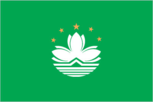
- green with a lotus flower above a stylized bridge and water in white, beneath an arc of five gold, five-pointed stars: one large in the center of the arc and two smaller on either side; the lotus is the floral emblem of Macau, the three petals represent the peninsula and two islands that make up Macau; the five stars echo those on the flag of China
- green with a lotus flower above a stylized bridge and water in white, beneath an arc of five gold, five-pointed stars
- one large in the center of the arc and two smaller on either side; the lotus is the floral emblem of Macau, the three petals represent the peninsula and two islands that make up Macau; the five stars echo those on the flag of China
Government type
presidential limited democracy; a special administrative region of the PRC
Independence
none (special administrative region of China)
International organization participation
ICC (national committees), IHO, IMF, IMO (associate), Interpol (subbureau), ISO (correspondent), UNESCO (associate), UNWTO (associate), UPU, WCO, WMO, WTO
Judicial branch
- Court of Final Appeal of Macau Special Administrative Region (consists of the court president and 2 associate justices) justices appointed by the Macau chief executive upon the recommendation of an independent commission of judges, lawyers, and "eminent" persons; judge tenure NA Court of Second Instance; Court of First instance; Lower Court; Administrative Court
- highest court(s)
- Court of Final Appeal of Macau Special Administrative Region (consists of the court president and 2 associate justices)
- judge selection and term of office
- justices appointed by the Macau chief executive upon the recommendation of an independent commission of judges, lawyers, and "eminent" persons; judge tenure NA
- subordinate courts
- Court of Second Instance; Court of First instance; Lower Court; Administrative Court
Legal system
civil law system based on the Portuguese model
Legislative branch
- unicameral Legislative Council or Regiao Administrativa Especial de Macau (33 seats; 14 members directly elected by proportional representation vote, 12 indirectly elected by an electoral college of professional and commercial interest groups, and 7 appointed by the chief executive; members serve 4-year terms) last held on 15 September 2013 (next to be held in September 2017) percent of vote - ACUM 18.0%, UMG 11.1%, UPP 10.8%, NE 9.0%, NUDM 8.9%, UPD 8.2%, APMD 7.5%, ANMD 6.0%, APM 6.0%, other 14.5%; seats by political group - ACUM 3, UMG 2, UPP 2, NE 2, NUDM 1, UPD 1, APMD 1, ANMD 1, APM 1; 12 seats filled by professional and business groups; 7 members appointed by the chief executive
- description
- unicameral Legislative Council or Regiao Administrativa Especial de Macau (33 seats; 14 members directly elected by proportional representation vote, 12 indirectly elected by an electoral college of professional and commercial interest groups, and 7 appointed by the chief executive; members serve 4-year terms)
- election results
- percent of vote - ACUM 18.0%, UMG 11.1%, UPP 10.8%, NE 9.0%, NUDM 8.9%, UPD 8.2%, APMD 7.5%, ANMD 6.0%, APM 6.0%, other 14.5%; seats by political group - ACUM 3, UMG 2, UPP 2, NE 2, NUDM 1, UPD 1, APMD 1, ANMD 1, APM 1; 12 seats filled by professional and business groups; 7 members appointed by the chief executive
- elections
- last held on 15 September 2013 (next to be held in September 2017)
National anthem
- as a Special Administrative Region of China, "Yiyongjun Jinxingqu" is the official anthem (see China)
- note
- as a Special Administrative Region of China, "Yiyongjun Jinxingqu" is the official anthem (see China)
National holiday
National Day (anniversary of the Founding of the People's Republic of China), 1 October (1949); note - 20 December 1999 is celebrated as Macau Special Administrative Region Establishment Day
National symbol(s)
- lotus blossom; national colors: green, white, yellow
- lotus blossom; national colors
- green, white, yellow
Political parties and leaders
- Alliance for Change or APM [Melinda CHAN Mei-yi] Macau-Guangdong Union or UMG [MAK Soi-kun] New Democratic Macau Association or ANMD (an electoral list of the New Macau Association) New Hope or NE [Jose Maria Pereira COUTINHO] New Macau Association or ANM [Sulu SOU Ka-hou] New Union for Macau's Development or NUDM [Angela LEONG On-kei] Prosperous Democratic Macau Association or APMD (an electoral list of the New Macau Association) Union for Development or UPD [KWAN Tsui-hang] Union for Promoting Progress or UPP [HO Ion-sang] United Citizens Association of Macau or ACUM [CHAN Meng-kam] there is no political party ordinance, so there are no registered political parties; politically active groups register as societies or companies
- note
- there is no political party ordinance, so there are no registered political parties; politically active groups register as societies or companies
Political pressure groups and leaders
Bar-Bending Workers' Association [WONG Wai-Man] Civic Power [Agnes LAM lok-fong] Democratic Action [LEE Kin-yun] Macau New Chinese Youth Association [LEONG Sin-man] Macau Worker's Union [HO Heng-kuok] New Macau Association [Antonio NG Kuok-cheong] Workers' Self-Help Union [CHEONG Weng-fat]
Suffrage
18 years of age in direct elections for some legislative positions, universal for permanent residents living in Macau for the past seven years; note - indirect elections are limited to organizations registered as "corporate voters" (973 were registered in the 2009 legislative elections) and a 400-member Election Committee for the Chief Executive drawn from broad regional groupings, municipal organizations, central government bodies, and elected Macau officials
Economy
Agriculture - products
only 2% of land area is cultivated, mainly by vegetable growers; fishing, mostly for crustaceans, is important; some of the catch is exported to Hong Kong
Budget
- $13.16 billion $6.625 billion (2015 est.)
- expenditures
- $6.625 billion (2015 est.)
- revenues
- $13.16 billion
Budget surplus (+) or deficit (-)
14.2% of GDP (2015 est.)
Commercial bank prime lending rate
5.25% (31 December 2015 est.) 5.25% (31 December 2014 est.)
Current account balance
$12.11 billion (2015 est.) $21.08 billion (2014 est.)
Debt - external
$0 (31 December 2013) $0 (31 December 2012)
Distribution of family income - Gini index
35 (2013) 38 (2008)
Economy - overview
Since opening up its locally-controlled casino industry to foreign competition in 2001, Macau has attracted tens of billions of dollars in foreign investment, transforming the territory into one of the world's largest gaming centers. Macau's gaming and tourism businesses were fueled by China's decision to relax travel restrictions on Chinese citizens wishing to visit Macau. In 2015, Macau's gaming-related taxes accounted for more than 76% of total government revenue. Macau's economy slowed dramatically in 2009 as a result of the global economic slowdown, but strong growth resumed in 2010-13, largely on the back of tourism from mainland China and the gaming sectors. In 2015, this city of 646,800 hosted nearly 30.7 million visitors. Almost 67% came from mainland China. Macau's traditional manufacturing industry has slowed greatly since the termination of the Multi-Fiber Agreement in 2005. Services export — primarily gaming — increasingly has driven Macau’s economic performance. Mainland China’s ongoing anti-corruption campaign has brought Macau’s gambling boom to a halt, with spending in casinos contracting 34.3% in 2015. As a result, Macau's inflation-adjusted GDP contracted 20.3% from 2014, down from double-digit expansion rates in 2010-13. Non-inflation adjusted exports of goods and services dropped 1.8% from 2014, reflecting the slowdown in gaming exports. Macau continues to face the challenges of managing its growing casino industry, risks from money-laundering activities, and the need to diversify the economy away from heavy dependence on gaming revenues. Macau's currency, the pataca, is closely tied to the Hong Kong dollar, which is also freely accepted in the territory.
Exchange rates
patacas (MOP) per US dollar - 7.985 (2015 est.) 7.9871 (2014 est.) 7.9871 (2013 est.) 7.99 (2012 est.) 8.0182 (2011 est.)
Exports
- $1.137 billion (2013 est.) $1.903 billion (2014 est.) includes reexports
- note
- includes reexports
Exports - commodities
clothing, textiles, footwear, toys, electronics, machinery and parts
Exports - partners
Hong Kong 63.4%, China 18.2% (2015)
Fiscal year
calendar year
GDP - composition, by end use
- 25.7% 9.5% 23.1% 1% 77.8% -37.1% (2015 est.)
- exports of goods and services
- 77.8%
- government consumption
- 9.5%
- household consumption
- 25.7%
- imports of goods and services
- -37.1% (2015 est.)
- investment in fixed capital
- 23.1%
- investment in inventories
- 1%
GDP - composition, by sector of origin
- 0% 10.2% 89.8% (2013 est.)
- agriculture
- 0%
- industry
- 10.2%
- services
- 89.8% (2013 est.)
GDP - per capita (PPP)
$98,200 (2015 est.) $129,100 (2014 est.) $136,200 (2013 est.)
GDP - real growth rate
-20.3% (2015 est.) -0.9% (2014 est.) 11.2% (2013 est.)
GDP (official exchange rate)
$46.18 billion (2015 est.)
GDP (purchasing power parity)
- $65.38 billion (2015 est.) $82.09 billion (2014 est.) $82.79 billion (2013 est.) data are in 2013 US dollars
- note
- data are in 2013 US dollars
Household income or consumption by percentage share
- NA% NA%
- highest 10%
- NA%
- lowest 10%
- NA%
Imports
$14.2 billion (2014 est.) $10.13 billion (2013 est.)
Imports - commodities
raw materials and semi-manufactured goods, consumer goods (foodstuffs, beverages, tobacco, garments and footwear, motor vehicles), capital goods, mineral fuels and oils
Imports - partners
China 33.8%, Hong Kong 8.8%, Japan 8.5%, Switzerland 8%, France 6.9%, Italy 6.7%, US 6.7% (2015)
Industrial production growth rate
4% (2015 est.)
Industries
tourism, gambling, clothing, textiles, electronics, footwear, toys
Inflation rate (consumer prices)
4.6% (2015 est.) 6% (2014 est.)
Labor force
403,500 (2015 est.)
Labor force - by occupation
- 2.5% 9.8% 4.4% 12.4% 15% 25.9% 7.1% 2.6% 20.3% (2013 est.)
- construction
- 9.8%
- financial services
- 2.6%
- gambling
- 25.9%
- manufacturing
- 2.5%
- other services
- 20.3% (2013 est.)
- public sector
- 7.1%
- restaurants and hotels
- 15%
- transport and communications
- 4.4%
- wholesale and retail trade
- 12.4%
Market value of publicly traded shares
$85.5 billion (2 March 2012 est.) $46.1 billion (31 February 2011 est.) $2.3 billion (31 December 2008 est.)
Population below poverty line
NA%
Reserves of foreign exchange and gold
- $18.89 billion (31 December 2015 est.) $16.44 billion (31 December 2014 est.) the Fiscal Reserves Act that came into force on 1 January 2012 requires the fiscal reserves to be separated from the foreign exchange reserves and to be managed separately; the transfer of assets took place in February 2012
- note
- the Fiscal Reserves Act that came into force on 1 January 2012 requires the fiscal reserves to be separated from the foreign exchange reserves and to be managed separately; the transfer of assets took place in February 2012
Stock of broad money
$64.67 billion (31 December 2014 est.) $55.29 billion (31 December 2013 est.)
Stock of direct foreign investment - abroad
$1.166 billion (2012 est.) $667.8 million (2011 est.)
Stock of direct foreign investment - at home
$18.91 billion (31 December 2011 est.) $14.91 billion (31 December 2011 est.)
Stock of domestic credit
$10.09 billion (31 December 2015 est.) $-147.8 million (31 December 2014 est.)
Stock of narrow money
$7.623 billion (31 December 2015 est.) $7.66 billion (31 December 2014 est.)
Taxes and other revenues
28.5% of GDP (2015 est.)
Unemployment rate
1.8% (2015 est.) 1.7% (2014 est.)
Energy
Carbon dioxide emissions from consumption of energy
1.8 million Mt (2013 est.)
Crude oil - exports
0 bbl/day (2013 est.)
Crude oil - imports
0 bbl/day (2013 est.)
Crude oil - production
0 bbl/day (2015 est.)
Crude oil - proved reserves
0 bbl (1 January 2016 es)
Electricity - consumption
4.5 billion kWh (2014 est.)
Electricity - exports
0 kWh (2013 est.)
Electricity - from fossil fuels
100% of total installed capacity (2013 est.)
Electricity - from hydroelectric plants
0% of total installed capacity (2013 est.)
Electricity - from nuclear fuels
0% of total installed capacity (2013 est.)
Electricity - from other renewable sources
0% of total installed capacity (2013 est.)
Electricity - imports
4.1 billion kWh (2014 est.)
Electricity - installed generating capacity
500,000 kW (2014 est.)
Electricity - production
600 million kWh (2014 est.)
Electricity access
- 59,742 91% 91% 72% (2012)
- electrification - rural areas
- 72% (2012)
- electrification - total population
- 91%
- electrification - urban areas
- 91%
- population without electricity
- 59,742
Natural gas - consumption
355,000 cu m (2013 est.)
Natural gas - exports
0 cu m (2013 est.)
Natural gas - imports
371,000 cu m (2013 est.)
Natural gas - production
0 cu m (2013 est.)
Natural gas - proved reserves
0 cu m (1 January 2014 es)
Refined petroleum products - consumption
11,000 bbl/day (2014 est.)
Refined petroleum products - exports
0 bbl/day (2013 est.)
Refined petroleum products - imports
10,750 bbl/day (2013 est.)
Refined petroleum products - production
0 bbl/day (2013 est.)
Communications
Broadcast media
local government dominates broadcast media; 2 television stations operated by the government with one broadcasting in Portuguese and the other in Cantonese and Mandarin; 1 cable TV and 4 satellite TV services available; 3 radio stations broadcasting, of which 2 are government-operated (2015)
Internet country code
.mo
Internet users
- 460,000 77.6% (July 2015 est.)
- percent of population
- 77.6% (July 2015 est.)
- total
- 460,000
Telephone system
- fairly modern communication facilities maintained for domestic and international services termination of monopoly over mobile-cellular telephone services in 2001 spurred sharp increase in subscriptions with mobile-cellular teledensity exceeding 300 per 100 persons; fixed-line subscribership appears to have peaked and is now in decline country code - 853; landing point for the SEA-ME-WE-3 submarine cable network that provides links to Asia, the Middle East, and Europe; HF radiotelephone communication facility; satellite earth station - 1 Intelsat (Indian Ocean) (2015)
- domestic
- termination of monopoly over mobile-cellular telephone services in 2001 spurred sharp increase in subscriptions with mobile-cellular teledensity exceeding 300 per 100 persons; fixed-line subscribership appears to have peaked and is now in decline
- general assessment
- fairly modern communication facilities maintained for domestic and international services
- international
- country code - 853; landing point for the SEA-ME-WE-3 submarine cable network that provides links to Asia, the Middle East, and Europe; HF radiotelephone communication facility; satellite earth station - 1 Intelsat (Indian Ocean) (2015)
Telephones - fixed lines
- 146,138 25 (July 2015 est.)
- subscriptions per 100 inhabitants
- 25 (July 2015 est.)
- total
- 146,138
Telephones - mobile cellular
- 1.896 million 320 (July 2015 est.)
- subscriptions per 100 inhabitants
- 320 (July 2015 est.)
- total
- 1.896 million
Transportation
Airports
1 (2013)
Airports - with paved runways
- 1 (2013)
- over 3,047 m
- 1 (2013)
- total
- 1
Civil aircraft registration country code prefix
B-M (2016)
Heliports
2 (2013)
National air transport system
- 1 (registered in China) 17 (registered in China) 2,276,436 25.435 million mt-km (2015)
- annual freight traffic on registered air carriers
- 25.435 million mt-km (2015)
- annual passenger traffic on registered air carriers
- 2,276,436
- inventory of registered aircraft operated by air carriers
- 17 (registered in China)
- number of registered air carriers
- 1 (registered in China)
Ports and terminals
- Macau
- major seaport(s)
- Macau
Roadways
- 424 km 424 km (2014)
- paved
- 424 km (2014)
- total
- 424 km
Military and Security
Military - note
defense is the responsibility of China
Military branches
no regular indigenous military forces
Transnational Issues
Disputes - international
none
Illicit drugs
transshipment point for drugs going into mainland China; consumer of opiates and amphetamines