2007 Edition
CIA World Factbook 2007 (Project Gutenberg)
Introduction
Administrative divisions
none (special administrative region of China)
Age structure
0-14 years: 16.2% (male 37,934/female 35,412) 15-64 years: 75.9% (male 163,975/female 179,830) 65 years and over: 7.9% (male 15,099/female 20,875) (2006 est.)
Agriculture - products
only 2% of land area is cultivated, mainly by vegetable growers; fishing, mostly for crustaceans, is important; some of the catch is exported to Hong Kong
Airports
1 (2006)
Airports - with paved runways
- over 3,047 m
- 1 (2006)
- total
- 1
Area
- land
- 28.2 sq km
- total
- 28.2 sq km
- water
- 0 sq km
Area - comparative
less than one-sixth the size of Washington, DC
Background
Colonized by the Portuguese in the 16th century, Macau was the first European settlement in the Far East. Pursuant to an agreement signed by China and Portugal on 13 April 1987, Macau became the Macau Special Administrative Region (SAR) of China on 20 December 1999. China has promised that, under its "one country, two systems" formula, China's socialist economic system will not be practiced in Macau, and that Macau will enjoy a high degree of autonomy in all matters except foreign and defense affairs for the next 50 years. Geography Macau
Birth rate
8.48 births/1,000 population (2006 est.)
Budget
- expenditures
- $3.16 billion; including capital expenditures of $NA (FY05/06)
- revenues
- $3.16 billion
Climate
subtropical; marine with cool winters, warm summers
Coastline
41 km
Constitution
Basic Law, approved in March 1993 by China's National People's Congress, is Macau's "mini-constitution"
Country name
- conventional long form
- Macau Special Administrative Region
- conventional short form
- Macau
- local long form
- Aomen Tebie Xingzhengqu (Chinese); Regiao Administrativa Especial de Macau (Portuguese)
- local short form
- Aomen (Chinese); Macau (Portuguese)
Currency (code)
pataca (MOP)
Currency code
MOP
Death rate
4.47 deaths/1,000 population (2006 est.)
Debt - external
$3.1 billion (2004)
Dependency status
special administrative region of China
Diplomatic representation from the US
the US has no offices in Macau; US interests are monitored by the US Consulate General in Hong Kong
Diplomatic representation in the US
none (special administrative region of China)
Disputes - international
none
Economic aid - recipient
$NA
Economy - overview
Macau's well-to-do economy has remained one of the most open in the world since its reversion to China in 1999. Apparel exports and tourism are mainstays of the economy. Although the territory was hit hard by the 1997-98 Asian financial crisis and the global downturn in 2001, its economy grew 10.1% in 2002, 14.2% in 2003, and 28.6% in 2004 before slowing to 6.7% in 2005. The economic boom was powered by gambling, tourism, and the construction necessary to support such endeavours. China's decision to ease travel restrictions led to a rapid rise in the number of mainland visitors. The opening of Macau's gaming industry to foreign access in 2001 spurred an increase in public works expenditures. The budget also returned to surplus in 2002 because of the surge in visitors from China and a hike in taxes on gambling profits, which generated about 70% of government revenue. Much of Macau's textile industry may move to the mainland due to the termination in 2005 of the Multi-Fiber Agreement, which provided a near guarantee of export markets, leaving the territory more dependant on gambling and trade-related services to generate growth. The Closer Economic Partnership Agreement (CEPA) between Macau and mainland China that came into effect on 1 January 2004 offers many Macau-made products tariff-free access to the mainland. The range of products covered by CEPA was expanded on 1 January 2005.
Electricity - consumption
2.159 billion kWh (2005)
Electricity - exports
1 million kWh (2004)
Electricity - imports
340.8 million kWh (2005)
Electricity - production
2.027 billion kWh (2005)
Electricity - production by source
- fossil fuel
- 100%
- hydro
- 0%
- nuclear
- 0%
- other
- 0% (2001)
Elevation extremes
- highest point
- Coloane Alto 172.4 m
- lowest point
- South China Sea 0 m
Environment - current issues
NA
Environment - international agreements
- party to
- Marine Dumping -associate member to the London Convention
Ethnic groups
Chinese 95.7%, Macanese (mixed Portuguese and Asian ancestry) 1%, other 3.3% (2001 census)
Exchange rates
patacas per US dollar - 8.011 (2005), 8.022 (2004), 8.021 (2003), 8.033 (2002)
Executive branch
- cabinet
- Executive Council consists of one government secretary, three legislators, four businessmen, one pro-Beijing unionist, and one pro-Beijing educator
- chief of state
- President of China HU Jintao (since 15 March 2003)
- election results
- Edmund HO Hau-wah reelected received 296 votes; three members submitted blank ballots; one member was absent
- elections
- chief executive chosen by a 300-member Election Committee for a five-year term (eligible for a second term); election last held 29 August 2004 (next to be held in 2009)
- head of government
- Chief Executive Edmund HO Hau-wah (since 20 December 1999)
Exports
$3.156 billion f.o.b.; note - includes reexports (2005)
Exports - commodities
clothing, textiles, footwear, toys, electronics, machinery and parts
Exports - partners
US 48.7%, China 14.9%, Hong Kong 9.8%, Germany 5.9% (2005)
Fiscal year
calendar year Communications Macau
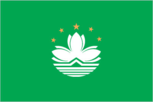
Flag description
light green with a lotus flower above a stylized bridge and water in white, beneath an arc of five gold, five-pointed stars: one large in center of arc and four smaller Economy Macau
GDP - composition by sector
- agriculture
- 0.1%
- industry
- 7.2%
- services
- 92.7% (2002 est.)
GDP - per capita (PPP)
$24,300 (2005)
GDP - real growth rate
6.7% (2005)
GDP (official exchange rate)
$11.56 billion (2005)
GDP (purchasing power parity)
$10 billion (2004)
Geographic coordinates
22 10 N, 113 33 E
Geography - note
essentially urban; an area of land reclaimed from the sea measuring 5.2 sq km and known as Cotai now connects the islands of Coloane and Taipa; the island area is connected to the mainland peninsula by three bridges People Macau
Government type
limited democracy
HIV/AIDS - adult prevalence rate
NA
HIV/AIDS - deaths
NA
HIV/AIDS - people living with HIV/AIDS
NA
Household income or consumption by percentage share
- highest 10%
- NA%
- lowest 10%
- NA%
Imports
$3.912 billion c.i.f. (2005)
Imports - commodities
raw materials and semi-manufactured goods, consumer goods (foodstuffs, beverages, tobacco), capital goods, mineral fuels and oils
Imports - partners
China 43.1%, Japan 10.9%, Hong Kong 10%, Singapore 5.2%, US 4.1%, Taiwan 4% (2005)
Independence
none (special administrative region of China)
Industrial production growth rate
NA%
Industries
tourism, gambling, clothing, textiles, electronics, footwear, toys
Infant mortality rate
- female
- 4.15 deaths/1,000 live births (2006 est.)
- male
- 4.54 deaths/1,000 live births
- total
- 4.35 deaths/1,000 live births
Inflation rate (consumer prices)
4.4% (2005)
International organization participation
IHO, IMF, IMO (associate), ISO (correspondent), UNESCO (associate), UNWTO (associate), UPU, WCO, WMO, WTO
Internet country code
.mo
Internet hosts
108 (2006)
Internet Service Providers (ISPs)
1 (2000)
Internet users
201,000 (2004) Transportation Macau
Irrigated land
NA
Judicial branch
Court of Final Appeal in Macau Special Administrative Region
Labor force
248,000 (2005)
Labor force - by occupation
manufacturing 13.7%, construction 13.7%, transport and communications 5.9%, wholesale and retail trade 10.5%, restaurants and hotels 10.3%, gambling 5.9%, public sector 7.8%, other services and agriculture 19.3% (2005 est.)
Land boundaries
- regional border
- China 0.34 km
- total
- 0.34 km
Land use
- arable land
- 0%
- other
- 100% (2005)
- permanent crops
- 0%
Languages
Cantonese 87.9%, Hokkien 4.4%, Mandarin 1.6%, other Chinese dialects 3.1%, other 3% (2001 census)
Legal system
based on Portuguese civil law system
Legislative branch
- unicameral Legislative Assembly (29 seats; 12 elected by popular vote, 10 by indirect vote, and 7 appointed by the chief executive; members serve four-year terms)
- election results
- percent of vote - New Democratic Macau Association 18.2%, Macau United Citizens' Association 16%, Development Union 12.8%, Macau Development Alliance 9%, others NA; seats by political group - New Democratic Macau Association 2, Macau United Citizens' Association 2, Development Union 2, Macau Development Alliance 1, New Hope 1, United Forces 2, others 2; 10 seats filled by professional and business groups; seven members appointed by chief executive
- elections
- last held 25 September 2005 (next in September 2009)
Life expectancy at birth
- female
- 85.17 years (2006 est.)
- male
- 79.36 years
- total population
- 82.19 years
Literacy
- definition
- age 15 and over can read and write
- female
- 92% (2003 est.) Government Macau
- male
- 97.2%
- total population
- 94.5%
Location
Eastern Asia, bordering the South China Sea and China
Manpower available for military service
- males age 18-49
- 112,744 (2005 est.)
Manpower fit for military service
- males age 18-49
- 91,299 (2005 est.)
Map references
Southeast Asia
Maritime claims
not specified
Median age
- female
- 36.4 years (2006 est.)
- male
- 35.7 years
- total
- 36.1 years
Military - note
defense is the responsiblity of China Transnational Issues Macau
Military branches
no regular military forces
National holiday
National Day (Anniversary of the Founding of the People's Republic of China), 1 October (1949); note - 20 December 1999 is celebrated as Macau Special Administrative Region Establishment Day
Nationality
- adjective
- Chinese
- noun
- Chinese
Natural gas - consumption
43.96 million cu m (2005 est.)
Natural gas - production
0 cu m (2005 est.)
Natural hazards
typhoons
Natural resources
NEGL
Net migration rate
4.56 migrant(s)/1,000 population (2006 est.)
Oil - consumption
12,360 bbl/day (2005 est.)
Oil - exports
21 bbl/day (2005)
Oil - imports
12,840 bbl/day (2005)
Oil - production
0 bbl/day (2005 est.)
Political parties and leaders
Civil Service Union [Jose Maria Pereira COUTINHO]; Development Union [KWAN Tsui-hang]; Macau Development Alliance [Angela LEONG On-kei]; Macau United Citizens' Association [CHAN Meng-kam]; New Democratic Macau Association [Antonio NG Kuok-cheong]; United Forces
Political pressure groups and leaders
NA
Population
453,125 (July 2006 est.)
Population below poverty line
NA%
Population growth rate
0.86% (2006 est.)
Ports and terminals
Macau Military Macau
Radio broadcast stations
AM 0, FM 2, shortwave 0 (1998)
Radios
160,000 (1997)
Religions
Buddhist 50%, Roman Catholic 15%, none and other 35% (1997 est.)
Roadways
- paved
- 368 km (2005)
- total
- 368 km
Sex ratio
- at birth
- 1.05 male(s)/female
- total population
- 0.92 male(s)/female (2006 est.)
- under 15 years
- 1.07 male(s)/female 15-64 years: 0.91 male(s)/female 65 years and over: 0.72 male(s)/female
Suffrage
direct election 18 years of age, universal for permanent residents living in Macau for the past seven years; indirect election limited to organizations registered as "corporate voters" (257 are currently registered) and a 300-member Election Committee drawn from broad regional groupings, municipal organizations, and central government bodies
Telephone system
- domestic
- NA
- general assessment
- fairly modern communication facilities maintained for domestic and international services
- international
- country code - 853; HF radiotelephone communication facility; access to international communications carriers provided via Hong Kong and China; satellite earth station - 1 Intelsat (Indian Ocean)
Telephones - main lines in use
174,400 (2005)
Telephones - mobile cellular
532,800 (2005)
Television broadcast stations
1 (2006)
Televisions
49,000 (1997)
Terrain
generally flat
Total fertility rate
1.02 children born/woman (2006 est.)
Trafficking in persons
- current situation
- Macau is a transit and destination territory for women trafficked for the purpose of commercial sexual exploitation; most females in Macau's sizeable sex industry come from the interior regions of China or Mongolia, though a significant number also come from Russia, Eastern Europe, Thailand, and Vietnam; the majority of women in Macau's prostitution trade appear to have entered Macau and the sex trade voluntarily, though there is evidence that some are deceived or coerced into sexual servitude, often through the use of debt bondage; organized criminal syndicates are reportedly involved in bringing women to Macau, and fear of reprisals from these groups may prevent some women from seeking help
- tier rating
- Tier 2 Watch List - Macau is placed on the Tier 2 Watch List for failing to show evidence of increasing efforts to address trafficking since 2004 This page was last updated on 8 February, 2007
Unemployment rate
4.1% (2005)