2003 Edition
CIA World Factbook 2003 (Project Gutenberg)
Introduction
Administrative divisions
none (special administrative region of China)
Age structure
0-14 years: 20.9% (male 51,078; female 47,118) 15-64 years: 71.8% (male 159,500; female 178,043) 65 years and over: 7.3% (male 13,930; female 20,234) (2003 est.)
Agriculture - products
vegetables, livestock
Airports
1 (2002)
Airports - with paved runways
- over 3,047 m
- 1 (2002) Military Macau
- total
- 1
Area
- land
- 25.4 sq km
- total
- 25.4 sq km
- water
- 0 sq km
Area - comparative
about 0.1 times the size of Washington, DC
Background
Colonized by the Portuguese in the 16th century, Macau was the first European settlement in the Far East. Pursuant to an agreement signed by China and Portugal on 13 April 1987, Macau became the Macau Special Administrative Region (SAR) of China on 20 December 1999. China has promised that, under its "one country, two systems" formula, China's socialist economic system will not be practiced in Macau and that Macau will enjoy a high degree of autonomy in all matters except foreign and defense affairs for the next 50 years. Geography Macau
Birth rate
12.07 births/1,000 population (2003 est.)
Budget
- expenditures
- $1.19 billion, including capital expenditures of $194 million (2002)
- revenues
- $1.41 billion
Climate
subtropical; marine with cool winters, warm summers
Coastline
41 km
Constitution
Basic Law, approved in March 1993 by China's National People's Congress, is Macau's "mini-constitution"
Country name
- conventional long form
- Macau Special Administrative Region
- conventional short form
- Macau
- local long form
- Aomen Tebie Xingzhengqu (Chinese); Regiao Administrativa Especial de Macau (Portuguese)
- local short form
- Aomen (Chinese); Macau (Portuguese)
Currency
pataca (MOP)
Currency code
MOP
Death rate
3.85 deaths/1,000 population (2003 est.)
Debt - external
$255 million (2000 est.)
Dependency status
special administrative region of China
Diplomatic representation from the US
the US has no offices in Macau; US interests are monitored by the US Consulate General in Hong Kong
Diplomatic representation in the US
none (special administrative region of China)
Disputes - international
none This page was last updated on 18 December, 2003
Economic aid - recipient
$NA
Economy - overview
Macau's economy four years after reversion to China remains one of the most open in the world. The territory's net exports of goods and services account for 39% of GDP with tourism and apparel exports as the mainstays. Although the territory was hit hard by the 1998 Asian financial crisis and the global downturn in 2001, its economy grew an estimated 9.5% in 2002. A rapid rise in the number of mainland visitors because of China's easing of restrictions on travel drove the recovery. The budget also returned to surplus in 2002 because of the surge in visitors from China and a hike in taxes on gambling profits, which generated about 63% of government revenue. The liberalization of Macao's gambling monopoly may contribute to GDP growth, as the three companies awarded gambling licenses have pledged to invest $2.2 billion - roughly 33% of GDP - in the territory. Much of Macau's textile industry may move to the mainland as the Multi-Fiber Agreement is phased out. The territory may have to rely more on gambling and trade-related services to generate growth. Growth fell to 4% in 2003, according to early government forecasts, with the drop in large measure due to concerns over the Severe Acute Respiratory Syndrome (SARS).
Electricity - consumption
1.688 billion kWh (2002)
Electricity - exports
1 million kWh (2001)
Electricity - imports
193 million kWh (2002)
Electricity - production
1.611 billion kWh (2002)
Electricity - production by source
- fossil fuel
- 100%
- hydro
- 0%
- nuclear
- 0%
- other
- 0% (2001)
Elevation extremes
- highest point
- Coloane Alto 172.4 m
- lowest point
- South China Sea 0 m
Environment - current issues
NA
Ethnic groups
Chinese 95%, Macanese (mixed Portuguese and Asian ancestry), Portuguese, other
Exchange rates
patacas per US dollar - 8.03 (2002), 8.03 (2001), 8.03 (2000), 7.99 (1999), 7.98 (1998)
Executive branch
- cabinet
- Executive Council consists of all five government secretaries, three legislators, and two businessmen
- chief of state
- President of China HU Jintao (since 15 March 2003)
- elections
- chief executive chosen by a 200-member selection committee for up to two five-year terms
- head of government
- Chief Executive Edmund HO Hau-wah (since 20 December 1999)
Exports
$2.36 billion f.o.b. (2002)
Exports - commodities
clothing, textiles, footwear, cement, machines, and parts
Exports - partners
US 48.6%, China 15.5%, Germany 7.4%, Hong Kong 5.8%, UK 5.4% (2002)
Fiscal year
calendar year Communications Macau
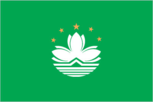
Flag description
light green with a lotus flower above a stylized bridge and water in white, beneath an arc of five gold, five-pointed stars: one large in center of arc and four smaller Economy Macau
GDP
purchasing power parity - $8.6 billion (2002 est.)
GDP - composition by sector
- agriculture
- 1%
- industry
- 12%
- services
- 87% (2002 est.)
GDP - per capita
purchasing power parity - $18,500 (2002 est.)
GDP - real growth rate
9.5% (2002 est.)
Geographic coordinates
22 10 N, 113 33 E
Geography - note
essentially urban; one causeway and two bridges connect the two islands of Coloane and Taipa to the peninsula on mainland People Macau
Government type
limited democracy
Highways
- paved
- 271 km
- total
- 271 km
- unpaved
- 0 km (2000)
HIV/AIDS - adult prevalence rate
NA%
HIV/AIDS - deaths
NA
HIV/AIDS - people living with HIV/AIDS
NA
Household income or consumption by percentage share
- highest 10%
- NA%
- lowest 10%
- NA%
Imports
$2.53 billion c.i.f. (2002)
Imports - commodities
clothing, textiles, yarn, foodstuffs, fuel, automobiles, capital goods
Imports - partners
China 41.7%, Hong Kong 14.5%, Japan 6.7%, Taiwan 6.6%, South Korea 5%, France 4.3%, US 4.1% (2002)
Independence
none (special administrative region of China)
Industrial production growth rate
NA%
Industries
tourism, gambling, clothing, textiles, electronics, footwear, toys
Infant mortality rate
- female
- 4.84 deaths/1,000 live births (2003 est.)
- male
- 4.01 deaths/1,000 live births
- total
- 4.42 deaths/1,000 live births
Inflation rate (consumer prices)
-2.6% (2002 est.)
International organization participation
ESCAP (associate), IHO, IMO (associate), Interpol (sub-bureau), ISO (correspondent), UNESCO (associate), WCO, WMO, WToO (associate), WTrO
Internet country code
.mo
Internet Service Providers (ISPs)
1 (2000)
Internet users
101,000 (2002) Transportation Macau
Irrigated land
NA sq km
Judicial branch
The Court of Final Appeal in the Macau Special Administrative Region
Labor force
214,000 (2002)
Labor force - by occupation
restaurants and hotels 12%, manufacturing 20%, other services and agriculture 68% (2002 est.)
Land boundaries
- border countries
- China 0.34 km
- total
- 0.34 km
Land use
- arable land
- 0%
- note
- "green areas" represent 22.4% (1998 est.)
- other
- 100%
- permanent crops
- 0%
Languages
Portuguese, Chinese (Cantonese)
Legal system
based on Portuguese civil law system
Legislative branch
- unicameral Legislative Council or LEGCO (27 seats; 10 elected by popular vote, 10 by indirect vote, and 7 appointed by the chief executive; members serve four-year terms)
- election results
- percent of vote - NA%; seats by political bloc - Entertainment Industry 3, pro-democracy 2, pro-Beijing Labor Union 2, pro-Beijing Neighborhood Association 2, pro-business 1
- elections
- last held 23 September 2001 (next to be held NA 2005)
Life expectancy at birth
- female
- 84.82 years (2003 est.)
- male
- 79.05 years
- total population
- 81.87 years
Literacy
- definition
- age 15 and over can read and write
- female
- 92% (2003 est.) Government Macau
- male
- 97.2%
- total population
- 94.5%
Location
Eastern Asia, bordering the South China Sea and China
Map references
Southeast Asia
Maritime claims
not specified
Median age
- female
- 33.3 years (2002)
- male
- 32.9 years
- total
- 33.1 years
Merchant marine
none (2002 est.)
Military branches
no regular indigenous military forces; responsibility for defense reverted to China on 20 December 1999; there is a local police force
Military manpower - availability
- males age 15-49
- 130,228 (2003 est.)
Military manpower - fit for military service
- males age 15-49
- 71,826 (2003 est.) Transnational Issues Macau
National holiday
National Day (Anniversary of the Founding of the People's Republic of China), 1 October (1949); note - 20 December 1999 is celebrated as Macau Special Administrative Region Establishment Day
Nationality
- adjective
- Chinese
- noun
- Chinese
Natural hazards
typhoons
Natural resources
NEGL
Net migration rate
8.93 migrant(s)/1,000 population (2003 est.)
Oil - consumption
11,000 bbl/day (2001 est.)
Oil - exports
NA (2001)
Oil - imports
NA (2001)
Oil - production
0 bbl/day (2001 est.)
Political parties and leaders
there are no formal political parties, however, there are civic associations that, for purposes of legislative voting, join together to form political blocs
Political pressure groups and leaders
Catholic Church [Domingos LAM, bishop]; Macau Society of Tourism and Entertainment or STDM [Stanley HO, managing director]; Union for Democracy Development [Antonio NG Kuok-cheong, leader]
Population
469,903 (July 2003 est.)
Population below poverty line
NA%
Population growth rate
1.72% (2003 est.)
Ports and harbors
Macau
Radio broadcast stations
AM 0, FM 2, shortwave 0 (1998)
Radios
160,000 (1997)
Railways
0 km
Religions
Buddhist 50%, Roman Catholic 15%, none and other 35% (1997 est.)
Sex ratio
- at birth
- 1.05 male(s)/female
- total population
- 0.91 male(s)/female (2003 est.)
- under 15 years
- 1.08 male(s)/female 15-64 years: 0.9 male(s)/female 65 years and over: 0.69 male(s)/female
Suffrage
direct election 18 years of age, universal for permanent residents living in Macau for the past seven years; indirect election limited to organizations registered as "corporate voters" (257 are currently registered) and a 300-member Election Committee drawn from broad regional groupings, municipal organizations, and central government bodies
Telephone system
- domestic
- NA
- general assessment
- fairly modern communication facilities maintained for domestic and international services
- international
- HF radiotelephone communication facility; access to international communications carriers provided via Hong Kong and China; satellite earth station - 1 Intelsat (Indian Ocean)
Telephones - main lines in use
176,902 (November 2001)
Telephones - mobile cellular
158,251 (November 2001)
Television broadcast stations
1 (2003)
Televisions
49,000 (1997)
Terrain
generally flat
Total fertility rate
1.32 children born/woman (2003 est.)
Unemployment rate
6.3% (2002)
Waterways
none