2000 Edition
CIA World Factbook 2000 (Project Gutenberg)
Introduction
Background
Founded in 963, Luxembourg became a grand duchy in 1815 and an independent state under the Netherlands. It lost more than half of its territory to Belgium in 1839, but gained a larger measure of autonomy. Full independence was attained in 1867. Overrun by Germany in both World Wars, it ended its neutrality in 1948 when it entered into the Benelux Customs Union and when it joined NATO the following year. In 1957, Luxembourg became one of the six founding countries of the European Economic Community (later the European Union) and in 1999 it joined the euro currency area.
Geography
Area
- land
- 2,586 sq km
- total
- 2,586 sq km
- water
- 0 sq km
Area - comparative
slightly smaller than Rhode Island
Climate
modified continental with mild winters, cool summers
Coastline
0 km (landlocked)
Elevation extremes
- highest point
- Burgplatz 559 m
- lowest point
- Moselle River 133 m
Environment - current issues
air and water pollution in urban areas
Environment - international agreements
- party to
- Air Pollution, Air Pollution-Nitrogen Oxides, Air Pollution-Sulphur 85, Air Pollution-Sulphur 94, Air Pollution-Volatile Organic Compounds, Biodiversity, Climate Change, Desertification, Endangered Species, Hazardous Wastes, Marine Dumping, Nuclear Test Ban, Ozone Layer Protection, Ship Pollution, Tropical Timber 83, Tropical Timber 94, Wetlands signed, but not ratified: Air Pollution-Persistent Organic Pollutants, Climate Change-Kyoto Protocol, Environmental Modification, Law of the Sea
Geographic coordinates
49 45 N, 6 10 E
Geography - note
landlocked
Irrigated land
10 sq km (including Belgium) (1993 est.)
Land boundaries
- border countries
- Belgium 148 km, France 73 km, Germany 138 km
- total
- 359 km
Land use
- arable land
- 24%
- forests and woodland
- 21%
- other
- 34%
- permanent crops
- 1%
- permanent pastures
- 20%
Location
Western Europe, between France and Germany
Map references
Europe
Maritime claims
none (landlocked)
Natural hazards
NA
Natural resources
iron ore (no longer exploited), arable land
Terrain
mostly gently rolling uplands with broad, shallow valleys; uplands to slightly mountainous in the north; steep slope down to Moselle flood plain in the southeast
People and Society
Age structure
0-14 years: 19% (male 42,375; female 40,109) 15-64 years: 67% (male 148,205; female 145,325) 65 years and over: 14% (male 24,446; female 36,929) (2000 est.)
Birth rate
12.45 births/1,000 population (2000 est.)
Death rate
8.91 deaths/1,000 population (2000 est.)
Ethnic groups
Celtic base (with French and German blend), Portuguese, Italian, and European (guest and worker residents)
Infant mortality rate
4.83 deaths/1,000 live births (2000 est.)
Languages
Luxembourgian, German, French, English
Life expectancy at birth
- female
- 80.63 years (2000 est.)
- male
- 73.84 years
- total population
- 77.13 years
Literacy
- definition
- age 15 and over can read and write
- female
- 100% (1980 est.)
- male
- 100%
- total population
- 100%
Nationality
- adjective
- Luxembourg
- noun
- Luxembourger(s)
Net migration rate
9.21 migrant(s)/1,000 population (2000 est.)
Population
437,389 (July 2000 est.)
Population growth rate
1.27% (2000 est.)
Religions
Roman Catholic 97%, Protestant and Jewish 3%
Sex ratio
- at birth
- 1.03 male(s)/female under 15 years: 1.06 male(s)/female 15-64 years: 1.02 male(s)/female 65 years and over: 0.66 male(s)/female
- total population
- 0.97 male(s)/female (2000 est.)
Total fertility rate
1.7 children born/woman (2000 est.)
Government
Administrative divisions
3 districts; Diekirch, Grevenmacher,
Capital
Luxembourg
Constitution
17 October 1868, occasional revisions
Country name
- conventional long form
- Grand Duchy of Luxembourg
- conventional short form
- Luxembourg
- local long form
- Grand-Duche de Luxembourg
- local short form
- Luxembourg
Data code
LU
Diplomatic representation from the US
- chief of mission
- Ambassador James C. HORMEL
- embassy
- 22 Boulevard Emmanuel-Servais, L-2535 Luxembourg City
- mailing address
- American Embassy Luxembourg, Unit 1410, APO AE 09126-1410 (official mail); American Embassy Luxembourg, PSC 9, Box 9500, APO AE 09123 (personal mail)
- telephone
- 46 01 23
Diplomatic representation in the US
- chancery
- 2200 Massachusetts Avenue NW, Washington, DC 20006
- chief of mission
- Ambassador Arlette CONZEMIUS
- telephone
- (202) 265-4171
Executive branch
- cabinet
- Council of Ministers recommended by the prime minister and appointed by the monarch
- chief of state
- Grand Duke JEAN (since 12 November 1964); Heir Apparent Prince HENRI (son of the monarch, born 16 April 1955); note - Grand Duke JEAN intends to abdicate in September 2000 in favor of his oldest son, Prince HENRI
- elections
- none; the monarch is hereditary; prime minister and vice prime minister appointed by the monarch, following popular election to the Chamber of Deputies; they are responsible to the Chamber of Deputies
- head of government
- Prime Minister Jean-Claude JUNCKER (since 1 January 1995) and Vice Prime Minister Lydie POLFER (since 7 August 1999)
- note
- government coalition - CSV and DP
FAX
- (202) 328-8270
- 46 14 01
- consulate(s) general
- New York and San Francisco
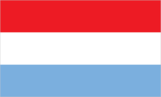
Flag description
three equal horizontal bands of red (top), white, and light blue; similar to the flag of the Netherlands, which uses a darker blue and is shorter; design was based on the flag of France
Government type
constitutional monarchy
Independence
1839 (from the Netherlands)
International organization participation
ACCT, Australia Group, Benelux, CCC, CE, EAPC, EBRD, ECE, EIB, EMU, EU, FAO, IAEA, IBRD, ICAO, ICC, ICFTU, ICRM, IDA, IEA, IFAD, IFC, IFRCS, ILO, IMF, IMO, Intelsat, Interpol, IOC, IOM, ISO, ITU, NATO, NEA, NSG, OECD, OPCW, OSCE, PCA, UN, UNCTAD, UNESCO, UNIDO, UPU, WCL, WEU, WHO, WIPO, WMO, WTrO, ZC
Judicial branch
Superior Court of Justice or Cour Superieure de Justice, judges are appointed for life by the monarch; Administrative Court or Tribunale Administratin, judges are appointed for life by the monarch
Legal system
based on civil law system; accepts compulsory ICJ jurisdiction
Legislative branch
- unicameral Chamber of Deputies or Chambre des Deputes (60 seats; members are elected by direct popular vote to serve five-year terms)
- election results
- percent of vote by party - CSV 29.79%, DP 21.58%, LSAP 23.75%, ADR 10.36%, Green Party 9.09%, the Left 3.77%; seats by party - CSV 19, DP 15, LSAP 13, ADR 6, Green Party 5, the Left 2
- elections
- last held 13 June 1999 (next to be held by NA June 2004)
- note
- the Council of State or Conseil d'Etat, which has 21 members who are appointed for life, is an advisory body whose views are considered by the Chamber of Deputies
National holiday
National Day, 23 June (1921) (public celebration of the Grand Duke's birthday)
Political parties and leaders
Action Committee for Democracy and Pension Rights or ADR ; Christian Social People's Party or CSV ; Democratic Party or DP [Lydie POLFER]; Green Party ; Luxembourg Socialist Workers' Party or LSAP ; Marxist and Reformed Communist Party DEI LENK (the Left) ; other minor parties
Political pressure groups and leaders
ABBL (bankers' association); ALEBA (financial sector trade union); Centrale Paysanne (federation of agricultural producers); CEP (professional sector chamber); CGFP (trade union representing civil service); Chambre de Commerce (Chamber of Commerce); Chambre des Metiers (Chamber of Artisans); FEDIL (federation of industrialists); LCGP (center-right trade union); OGBL (center-left trade union)
Suffrage
18 years of age; universal and compulsory
Economy
Agriculture - products
barley, oats, potatoes, wheat, fruits, wine grapes; livestock products
Budget
- expenditures
- $4.71 billion, including capital expenditures of $NA (2000 est.)
- revenues
- $4.73 billion
Currency
1 Luxembourg franc (LuxF) = 100 centimes; note - centimes no longer in use
Debt - external
$NA
Economic aid - donor
ODA, $160 million (1999)
Economy - overview
The stable, high-income economy features moderate growth, low inflation, and low unemployment. The industrial sector, until recently dominated by steel, has become increasingly more diversified to include chemicals, rubber, and other products. During the past decades, growth in the financial sector has more than compensated for the decline in steel. Services, especially banking, account for a growing proportion of the economy. Agriculture is based on small family-owned farms. Luxembourg has especially close trade and financial ties to Belgium and the Netherlands, and as a member of the EU, enjoys the advantages of the open European market. It joined with 10 other EU members to launch the euro on 1 January 1999.
Electricity - consumption
5.856 billion kWh (1998)
Electricity - exports
900 million kWh (1998)
Electricity - imports
6.4 billion kWh (1998)
Electricity - production
382 million kWh (1998)
Electricity - production by source
- fossil fuel
- 60.73%
- hydro
- 24.86%
- nuclear
- 0%
- other
- 14.41% (1998)
Exchange rates
- euros per US$1 - 0.9867 (January 2000), 0.9386 (1999); Luxembourg francs (LuxF) per US$1 - 34.77 (January 1999), 36.299 (1998), 35.774 (1997), 30.962 (1996), 29.480 (1995); note - the Luxembourg franc is at par with the Belgian franc, which circulates freely in Luxembourg
- note
- on 1 January 1999, the EU introduced a common currency that is now being used by financial institutions in some member countries at a fixed rate of 40.3399 francs per euro; the euro will replace the local currency in consenting countries for all transactions in 2002
Exports
$7.5 billion (f.o.b., 1998)
Exports - commodities
finished steel products, chemicals, rubber products, glass, aluminum, other industrial products
Exports - partners
Germany 33%, France 20%, Belgium 12%, UK 6%, US 5%, Netherlands 4% (1998)
Fiscal year
calendar year
GDP
purchasing power parity - $14.7 billion (1999 est.)
GDP - composition by sector
- agriculture
- 1%
- industry
- 23%
- services
- 76% (1999 est.)
GDP - per capita
purchasing power parity - $34,200 (1999 est.)
GDP - real growth rate
4.2% (1999 est.)
Household income or consumption by percentage share
lowest 10%: NA% highest 10%: NA%
Imports
$9.6 billion (c.i.f., 1998)
Imports - commodities
minerals, metals, foodstuffs, quality consumer goods
Imports - partners
Belgium 36%, Germany 27%, France 12%, Netherlands 5%, US 4% (1998)
Industrial production growth rate
1.6% (1999 est.)
Industries
banking, iron and steel, food processing, chemicals, metal products, engineering, tires, glass, aluminum
Inflation rate (consumer prices)
1.1% (1999 est.)
Labor force
236,400 (one-third of labor force is foreign workers, mostly from Portugal, Italy, France, Belgium, and Germany) (1998 est.)
Labor force - by occupation
services 83.2%, industry 14.3%, agriculture 2.5% (1998 est.)
Population below poverty line
NA%
Unemployment rate
2.7% (1999 est.)
Communications
Internet Service Providers (ISPs)
13 (1999)
Radio broadcast stations
AM 2, FM 9, shortwave 2 (1999)
Radios
285,000 (1997)
Telephone system
- highly developed, completely automated and efficient system, mainly buried cables
- domestic
- nationwide cellular telephone system; buried cable
- international
- 3 channels leased on TAT-6 coaxial submarine cable (Europe to North America)
Telephones - main lines in use
314,700 (1999)
Telephones - mobile cellular
95,400 (1999)
Television broadcast stations
8 (1999)
Televisions
285,000 (1998 est.)
Transportation
Airports
2 (1999 est.)
Airports - with paved runways
- total
- 1 over 3,047 m: 1 (1999 est.)
Airports - with unpaved runways
- total
- 1 under 914 m: 1 (1999 est.)
Highways
- paved
- 5,166 km (including 118 km of expressways)
- total
- 5,166 km
- unpaved
- 0 km (1998 est.)
Merchant marine
- ships by type
- bulk 2, chemical tanker 10, container 1, liquified gas 18, passenger 4, petroleum tanker 6, roll-on/roll-off 7 (1999 est.)
- total
- 48 ships (1,000 GRT or over) totaling 1,283,738 GRT/1,872,071 DWT
Pipelines
petroleum products 48 km
Ports and harbors
Mertert
Railways
- standard gauge
- 274 km 1.435-m gauge (242 km electrified; 178 km double track) (1998)
- total
- 274 km
Waterways
37 km; Moselle
Military and Security
Military branches
Army; note - the new government abolished the Gendarmerie
Military expenditures - dollar figure
$131 million (FY98)
Military expenditures - percent of GDP
1% (FY98)
Military manpower - availability
males age 15-49: 111,882 (2000 est.)
Military manpower - fit for military service
males age 15-49: 92,238 (2000 est.)
Military manpower - military age
19 years of age
Military manpower - reaching military age annually
- males
- 2,563 (2000 est.)
Transnational Issues
Disputes - international
- none
- MACAU