1989 Edition
CIA World Factbook 1989 (Internet Archive)
Geography
Climate
modified continental with mild winters, cool summers
Coastline
none — landlocked
Comparative area
slightly smaller than Rhode Island
Environment
deforestation
Flag
two equal horizontal bands of blue (top) and red with a gold crown on the hoist side of the blue band
Labor force
161,000; one-third of labor force is foreign workers, mostly from Portugal, Italy, France, Belgium, and FRO; 48.9% services, 24.7% industry, 13.2% government, 8.8% construction, 4.4% agriculture (1984)
Land boundaries
359 km total; Belgium 148 km, France 73 km, FRG 138 km
Land use
24% arable land; 1% permanent crops; 20% meadows and pastures; 21% forest and woodland; 34% other
Language
Luxembourgish, German, French; many also speak English
Literacy
100%
Maritime claims
none — landlocked
Natural resources
iron ore (no longer exploited)
Note
landlocked
Organized labor
100,000 (est.) members of four confederated trade unions
Religion
97% Roman Catholic, 3% Protestant and Jewish
Terrain
mostly gently rolling uplands with broad, shallow valleys; uplands to slightly mountainous in the north; steep slope down to Moselle floodplain in the southeast
Total area
2,586 km2; land area: 2,586 km2
People and Society
Birth rate
12 births/ 1,000 population (1990)
Death rate
10 deaths/ 1,000 population (1990)
Ethnic divisions
Celtic base, with French and German blend; also guest and worker residents from Portugal, Italy, and European countries
Infant mortality rate
7 deaths/ 1,000 live births (1990)
Life expectancy at birth
72 years male, 80 years female (1990)
Nationality
noun — Luxembourger(s); adjective— Luxembourg
Net migration rate
9 migrants/ 1 ,000 population (1990)
Population
383,813 (July 1990), growth rate 1.1% (1989)
Total fertility rate
1.5 children born/ woman (1990)
Government
Administrative divisions
3 districts; Diekirch, Grevenmacher, Luxembourg
Capital
Luxembourg
Communists
500 party members (1982)
Constitution
17 October 1868, occasional revisions
Diplomatic representation
Ambassador Andre PHILIPPE; Chancery at 2200 Massachusetts Avenue NW, Washington DC 20008; telephone (202) 265-4171; there are Luxembourg Consulates General in New York and San Francisco; US — Ambassador Jean B. S. GERARD; Embassy at 22 Boulevard Emmanuel-Servais, 2535 Luxembourg City (mailing address is APO New York 09132); telephone [352]
Elections
Chamber of Deputies — last held on 18 June 1989 (next to be held by June 1994); results— CSV 31.7%, LSAP 27.2%, DP 16.2%, Greens 8.4%, PAC 7.3%, KPL 5.1%, others 4%; seats— (60 total) CSV 22, LSAP 18, DP 1 1, Greens 4, PAC 4, KPL 1, others 4
Executive branch
grand duke, prime minister, vice prime minister. Council of Ministers (cabinet)
Flag
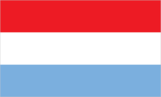
three equal horizontal bands of red (top), white, and light blue; similar to the flag of the Netherlands which uses a darker blue and is shorter; design was based on the flag of France
Independence
1839
Judicial branch
Superior Court of Justice (Cour Superieure de de Justice)
Leaders
Chief of State — Grand Duke JEAN (since 12 November 1964); Heir Apparent Prince HENRI (son of Grand Duke Jean, born 16 April 1955); Head of Government — Prime Minister Jacques SANTER (since 21 July 1984); Deputy Prime Minister Jacques F. POOS (since 21 July 1984) Political parties and leaders: Christian Social Party (CSV), Jacques Santer; Socialist Workers Party (LSAP), Jacques Poos; Liberal (DP), Colette Flesch; Communist (KPL), Rene Urbany; Green Alternative (GAP), Jean Huss
Legal system
based on civil law system; accepts compulsory ICJ jurisdiction
Legislative branch
unicameral Chamber of Deputies (Chambre des Deputes); note — the Council of State (Conseil d'Etat) is an advisory body whose views are considered by the Chamber of Deputies
Long-form name
Grand Duchy of Luxembourg
Member of
Benelux, BLEU, CCC, Council of Europe, EC, EIB, EMS, FAO, GATT, IAEA, IBRD, ICAO, IDA, IEA, IFAD, IFC, ILO, IMF, INTELSAT, INTERPOL, IOOC, IPU, ITU, NATO, OECD, UN, UNESCO, UPU, WEU, WHO, WIPO, WMO
National holiday
National Day (public celebration of the Grand Duke's birthday), 23 June (1921)
Other political or pressure groups
group of steel industries representing iron and steel industry, Centrale Paysanne representing agricultural producers; Christian and Socialist labor unions; Federation of Industrialists; Artisans and Shopkeepers Federation
Suffrage
universal and compulsory at age
Type
constitutional monarchy
Economy
Agriculture
livestock, vegetables, corn, wheat, potatoes, grapes
Aid
none
Budget
revenues $171 million; expenditures $189 million, including capital expenditures of NA (1986)
Currency
Swiss franc, franken, or franco (plural — francs, franken, or franchi); 1 Swiss franc, franken, or franco (SwF) = 100 centimes, rappen, or centesimi
Electricity
23,000 kW capacity; 150 million kWh produced, 5,340 kWh per capita (1989)
Exchange rates
Swiss francs, franken, or franchi (SwF) per US$1— 1.5150 (January 1990), 1.6359 (1989), 1.4633 (1988), 1.4912 (1987), 1.7989 (1986), 2.4571 (1985)
Exports
$807 million; commodities — small specialty machinery, dental products, stamps, hardware, pottery; partners— EC 40%, EFTA 26% (Switzerland 19%) (1986)
External debt
SNA
Fiscal year
calendar year
GNP
SNA, per capita SNA; real growth rate NA%
Imports
$NA; commodities — machinery, metal goods, textiles, foodstuffs, motor vehicles; partners — NA
Industrial production
growth rate NA%
Industries
electronics, metal manufacturing, textiles, ceramics, Pharmaceuticals, food products, precision instruments, tourism
Inflation rate (consumer prices)
1.5% (1987 est.)
Overview
- The prosperous economy is based primarily on small-scale light industry and some farming. Industry accounts for 54% of total employment, the service sector 42% (mostly based on tourism), and agriculture and forestry 4%. The sale of postage stamps to collectors is estimated at $10 million annually and accounts for 10% of revenues. Low business taxes (the maximum tax rate is 20%) and easy incorporation rules have induced about 25,000 holding or so-called letter box companies to establish nominal offices in Liechtenstein. Such companies, incorporated solely for tax purposes, provide an additional 30% of state revenues. The economy is tied closely to that of Switzerland in a customs union, and incomes and living standards parallel those of the more prosperous Swiss groups.
- The stable economy features moderate growth, low inflation, and negligible unemployment. Agriculture is based on small but highly productive familyowned farms. The industrial sector, until recently dominated by steel, has become increasingly more diversified, particularly toward high-technology firms. During the past decade growth in the financial sector has more than compensated for the decline in steel. Services, especially banking, account for a growing proportion of the economy. Luxembourg participates in an economic union with Belgium on trade and most financial matters and is also closely connected economically with the
Unemployment rate
0. 1 % (December 1986)
Communications
Airports
none
Civil air
no transport aircraft
Highways
130.66 km main roads, 192.27 km byroads
Note
defense is responsibility of Switzerland Troisvierg
Railroads
18.5 km 1.435-meter standard gauge, electrified; owned, operated, and included in statistics of Austrian Federal Railways
Telecommunications
automatic telephone system; 25,400 telephones; stations — no AM, no FM, no TV Defense Forces