2001 Edition
CIA World Factbook 2001 (Project Gutenberg)
Introduction
Administrative divisions
44 regions (rajonai, singular - rajonas) and 11 municipalities*: Akmenes Rajonas, Alytaus Rajonas, Alytus*, Anyksciu Rajonas, Birstonas*, Birzu Rajonas, Druskininkai*, Ignalinos Rajonas, Jonavos Rajonas, Joniskio Rajonas, Jurbarko Rajonas, Kaisiadoriu Rajonas, Kaunas*, Kauno Rajonas, Kedainiu Rajonas, Kelmes Rajonas, Klaipeda*, Klaipedos Rajonas, Kretingos Rajonas, Kupiskio Rajonas, Lazdiju Rajonas, Marijampole*, Marijampoles Rajonas, Mazeikiu Rajonas, Moletu Rajonas, Neringa* Pakruojo Rajonas, Palanga*, Panevezio Rajonas, Panevezys*, Pasvalio Rajonas, Plunges Rajonas, Prienu Rajonas, Radviliskio Rajonas, Raseiniu Rajonas, Rokiskio Rajonas, Sakiu Rajonas, Salcininku Rajonas, Siauliai*, Siauliu Rajonas, Silales Rajonas, Silutes Rajonas, Sirvintu Rajonas, Skuodo Rajonas, Svencioniu Rajonas, Taurages Rajonas, Telsiu Rajonas, Traku Rajonas, Ukmerges Rajonas, Utenos Rajonas, Varenos Rajonas, Vilkaviskio Rajonas, Vilniaus Rajonas, Vilnius*, Zarasu Rajonas
Age structure
0-14 years: 18.75% (male 345,694; female 331,125) 15-64 years: 67.69% (male 1,181,119; female 1,262,872) 65 years and over: 13.56% (male 165,732; female 323,993) (2001 est.)
Agriculture - products
grain, potatoes, sugar beets, flax, vegetables; beef, milk, eggs; fish
Airports
72 (2000 est.)
Airports - with paved runways
total: 9 over 3,047 m: 2 1,524 to 2,437 m: 4 under 914 m: 3 (2000 est.)
Airports - with unpaved runways
total: 63 1,524 to 2,437 m: 3 914 to 1,523 m: 5 under 914 m: 55 (2000 est.) Lithuania Military
Area
total: 65,200 sq km land: 65,200 sq km water: 0 sq km
Area - comparative
slightly larger than West Virginia
Background
Independent between the two World Wars, Lithuania was annexed by the USSR in 1940. On 11 March 1990, Lithuania became the first of the Soviet republics to declare its independence, but this proclamation was not generally recognized until September of 1991 (following the abortive coup in Moscow). The last Russian troops withdrew in 1993. Lithuania subsequently has restructured its economy for eventual integration into Western European institutions. Lithuania Geography
Birth rate
10 births/1,000 population (2001 est.)
Budget
revenues: $1.5 billion expenditures: $1.7 billion, including capital expenditures of $NA (1997 est.)
Capital
Vilnius
Climate
transitional, between maritime and continental; wet, moderate winters and summers
Coastline
99 km
Constitution
adopted 25 October 1992
Country name
conventional long form: Republic of Lithuania conventional short form: Lithuania local long form: Lietuvos Respublika local short form: Lietuva former: Lithuanian Soviet Socialist Republic
Currency
litas (LTL)
Currency code
LTL
Death rate
12.86 deaths/1,000 population (2001 est.)
Debt - external
$2.5 billion (2000 est.)
Diplomatic representation from the US
chief of mission: Ambassador John F. TEFFT embassy: Akmenu 6, 2600 Vilnius mailing address: American Embassy, Vilnius, PSC 78, Box V, APO AE 09723 telephone: [370] (2) 223-031
Diplomatic representation in the US
chief of mission: Ambassador Vygaudas USACKAS chancery: 2622 16th Street NW, Washington, DC 20009 telephone: [1] (202) 234-5860
Disputes - international
Latvia has not ratified a 1998 maritime boundary agreement with Lithuania (primary concern is oil exploration rights); 1997 border agreement with Russia not yet ratified by Russia
Economic aid - recipient
$228.5 million (1995)
Economy - overview
Lithuania, the Baltic state that has conducted the most trade with Russia, has been slowly rebounding from the 1998 Russian financial crisis. High unemployment and weak consumption have held back recovery. GDP growth for 2000 - estimated at 2.9% - fell behind that of Estonia and Latvia, and unemployment is estimated at 10.8%, the country's highest since regaining independence in 1990. For 2001, Lithuanians forecast 3.2% growth, 1.8% inflation, and a fiscal deficit of 3.3%. In early 2001, the Lithuanian Government announced that it will repeg its currency, the litas, to the euro (the litas is currently pegged to the dollar) some time in 2002. Lithuania must ratify 25 agreements along with other legal documents and obligations by 1 May 2001 before gaining World Trade Organization membership. Lithuania was invited to the Helsinki summit in December 1999 and began EU accession talks in early 2000. Privatization of the large, state-owned utilities, particularly in the energy sector, remains a key challenge for 2001.
Electricity - consumption
9.817 billion kWh (1999)
Electricity - exports
3.2 billion kWh (1999)
Electricity - imports
400 million kWh (1999)
Electricity - production
13.567 billion kWh (1999)
Electricity - production by source
fossil fuel: 23.89% hydro: 3.43% nuclear: 72.68% other: 0% (1999)
Elevation extremes
lowest point: Baltic Sea 0 m highest point: Juozapines/Kalnas 292 m
Environment - current issues
contamination of soil and groundwater with petroleum products and chemicals at military bases
Environment - international agreements
party to: Biodiversity, Climate Change, Hazardous Wastes, Ozone Layer Protection, Ship Pollution, Wetlands signed, but not ratified: Air Pollution-Persistent Organic Pollutants, Climate Change-Kyoto Protocol Lithuania People
Ethnic groups
Lithuanian 80.6%, Russian 8.7%, Polish 7%, Byelorussian 1.6%, other 2.1%
Exchange rates
litai per US dollar - 4.000 (fixed rate since 1 May 1994); note - litai is the plural of litas
Executive branch
chief of state: President Valdas ADAMKUS (since 26 February 1998) head of government: Premier Algirdas BRAZAUSKAS (since 3 July 2001) cabinet: Council of Ministers appointed by the president on the nomination of the premier elections: president elected by popular vote for a five-year term; election last held 21 December 1997 and 4 January 1998 (next to be held NA 2002); premier appointed by the president on the approval of the Parliament election results: Valdas ADAMKUS elected president; percent of vote - Valdas ADAMKUS 50.4%, Arturas PAULAUSKAS 49.6%
Exports
$3.7 billion (f.o.b., 2000)
Exports - commodities
machinery and equipment 22%, mineral products 15%, chemicals 12%, textiles and clothing, foodstuffs (1999)
Exports - partners
Germany 15.8%, Latvia 12.6%, Russia 6.9%, Belarus 5.8%, Denmark (1999)
FAX
- [1] (202) 328-0466 consulate(s) general: Chicago and New York
- [370] (2) 227-236
Fiscal year
calendar year Lithuania Communications
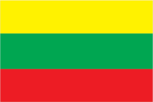
Flag description
three equal horizontal bands of yellow (top), green, and red Lithuania Economy
GDP
purchasing power parity - $26.4 billion (2000 est.)
GDP - composition by sector
agriculture: 10% industry: 33% services: 57% (1999 est.)
GDP - per capita
purchasing power parity - $7,300 (2000 est.)
GDP - real growth rate
2.9% (2000 est.)
Geographic coordinates
56 00 N, 24 00 E
Government type
parliamentary democracy
Highways
total: 44,000 km paved: 35,500 km unpaved: 8,500 km (2000)
HIV/AIDS - adult prevalence rate
0.02% (1999 est.)
HIV/AIDS - deaths
less than 100 (1999 est.)
HIV/AIDS - people living with HIV/AIDS
less than 500 (1999 est.)
Household income or consumption by percentage share
lowest 10%: 3.1% highest 10%: 25.6% (1996)
Illicit drugs
transshipment point for opiates and other illicit drugs from Southwest Asia, Latin America, and Western Europe to Western Europe and Scandinavia; limited production of methamphetamine and ecstasy
Imports
$4.9 billion (f.o.b., 2000)
Imports - commodities
machinery and equipment 18%, mineral products 16%, chemicals 10%, textiles and clothing 10%, transport equipment 7% (1999)
Imports - partners
Russia 20.4%, Germany 16.5%, Denmark 3.8%, Belarus 2.2%, Latvia 2% (1999)
Independence
11 March 1990 (independence declared from Soviet Union); 6 September 1991 (Soviet Union recognizes Lithuania's independence)
Industrial production growth rate
2.3% (2000 est.)
Industries
metal-cutting machine tools, electric motors, television sets, refrigerators and freezers, petroleum refining, shipbuilding (small ships), furniture making, textiles, food processing, fertilizers, agricultural machinery, optical equipment, electronic components, computers, amber
Infant mortality rate
14.5 deaths/1,000 live births (2001 est.)
Inflation rate (consumer prices)
1% (2000 est.)
International organization participation
ACCT (observer), BIS, CBSS, CCC, CE, EAPC, EBRD, ECE, EU (applicant), FAO, IAEA, IBRD, ICAO, ICC, ICFTU, ICRM, IFC, IFRCS, ILO, IMF, IMO, Intelsat (nonsignatory user), Interpol, IOC, IOM, ISO (correspondent), ITU, OPCW, OSCE, PFP, UN, UNCTAD, UNESCO, UNMIK, UPU, WCL, WEU (associate partner), WHO, WIPO, WMO, WTrO (observer)
Internet country code
.lt
Internet Service Providers (ISPs)
14 (2000)
Internet users
225,000 (2000) Lithuania Transportation
Irrigated land
430 sq km (1993 est.)
Judicial branch
Supreme Court; Court of Appeal; judges for both courts appointed by the Parliament
Labor force
2 million (2000 est.)
Labor force - by occupation
industry 30%, agriculture 20%, services 50% (1997 est.)
Land boundaries
total: 1,273 km border countries: Belarus 502 km, Latvia 453 km, Poland 91 km, Russia (Kaliningrad) 227 km
Land use
arable land: 39% permanent crops: 9% permanent pastures: 6% forests and woodland: 31% other: 15% (2001 est.)
Languages
Lithuanian (official), Polish, Russian
Legal system
based on civil law system; no judicial review of legislative acts
Legislative branch
unicameral Parliament or Seimas (141 seats, 71 members are directly elected by popular vote, 70 are elected by proportional representation; members serve four-year terms) elections: last held 8 October 2000 (next to be held NA October 2004) election results: percent of vote by party - Social Democratic Coalition 31.1%, New Union/Social Liberals 19.6%, Liberal Union 17.2%, TS 8.6%, remaining parties all less than 5%; seats by party - Social Democratic Coalition 52, Liberal Union 34, New Union/Social Liberals 29, TS 9, Farmer's Party 4, Center Union 2, Poles' Electoral Action 2, Modern Christian Democratic Union 1, independents 3, others 5
Life expectancy at birth
total population: 69.25 years male: 63.3 years female: 75.5 years (2001 est.)
Literacy
definition: age 15 and over can read and write total population: 98% male: 99% female: 98% (1989 est.) Lithuania Government
Location
Eastern Europe, bordering the Baltic Sea, between Latvia and Russia
Map references
Europe
Maritime claims
territorial sea: 12 NM
Merchant marine
total: 50 ships (1,000 GRT or over) totaling 293,168 GRT/327,827 DWT ships by type: cargo 26, combination bulk 10, petroleum tanker 2, railcar carrier 1, refrigerated cargo 7, roll on/roll off 1, short-sea passenger 3 (2000 est.)
Military branches
Ground Forces, Navy, Air and Air Defense Force, Security Forces (internal and border troops), National Guard (Skat)
Military expenditures - dollar figure
$181 million (FY99)
Military expenditures - percent of GDP
1.66% (FY00) Lithuania Transnational Issues
Military manpower - availability
males age 15-49: 929,389 (2001 est.)
Military manpower - fit for military service
males age 15-49: 730,363 (2001 est.)
Military manpower - military age
18 years of age
Military manpower - reaching military age annually
males: 28,506 (2001 est.)
National holiday
Independence Day, 16 February (1918); note - 16 February 1918 is the date of independence from German, Austrian, Prussian, and Russian occupation, 11 March 1990 is the date of independence from the Soviet Union
Nationality
noun: Lithuanian(s) adjective: Lithuanian
Natural hazards
NA
Natural resources
peat, arable land
Net migration rate
0.15 migrant(s)/1,000 population (2001 est.)
Pipelines
crude oil, 105 km; natural gas 760 km (1992)
Political parties and leaders
Christian Democratic Party or LKDP [Zigmas ZINKEVICIUS, chairman]; Electoral Action of Lithuanian Poles [Valdemar TOMASZEVSKI, chairman]; Homeland Union/Conservative Party or TS [Vytautas LANDSBERGIS, chairman]; Lithuanian Center Union or LCS [Kestutis GLAVECKAS, chairman]; Lithuanian Farmer's Party or LUP [Ramunas KARBAUSKIS, chairman]; Lithuanian Liberal Union [Rolandas PAKSAS, chairman]; Lithuanian Social Democratic Coalition [Algirdas BRAZAUSKAS, chairman] consists of the Lithuanian Democratic Labor Party or LDDP, the Lithuanian Social Democratic Party or LSPD, and New Democracy; Modern Christian Democratic Union [Vytautas BOGUSIS, chairman]; New Union-Social Liberals [Arturas PAULAUSKAS, chairman]
Political pressure groups and leaders
NA
Population
3,610,535 (July 2001 est.)
Population below poverty line
NA%
Population growth rate
-0.27% (2001 est.)
Ports and harbors
Butinge, Kaunas, Klaipeda
Radio broadcast stations
AM 3, FM 112, shortwave 1 (1998)
Radios
1.9 million (1997)
Railways
total: 2,002 km broad gauge: 2,002 km 1.524-m gauge (122 km electrified) (1994)
Religions
Roman Catholic (primarily), Lutheran, Russian Orthodox, Protestant, Evangelical Christian Baptist, Muslim, Jewish
Sex ratio
at birth: 1.05 male(s)/female under 15 years: 1.04 male(s)/female 15-64 years: 0.94 male(s)/female 65 years and over: 0.51 male(s)/female total population: 0.88 male(s)/female (2001 est.)
Suffrage
18 years of age; universal
Telephone system
general assessment: inadequate, but is being modernized to provide an improved international capability and better residential access domestic: a national, fiber-optic cable, interurban, trunk system is nearing completion; rural exchanges are being improved and expanded; mobile cellular systems are being installed; access to the Internet is available; still many unsatisfied telephone subscriber applications international: landline connections to Latvia and Poland; major international connections to Denmark, Sweden, and Norway by submarine cable for further transmission by satellite
Telephones - main lines in use
1.048 million (1997)
Telephones - mobile cellular
297,500 (November 1998)
Television broadcast stations
20 (plus 30 repeaters) (1995)
Televisions
1.7 million (1997)
Terrain
lowland, many scattered small lakes, fertile soil
Total fertility rate
1.37 children born/woman (2001 est.)
Unemployment rate
10.8% (2000)
Waterways
600 km (perennially navigable)