1993 Edition
CIA World Factbook 1993 (Project Gutenberg)
Geography
Area
total area: 65,200 km2 land area: 65,200 km2 comparative area: slightly larger than West Virginia
Climate
maritime; wet, moderate winters
Coastline
108 km
Environment
risk of accidents from the two Chernobyl-type reactors at the Ignalina Nuclear Power Plant; contamination of soil and groundwater with petroleum products and chemicals at military bases
International disputes
dispute with Russia (Kaliningrad Oblast) over the position of the Neman River border presently located on the Lithuanian bank and not in midriver as by international standards
Irrigated land
430 km2 (1990)
Land boundaries
total 1,273 km, Belarus 502 km, Latvia 453 km, Poland 91 km, Russia (Kaliningrad) 227 km
Land use
arable land: 49.1% permanent crops: 0% meadows and pastures: 22.2% forest and woodland: 16.3% other: 12.4%
Location
Eastern Europe, bordering the Baltic Sea, between Sweden and Russia
Map references
Asia, Europe, Standard Time Zones of the World
Maritime claims
territorial sea: 12 nm
Natural resources
peat
Terrain
lowland, many scattered small lakes, fertile soil
People and Society
Birth rate
14.95 births/1,000 population (1993 est.)
Death rate
10.94 deaths/1,000 population (1993 est.)
Ethnic divisions
Lithuanian 80.1%, Russian 8.6%, Polish 7.7%, Belarusian 1.5%, other 2.1%
Infant mortality rate
16.9 deaths/1,000 live births (1993 est.)
Labor force
1.836 million by occupation: industry and construction 42%, agriculture and forestry 18%, other 40% (1990)
Languages
Lithuanian (official), Polish, Russian
Life expectancy at birth
total population: 71.12 years male: 66.39 years female: 76.08 years (1993 est.)
Literacy
age 9-49 can read and write (1970) total population: 100% male: 100% female: 100%
Nationality
noun: Lithuanian(s) adjective: Lithuanian
Net migration rate
3.62 migrant(s)/1,000 population (1993 est.)
Population
3,819,638 (July 1993 est.)
Population growth rate
0.76% (1993 est.)
Religions
Roman Catholic, Lutheran, other
Total fertility rate
2.03 children born/woman (1993 est.)
Government
Administrative divisions
NA districts
Capital
Vilnius
Chief of State
Seimas Chairman and Acting President Algirdas Mykolas BRAZAUSKAS (since 15 November 1992); Deputy Seimas Chairmen Aloyzas SAKALAS (since NA December 1992) and Egidius BICKAUSKAS (since NA December 1992)
Constitution
adopted 25 October 1992
Digraph
LH
Diplomatic representation in US
chief of mission: Ambassador Stasys LOZORAITIS, Jr. chancery: 2622 16th St. NW, Washington, DC 20009 telephone: (202) 234-5860, 2639
Executive branch
president, prime minister, cabinet
FAX
- (202) 328-0466 consulate general: New York
- 011 [7] (012-2) 222-779
Flag
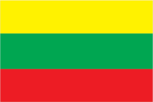
three equal horizontal bands of yellow (top), green, and red
Head of Government
Premier Adolfas SLEZEVICIUS (since NA)
Independence
6 September 1991 (from Soviet Union)
Judicial branch
Supreme Court, Court of Appeals
Legal system
based on civil law system; no judicial review of legislative acts
Legislative branch
unicameral Seimas (parliament)
Member of
CBSS, CSCE, EBRD, ECE, FAO, IBRD, ICAO, ILO, IMF, INTERPOL, ITU, NACC, UN, UNCTAD, UNESCO, UNIDO, UPU, WHO, WIPO
Names
conventional long form: Republic of Lithuania conventional short form: Lithuania local long form: Lietuvos Respublika local short form: Lietuva former: Lithuanian Soviet Socialist Republic
National holiday
Independence Day, 16 February
Other political or pressure groups
Sajudis; Lithuanian Future Forum; Farmers Union
Political parties and leaders
Christian Democratic Party, Egidijus KLUMBYS, chairman; Democratic Labor Party of Lithuania, Algirdas Mykolas BRAZAUSKAS, chairman; Lithuanian Democratic Party, Sauluis PECELIUNAS, chairman; Lithuanian Green Party, Irena IGNATAVICIENE, chairwoman; Lithuanian Humanism Party, Vytautas KAZLAUSKAS, chairman; Lithuanian Independence Party, Virgilijus CEPAITIS, chairman; Lithuanian Liberty League, Antanas TERLECKAS; Lithuanian Liberal Union, Vytautus RADZVILAS, chairman; Lithuanian Nationalist Union, Rimantas SMETONA, chairman; Lithuanian Social Democratic Party, Aloizas SAKALAS, chairman; Union of the Motherland, Vytavtas LANDSBERGIS, chairman
President
last held 14 February 1993 (next to be held NA); results - Algirdas BRAZAUSKAS was elected
Seimas (parliament)
last held 26 October and 25 November 1992 (next to be held NA); results - Democratic Labor Party 51%; seats - (141 total) Democratic Labor Party 73
Suffrage
18 years of age; universal
Type
republic
US diplomatic representation
chief of mission: Ambassador Darryl N. JOHNSON embassy: Akmenu 6, Vilnius 232600 mailing address: APO AE 09723 telephone: 011 [7] (012-2) 222-031
Economy
Agriculture
employs around 20% of labor force; sugar, grain, potatoes, sugarbeets, vegetables, meat, milk, dairy products, eggs, fish; most developed are the livestock and dairy branches, which depend on imported grain; net exporter of meat, milk, and eggs
Budget
revenues $258.5 million; expenditures $270.2 million, including capital expenditures of $NA (1992 est.)
Currency
using talonas as temporary currency (March 1993), but planning introduction of convertible litas (late 1993)
Economic aid
US commitments, including Ex-Im (1992), $10 million; Western (non-US) countries, ODA and OOF bilateral commitments (1970-86), $NA million; Communist countries (1971-86), $NA million
Electricity
5,925,000 kW capacity; 25,000 million kWh produced, 6,600 kWh per capita (1992)
Exchange rates
NA
Exports
$NA commodities: electronics 18%, petroleum products 5%, food 10%, chemicals 6% (1989) partners: Russia 40%, Ukraine 16%, other former Soviet republics 32%, West 12%
External debt
$650 million (1991 est.)
Fiscal year
calendar year
Illicit drugs
transshipment point for illicit drugs from Central and Southwest Asia to Western Europe; limited producer of illicit opium; mostly for domestic consumption
Imports
$NA commodities: oil 24%, machinery 14%, chemicals 8%, grain NA% (1989) partners: Russia 62%, Belarus 18%, former Soviet republics 10%, West 10%
Industrial production
growth rate -50% (1992 est.)
Industries
employs 25% of the labor force; shares in the total production of the former
Inflation rate (consumer prices)
10%-20% per month (first quarter 1993)
National product
GDP $NA
National product per capita
$NA
National product real growth rate
-30% (1992 est.)
Overview
Lithuania is striving to become an independent privatized economy. Although it was substantially above average in living standards and technology in the old USSR, Lithuania historically lagged behind Latvia and Estonia in economic development. The country has no important natural resources aside from its arable land and strategic location. Industry depends entirely on imported materials that have come from the republics of the former USSR. Lithuania benefits from its ice-free port at Klaipeda on the Baltic Sea and its rail and highway hub at Vilnius, which provides land communication between Eastern Europe and Russia, Latvia, Estonia, and Belarus. Industry produces a small assortment of high-quality products, ranging from complex machine tools to sophisticated consumer electronics. Because of nuclear power, Lithuania is presently self-sufficient in electricity, exporting its surplus to Latvia and Belarus; the nuclear facilities inherited from the USSR, however, have come under world scrutiny as seriously deficient in safety standards. Agriculture is efficient compared with most of the former Soviet Union. Lithuania held first place in per capita consumption of meat, second place for eggs and potatoes, and fourth place for milk and dairy products. Grain must be imported to support the meat and dairy industries. Lithuania is pressing ahead with plans to privatize at least 60% of state-owned property (industry, agriculture, and housing), having already sold almost all housing and many small enterprises using a voucher system. Other government priorities include encouraging foreign investment by protecting the property rights of foreign firms and redirecting foreign trade away from Eastern markets to the more competitive Western markets. For the moment, Lithuania will remain highly dependent on Russia for energy, raw materials, grains, and markets for its products. In 1992, output plummeted by 30% because of cumulative problems with inputs and with markets, problems that were accentuated by the phasing out of the Russian ruble as the medium of exchange.
Unemployment rate
1% (February 1993); but large numbers of underemployed workers
USSR are
- metal-cutting machine tools 6.6%; electric motors 4.6%; television
- refining, shipbuilding (small ships), furniture making, textiles, food processing, fertilizers, agricultural machinery, optical equipment, electronic components, computers, and amber
- sets 6.2%; refrigerators and freezers 5.4%; other branches
- petroleum
Communications
Airports
total: 96 useable: 19 with permanent-surface runways: 12 with runways over 3,659 m: with runways 2,440-3,659 m: 5 with runways 1,220-2,439 m: 11
Highways
44,200 km total 35,500 km hard surfaced, 8,700 km earth (1990)
Inland waterways
600 km perennially navigable
Merchant marine
46 ships (1,000 GRT or over) totaling 282,633 GRT/332,447 DWT; includes 31 cargo, 3 railcar carrier, 1 roll-on/roll-off, 11 combination bulk
Pipelines
crude oil 105 km, natural gas 760 km (1992)
Ports
coastal - Klaipeda; inland - Kaunas
Railroads
2,100 km; does not include industrial lines (1990)
Telecommunications
better developed than in most other former USSR republics; operational NMT-450 analog cellular network in Vilnius; fiber optic cable installed beween Vilnius and Kaunas; 224 telephones per 1000 persons; broadcast stations - 13 AM, 26 FM, 1 SW, 1 LW, 3 TV; landlines or microwave to former USSR republics; leased connection to the Moscow international switch for traffic with other countries; satellite earth stations - (8 channels to Norway); new international digital telephone exchange in Kaunas for direct access to 13 countries via satellite link out of Copenhagen, Denmark
Military and Security
Branches
Ground Forces, Navy, Air Force, Security Forces (internal and border troops), National Guard (Skat)
Defense expenditures
exchange rate conversion - $NA, 5.5% of GDP (1993 est.)
Manpower availability
males age 15-49 933,245; fit for military service 739,400; reach military age (18) annually 27,056 (1993 est.)