1992 Edition
CIA World Factbook 1992 (Project Gutenberg)
Geography
Climate
maritime; wet, moderate winters
Coastline
108 km
Comparative area
slightly larger than West Virginia
Contiguous zone
NA nm
Continental shelf
NA meter depth
Disputes
dispute with Russia (Kaliningrad Oblast) over the position of the Neman River border presently located on the Lithuanian bank and not in midriver as by international standards
Environment
NA
Exclusive economic zone
NA nm
Exclusive fishing zone
NA nm
Land area
65,200 km2
Land boundaries
1,273 km; Belarus 502 km, Latvia 453 km, Poland 91 km, Russia (Kaliningrad) 227 km
Land use
49.1% arable land; NA% permanent crops; 22.2% meadows and pastures; 16.3% forest and woodland; 12.4% other; includes NA% irrigated
Natural resources
peat
Terrain
lowland, many scattered small lakes, fertile soil
Territorial sea
NA nm
Total area
65,200 km2
People and Society
Birth rate
15 births/1,000 population (1992)
Death rate
11 deaths/1,000 population (1992)
Ethnic divisions
Lithuanian 80.1%, Russian 8.6%, Poles 7.7%, Byelorussian 1.5%, other 2.1%
Infant mortality rate
18 deaths/1,000 live births (1992)
Labor force
1,836,000; industry and construction 42%, agriculture and forestry 18%, other 40% (1990)
Languages
Lithuanian (official), Polish NA%, Russian NA%
Life expectancy at birth
66 years male, 76 years female (1992)
Literacy
NA% (male NA%, female NA%) age 15 and over can read and write
Nationality
noun - Lithuanian(s); adjective - Lithuanian
Net migration rate
4 migrants/1,000 population (1992)
Organized labor
Lithuanian Trade Union Association; Labor Federation of Lithuania; Union of Workers
Population
3,788,542 (July 1992), growth rate 0.8% (1992)
Religions
Catholic NA%, Lutheran NA%, unknown NA%, none NA%, other NA%
Total fertility rate
2.1 children born/woman (1992)
Government
Administrative divisions
none - all rayons are under direct republic jurisdiction
Capital
Vilnius
Chief of State
Chairman, Supreme Council Vytautas LANDSBERGIS (since March 1990), Deputy Chairmen Bronius KUZMICKAS (since March 1990), Ceslovas STANKEVICIUS (since March 1990)
Constitution
NA; Constitutional Commission has drafted a new constitution that will be sent to Parliament for ratification
Diplomatic representation
Ambassador Stasys LOZORAITIS, Jr.; Embassy at 2622 16th St. NW, Washington, DC 20009; telephone (202) 234-5860, 2639 US: Ambassador Darryl JOHNSON; Embassy at Mykolaicio putino 4, Vilnius; (mailing address is APO AE 09862); telephone [7] (01-22) 628-049
Executive branch
prime minister, Council of Ministers, Government,
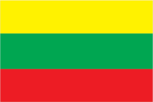
Flag
yellow, green, and red horizontal stripes
Head of Government
Prime Minister Gediminas VAGNORIUS (since January 1991); Deputy Prime Ministers Algis DOBROVOLSKAS (since January 1991), Vytantas PAKALNISKIS (since January 1991), Zigmas VAISVILA (since January 1991)
Independence
1918; annexed by the Soviet Union 3 August 1940; restored independence 11 March 1990; and regained indpendence from the USSR 6 September 1991
Judicial branch
Supreme Court; Court of Appeals; district and city courts; Procurator General of Lithuania
Legal system
based on civil law system; no judicial review of legislative acts
Legislative branch
unicameral Supreme Council, Parliament
Long-form name
Republic of Lithuania
Member of
CSCE, IAEA, ILO, NACC, UN, UNCTAD
National holiday
Independence Day, 16 February; Defenders of Freedom Day, 13 January
Other political or pressure groups
Sajudis; Lithuanian Future Forum; Farmers Union
Political parties and leaders
Christian Democratic Party, FNU KATILIUS, chairman; Democratic Labor Party of Lithuania, Algirdas Mykolas BRAZAUSKAS, chairman; Lithuanian Democratic Party, Sauluis PECELIUNAS, chairman; Lithuanian Green Party, Irena IGNATAVICIENE, chairwoman; Lithuanian Humanism Party, Vytautas KAZLAUSKAS, chairman; Lithuanian Independence Party, Virgilijus CEPAITIS, chairman; Lithuanian Liberty League, Antanas TERLECKAS; Lithuanian Liberals Union, Vytautus RADZVILAS, chairman; Lithuanian Nationalist Union, Rimantas SMETONA, chairman; Lithuanian Social Democratic Party, Aloizas SAKALAS, chairman
President
last held March 1990 (elected by Parliament); results - LANDSBERGIS, BRAZAUSKAS
Suffrage
universal at age 18
Supreme Council
last held 24 February 1990; results - Sajudis (nationalist movement won a large majority) (90) 63%; seats - (141 total)
Type
republic
Economy
Agriculture
employs 29% of labor force; sugar, grain, potatoes, sugarbeets, vegetables, meat, milk, dairy products, eggs, and fish; most developed are the livestock and dairy branches - these depend on imported grain; Lithuania is a net exporter of meat, milk, and eggs
Budget
revenues 4.8 billion rubles; expenditures 4.7 billion rubles (1989 economic survey); note - budget revenues and expenditures are not given for other former Soviet republics; implied deficit from these figures does not have a clear interpretation
Currency
as of May 1992, retaining ruble as currency but planning early introduction of ``litas''
Economic aid
US commitments, including Ex-Im (1992), $10 million; Western (non-US) countries, ODA and OOF bilateral commitments (1970-86), $NA million; Communist countries (1971-86), $NA million
Electricity
5,875,000 kW capacity; 25,500 million kWh produced, NA kWh per capita (1991)
Exchange rates
NA
Exports
700 million rubles (f.o.b., 1990) commodities: electronics 18%, petroleum products 16%, food 10%, chemicals 6% (1989) partners: Russia 60%, Ukraine 15%, other former Soviet republics 20%, West 5%
External debt
$650 million (1991 est.)
Fiscal year
calendar year
GDP
purchasing power equivalent - $NA; per capita NA; real growth rate -13% (1991)
Illicit drugs
transshipment point for illicit drugs from Central and Southwest Asia to Western Europe
Imports
2.2 billion rubles (c.i.f., 1990) commodities: oil 24%, machinery 14%, chemicals 8%, grain NA% partners: NA
Industrial production
growth rate -1.3% (1991)
Industries
employs 25% of the labor force; its shares in the total production of the former USSR are metal-cutting machine tools 6.6%; electric motors 4.6%; television sets 6.2%; refrigerators and freezers 5.4%; other production includes petroleum refining, shipbuilding (small ships), furniture making, textiles, food processing, fertilizers, agricultural machinery, optical equipment, electronic components, computers, and amber
Inflation rate (consumer prices)
200% (1991)
Overview
Lithuania is striving to become a small, independent, largely privatized economy rather than a segment of a huge, centrally planned economy. Although substantially above average in living standards and technology in the old USSR, Lithuania historically lagged behind Latvia and Estonia in economic development. It is ahead of its Baltic neighbors, however, in implementing market reform. The country has no important natural resources aside from its arable land and strategic location. Industry depends entirely on imported materials that have come from the republics of the former USSR. Lithuania benefits from its ice-free port at Klaipeda on the Baltic Sea and its rail and highway hub at Vilnius, which provides land communication between Eastern Europe and Russia, Latvia, Estonia, and Belarus. Industry produces a small assortment of high-quality products, ranging from complex machine tools to sophisticated consumer electronics. Thanks to nuclear power, Lithuania is presently self-sufficient in electricity, exporting its surplus to Latvia and Belarus; the nuclear facilities inherited from the USSR, however, have come under world scrutiny as seriously deficient in safety standards. Agriculture is efficient compared with most of the former Soviet Union. Lithuania holds first place in per capita consumption of meat, second place for eggs and potatoes, and fourth place for milk and dairy products. Grain must be imported to support the meat and dairy industries. As to economic reforms, Lithuania is pressing ahead with plans to privatize at least 60% of state-owned property (industry, agriculture, and housing) having already sold many small enterprises using a voucher system. Other government priorities include stimulating foreign investment by protecting the property rights of foreign firms and redirecting foreign trade away from Eastern markets to the more competitive Western markets. For the moment, Lithuania will remain highly dependent on Russia for energy, raw materials, grains, and markets for its products.
Unemployment rate
NA%
Communications
Airports
NA
Civil air
NA
Highways
44,200 km total (1990); 35,500 km hard surfaced, 8,700 km earth
Inland waterways
600 km perennially navigable
Merchant marine
66 ships (1,000 GRT or over) totaling 268,854 GRT/315,690 DWT; includes 27 cargo, 24 timber carrier, 1 container, 3 railcar carrier, 11 combination bulk
Pipelines
NA
Ports
maritime - Klaipeda; inland - Kaunas
Railroads
2,010 km (includes NA km electrified); does not include industrial lines (1990)
Telecommunications
better developed than in most other former USSR republics; 22.4 telephones per 100 persons; broadcast stations - 13 AM, 26 FM, 1 SW, 1 LW, 3 TV; landlines or microwave to former USSR republics; leased connection to the Moscow international switch for traffic with other countries; satellite earth stations - (8 channels to Norway)
Military and Security
Branches
Ground Forces, Republic Security Forces (internal and border troops), National Guard/Volunteers; Russian Forces (Ground, Navy, Air, and Air Defense)
Manpower availability
NA