2016 Edition
CIA World Factbook 2016 Archive (HTML)
Introduction
Background
The Italians supplanted the Ottoman Turks in the area around Tripoli in 1911 and did not relinquish their hold until 1943 when defeated in World War II. Libya then passed to UN administration and achieved independence in 1951. Following a 1969 military coup, Col. Muammar al-QADHAFI assumed leadership and began to espouse his political system at home, which was a combination of socialism and Islam. During the 1970s, QADHAFI used oil revenues to promote his ideology outside Libya, supporting subversive and terrorist activities that included the downing of two airliners - one over Scotland, another in Northern Africa - and a discotheque bombing in Berlin. UN sanctions in 1992 isolated QADHAFI politically and economically following the attacks; sanctions were lifted in 2003 following Libyan acceptance of responsibility for the bombings and agreement to claimant compensation. QADHAFI also agreed to end Libya's program to develop weapons of mass destruction, and he made significant strides in normalizing relations with Western nations. Unrest that began in several Middle Eastern and North African countries in late 2010 erupted in Libyan cities in early 2011. QADHAFI's brutal crackdown on protesters spawned a civil war that triggered UN authorization of air and naval intervention by the international community. After months of seesaw fighting between government and opposition forces, the QADHAFI regime was toppled in mid-2011 and replaced by a transitional government. Libya in 2012 formed a new parliament and elected a new prime minister. The country subsequently elected the House of Representatives in 2014, but remnants of the outgoing legislature refused to leave office and created a rival, Islamist-led government, the General National Congress. In October 2015, UN envoy to Libya, Bernardino LEON, proposed a power-sharing arrangement - known as the Libyan Political Agreement, which was signed by the rival governments two months later and subsequently endorsed by the UN. The agreement called for the formation of an interim Government of National Accord or GNA and the holding of general elections within two years.
Geography
Area
- 1,759,540 sq km 1,759,540 sq km 0 sq km
- land
- 1,759,540 sq km
- total
- 1,759,540 sq km
- water
- 0 sq km
Area - comparative
about 2.5 times the size of Texas; slightly larger than Alaska
Climate
Mediterranean along coast; dry, extreme desert interior
Coastline
1,770 km
Elevation
- 423 m lowest point: Sabkhat Ghuzayyil -47 m highest point: Bikku Bitti 2,267 m
- elevation extremes
- lowest point: Sabkhat Ghuzayyil -47 m
- highest point
- Bikku Bitti 2,267 m
- mean elevation
- 423 m
Environment - current issues
desertification; limited natural freshwater resources; the Great Manmade River Project, the largest water development scheme in the world, brings water from large aquifers under the Sahara to coastal cities
Environment - international agreements
- Biodiversity, Climate Change, Climate Change-Kyoto Protocol, Desertification, Endangered Species, Hazardous Wastes, Marine Dumping, Ozone Layer Protection, Ship Pollution, Wetlands Law of the Sea
- party to
- Biodiversity, Climate Change, Climate Change-Kyoto Protocol, Desertification, Endangered Species, Hazardous Wastes, Marine Dumping, Ozone Layer Protection, Ship Pollution, Wetlands
- signed, but not ratified
- Law of the Sea
Geographic coordinates
25 00 N, 17 00 E
Geography - note
more than 90% of the country is desert or semidesert
Irrigated land
4,700 sq km (2012)
Land boundaries
- 4,339 km Algeria 989 km, Chad 1,050 km, Egypt 1,115 km, Niger 342 km, Sudan 382 km, Tunisia 461 km
- border countries (6)
- Algeria 989 km, Chad 1,050 km, Egypt 1,115 km, Niger 342 km, Sudan 382 km, Tunisia 461 km
- total
- 4,339 km
Land use
- 8.8% arable land 1%; permanent crops 0.2%; permanent pasture 7.6% 0.1% 91.1% (2011 est.)
- agricultural land
- 8.8%
- forest
- 0.1%
- other
- 91.1% (2011 est.)
Location
Northern Africa, bordering the Mediterranean Sea, between Egypt, Tunisia, and Algeria
Map references
Africa
Maritime claims
- 12 nm Gulf of Sidra closing line - 32 degrees, 30 minutes north 62 nm
- exclusive fishing zone
- 62 nm
- note
- Gulf of Sidra closing line - 32 degrees, 30 minutes north
- territorial sea
- 12 nm
Natural hazards
hot, dry, dust-laden ghibli is a southern wind lasting one to four days in spring and fall; dust storms, sandstorms
Natural resources
petroleum, natural gas, gypsum
Population - distribution
well over 90% of the population lives along the Mediterranean coast in and between the western city of Az Zawiyah (just west of Tripoli) and the eastern city of Darnah; the interior remains vastly underpopulated due to the Sahara and lack of surface water
Terrain
mostly barren, flat to undulating plains, plateaus, depressions
People and Society
Age structure
- 26.17% (male 875,430/female 836,272) 17.41% (male 586,713/female 552,531) 46.99% (male 1,613,168/female 1,460,987) 5.21% (male 174,023/female 167,072) 4.22% (male 137,409/female 138,343) (2016 est.)
- 0-14 years
- 26.17% (male 875,430/female 836,272)
- 15-24 years
- 17.41% (male 586,713/female 552,531)
- 25-54 years
- 46.99% (male 1,613,168/female 1,460,987)
- 55-64 years
- 5.21% (male 174,023/female 167,072)
- 65 years and over
- 4.22% (male 137,409/female 138,343) (2016 est.)
Birth rate
17.8 births/1,000 population (2016 est.)
Children under the age of 5 years underweight
5.6% (2007)
Contraceptive prevalence rate
41.9% (2007)
Death rate
3.6 deaths/1,000 population (2016 est.)
Demographic profile
Despite continuing unrest, Libya remains a destination country for economic migrants. It is also a hub for transit migration to Europe because of its proximity to southern Europe and its lax border controls. Labor migrants have been drawn to Libya since the development of its oil sector in the 1960s. Until the latter part of the 1990s, most migrants to Libya were Arab (primarily Egyptians and Sudanese). However, international isolation stemming from Libya’s involvement in international terrorism and a perceived lack of support from Arab countries led QADHAFI in 1998 to adopt a decade-long pan-African policy that enabled large numbers of sub-Saharan migrants to enter Libya without visas to work in the construction and agricultural industries. Although sub-Saharan Africans provided a cheap labor source, they were poorly treated and were subjected to periodic mass expulsions. By the mid-2000s, domestic animosity toward African migrants and a desire to reintegrate into the international community motivated QADHAFI to impose entry visas on Arab and African immigrants and to agree to joint maritime patrols and migrant repatriations with Italy, the main recipient of illegal migrants departing Libya. As his regime neared collapse in 2011, QADHAFI reversed his policy of cooperating with Italy to curb illegal migration and sent boats loaded with migrants and asylum seekers to strain European resources. Libya’s 2011 revolution decreased inmigration drastically and prompted nearly 800,000 migrants to flee to third countries, mainly Tunisia and Egypt, or to their countries of origin. The inflow of migrants declined in 2012 but returned to normal levels by 2013, despite continued hostility toward sub-Saharan Africans and a less-inviting job market. While Libya is not an appealing destination for migrants, since 2014, transiting migrants – primarily from East and West Africa – continue to exploit its political instability and weak border controls and use it as a primary departure area to migrate across the central Mediterranean to Europe in growing numbers. In addition, almost 350,000 people were displaced internally as of August 2016 by fighting between armed groups in eastern and western Libya and, to a lesser extent, by inter-tribal clashes in the country’s south.
Dependency ratios
- 52.4% 45.5% 6.9% 14.5% (2015 est.)
- elderly dependency ratio
- 6.9%
- potential support ratio
- 14.5% (2015 est.)
- total dependency ratio
- 52.4%
- youth dependency ratio
- 45.5%
Drinking water source
- urban: 54.2% of population rural: 54.9% of population total: 54.4% of population urban: 45.8% of population rural: 45.1% of population total: 45.6% of population (2001 est.)
- rural
- 45.1% of population
- total
- 45.6% of population (2001 est.)
- urban
- 45.8% of population
Education expenditures
NA
Ethnic groups
Berber and Arab 97%, other 3% (includes Greeks, Maltese, Italians, Egyptians, Pakistanis, Turks, Indians, and Tunisians)
Health expenditures
5% of GDP (2014)
HIV/AIDS - deaths
NA
HIV/AIDS - people living with HIV/AIDS
NA
Hospital bed density
3.7 beds/1,000 population (2012)
Infant mortality rate
- 11.1 deaths/1,000 live births 12 deaths/1,000 live births 10.2 deaths/1,000 live births (2016 est.)
- female
- 10.2 deaths/1,000 live births (2016 est.)
- male
- 12 deaths/1,000 live births
- total
- 11.1 deaths/1,000 live births
Languages
Arabic (official), Italian, English (all widely understood in the major cities); Berber (Nafusi, Ghadamis, Suknah, Awjilah, Tamasheq)
Life expectancy at birth
- 76.5 years 74.7 years 78.3 years (2016 est.)
- female
- 78.3 years (2016 est.)
- male
- 74.7 years
- total population
- 76.5 years
Literacy
- age 15 and over can read and write 91% 96.7% 85.6% (2015 est.)
- definition
- age 15 and over can read and write
- female
- 85.6% (2015 est.)
- male
- 96.7%
- total population
- 91%
Major urban areas - population
TRIPOLI (capital) 1.126 million (2015)
Maternal mortality rate
9 deaths/100,000 live births (2015 est.)
Median age
- 28.5 years 28.6 years 28.3 years (2016 est.)
- female
- 28.3 years (2016 est.)
- male
- 28.6 years
- total
- 28.5 years
Nationality
- Libyan(s) Libyan
- adjective
- Libyan
- noun
- Libyan(s)
Net migration rate
3.8 migrant(s)/1,000 population (2016 est.)
Obesity - adult prevalence rate
31.9% (2014)
Physicians density
1.9 physicians/1,000 population (2009)
Population
- 6,541,948 (July 2015 est.) immigrants make up just over 12% of the total population, according to UN data (2015) (July 2016 est.)
- note
- immigrants make up just over 12% of the total population, according to UN data (2015) (July 2016 est.)
Population distribution
well over 90% of the population lives along the Mediterranean coast in and between the western city of Az Zawiyah (just west of Tripoli) and the eastern city of Darnah; the interior remains vastly underpopulated due to the Sahara and lack of surface water
Population growth rate
1.8% (2016 est.)
Religions
- Muslim (official; virtually all Sunni) 96.6%, Christian 2.7%, Buddhist 0.3%, Hindu non-Sunni Muslims include native Ibadhi Muslims (
- note
- non-Sunni Muslims include native Ibadhi Muslims (
Sanitation facility access
- urban: 96.8% of population rural: 95.7% of population total: 96.6% of population urban: 3.2% of population rural: 4.3% of population total: 3.4% of population (2015 est.)
- rural
- 4.3% of population
- total
- 3.4% of population (2015 est.)
- urban
- 3.2% of population
Sex ratio
- 1.05 male(s)/female 1.05 male(s)/female 1.06 male(s)/female 1.1 male(s)/female 1.04 male(s)/female 1.01 male(s)/female 1.07 male(s)/female (2016 est.)
- 0-14 years
- 1.05 male(s)/female
- 15-24 years
- 1.06 male(s)/female
- 25-54 years
- 1.1 male(s)/female
- 55-64 years
- 1.04 male(s)/female
- 65 years and over
- 1.01 male(s)/female
- at birth
- 1.05 male(s)/female
- total population
- 1.07 male(s)/female (2016 est.)
Total fertility rate
2.04 children born/woman (2016 est.)
Unemployment, youth ages 15-24
- 48.7% 40.8% 67.8% (2012 est.)
- female
- 67.8% (2012 est.)
- male
- 40.8%
- total
- 48.7%
Urbanization
- 78.6% of total population (2015) 1.13% annual rate of change (2010-15 est.)
- rate of urbanization
- 1.13% annual rate of change (2010-15 est.)
- urban population
- 78.6% of total population (2015)
Government
Administrative divisions
22 districts (shabiyat, singular - shabiyat); Al Butnan, Al Jabal al Akhdar, Al Jabal al Gharbi, Al Jafarah, Al Jufrah, Al Kufrah, Al Marj, Al Marqab, Al Wahat, An Nuqat al Khams, Az Zawiyah, Banghazi, Darnah, Ghat, Misratah, Murzuq, Nalut, Sabha, Surt, Tarabulus, Wadi al Hayat, Wadi ash Shati
Capital
- Tripoli (Tarabulus) 32 53 N, 13 10 E UTC+2 (7 hours ahead of Washington, DC, during Standard Time)
- geographic coordinates
- 32 53 N, 13 10 E
- name
- Tripoli (Tarabulus)
- time difference
- UTC+2 (7 hours ahead of Washington, DC, during Standard Time)
Citizenship
- no at least one parent or grandparent must be a citizen of Libya no varies from 3 to 5 years
- citizenship by birth
- no
- citizenship by descent only
- at least one parent or grandparent must be a citizen of Libya
- dual citizenship recognized
- no
- residency requirement for naturalization
- varies from 3 to 5 years
Constitution
previous 1951, 1977; latest 2011 (interim); note - the Constitution Drafting Assembly continued drafting a new constitution as of early 2016 (2016)
Country name
- none Libya none Libiya name derives from the Libu, an ancient Libyan tribe first mentioned in texts from the 13th century B.C.
- conventional long form
- none
- conventional short form
- Libya
- local long form
- none
- local short form
- Libiya
- note
- name derives from the Libu, an ancient Libyan tribe first mentioned in texts from the 13th century B.C.
Diplomatic representation from the US
- Ambassador Peter William BODDE (since 21 December 2015) the embassy was closed in July 2014 due to major fighting near the embassy related to the Libyan civil war; embassy staff and operations were temporarily moved to Tunis, Tunisia Sidi Slim Area/Walie Al-Ahed Road, Tripoli US Embassy, 8850 Tripoli Place, Washington, DC 20521-8850 [218] (0) 91-220-3239
- chief of mission
- Ambassador Peter William BODDE (since 21 December 2015)
- embassy
- Sidi Slim Area/Walie Al-Ahed Road, Tripoli
- mailing address
- US Embassy, 8850 Tripoli Place, Washington, DC 20521-8850
- note
- the embassy was closed in July 2014 due to major fighting near the embassy related to the Libyan civil war; embassy staff and operations were temporarily moved to Tunis, Tunisia
- telephone
- [218] (0) 91-220-3239
Diplomatic representation in the US
- Ambassador (vacant); Charge d'Affaires Wafa M.T. BUGHAIGHIS (since 5 December 2014) 2600 Virginia Avenue NW, Suite 705, Washington, DC 20037 [1] (202) 944-9601 [1] (202) 944-9606
- chancery
- 2600 Virginia Avenue NW, Suite 705, Washington, DC 20037
- chief of mission
- Ambassador (vacant); Charge d'Affaires Wafa M.T. BUGHAIGHIS (since 5 December 2014)
- FAX
- [1] (202) 944-9606
- telephone
- [1] (202) 944-9601
Executive branch
- Chairman, Presidential Council, Fayiz al-SARAJ (since December 2015) Prime Minister Fayiz al-SARAJ (since April 2016) new cabinet awaiting approval by the House of Representatives NA NA
- cabinet
- new cabinet awaiting approval by the House of Representatives
- chief of state
- Chairman, Presidential Council, Fayiz al-SARAJ (since December 2015)
- election results
- NA
- elections/appointments
- NA
- head of government
- Prime Minister Fayiz al-SARAJ (since April 2016)
Flag description
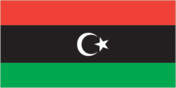
- three horizontal bands of red (top), black (double width), and green with a white crescent and star centered on the black stripe; the National Transitional Council reintroduced this flag design of the former Kingdom of Libya (1951-1969) on 27 February 2011; it replaced the former all-green banner promulgated by the QADHAFI regime in 1977; the colors represent the three major regions of the country: red stands for Fezzan, black symbolizes Cyrenaica, and green denotes Tripolitania; the crescent and star represent Islam, the main religion of the country
- three horizontal bands of red (top), black (double width), and green with a white crescent and star centered on the black stripe; the National Transitional Council reintroduced this flag design of the former Kingdom of Libya (1951-1969) on 27 February 201
- red stands for Fezzan, black symbolizes Cyrenaica, and green denotes Tripolitania; the crescent and star represent Islam, the main religion of the country
Government type
in transition
Independence
24 December 1951 (from UN trusteeship)
International law organization participation
has not submitted an ICJ jurisdiction declaration; non-party state to the ICCt
International organization participation
ABEDA, AfDB, AFESD, AMF, AMU, AU, BDEAC, CAEU, COMESA, FAO, G-77, IAEA, IBRD, ICAO, ICC (NGOs), ICRM, IDA, IDB, IFAD, IFC, IFRCS, ILO, IMF, IMO, IMSO, Interpol, IOC, IOM, IPU, ISO, ITSO, ITU, LAS, MIGA, NAM, OAPEC, OIC, OPCW, OPEC, PCA, UN, UNCTAD, UNESCO, UNIDO, UNWTO, UPU, WCO, WFTU (NGOs), WHO, WIPO, WMO, WTO (observer)
Judicial branch
- NA; note - government is in transition
- highest court(s)
- NA; note - government is in transition
Legal system
Libya's post-revolution legal system is in flux and driven by state and non-state entities
Legislative branch
- unicameral Council of Deputies or Majlis Al Nuwab (200 seats including 32 reserved for women; members elected by direct popular vote; member term NA) election last held in June 2014; note - the Libyan Supreme Court in November 2014 declared the House election unconstitutional, but the Council rejected the ruling; no country has officially recognized the rival government percent of vote by party - NA; seats by party - independent 200; note - not all 200 seats were filled in the June election because of boycotts and lack of security at some polling stations; some elected members of the Council also boycotted the election
- description
- unicameral Council of Deputies or Majlis Al Nuwab (200 seats including 32 reserved for women; members elected by direct popular vote; member term NA)
- election results
- percent of vote by party - NA; seats by party - independent 200; note - not all 200 seats were filled in the June election because of boycotts and lack of security at some polling stations; some elected members of the Council also boycotted the election
- elections
- election last held in June 2014; note - the Libyan Supreme Court in November 2014 declared the House election unconstitutional, but the Council rejected the ruling; no country has officially recognized the rival government
National anthem
- "Libya, Libya, Libya" Al Bashir AL AREBI/Mohamad Abdel WAHAB also known as "Ya Beladi" or "Oh, My Country!"; adopted 1951; readopted 2011 with some modification to the lyrics; during the QADHAFI years between 1969 and 2011, the anthem was "Allahu Akbar," (God is Great) a marching song of the Egyptian Army in the 1956 Suez War
- lyrics/music
- Al Bashir AL AREBI/Mohamad Abdel WAHAB
- name
- "Libya, Libya, Libya"
- note
- also known as "Ya Beladi" or "Oh, My Country!"; adopted 1951; readopted 2011 with some modification to the lyrics; during the QADHAFI years between 1969 and 2011, the anthem was "Allahu Akbar," (God is Great) a marching song of the Egyptian Army in the 1956 Suez War
National holiday
Liberation Day, 23 October (2011)
National symbol(s)
- star and crescent, hawk; national colors: red, black, green
- star and crescent, hawk; national colors
- red, black, green
Political parties and leaders
- Al-Watan (Homeland) Party Justice and Construction Party or JCP [Mohamed SOWAN] National Forces Alliance or NFA [Mahmoud JIBRIL] (includes many political organizations, NGOs, and independents) National Front (initially the National Front for the Salvation of Libya, formed in 1981 as a diaspora opposition group) Union for the Homeland [Abd al-Rahman al-SUWAYHILI] partial list of the larger political parties and leaders
- note
- partial list of the larger political parties and leaders
Political pressure groups and leaders
NA
Suffrage
18 years of age, universal
Economy
Agriculture - products
wheat, barley, olives, dates, citrus, vegetables, peanuts, soybeans; cattle
Budget
- $9.058 billion $21.02 billion (2015 est.)
- expenditures
- $21.02 billion (2015 est.)
- revenues
- $9.058 billion
Budget surplus (+) or deficit (-)
-31.2% of GDP (2015 est.)
Central bank discount rate
9.52% (31 December 2010) 3% (31 December 2009)
Commercial bank prime lending rate
6% (31 December 2015 est.) 6% (31 December 2014 est.)
Current account balance
-$16.7 billion (2015 est.) -$12.36 billion (2014 est.)
Debt - external
$3.985 billion (31 December 2015 est.) $5.244 billion (31 December 2014 est.)
Economy - overview
Libya's economy, almost entirely dependent on oil and gas exports, struggled during 2015 as the country plunged into civil war and world oil prices dropped to seven-year lows. In early 2015, armed conflict between rival forces for control of the country’s largest oil terminals caused a decline in Libyan crude oil production, which never recovered to more than one-third of the average pre-Revolution highs of 1.6 million barrels per day. The Central Bank of Libya continued to pay government salaries to a majority of the Libyan workforce and to fund subsidies for fuel and food, resulting in an estimated budget deficit of about 49% of GDP. Libya’s economic transition away from QADHAFI’s notionally socialist model has completely stalled as political chaos persists and security continues to deteriorate. Libya’s leaders have hindered economic development by failing to use its financial resources to invest in national infrastructure. The country suffers from widespread power outages in its largest cities, caused by shortages of fuel for power generation. Living conditions, including access to clean drinking water, medical services, and safe housing, have all declined as the civil war has caused more people to become internally displaced, further straining local resources. Extremists affiliated with the Islamic State of Iraq and the Levant (ISIL) attacked Libyan oilfields in the first half of 2015; ISIL has a presence in many cities across Libya including near oil infrastructure, threatening future government revenues from oil and gas.
Exchange rates
Libyan dinars (LYD) per US dollar - 1.379 (2015 est.) 1.2724 (2014 est.) 1.2724 (2013 est.) 1.26 (2012 est.) 1.224 (2011 est.)
Exports
$10.86 billion (2015 est.) $13.81 billion (2014 est.)
Exports - commodities
crude oil, refined petroleum products, natural gas, chemicals
Exports - partners
Italy 32.1%, Germany 11.3%, China 8%, France 8%, Spain 5.6%, Netherlands 5.4%, Syria 5.3% (2015)
Fiscal year
calendar year
GDP - composition, by end use
- 86.8% 21.7% 4% 1% 32.7% -46.2% (2015 est.)
- exports of goods and services
- 32.7%
- government consumption
- 21.7%
- household consumption
- 86.8%
- imports of goods and services
- -46.2% (2015 est.)
- investment in fixed capital
- 4%
- investment in inventories
- 1%
GDP - composition, by sector of origin
- 1.9% 43.1% 54.9% (2015 est.)
- agriculture
- 1.9%
- industry
- 43.1%
- services
- 54.9% (2015 est.)
GDP - per capita (PPP)
- $14,600 (2015 est.) $15,800 (2014 est.) $20,800 (2013 est.) data are in 2015 US dollars
- note
- data are in 2015 US dollars
GDP - real growth rate
-6.4% (2015 est.) -24% (2014 est.) -13.6% (2013 est.)
GDP (official exchange rate)
$38.3 billion (2015 est.)
GDP (purchasing power parity)
- $92.61 billion (2015 est.) $98.92 billion (2014 est.) $130.2 billion (2013 est.) data are in 2015 US dollars
- note
- data are in 2015 US dollars
Gross national saving
-17.9% of GDP (2015 est.) -34% of GDP (2014 est.) 5.6% of GDP (2013 est.)
Household income or consumption by percentage share
- NA% NA%
- highest 10%
- NA%
- lowest 10%
- NA%
Imports
$11.24 billion (2015 est.) $20.43 billion (2014 est.)
Imports - commodities
machinery, semi-finished goods, food, transport equipment, consumer products
Imports - partners
China 14.8%, Italy 12.9%, Turkey 11.1%, Tunisia 6.5%, France 6.1%, Spain 4.6%, Syria 4.5%, Egypt 4.4%, South Korea 4.3% (2015)
Industrial production growth rate
-13% (2015 est.)
Industries
petroleum, petrochemicals, aluminum, iron and steel, food processing, textiles, handicrafts, cement
Inflation rate (consumer prices)
12.1% (2015 est.) 8.7% (2014 est.)
Labor force
1.193 million (2015 est.)
Labor force - by occupation
- 17% 23% 59% (2004 est.)
- agriculture
- 17%
- industry
- 23%
- services
- 59% (2004 est.)
Market value of publicly traded shares
$NA
Population below poverty line
- NA% about one-third of Libyans live at or below the national poverty line
- note
- about one-third of Libyans live at or below the national poverty line
Public debt
8% of GDP (2015 est.) 7.2% of GDP (2014 est.)
Reserves of foreign exchange and gold
$70.99 billion (31 December 2015 est.) $89.25 billion (31 December 2014 est.)
Stock of broad money
$54.66 billion (31 December 2014 est.) $53.34 billion (31 December 2013 est.)
Stock of direct foreign investment - abroad
$21.59 billion (31 December 2015 est.) $20.91 billion (31 December 2014 est.)
Stock of direct foreign investment - at home
$18.83 billion (31 December 2015 est.) $18.66 billion (31 December 2014 est.)
Stock of domestic credit
$767.3 million (31 December 2015 est.) $-16.48 billion (31 December 2014 est.)
Stock of narrow money
$51.23 billion (31 December 2015 est.) $48.02 billion (31 December 2014 est.)
Taxes and other revenues
23.7% of GDP (2015 est.)
Unemployment rate
30% (2004 est.)
Energy
Carbon dioxide emissions from consumption of energy
57 million Mt (2013 est.)
Crude oil - exports
- 834,100 bbl/day Libyan crude oil export values are highly volatile because of continuing protests and other disruptions across the country (2013 est.)
- note
- Libyan crude oil export values are highly volatile because of continuing protests and other disruptions across the country (2013 est.)
Crude oil - imports
0 bbl/day (2013 est.)
Crude oil - production
404,000 bbl/day (2015 est.)
Crude oil - proved reserves
48.36 billion bbl (1 January 2016 es)
Electricity - consumption
9.3 billion kWh (2014 est.)
Electricity - exports
1 million kWh (2013 est.)
Electricity - from fossil fuels
99.2% of total installed capacity (2012 est.)
Electricity - from hydroelectric plants
0% of total installed capacity (2012 est.)
Electricity - from nuclear fuels
0% of total installed capacity (2012 est.)
Electricity - from other renewable sources
0.8% of total installed capacity (2012 est.)
Electricity - imports
88 million kWh (2014 est.)
Electricity - installed generating capacity
8.9 million kW (2014 est.)
Electricity - production
- 35 billion kWh persistent electricity shortages have contributed to the ongoing instability throughout the country (2014 est.)
- note
- persistent electricity shortages have contributed to the ongoing instability throughout the country (2014 est.)
Electricity access
- 13,083 99.8% 100% 99.1% (2013)
- electrification - rural areas
- 99.1% (2013)
- electrification - total population
- 99.8%
- electrification - urban areas
- 100%
- population without electricity
- 13,083
Natural gas - consumption
5.804 billion cu m (2014 est.)
Natural gas - exports
6 billion cu m (2014 est.)
Natural gas - imports
0 cu m (2013 est.)
Natural gas - production
11.8 billion cu m (2014 est.)
Natural gas - proved reserves
1.505 trillion cu m (1 January 2016 es)
Refined petroleum products - consumption
255,000 bbl/day (2014 est.)
Refined petroleum products - exports
50,890 bbl/day (2013 est.)
Refined petroleum products - imports
144,000 bbl/day (2013 est.)
Refined petroleum products - production
158,300 bbl/day (2013 est.)
Communications
Broadcast media
state-funded and private TV stations; some provinces operate local TV stations; pan-Arab satellite TV stations are available; state-funded radio (2012)
Internet country code
.ly
Internet users
- 1.219 million 19% (July 2015 est.)
- percent of population
- 19% (July 2015 est.)
- total
- 1.219 million
Telephone system
- Libya's civil war has disrupted its telecommunications sector, but much of its infrastructure remains superior to that in most other African countries combined fixed-line and mobile-cellular service generally adequate, but pressure to rebuild damaged infrastructure growing country code - 218; satellite earth stations - 4 Intelsat, NA Arabsat, and NA Intersputnik; submarine cable to France and Italy; microwave radio relay to Tunisia and Egypt; tropospheric scatter to Greece; participant in Medarabtel (2015)
- domestic
- combined fixed-line and mobile-cellular service generally adequate, but pressure to rebuild damaged infrastructure growing
- general assessment
- Libya's civil war has disrupted its telecommunications sector, but much of its infrastructure remains superior to that in most other African countries
- international
- country code - 218; satellite earth stations - 4 Intelsat, NA Arabsat, and NA Intersputnik; submarine cable to France and Italy; microwave radio relay to Tunisia and Egypt; tropospheric scatter to Greece; participant in Medarabtel (2015)
Telephones - fixed lines
- 632,000 10 (July 2015 est.)
- subscriptions per 100 inhabitants
- 10 (July 2015 est.)
- total subscriptions
- 632,000
Telephones - mobile cellular
- 9.918 million 155 (July 2015 est.)
- subscriptions per 100 inhabitants
- 155 (July 2015 est.)
- total
- 9.918 million
Transportation
Airports
146 (2013)
Airports - with paved runways
- 1 (2013)
- 1,524 to 2,437 m
- 30
- 2,438 to 3,047 m
- 7
- 914 to 1,523 m
- 7
- over 3,047 m
- 23
- total
- 68
- under 914 m
- 1 (2013)
Airports - with unpaved runways
- 20 (2013)
- 1,524 to 2,437 m
- 14
- 2,438 to 3,047 m
- 5
- 914 to 1,523 m
- 37
- over 3,047 m
- 2
- total
- 78
- under 914 m
- 20 (2013)
Civil aircraft registration country code prefix
5A (2016)
Heliports
2 (2013)
Merchant marine
- cargo 2, chemical tanker 4, liquefied gas 3, petroleum tanker 13, roll on/roll off 1 2 (Kuwait 1, Norway 1) 6 (Hong Kong 1, Malta 5) (2010)
- by type
- cargo 2, chemical tanker 4, liquefied gas 3, petroleum tanker 13, roll on/roll off 1
- foreign-owned
- 2 (Kuwait 1, Norway 1)
- registered in other countries
- 6 (Hong Kong 1, Malta 5) (2010)
- total
- 23
National air transport system
- 2,566,465 3,833,542 mt-km (2015)
- annual freight traffic on registered air carriers
- 3,833,542 mt-km (2015)
- annual passenger traffic on registered air carriers
- 2,566,465
- inventory of registered aircraft operated by air carriers
- 23
- number of registered air carriers
- 8
Pipelines
condensate 882 km; gas 3,743 km; oil 7,005 km (2013)
Ports and terminals
- Marsa al Burayqah (Marsa el Brega), Tripoli Az Zawiyah, Ra's Lanuf Marsa el Brega
- LNG terminal (export)
- Marsa el Brega
- major seaport(s)
- Marsa al Burayqah (Marsa el Brega), Tripoli
- oil terminal(s)
- Az Zawiyah, Ra's Lanuf
Roadways
- 100,024 km 57,214 km 42,810 km (2003)
- paved
- 57,214 km
- total
- 100,024 km
- unpaved
- 42,810 km (2003)
Military and Security
Military branches
note - in transition; government has affiliated Army, Air Force, and Navy forces (2015)
Military service age and obligation
18 years of age for mandatory or voluntary service (2012)
Transnational Issues
Disputes - international
dormant disputes include Libyan claims of about 32,000 sq km still reflected on its maps of southeastern Algeria and the FLN's assertions of a claim to Chirac Pastures in southeastern Morocco; various Chadian rebels from the Aozou region reside in southern Libya
Refugees and internally displaced persons
- 5,380 (West Bank and Gaza Strip) (2015) 313,236 (conflict between pro-Qadhafi and anti-Qadhafi forces in 2011; post-Qadhafi tribal clashes 2014) (2016)
- IDPs
- 313,236 (conflict between pro-Qadhafi and anti-Qadhafi forces in 2011; post-Qadhafi tribal clashes 2014) (2016)
- refugees (country of origin)
- 5,380 (West Bank and Gaza Strip) (2015)
Trafficking in persons
- Libya is a destination and transit country for men and women from sub-Saharan Africa and Asia subjected to forced labor and forced prostitution; migrants who seek employment in Libya as laborers and domestic workers or who transit Libya en route to Europe are vulnerable to forced labor; private employers also exploit migrants from detention centers as forced laborers on farms and construction sites, returning them to detention when they are no longer needed; some sub-Saharan women are reportedly forced to work in Libyan brothels, particularly in the country’s south; since 2013, militia groups and other informal armed groups, including some affiliated with the government, are reported to conscript Libyan children under the age of 18; large-scale violence driven by militias, civil unrest, and increased lawlessness increased in 2014, making it more difficult to obtain information on human trafficking Tier 3 - the Libyan Government does not fully comply with the minimum standards for the elimination of trafficking and is not making significant efforts to do so; in 2014, the government’s capacity to address human trafficking was hampered by the ongoing power struggle and violence; the judicial system was not functioning, preventing any efforts to investigate, prosecute, or convict traffickers, complicit detention camp guards or government officials, or militias or armed groups that used child soldiers; the government failed to identify or provide protection to trafficking victims, including child conscripts, and continued to punish victims for unlawful acts committed as a direct result of being trafficked; no public anti-trafficking awareness campaigns were conducted (2015)
- current situation
- Libya is a destination and transit country for men and women from sub-Saharan Africa and Asia subjected to forced labor and forced prostitution; migrants who seek employment in Libya as laborers and domestic workers or who transit Libya en route to Europe are vulnerable to forced labor; private employers also exploit migrants from detention centers as forced laborers on farms and construction sites, returning them to detention when they are no longer needed; some sub-Saharan women are reportedly forced to work in Libyan brothels, particularly in the country’s south; since 2013, militia groups and other informal armed groups, including some affiliated with the government, are reported to conscript Libyan children under the age of 18; large-scale violence driven by militias, civil unrest, and increased lawlessness increased in 2014, making it more difficult to obtain information on human trafficking
- tier rating
- Tier 3 - the Libyan Government does not fully comply with the minimum standards for the elimination of trafficking and is not making significant efforts to do so; in 2014, the government’s capacity to address human trafficking was hampered by the ongoing power struggle and violence; the judicial system was not functioning, preventing any efforts to investigate, prosecute, or convict traffickers, complicit detention camp guards or government officials, or militias or armed groups that used child soldiers; the government failed to identify or provide protection to trafficking victims, including child conscripts, and continued to punish victims for unlawful acts committed as a direct result of being trafficked; no public anti-trafficking awareness campaigns were conducted (2015)