1991 Edition
CIA World Factbook 1991 (Project Gutenberg)
Geography
Climate
Mediterranean along coast; dry, extreme desert interior
Coastline
1,770 km
Comparative area
slightly larger than Alaska
Disputes
claims and occupies the 100,000 km2 Aozou Strip in northern Chad; maritime boundary dispute with Tunisia; Libya claims about 19,400 km2 in northern Niger; Libya claims about 19,400 km2 in southeastern Algeria
Environment
hot, dry, dust-laden ghibli is a southern wind lasting one to four days in spring and fall; desertification; sparse natural surface-water resources
Land boundaries
4,383 km total; Algeria 982 km, Chad 1,055 km, Egypt 1,150 km, Niger 354 km, Sudan 383 km, Tunisia 459 km
Land use
arable land 1%; permanent crops 0%; meadows and pastures 8%; forest and woodland 0%; other 91%; includes irrigated NEGL%
Maritime claims
Territorial sea: 12 nm; Gulf of Sidra closing line: 32o 30%19 N
Natural resources
crude oil, natural gas, gypsum
Note
the Great Manmade River Project, the largest water development scheme in the world, is being built to bring water from large aquifers under the Sahara to coastal cities
Terrain
mostly barren, flat to undulating plains, plateaus, depressions
Total area
1,759,540 km2; land area: 1,759,540 km2
People and Society
Birth rate
36 births/1,000 population (1991)
Death rate
6 deaths/1,000 population (1991)
Ethnic divisions
Berber and Arab 97%; some Greeks, Maltese, Italians, Egyptians, Pakistanis, Turks, Indians, and Tunisians
Infant mortality rate
62 deaths/1,000 live births (1991)
Labor force
1,000,000, includes about 280,000 resident foreigners; industry 31%, services 27%, government 24%, agriculture 18%
Language
Arabic; Italian and English widely understood in major cities
Life expectancy at birth
66 years male, 71 years female (1991)
Literacy
64% (male 75%, female 50%) age 15 and over can read and write (1990 est.)
Nationality
noun--Libyan(s); adjective--Libyan
Net migration rate
0 migrants/1,000 population (1991)
Organized labor
National Trade Unions' Federation, 275,000 members; General Union for Oil and Petrochemicals; Pan-Africa Federation of Petroleum Energy and Allied Workers
Population
4,350,742 (July 1991), growth rate 3.0% (1991)
Religion
Sunni Muslim 97%
Total fertility rate
5.1 children born/woman (1991)
Government
Administrative divisions
46 municipalities (baladiyat, singular--baladiyah); Ajdabiya, Al Abyar, Al Aziziyah, Al Bayda, Al Jufrah, Al Jumayl, Al Khums, Al Kufrah, Al Marj, Al Qarabulli, Al Qubbah, Al Ujaylat, Ash Shati, Awbari, Az Zahra, Az Zawiyah, Banghazi, Bani Walid, Bin Jawwad, Darnah, Ghadamis, Gharyan, Ghat, Jadu, Jalu, Janzur, Masallatah, Misratah, Mizdah, Murzuq, Nalut, Qaminis, Qasr Bin Ghashir, Sabha, Sabratah, Shahhat, Surman, Surt, Tajura, Tarabulus, Tarhunah, Tubruq, Tukrah, Yafran, Zlitan, Zuwarah; note--the number of municipalities may have been reduced to 13 named Al Jabal al-Akhdar, Al Jabal al-Gharbi, Al Jabal al-Khums, Al Batnam, Al Kufrah, Al Marqab, Al Marzuq, Az Zawiyah, Banghazi, Khalij Surt, Sabha, Tripoli, Wadi al-Hayat
Capital
Tripoli
Communists
no organized party, negligible membership
Constitution
11 December 1969, amended 2 March 1977
Diplomatic representation
none
Elections
national elections are indirect through a hierarchy of revolutionary committees
Executive branch
revolutionary leader, chairman of the General People's Committee, General People's Committee (cabinet)
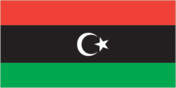
Flag
plain green; green is the traditional color of Islam (the state religion)
Independence
24 December 1951 (from Italy)
Judicial branch
Supreme Court
Leaders
Chief of State--Revolutionary Leader Col. Muammar Abu Minyar al-QADHAFI (since 1 September 1969); Head of Government--Chairman of the General People's Committee (Premier) Abu Zayd Umar DURDA (since 7 October 1990)
Legal system
based on Italian civil law system and Islamic law; separate religious courts; no constitutional provision for judicial review of legislative acts; has not accepted compulsory ICJ jurisdiction
Legislative branch
unicameral General People's Congress
Long-form name
Socialist People's Libyan Arab Jamahiriya
Member of
ABEDA, AfDB, AFESD, AL, AMF, AMU, CAEU, CCC, ECA, FAO, G-77, IAEA, IBRD, ICAO, IDA, IDB, IFAD, IFC, ILO, IMF, IMO, INTELSAT, INTERPOL, IOC, ITU, LORCS, NAM, OAPEC, OAU, OIC, OPEC, UN, UNCTAD, UNESCO, UNIDO, UPU, WHO, WIPO, WMO, WTO
National holiday
Revolution Day, 1 September (1969)
Other political or pressure groups
various Arab nationalist movements and the Arab Socialist Resurrection (Ba'th) party with almost negligible memberships may be functioning clandestinely, as well as some Islamic elements
Political parties
none
Political parties and leaders
none
Suffrage
universal and compulsory at age 18
Type
Jamahiriya (a state of the masses); in theory, governed by the populace through local councils; in fact, a military dictatorship
Economy
Agriculture
5% of GNP; cash crops--wheat, barley, olives, dates, citrus fruits, peanuts; 75% of food is imported
Budget
revenues $8.1 billion; expenditures $9.8 billion, including capital expenditures of $3.1 billion (1989 est.)
Currency
Libyan dinar (plural--dinars); 1 Libyan dinar (LD) = 1,000 dirhams
Economic aid
Western (non-US) countries, ODA and OOF bilateral commitments (1970-87), $242 million; no longer a recipient
Electricity
4,705,000 kW capacity; 13,600 million kWh produced, 3,220 kWh per capita (1990)
Exchange rates
Libyan dinars (LD) per US$1--0.2669 (January 1991), 0.2699 (1990), 0.2922 (1989), 0.2853 (1988), 0.2706 (1987), 0.3139 (1986), 0.2961 (1985)
Exports
$6.1 billion (f.o.b., 1989 est.); commodities--petroleum, peanuts, hides; partners--Italy, USSR, FRG, Spain, France, Belgium/Luxembourg, Turkey
External debt
$3.5 billion, excluding military debt (December 1990 est.)
Fiscal year
calendar year
GNP
$24 billion, per capita $5,860; real growth rate 3% (1989 est.)
Imports
$6.2 billion (f.o.b., 1989 est.); commodities--machinery, transport equipment, food, manufactured goods; partners--Italy, USSR, FRG, UK, Japan
Industrial production
growth rate NA%; accounts for 43% of GDP (including oil)
Industries
petroleum, food processing, textiles, handicrafts, cement
Inflation rate (consumer prices)
20% (1988 est.)
Overview
The socialist-oriented economy depends primarily upon revenues from the oil sector, which contributes practically all export earnings and about one-third of GNP. Since 1980, however, the sharp drop in oil prices and the resulting decline in export revenues have adversely affected economic development. In 1988 per capita GNP was the highest in Africa at $5,410, but it had been $2,000 higher in 1982. Severe cutbacks in imports over the past five years have led to shortages of basic goods and foodstuffs, although the reopening of the Libyan-Tunisian border in April 1988 and the Libyan-Egyptian border in December 1989 have somewhat eased shortages. Austerity budgets and a lack of trained technicians have undermined the government's ability to implement a number of planned infrastructure development projects. Windfall profits from the hike in world oil prices in late 1990 improved the foreign payments position and may permit Tripoli to ease austerity measures. The nonoil industrial and construction sectors, which account for about 22% of GDP, have expanded from processing mostly agricultural products to include petrochemicals, iron, steel, and aluminum. Although agriculture accounts for less than 5% of GNP, it employs 18% of the labor force. Climatic conditions and poor soils severely limit farm output, requiring Libya to import about 75% of its food requirements.
Unemployment rate
2% (1988 est.)
Communications
Airports
131 total, 123 usable; 53 with permanent-surface runways; 7 with runways over 3,659 m; 31 with runways 2,440-3,659 m; 44 with runways 1,220-2,439 m
Civil air
59 major transport aircraft
Highways
32,500 km total; 24,000 km bituminous and bituminous treated, 8,500 km gravel, crushed stone and earth
Merchant marine
30 ships (1,000 GRT or over) totaling 807,539 GRT/1,452,847 DWT; includes 3 short-sea passenger, 11 cargo, 4 roll-on/roll-off cargo, 11 petroleum, oils, and lubricants (POL) tanker, 1 chemical tanker
Pipelines
crude oil 4,383 km; natural gas 1,947 km; refined products 443 km (includes 256 km liquid petroleum gas)
Ports
Tobruk, Tripoli, Banghazi, Misratah, Marsa el Brega
Telecommunications
modern telecommunications system using radio relay, coaxial cable, tropospheric scatter, and domestic satellite stations; 370,000 telephones; stations--18 AM, 3 FM, 13 TV; satellite earth stations--1 Atlantic Ocean INTELSAT, 1 Indian Ocean INTELSAT, and 14 domestic; submarine cables to France and Italy; radio relay to Tunisia; tropospheric scatter to Greece; planned ARABSAT and Intersputnik satellite stations
Military and Security
Branches
Armed Peoples of the Libyan Arab Jamahariya (includes Army, Navy, Air Force, Air Defense Command), National Police
Defense expenditures
$NA, 11.1% of GNP (1987) _%_
Manpower availability
males 15-49, 1,023,335; 603,886 fit for military service; 52,059 reach military age (17) annually; conscription now being implemented