2019 Edition
CIA World Factbook 2019 Archive (Wayback Machine)
Introduction
Background
Settlement of freed slaves from the US in what is today Liberia began in 1822; by 1847, the Americo-Liberians were able to establish a republic. William TUBMAN, president from 1944-71, did much to promote foreign investment and to bridge the economic, social, and political gaps between the descendants of the original settlers and the inhabitants of the interior. In 1980, a military coup led by Samuel DOE ushered in a decade of authoritarian rule. In December 1989, Charles TAYLOR launched a rebellion against DOE's regime that led to a prolonged civil war in which DOE was killed. A period of relative peace in 1997 allowed for an election that brought TAYLOR to power, but major fighting resumed in 2000. An August 2003 peace agreement ended the war and prompted the resignation of former president Charles TAYLOR, who was convicted by the UN-backed Special Court for Sierra Leone in The Hague for his involvement in Sierra Leone's civil war. After two years of rule by a transitional government, democratic elections in late 2005 brought President Ellen JOHNSON SIRLEAF to power. She subsequently won reelection in 2011 but was challenged to rebuild Liberia's economy, particularly following the 2014-15 Ebola epidemic, and to reconcile a nation still recovering from 14 years of fighting. Constitutional term limits barred President JOHNSON SIRLEAF from running for re-election. Legal challenges delayed the 2017 presidential runoff election, which was eventually won by George WEAH. In March 2018, the UN completed its 15-year peacekeeping mission in Liberia.
Geography
Area
- Land
- 96,320 sq km
- Total
- 111,369 sq km
- Water
- 15,049 sq km
Area Comparative
slightly larger than Virginia
Climate
tropical; hot, humid; dry winters with hot days and cool to cold nights; wet, cloudy summers with frequent heavy showers
Coastline
579 km
Elevation
- Highest Point
- Mount Wuteve 1,447 m
- Lowest Point
- Atlantic Ocean 0 m
- Mean Elevation
- 243 m
Environment Current Issues
tropical rain forest deforestation; soil erosion; loss of biodiversity; hunting of endangered species for bushmeat; pollution of coastal waters from oil residue and raw sewage; pollution of rivers from industrial run-off; burning and dumping of household waste
Environment International Agreements
- Party To
- Biodiversity, Climate Change, Climate Change-Kyoto Protocol, Desertification, Endangered Species, Hazardous Wastes, Law of the Sea, Ozone Layer Protection, Ship Pollution, Tropical Timber 83, Tropical Timber 94, Wetlands
- Signed But Not Ratified
- Environmental Modification, Marine Life Conservation
Geographic Coordinates
6 30 N, 9 30 W
Geography Note
facing the Atlantic Ocean, the coastline is characterized by lagoons, mangrove swamps, and river-deposited sandbars; the inland grassy plateau supports limited agriculture
Irrigated Land
30 sq km (2012)
Land Boundaries
- Border Countries
- Guinea 590 km, Cote d'Ivoire 778 km, Sierra Leone 299 km
- Total
- 1,667 km
Land Use
- Agricultural Land
- 28.1% (2011 est.)
- Agricultural Land Arable Land
- 5.2% (2011 est.)
- Agricultural Land Permanent Crops
- 2.1% (2011 est.)
- Agricultural Land Permanent Pasture
- 20.8% (2011 est.)
- Forest
- 44.6% (2011 est.)
- Other
- 27.3% (2011 est.)
Location
Western Africa, bordering the North Atlantic Ocean, between Cote d'Ivoire and Sierra Leone
Map References
Africa
Maritime Claims
200 nm
Natural Hazards
dust-laden harmattan winds blow from the Sahara (December to March)
Natural Resources
iron ore, timber, diamonds, gold, hydropower
Population Distribution
more than half of the population lives in urban areas, with approximately one-third living within an 80-km radius of Monrovia
Terrain
mostly flat to rolling coastal plains rising to rolling plateau and low mountains in northeast
People and Society
Age Structure
- 0 14 Years
- 43.72% (male 1,062,766 /female 1,040,211)
- 15 24 Years
- 19.9% (male 478,041 /female 478,999)
- 25 54 Years
- 30.1% (male 711,963 /female 735,878)
- 55 64 Years
- 3.43% (male 84,474 /female 80,410)
- 65 Years And Over
- 2.85% (male 67,229 /female 69,797) (2018 est.)
Birth Rate
37.9 births/1,000 population (2018 est.)
Children Under The Age Of 5 Years Underweight
15.3% (2013)
Contraceptive Prevalence Rate
31.2% (2016)
Current Health Expenditure
9.6% (2016)
Death Rate
7.4 deaths/1,000 population (2018 est.)
Demographic Profile
Liberia’s high fertility rate of nearly 5 children per woman and large youth cohort – more than 60% of the population is under the age of 25 – will sustain a high dependency ratio for many years to come. Significant progress has been made in preventing child deaths, despite a lack of health care workers and infrastructure. Infant and child mortality have dropped nearly 70% since 1990; the annual reduction rate of about 5.4% is the highest in Africa.Nevertheless, Liberia’s high maternal mortality rate remains among the world’s worst; it reflects a high unmet need for family planning services, frequency of early childbearing, lack of quality obstetric care, high adolescent fertility, and a low proportion of births attended by a medical professional. Female mortality is also increased by the prevalence of female genital cutting (FGC), which is practiced by 10 of Liberia’s 16 tribes and affects more than two-thirds of women and girls. FGC is an initiation ritual performed in rural bush schools, which teach traditional beliefs on marriage and motherhood and are an obstacle to formal classroom education for Liberian girls.Liberia has been both a source and a destination for refugees. During Liberia’s 14-year civil war (1989-2003), more than 250,000 people became refugees and another half million were internally displaced. Between 2004 and the cessation of refugee status for Liberians in June 2012, the UNHCR helped more than 155,000 Liberians to voluntarily repatriate, while others returned home on their own. Some Liberian refugees spent more than two decades living in other West African countries. Liberia hosted more than 125,000 Ivoirian refugees escaping post-election violence in 2010-11; as of mid-2017, about 12,000 Ivoirian refugees were still living in Liberia as of October 2017 because of instability.
Dependency Ratios
- Elderly Dependency Ratio
- 5.5 (2015 est.)
- Potential Support Ratio
- 18.1 (2015 est.)
- Total Dependency Ratio
- 83.2 (2015 est.)
- Youth Dependency Ratio
- 77.6 (2015 est.)
Drinking Water Source
- Improved Rural
- 62.6% of population
- Improved Total
- 75.6% of population
- Improved Urban
- 88.6% of population
- Unimproved Rural
- 37.4% of population
- Unimproved Total
- 24.4% of population (2015 est.)
- Unimproved Urban
- 11.4% of population
Education Expenditures
3.8% of GDP (2017)
Ethnic Groups
Kpelle 20.3%, Bassa 13.4%, Grebo 10%, Gio 8%, Mano 7.9%, Kru 6%, Lorma 5.1%, Kissi 4.8%, Gola 4.4%, Krahn 4%, Vai 4%, Mandingo 3.2%, Gbandi 3%, Mende 1.3%, Sapo 1.3%, other Liberian 1.7%, other African 1.4%, non-African .1% (2008 est.)
HIV/AIDS Adult Prevalence Rate
1.3% (2018 est.)
HIV/AIDS Deaths
1,800 (2018 est.)
HIV/AIDS People Living With HIV/AIDS
39,000 (2018 est.)
Hospital Bed Density
0.8 beds/1,000 population (2010)
Infant Mortality Rate
- Female
- 46 deaths/1,000 live births
- Male
- 55 deaths/1,000 live births
- Total
- 50.6 deaths/1,000 live births (2018 est.)
Languages
English 20% (official), some 20 ethnic group languages few of which can be written or used in correspondence
Life Expectancy at Birth
- Female
- 66 years
- Male
- 61.6 years
- Total Population
- 63.8 years (2018 est.)
Literacy
- Definition
- age 15 and over can read and write
- Female
- 32.8% (2015)
- Male
- 62.4%
- Total Population
- 47.6%
Major Infectious Diseases
- Aerosolized Dust Or Soil Contact Diseases
- Lassa fever (2016)
- Animal Contact Diseases
- rabies (2016)
- Degree Of Risk
- very high (2016)
- Food Or Waterborne Diseases
- bacterial and protozoal diarrhea, hepatitis A, and typhoid fever (2016)
- Vectorborne Diseases
- malaria, dengue fever, and yellow fever (2016)
- Water Contact Diseases
- schistosomiasis (2016)
Major Urban Areas Population
1.467 million MONROVIA (capital) (2019)
Maternal Mortality Rate
661 deaths/100,000 live births (2017 est.)
Median Age
- Female
- 18.1 years
- Male
- 17.6 years
- Total
- 17.8 years (2018 est.)
Mother's Mean Age at First Birth
19.2 years (2013 est.)
Nationality
- Adjective
- Liberian
- Noun
- Liberian(s)
Net Migration Rate
-4.7 migrant(s)/1,000 population (2018 est.)
Obesity Adult Prevalence Rate
9.9% (2016)
Physicians Density
0.04 physicians/1,000 population (2015)
Population
4,809,768 (July 2018 est.)
Population Growth Rate
2.59% (2018 est.)
Religions
Christian 85.6%, Muslim 12.2%, Traditional 0.6%, other 0.2%, none 1.5% (2008 est.)
Sanitation Facility Access
- Improved Rural
- 5.9% of population (2015 est.)
- Improved Total
- 16.9% of population (2015 est.)
- Improved Urban
- 28% of population (2015 est.)
- Unimproved Rural
- 94.1% of population (2015 est.)
- Unimproved Total
- 83.1% of population (2015 est.)
- Unimproved Urban
- 72% of population (2015 est.)
Sex Ratio
- 0 14 Years
- 1.02 male(s)/female
- 15 24 Years
- 1 male(s)/female
- 25 54 Years
- 0.97 male(s)/female
- 55 64 Years
- 1.05 male(s)/female
- 65 Years And Over
- 0.96 male(s)/female
- At Birth
- 1.03 male(s)/female
- Total Population
- 1 male(s)/female (2018 est.)
Total Fertility Rate
5 children born/woman (2018 est.)
Unemployment Youth Ages 15 24
- Female
- 2.2% (2016 est.)
- Male
- 2.4%
- Total
- 2.3%
Urbanization
- Rate Of Urbanization
- 3.41% annual rate of change (2015-20 est.)
- Urban Population
- 51.6% of total population (2019)
Government
Administrative Divisions
15 counties; Bomi, Bong, Gbarpolu, Grand Bassa, Grand Cape Mount, Grand Gedeh, Grand Kru, Lofa, Margibi, Maryland, Montserrado, Nimba, River Cess, River Gee, Sinoe
Capital
- Geographic Coordinates
- 6 18 N, 10 48 W
- Name
- Monrovia
- Time Difference
- UTC 0 (5 hours ahead of Washington, DC, during Standard Time)
Citizenship
- Citizenship By Birth
- no
- Citizenship By Descent Only
- at least one parent must be a citizen of Liberia
- Dual Citizenship Recognized
- no
- Residency Requirement For Naturalization
- 2 years
Constitution
- Amendments
- proposed by agreement of at least two thirds of both National Assembly houses or by petition of at least 10,000 citizens; passage requires at least two-thirds majority approval of both houses and approval in a referendum by at least two-thirds majority of registered voters; amended 2011 (2018)
- History
- previous 1847 (at independence); latest drafted 19 October 1983, revised version adopted by referendum 3 July 1984, effective 6 January 1986
Country Name
- Conventional Long Form
- Republic of Liberia
- Conventional Short Form
- Liberia
- Etymology
- name derives from the Latin word "liber" meaning "free"; so named because the nation was created as a homeland for liberated African-American slaves
Diplomatic Representation From The Us
- Chief Of Mission
- Ambassador Christine A. ELDER (since 23 June 2016)
- Embassy
- U.S. Embassy, 502 Benson Street, Monrovia
- Fax
- [231] 77-677-7370
- Mailing Address
- P.O. Box 98, Monrovia
- Telephone
- [231] 77-677-7000
Diplomatic Representation In The Us
- Chancery
- 5201 16th Street NW, Washington, DC 20011
- Chief Of Mission
- Ambassador George PATTEN (since 11 January 2019)
- Consulate's General
- New York
- Fax
- [1] (202) 723-0436
- Telephone
- [1] (202) 723-0437
Executive Branch
- Cabinet
- Cabinet appointed by the president, confirmed by the Senate
- Chief Of State
- President George WEAH (since 22 January 2018); Vice President Jewel HOWARD-TAYLOR (since 22 January 2018); note - the president is both chief of state and head of government
- Election Results
- George WEAH elected president in second round; percent of vote in first round - George WEAH (Coalition for Democratic Change) 38.4%, Joseph BOAKAI (UP) 28.8%, Charles BRUMSKINE (LP) 9.6%, Prince JOHNSON (MDR) 8.2%, Alexander B. CUMMINGS (ANC) 7.2%, other 7.8%; percentage of vote in second round - George WEAH 61.5%, Joseph BOAKAI 38.5%
- Elections Appointments
- president directly elected by absolute majority popular vote in 2 rounds if needed for a 6-year term (eligible for a second term); election last held on 10 October 2017 with a run-off on 26 December 2017); the runoff originally scheduled for 7 November 2017 was delayed due to allegations of fraud in the first round, which the Supreme Court dismissed
- Head Of Government
- President George WEAH (since 22 January 2018); Vice President Jewel HOWARD-TAYLOR (since 22 January 2018)
Flag Description
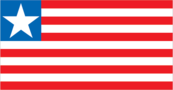
11 equal horizontal stripes of red (top and bottom) alternating with white; a white five-pointed star appears on a blue square in the upper hoist-side corner; the stripes symbolize the signatories of the Liberian Declaration of Independence; the blue square represents the African mainland, and the star represents the freedom granted to the ex-slaves; according to the constitution, the blue color signifies liberty, justice, and fidelity, the white color purity, cleanliness, and guilelessness, and the red color steadfastness, valor, and fervor
Government Type
presidential republic
Independence
26 July 1847
International Law Organization Participation
accepts compulsory ICJ jurisdiction with reservations; accepts ICCt jurisdiction
International Organization Participation
ACP, AfDB, AU, ECOWAS, EITI (compliant country), FAO, G-77, IAEA, IBRD, ICAO, ICC (NGOs), ICCt, ICRM, IDA, IFAD, IFC, IFRCS, ILO, IMF, IMO, IMSO, Interpol, IOC, IOM, ISO (correspondent), ITU, ITUC (NGOs), MIGA, MINUSMA, NAM, OPCW, UN, UNCTAD, UNESCO, UNIDO, UNWTO, UPU, WCO, WFTU (NGOs), WHO, WIPO, WMO, WTO (observer)
Judicial Branch
- Highest Courts
- Supreme Court (consists of a chief justice and 4 associate justices); note - the Supreme Court has jurisdiction for all constitutional cases
- Judge Selection And Term Of Office
- chief justice and associate justices appointed by the president of Liberia with consent of the Senate; judges can serve until age 70
- Subordinate Courts
- judicial circuit courts; special courts, including criminal, civil, labor, traffic; magistrate and traditional or customary courts
Legal System
mixed legal system of common law, based on Anglo-American law, and customary law
Legislative Branch
- Description
- bicameral National Assembly consists of: The Liberian Senate (30 seats; members directly elected in 15 2-seat districts by simple majority vote to serve 9-year staggered terms; each district elects 1 senator and elects the second senator 3 years later, followed by a 6-year hiatus, after which the first Senate seat is up for election) House of Representatives (73 seats; members directly elected in single-seat districts by simple majority vote to serve 6-year terms; eligible for a second term)
- Election Results
- Senate - percent of vote by party - CDC 29.8%, UP 10.3%, LP 11.5%, NPP 6.1%, PUP 4.9%, ANC 4.2%, NDC 1.3%, other 7.6%, independent 24.3%; seats by party - UP 4, CDC 2, LP 2, ANC 1, NDC 1, NPP 1, PUP 1, independent 3; composition - men 27, women 3, percent of women 10% House of Representatives - percent of vote by party/coalition - Coalition for Democratic Change 15.6%, UP 14%, LP 8.7%, ANC 6.1%, PUP 5.9%, ALP 5.1%, MDR 3.4%, other 41.2%; seats by coalition/party - Coalition for Democratic Change 21, UP 20, PUP 5, LP 3, ALP 3, MDR 2, independent 13, other 6; composition - men 64, women 9, percent of women 12.3%; total Parliament percent of women 11.7%
- Elections
- Senate - last held on 20 December 2014 (originally scheduled for 14 October 2014 but postponed due to Ebola-virus epidemic; next to be held in October 2020); by-elections to fill the senate seats vacated by WEAH and HOWARD-TAYLOR was held on 31 July 2018 House of Representatives - last held on 10 October 2017 (next to be held in October 2023)
National Anthem
- Lyrics Music
- Daniel Bashiel WARNER/Olmstead LUCA
- Name
- All Hail, Liberia Hail!
National Holiday
Independence Day, 26 July (1847)
National Symbol S
white star; national colors: red, white, blue
Political Parties And Leaders
Alliance for Peace and Democracy or APD [Marcus S. G. DAHN] All Liberian Party or ALP [Benoi UREY] Alternative National Congress or ANC [Orishil GOULD] Coalition for Democratic Change [George WEAH] (includes CDC, NPP, and LPDP)Congress for Democratic Change or CDC [George WEAH] Liberia Destiny Party or LDP [Nathaniel BARNES] Liberia National Union or LINU [Nathaniel BLAMA] Liberia Transformation Party or LTP [Julius SUKU] Liberian People Democratic Party or LPDP [Alex J. TYLER] Liberian People's Party or LPP Liberty Party or LP [J. Fonati KOFFA] Movement for Democracy and Reconstruction or MDR [Prince Y. JOHNSON] Movement for Economic Empowerment [J. Mill JONES, Dr.] Movement for Progressive Change or MPC [Simeon FREEMAN] National Democratic Coalition or NDC [Dew MAYSON] National Democratic Party of Liberia or NDPL [D. Nyandeh SIEH] National Patriotic Party or NPP [Jewel HOWARD TAYLOR] National Reformist Party or NRP [Maximillian T. W. DIABE] National Union for Democratic Progress or NUDP [Victor BARNEY] People's Unification Party or PUP [Isobe GBORKORKOLLIE] Unity Party or UP [Varney SHERMAN] United People's Party [MacDonald WENTO] Victory for Change Party [Marcus R. JONES]
Suffrage
18 years of age; universal
Economy
Agriculture Products
rubber, coffee, cocoa, rice, cassava (manioc, tapioca), palm oil, sugarcane, bananas; sheep, goats; timber
Budget
- Expenditures
- 693.8 million (2017 est.)
- Revenues
- 553.6 million (2017 est.)
Budget Surplus Or Deficit
-4.3% (of GDP) (2017 est.)
Central Bank Discount Rate
- 2016
- 3.2%
Commercial Bank Prime Lending Rate
- 31 December 2016
- 13.59%
- 31 December 2017
- 13.3%
Current Account Balance
- 2016
- -$464 million
- 2017
- -$627 million
Debt External
- 31 December 2016
- $938.9 million
- 31 December 2017
- $1.036 billion
Distribution Of Family Income Gini Index
- 2007
- 38.2
- 2014
- 32
Economy Overview
Liberia is a low-income country that relies heavily on foreign assistance and remittances from the diaspora. It is richly endowed with water, mineral resources, forests, and a climate favorable to agriculture. Its principal exports are iron ore, rubber, diamonds, and gold. Palm oil and cocoa are emerging as new export products. The government has attempted to revive raw timber extraction and is encouraging oil exploration.In the 1990s and early 2000s, civil war and government mismanagement destroyed much of Liberia's economy, especially infrastructure in and around the capital. Much of the conflict was fueled by control over Liberia’s natural resources. With the conclusion of fighting and the installation of a democratically elected government in 2006, businesses that had fled the country began to return. The country achieved high growth during the period 2010-13 due to favorable world prices for its commodities. However, during the 2014-2015 Ebola crisis, the economy declined and many foreign-owned businesses departed with their capital and expertise. The epidemic forced the government to divert scarce resources to combat the spread of the virus, reducing funds available for needed public investment. The cost of addressing the Ebola epidemic coincided with decreased economic activity reducing government revenue, although higher donor support significantly offset this loss. During the same period, global commodities prices for key exports fell and have yet to recover to pre-Ebola levels.In 2017, gold was a key driver of growth, as a new mining project began its first full year of production; iron ore exports are also increased as Arcelor Mittal opened new mines at Mount Gangra. The completion of the rehabilitation of the Mount Coffee Hydroelectric Dam increased electricity production to support ongoing and future economic activity, although electricity tariffs remain high relative to other countries in the region and transmission infrastructure is limited. Presidential and legislative elections in October 2017 generated election-related spending pressures.Revitalizing the economy in the future will depend on economic diversification, increasing investment and trade, higher global commodity prices, sustained foreign aid and remittances, development of infrastructure and institutions, combating corruption, and maintaining political stability and security.
Exchange Rates
- 2013
- 83.893
- 2014
- 85.3
- 2015
- 93.4
- 2016
- 93.4
- 2017
- 109.4
- Currency
- Liberian dollars (LRD) per US dollar -
Exports
- 2016
- $169.8 million
- 2017
- $260.6 million
Exports Commodities
rubber, timber, iron, diamonds, cocoa, coffee
Exports Partners
Germany 36.2%, Switzerland 14.2%, UAE 8.8%, US 6.8%, Indonesia 4.7% (2017)
Fiscal Year
calendar year
GDP Composition By End Use
- Exports Of Goods And Services
- 17.5% (2016 est.)
- Government Consumption
- 16.7% (2016 est.)
- Household Consumption
- 128.8% (2016 est.)
- Imports Of Goods And Services
- -89.2% (2016 est.)
- Investment In Fixed Capital
- 19.5% (2016 est.)
- Investment In Inventories
- 6.7% (2016 est.)
GDP Composition By Sector Of Origin
- Agriculture
- 34% (2017 est.)
- Industry
- 13.8% (2017 est.)
- Services
- 52.2% (2017 est.)
GDP Official Exchange Rate
$3.285 billion (2017 est.)
GDP Per Capita Ppp
- 2015
- $1,300
- 2016
- $1,300
- 2017
- $1,300
GDP Purchasing Power Parity
- 2015
- $6.064 billion
- 2016
- $5.965 billion
- 2017
- $6.112 billion
GDP Real Growth Rate
- 2015
- 0%
- 2016
- -1.6%
- 2017
- 2.5%
Gross National Saving
- 2016
- 1.9% of GDP
- 2017
- NA%
Household Income Or Consumption By Percentage Share
- Highest 10
- 30.1% (2007)
- Lowest 10
- 2.4%
Imports
- 2016
- $1.296 billion
- 2017
- $1.166 billion
Imports Commodities
fuels, chemicals, machinery, transportation equipment, manufactured goods; foodstuffs
Imports Partners
Singapore 29.8%, China 24.4%, South Korea 17.5%, Japan 9.4% (2017)
Industrial Production Growth Rate
9% (2017 est.)
Industries
mining (iron ore and gold), rubber processing, palm oil processing, diamonds
Inflation Rate Consumer Prices
- 2016
- 8.8%
- 2017
- 12.4%
Labor Force
1.677 million (2017 est.)
Labor Force By Occupation
- Agriculture
- 70%
- Industry
- 8%
- Services
- 22% (2000 est.)
Market Value Of Publicly Traded Shares
NA
Population Below Poverty Line
54.1% (2014 est.)
Public Debt
- 2016
- 28.3% of GDP
- 2017
- 34.4% of GDP
Reserves Of Foreign Exchange And Gold
- 31 December 2016
- $528.7 million
- 31 December 2017
- $459.8 million
Stock Of Broad Money
- 31 December 2016
- $438.3 million
- 31 December 2017
- $423 million
Stock Of Direct Foreign Investment Abroad
- 31 December 2012
- $201 million
- 31 December 2013
- $201 million
Stock Of Direct Foreign Investment at Home
- 31 December 2014
- $16.56 billion
- 31 December 2015
- $17.01 billion
Stock Of Domestic Credit
- 31 December 2016
- $789.4 million
- 31 December 2017
- $792.3 million
Stock Of Narrow Money
- 31 December 2016
- $438.3 million
- 31 December 2017
- $423 million
Taxes And Other Revenues
16.9% (of GDP) (2017 est.)
Unemployment Rate
- 2014
- 2.8%
Energy
Carbon Dioxide Emissions From Consumption Of Energy
1.163 million Mt (2017 est.)
Crude Oil Exports
0 bbl/day (2015 est.)
Crude Oil Imports
0 bbl/day (2015 est.)
Crude Oil Production
0 bbl/day (2018 est.)
Crude Oil Proved Reserves
0 bbl (1 January 2018 est.)
Electricity Access
- Electrification Rural Areas
- 1.3% (2016)
- Electrification Total Population
- 19.8% (2016)
- Electrification Urban Areas
- 34% (2016)
- Population Without Electricity
- 4 million (2017)
Electricity Consumption
279 million kWh (2016 est.)
Electricity Exports
0 kWh (2016 est.)
Electricity From Fossil Fuels
57% of total installed capacity (2016 est.)
Electricity From Hydroelectric Plants
43% of total installed capacity (2017 est.)
Electricity From Nuclear Fuels
0% of total installed capacity (2017 est.)
Electricity From Other Renewable Sources
0% of total installed capacity (2017 est.)
Electricity Imports
0 kWh (2016 est.)
Electricity Installed Generating Capacity
151,000 kW (2016 est.)
Electricity Production
300 million kWh (2016 est.)
Natural Gas Consumption
0 cu m (2017 est.)
Natural Gas Exports
0 cu m (2017 est.)
Natural Gas Imports
0 cu m (2017 est.)
Natural Gas Production
0 cu m (2017 est.)
Natural Gas Proved Reserves
0 cu m (1 January 2014 est.)
Refined Petroleum Products Consumption
8,000 bbl/day (2016 est.)
Refined Petroleum Products Exports
0 bbl/day (2015 est.)
Refined Petroleum Products Imports
8,181 bbl/day (2015 est.)
Refined Petroleum Products Production
0 bbl/day (2017 est.)
Communications
Broadband Fixed Subscriptions
- Subscriptions Per 100 Inhabitants
- less than 1 (2017 est.)
- Total
- 8,000
Broadcast Media
8 private and 1 government-owned TV station; satellite TV service available; 1 state-owned radio station; approximately 20 independent radio stations broadcasting in Monrovia, with approximately 80 more local stations operating in other areas; transmissions of 4 international (including the British Broadcasting Corporation and Radio France Internationale) broadcasters are available (2019)
Internet Country Code
.lr
Internet Users
- Percent Of Population
- 7.3% (July 2016 est.)
- Total
- 314,717
Telephone System
- Domestic
- fixed-line less than 1 per 100; mobile-cellular subscription base growing and teledensity approached 66 per 100 persons (2018)
- General Assessment
- the limited services available are found almost exclusively in the capital, Monrovia; fixed-line service stagnant and extremely limited; telephone coverage extended to a number of other towns and rural areas by four mobile-cellular network operators; almost entirely wireless telecommunications market; mobile market penetration is low compared to others in the region; number of operators avoid paying dues and operate despite regulations (2018)
- International
- country code - 231; landing point for the ACE submarine cable linking 20 West African countries and Europe; satellite earth station - 1 Intelsat (Atlantic Ocean) (2019)
Telephones Fixed Lines
- Subscriptions Per 100 Inhabitants
- less than 1 (July 2016 est.)
- Total Subscriptions
- 8,000
Telephones Mobile Cellular
- Subscriptions Per 100 Inhabitants
- 66 (July 2016 est.)
- Total Subscriptions
- 3,117,002
Transportation
Airports
29 (2013)
Airports With Paved Runways
- 1 524 To 2 437 M
- 1 (2017)
- Over 3 047 M
- 1 (2017)
- Total
- 2 (2017)
Airports With Unpaved Runways
- 1 524 To 2 437 M
- 5 (2013)
- 914 To 1 523 M
- 8 (2013)
- Total
- 27 (2013)
- Under 914 M
- 14 (2013)
Civil Aircraft Registration Country Code Prefix
A8 (2016)
Merchant Marine
- By Type
- bulk carrier 1086, container ship 834, general cargo 130, oil tanker 723, other 548 (2018)
- Total
- 3,321
Pipelines
4 km oil (2013)
Ports And Terminals
Buchanan, Monrovia
Railways
- Narrow Gauge
- 84 km 1.067-m gauge (2008)
- Standard Gauge
- 345 km 1.435-m gauge (2008)
- Total
- 429 km (2008)
Roadways
- Paved
- 657 km (2018)
- Total
- 10,600 km (2018)
- Unpaved
- 9,943 km (2018)
Military and Security
Military And Security Forces
Armed Forces of Liberia (AFL): Army, Liberia Air Wing, Liberian Coast Guard (2019)
Military Expenditures
- 2014
- 0.72% of GDP
- 2015
- 0.73% of GDP
- 2016
- 0.7% of GDP
- 2017
- 0.73% of GDP
- 2018
- 0.77% of GDP
Military Service Age And Obligation
18 years of age for voluntary military service; no conscription (2012)
Transnational Issues
Disputes International
as the UN Mission in Liberia (UNMIL) continues to drawdown prior to the 1 March 2018 closure date, the peacekeeping force is being reduced to 434 soldiers and two police units; some Liberian refugees still remain in Guinea, Cote d'Ivoire, Sierra Leone, and Ghana; Liberia shelters 8,804 Ivoirian refugees, as of 2019
Illicit Drugs
transshipment point for Southeast and Southwest Asian heroin and South American cocaine for the European and US markets; corruption, criminal activity, arms-dealing, and diamond trade provide significant potential for money laundering, but the lack of well-developed financial system limits the country's utility as a major money-laundering center
Refugees And Internally Displaced Persons
8,551 (Cote d'Ivoire) (2019)