2011 Edition
CIA World Factbook 2011 Archive (HTML)
Introduction
Background
Settlement of freed slaves from the US in what is today Liberia began in 1822; by 1847, the Americo-Liberians were able to establish a republic. William TUBMAN, president from 1944-71, did much to promote foreign investment and to bridge the economic, social, and political gaps between the descendents of the original settlers and the inhabitants of the interior. In 1980, a military coup led by Samuel DOE ushered in a decade of authoritarian rule. In December 1989, Charles TAYLOR launched a rebellion against DOE's regime that led to a prolonged civil war in which DOE himself was killed. A period of relative peace in 1997 allowed for elections that brought TAYLOR to power, but major fighting resumed in 2000. An August 2003 peace agreement ended the war and prompted the resignation of former president Charles TAYLOR, who faces war crimes charges in The Hague related to his involvement in Sierra Leone's civil war. After two years of rule by a transitional government, democratic elections in late 2005 brought President Ellen JOHNSON SIRLEAF to power. The UN Mission in Liberia (UNMIL) maintains a strong presence throughout the country, but the security situation is still fragile and the process of rebuilding the social and economic structure of this war-torn country continues.
Geography
Area
- 111,369 sq km 96,320 sq km 15,049 sq km
- total
- 111,369 sq km
- water
- 15,049 sq km
Area - comparative
slightly larger than Tennessee
Climate
tropical; hot, humid; dry winters with hot days and cool to cold nights; wet, cloudy summers with frequent heavy showers
Coastline
579 km
Elevation extremes
- Atlantic Ocean 0 m Mount Wuteve 1,380 m
- highest point
- Mount Wuteve 1,380 m
- lowest point
- Atlantic Ocean 0 m
Environment - current issues
tropical rain forest deforestation; soil erosion; loss of biodiversity; pollution of coastal waters from oil residue and raw sewage
Environment - international agreements
- Biodiversity, Climate Change, Climate Change-Kyoto Protocol, Desertification, Endangered Species, Hazardous Wastes, Law of the Sea, Ozone Layer Protection, Ship Pollution, Tropical Timber 83, Tropical Timber 94, Wetlands Environmental Modification, Marine Life Conservation
- party to
- Biodiversity, Climate Change, Climate Change-Kyoto Protocol, Desertification, Endangered Species, Hazardous Wastes, Law of the Sea, Ozone Layer Protection, Ship Pollution, Tropical Timber 83, Tropical Timber 94, Wetlands
- signed, but not ratified
- Environmental Modification, Marine Life Conservation
Freshwater withdrawal (domestic/industrial/agricultural)
- 0.11 cu km/yr (27%/18%/55%) 34 cu m/yr (2000)
- per capita
- 34 cu m/yr (2000)
- total
- 0.11 cu km/yr (27%/18%/55%)
Geographic coordinates
6 30 N, 9 30 W
Geography - note
facing the Atlantic Ocean, the coastline is characterized by lagoons, mangrove swamps, and river-deposited sandbars; the inland grassy plateau supports limited agriculture
Irrigated land
30 sq km (2008)
Land boundaries
- 1,585 km Guinea 563 km, Cote d'Ivoire 716 km, Sierra Leone 306 km
- border countries
- Guinea 563 km, Cote d'Ivoire 716 km, Sierra Leone 306 km
- total
- 1,585 km
Land use
- 3.43% 1.98% 94.59% (2005)
- arable land
- 3.43%
- other
- 94.59% (2005)
- permanent crops
- 1.98%
Location
Western Africa, bordering the North Atlantic Ocean, between Cote d'Ivoire and Sierra Leone
Map references
Africa
Maritime claims
- 200 nm
- territorial sea
- 200 nm
Natural hazards
dust-laden harmattan winds blow from the Sahara (December to March)
Natural resources
iron ore, timber, diamonds, gold, hydropower
Terrain
mostly flat to rolling coastal plains rising to rolling plateau and low mountains in northeast
Total renewable water resources
232 cu km (1987)
People and Society
Age structure
- 44.3% (male 843,182/female 834,922) 52.7% (male 989,623/female 1,007,577) 2.9% (male 56,189/female 55,271) (2011 est.)
- 0-14 years
- 44.3% (male 843,182/female 834,922)
- 15-64 years
- 52.7% (male 989,623/female 1,007,577)
- 65 years and over
- 2.9% (male 56,189/female 55,271) (2011 est.)
Birth rate
37.25 births/1,000 population (2011 est.)
Children under the age of 5 years underweight
20.4% (2007)
Death rate
10.62 deaths/1,000 population (July 2011 est.)
Drinking water source
- urban: 79% of population rural: 51% of population total: 68% of population urban: 21% of population rural: 49% of population total: 32% of population (2008)
- rural
- 49% of population
- total
- 32% of population (2008)
- urban
- 21% of population
Education expenditures
2.7% of GDP (2008)
Ethnic groups
Kpelle 20.3%, Bassa 13.4%, Grebo 10%, Gio 8%, Mano 7.9%, Kru 6%, Lorma 5.1%, Kissi 4.8%, Gola 4.4%, other 20.1% (2008 census)
Health expenditures
3.9% of GDP (2009)
HIV/AIDS - adult prevalence rate
1.5% (2009 est.)
HIV/AIDS - deaths
3,600 (2009 est.)
HIV/AIDS - people living with HIV/AIDS
37,000 (2009 est.)
Hospital bed density
0.7 beds/1,000 population (2009)
Infant mortality rate
- 74.52 deaths/1,000 live births 78.96 deaths/1,000 live births 69.95 deaths/1,000 live births (2011 est.)
- female
- 69.95 deaths/1,000 live births (2011 est.)
- total
- 74.52 deaths/1,000 live births
Languages
English 20% (official), some 20 ethnic group languages few of which can be written or used in correspondence
Life expectancy at birth
- 57 years 55.44 years 58.6 years (2011 est.)
- female
- 58.6 years (2011 est.)
- total population
- 57 years
Literacy
- age 15 and over can read and write 57.5% 73.3% 41.6% (2003 est.)
- definition
- age 15 and over can read and write
- female
- 41.6% (2003 est.)
- male
- 73.3%
- total population
- 57.5%
Major cities - population
MONROVIA (capital) 882,000 (2009)
Major infectious diseases
- very high bacterial and protozoal diarrhea, hepatitis A, and typhoid fever malaria and yellow fever schistosomiasis Lassa fever rabies (2009)
- aerosolized dust or soil contact disease
- Lassa fever
- animal contact disease
- rabies (2009)
- degree of risk
- very high
- food or waterborne diseases
- bacterial and protozoal diarrhea, hepatitis A, and typhoid fever
- vectorborne diseases
- malaria and yellow fever
- water contact disease
- schistosomiasis
Maternal mortality rate
990 deaths/100,000 live births (2008)
Median age
- 18.3 years 18.2 years 18.3 years (2011 est.)
- female
- 18.3 years (2011 est.)
- male
- 18.2 years
- total
- 18.3 years
Nationality
- Liberian(s) Liberian
- adjective
- Liberian
- noun
- Liberian(s)
Net migration rate
0 migrant(s)/1,000 population (2011 est.)
Physicians density
0.014 physicians/1,000 population (2008)
Population
3,786,764 (July 2011 est.)
Population growth rate
2.663% (2011 est.)
Religions
Christian 85.6%, Muslim 12.2%, Traditional 0.6%, other 0.2%, none 1.4% (2008 census)
Sanitation facility access
- urban: 25% of population rural: 4% of population total: 17% of population urban: 75% of population rural: 96% of population total: 83% of population (2008)
- rural
- 96% of population
- total
- 83% of population (2008)
- urban
- 75% of population
School life expectancy (primary to tertiary education)
- 11 years 13 years 9 years (2000)
- female
- 9 years (2000)
- male
- 13 years
- total
- 11 years
Sex ratio
- 1.03 male(s)/female 1.01 male(s)/female 0.98 male(s)/female 1.03 male(s)/female 1 male(s)/female (2011 est.)
- 15-64 years
- 0.98 male(s)/female
- 65 years and over
- 1.03 male(s)/female
- at birth
- 1.03 male(s)/female
- total population
- 1 male(s)/female (2011 est.)
- under 15 years
- 1.01 male(s)/female
Total fertility rate
5.13 children born/woman (2011 est.)
Unemployment, youth ages 15-24
- 4.7% 5.7% 3.7% (2007)
- female
- 3.7% (2007)
- total
- 4.7%
Urbanization
- 48% of total population (2010) 3.4% annual rate of change (2010-15 est.)
- rate of urbanization
- 3.4% annual rate of change (2010-15 est.)
- urban population
- 48% of total population (2010)
Government
Administrative divisions
15 counties; Bomi, Bong, Gbarpolu, Grand Bassa, Grand Cape Mount, Grand Gedeh, Grand Kru, Lofa, Margibi, Maryland, Montserrado, Nimba, River Cess, River Gee, Sinoe
Capital
- Monrovia 6 18 N, 10 48 W UTC 0 (5 hours ahead of Washington, DC during Standard Time)
- geographic coordinates
- 6 18 N, 10 48 W
- name
- Monrovia
- time difference
- UTC 0 (5 hours ahead of Washington, DC during Standard Time)
Constitution
6 January 1986
Country name
- Republic of Liberia Liberia
- conventional long form
- Republic of Liberia
- conventional short form
- Liberia
Diplomatic representation from the US
- Ambassador Linda THOMAS-GREENFIELD 111 United Nations Drive, P. O. Box 98, Mamba Point, 1000 Monrovia, 10 use embassy street address [231] 7-705-4826 [231] 7-701-0370
- chief of mission
- Ambassador Linda THOMAS-GREENFIELD
- embassy
- 111 United Nations Drive, P. O. Box 98, Mamba Point, 1000 Monrovia, 10
- FAX
- [231] 7-701-0370
- mailing address
- use embassy street address
- telephone
- [231] 7-705-4826
Diplomatic representation in the US
- Ambassador (vacant); Charge d'Affaires William V. BULL 5201 16th Street NW, Washington, DC 20011 [1] (202) 723-0437 [1] (202) 723-0436 New York
- chancery
- 5201 16th Street NW, Washington, DC 20011
- chief of mission
- Ambassador (vacant); Charge d'Affaires William V. BULL
- consulate(s) general
- New York
- FAX
- [1] (202) 723-0436
- telephone
- [1] (202) 723-0437
Executive branch
- President Ellen JOHNSON SIRLEAF (since 16 January 2006); note - the President is both the chief of state and head of government President Ellen JOHNSON SIRLEAF (since 16 January 2006) Cabinet appointed by the president and confirmed by the Senate president elected by popular vote for a six-year term (eligible for a second term); elections last held on 11 October and 8 November 2011 (next to be held in 2017) Ellen JOHNSON SIRLEAF re-elected president; percent of vote, second round - Ellen JOHNSON SIRLEAF 90.7%, Winston TUBMAN 9.3%
- cabinet
- Cabinet appointed by the president and confirmed by the Senate
- chief of state
- President Ellen JOHNSON SIRLEAF (since 16 January 2006); note - the President is both the chief of state and head of government
- election results
- Ellen JOHNSON SIRLEAF re-elected president; percent of vote, second round - Ellen JOHNSON SIRLEAF 90.7%, Winston TUBMAN 9.3%
- elections
- president elected by popular vote for a six-year term (eligible for a second term); elections last held on 11 October and 8 November 2011 (next to be held in 2017)
- head of government
- President Ellen JOHNSON SIRLEAF (since 16 January 2006)
Flag description
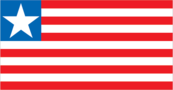
11 equal horizontal stripes of red (top and bottom) alternating with white; a white five-pointed star appears on a blue square in the upper hoist-side corner; the stripes symbolize the signatories of the Liberian Declaration of Independence; the blue square represents the African mainland, and the star represents the freedom granted to the ex-slaves; according to the constitution, the blue color signifies liberty, justice, and fidelity, the white color purity, cleanliness, and guilelessness, and the red color steadfastness, valor, and fervor the design is based on the US flag
Government type
republic
Independence
26 July 1847
International law organization participation
accepts compulsory ICJ jurisdiction with reservations; accepts ICCt jurisdiction
International organization participation
ACP, AfDB, AU, ECOWAS, FAO, G-77, IAEA, IBRD, ICAO, ICRM, IDA, IFAD, IFC, IFRCS, ILO, IMF, IMO, IMSO, Interpol, IOC, IOM, IPU, ISO (correspondent), ITU, ITUC, MIGA, NAM, OPCW, UN, UNCTAD, UNESCO, UNIDO, UPU, WCO, WFTU, WHO, WIPO, WMO, WTO (observer)
Judicial branch
Supreme Court
Legal system
mixed legal system of common law (based on Anglo-American law) and customary law
Legislative branch
- bicameral National Assembly consists of the Senate (30 seats; members elected by popular vote to serve nine-year terms) and the House of Representatives (73 seats; members elected by popular vote to serve six-year terms) Senate - last held on 11 October 2011 (next to be held in 2020); House of Representatives - last held on 11 October 2011 (next to be held 1n 2017) Senate - percent of vote by party - NA; seats by party - UP 10, NPP 6, CDC 3, ADP 2, NUDP 2, LDP 1, LP 1, NDC 1, NDP 1, independents 3 ; House of Representatives - percent of vote by party - NA; seats by party - UP 30, CDC 11, LP 7, NUDP 6, NDC 5, ADP 3, NPP3, MPC 2, LDP1, LTP 1, NRP 1, independents 9
- election results
- Senate - percent of vote by party - NA; seats by party - UP 10, NPP 6, CDC 3, ADP 2, NUDP 2, LDP 1, LP 1, NDC 1, NDP 1, independents 3 ; House of Representatives - percent of vote by party - NA; seats by party - UP 30, CDC 11, LP 7, NUDP 6, NDC 5, ADP 3, NPP3, MPC 2, LDP1, LTP 1, NRP 1, independents 9
- elections
- Senate - last held on 11 October 2011 (next to be held in 2020); House of Representatives - last held on 11 October 2011 (next to be held 1n 2017)
National anthem
- "All Hail, Liberia Hail!" Daniel Bashiel WARNER/Olmstead LUCA lyrics adopted 1847, music adopted 1860; the anthem's author would become the third president of Liberia
- lyrics/music
- Daniel Bashiel WARNER/Olmstead LUCA
- name
- "All Hail, Liberia Hail!"
National holiday
Independence Day, 26 July (1847)
National symbol(s)
white star
Political parties and leaders
Alliance for Peace and Democracy or APD [Togba-na TIPOTEH]; Congress for Democratic Change or CDC [George WEAH]; Liberty Party or LP [Charles BRUMSKINE]; National Patriotic Party or NPP [Roland MASSAQUOI]; Unity Party or UP [Varney SHERMAN]
Political pressure groups and leaders
- demobilized former military officers
- other
- demobilized former military officers
Suffrage
18 years of age; universal
Economy
Agriculture - products
rubber, coffee, cocoa, rice, cassava (tapioca), palm oil, sugarcane, bananas; sheep, goats; timber
Budget
- $NA $NA
- expenditures
- $NA
- revenues
- $NA
Budget surplus (+) or deficit (-)
-0.7% of GDP (2010 est.)
Commercial bank prime lending rate
14.3% (31 December 2010 est.) 14.183% (31 December 2009 est.)
Current account balance
-$692.5 million (2010 est.) -$541.1 million (2009 est.)
Debt - external
$1.66 billion (31 December 2009 est.) $3.2 billion (2005 est.)
Distribution of family income - Gini index
38.2 (2007)
Economy - overview
Liberia is a low income country heavily reliant on foreign assistance for revenue. Civil war and government mismanagement destroyed much of Liberia's economy, especially the infrastructure in and around the capital, Monrovia. Many businesses fled the country, taking capital and expertise with them, but with the conclusion of fighting and the installation of a democratically-elected government in 2006, several have returned. Liberia has the distinction of having the highest ratio of direct foreign investment to GDP in the world. Richly endowed with water, mineral resources, forests, and a climate favorable to agriculture, Liberia had been a producer and exporter of basic products, primarily raw timber and rubber and is reviving those sectors. Local manufacturing, mainly foreign owned, had been small in scope. President JOHNSON SIRLEAF, a Harvard-trained banker and administrator, has taken steps to reduce corruption, build support from international donors, and encourage private investment. Embargos on timber and diamond exports have been lifted, opening new sources of revenue for the government and Liberia shipped its first major timber exports to Europe in 2010. The country reached its Heavily Indebted Poor Countries initiative completion point in 2010 and nearly $5 billion of international debt was permanently eliminated. This new status will enable Liberia to establish a sovereign credit rating and issue bonds. Liberia's Paris Club creditors agreed to cancel Liberia's debt as well. Rebuilding infrastructure and raising incomes will depend on generous financial and technical assistance from donor countries and foreign investment in key sectors, such as infrastructure and power generation.
Electricity - consumption
311.6 million kWh (2008 est.)
Electricity - exports
0 kWh (2009 est.)
Electricity - imports
0 kWh (2009 est.)
Electricity - production
335 million kWh (2008 est.)
Exchange rates
Liberian dollars (LRD) per US dollar - NA (2007) 59.43 (2006) 53.098 (2005) 54.906 (2004) 59.379 (2003)
Exports
$207 million (2010 est.) $180 million (2009 est.)
Exports - commodities
rubber, timber, iron, diamonds, cocoa, coffee
Exports - partners
South Africa 26.9%, US 18.1%, Spain 7.8%, Denmark 5.4%, Venezuela 4.8%, Malaysia 4.3% (2010)
GDP - composition by sector
- 76.9% 5.4% 17.7% (2002 est.)
- agriculture
- 76.9%
- industry
- 5.4%
- services
- 17.7% (2002 est.)
GDP - per capita (PPP)
$500 (2010 est.) $400 (2009 est.) $400 (2008 est.) data are in 2010 US dollars
GDP - real growth rate
5.1% (2010 est.) 4.6% (2009 est.) 7.1% (2008 est.)
GDP (official exchange rate)
$974 million (2010 est.)
GDP (purchasing power parity)
$1.691 billion (2010 est.) $1.608 billion (2009 est.) $1.537 billion (2008 est.) data are in 2010 US dollars
Household income or consumption by percentage share
- 2.4% 30.1% (2007)
- highest 10%
- 30.1% (2007)
- lowest 10%
- 2.4%
Imports
$726.7 million (2010 est.) $559 million (2009 est.)
Imports - commodities
fuels, chemicals, machinery, transportation equipment, manufactured goods; foodstuffs
Imports - partners
South Korea 37.2%, China 26.3%, Singapore 17.3%, Japan 11.5% (2010)
Industrial production growth rate
NA%
Industries
rubber processing, palm oil processing, timber, diamonds
Inflation rate (consumer prices)
7.3% (2010 est.) 7.4% (2009 est.)
Labor force
1.372 million (2007)
Labor force - by occupation
- 70% 8% 22% (2000 est.)
- agriculture
- 70%
- industry
- 8%
- services
- 22% (2000 est.)
Market value of publicly traded shares
$NA
Natural gas - consumption
0 cu m (2009 est.)
Natural gas - exports
0 cu m (2009 est.)
Natural gas - imports
0 cu m (2009 est.)
Natural gas - production
0 cu m (2009 est.)
Natural gas - proved reserves
0 cu m (1 January 2011 est.)
Oil - consumption
4,500 bbl/day (2010 est.)
Oil - exports
23 bbl/day (2009 est.)
Oil - imports
4,552 bbl/day (2009 est.)
Oil - production
0 bbl/day (2010 est.)
Oil - proved reserves
0 bbl (1 January 2011 est.)
Population below poverty line
80% (2000 est.)
Reserves of foreign exchange and gold
$399.8 million (31 December 2010 est.) $372.5 million (31 December 2009 est.)
Stock of broad money
$398.6 million $343.6 million
Stock of direct foreign investment - abroad
$NA
Stock of direct foreign investment - at home
$NA
Stock of domestic credit
$1.334 billion (31 December 2010 est.) $1.269 billion (31 December 2009 est.)
Stock of narrow money
$289 million (31 December 2010 est.) $260.1 million (31 December 2009 est.)
Taxes and other revenues
34.3% of GDP (2010 est.)
Unemployment rate
85% (2003 est.)
Communications
Broadcast media
3 private TV stations; satellite TV service is available; 1 state-owned radio station; about 15 independent radio stations broadcasting in Monrovia, with another 25 local stations operating in other areas; transmissions of 2 international broadcasters are available (2007)
Internet country code
.lr
Internet hosts
8 (2010)
Internet users
20,000 (2009)
Telephone system
- the limited services available are found almost exclusively in the capital Monrovia; fixed-line service stagnant and extremely limited; telephone coverage extended to a number of other towns and rural areas by four mobile-cellular network operators mobile-cellular subscription base growing and teledensity reached 25 per 100 persons in 2009 country code - 231; satellite earth station - 1 Intelsat (Atlantic Ocean) (2009)
- domestic
- mobile-cellular subscription base growing and teledensity reached 25 per 100 persons in 2009
- general assessment
- the limited services available are found almost exclusively in the capital Monrovia; fixed-line service stagnant and extremely limited; telephone coverage extended to a number of other towns and rural areas by four mobile-cellular network operators
- international
- country code - 231; satellite earth station - 1 Intelsat (Atlantic Ocean) (2009)
Telephones - main lines in use
5,900 (2010)
Telephones - mobile cellular
1.571 million (2010)
Transportation
Airports
29 (2010)
Airports - with paved runways
- 1 (2010)
- 1,524 to 2,437 m
- 1 (2010)
- over 3,047 m
- 1
- total
- 2
Airports - with unpaved runways
- 14 (2010)
- 1,524 to 2,437 m
- 5
- 914 to 1,523 m
- 8
- total
- 27
- under 914 m
- 14 (2010)
Merchant marine
- 2,512 barge carrier 3, bulk carrier 507, cargo 136, carrier 1, chemical tanker 232, combination ore/oil 6, container 875, liquefied gas 93, passenger 2, passenger/cargo 2, petroleum tanker 509, refrigerated cargo 109, roll on/roll off 2, specialized tanker 10, vehicle carrier 25 2,356 (Angola 1, Argentina 3, Australia 2, Belgium 1, Bermuda 4, Brazil 20, Canada 4, Chile 7, China 10, Croatia 2, Cyprus 7, Denmark 4, Finland 2, Germany 1049, Gibraltar 5, Greece 454, Hong Kong 47, India 1, Indonesia 4, Isle of Man 19, Israel 31, Italy 48, Japan 102, Latvia 9, Lebanon 1, Monaco 10, Netherlands 35, Nigeria 4, Norway 42, Poland 13, Qatar 5, Romania 3, Russia 108, Saudi Arabia 24, Singapore 27, Slovenia 5, South Korea 1, Sweden 10, Switzerland 17, Syria 1, Taiwan 88, Turkey 15, UAE 27, UK 25, Ukraine 16, Uruguay 1, US 39, Vietnam 3) this country allows large numbers of ships owned by foreign entities to be registered in its national shipping registry and to fly its flag; these ships operate under the laws of the flag state (2010)
- foreign-owned
- 2,356 (Angola 1, Argentina 3, Australia 2, Belgium 1, Bermuda 4, Brazil 20, Canada 4, Chile 7, China 10, Croatia 2, Cyprus 7, Denmark 4, Finland 2, Germany 1049, Gibraltar 5, Greece 454, Hong Kong 47, India 1, Indonesia 4, Isle of Man 19, Israel 31, Italy 48, Japan 102, Latvia 9, Lebanon 1, Monaco 10, Netherlands 35, Nigeria 4, Norway 42, Poland 13, Qatar 5, Romania 3, Russia 108, Saudi Arabia 24, Singapore 27, Slovenia 5, South Korea 1, Sweden 10, Switzerland 17, Syria 1, Taiwan 88, Turkey 15, UAE 27, UK 25, Ukraine 16, Uruguay 1, US 39, Vietnam 3)
- total
- 2,512
Pipelines
oil 4 km
Ports and terminals
Buchanan, Monrovia
Railways
- 429 km 345 km 1.435-m gauge 84 km 1.067-m gauge most sections of the railways were inoperable because of damage suffered during the civil wars from 1980 to 2003, but many are being rebuilt (2010)
- narrow gauge
- 84 km 1.067-m gauge
- total
- 429 km
Roadways
- 10,600 km 657 km 9,943 km (2000)
- total
- 10,600 km
- unpaved
- 9,943 km (2000)
Military and Security
Manpower available for military service
- 815,826 828,484 (2010 est.)
- females age 16-49
- 828,484 (2010 est.)
- males age 16-49
- 815,826
Manpower fit for military service
- 524,243 544,349 (2010 est.)
- females age 16-49
- 544,349 (2010 est.)
- males age 16-49
- 524,243
Manpower reaching militarily significant age annually
- 36,585 38,516 (2010 est.)
- female
- 38,516 (2010 est.)
- male
- 36,585
Military branches
- Armed Forces of Liberia (AFL): Army, Navy, Air Force
- Armed Forces of Liberia (AFL)
- Army, Navy, Air Force
Military expenditures
1.3% of GDP (2006 est.)
Military service age and obligation
18 years of age for voluntary military service; no conscription (2010)
Transnational Issues
Disputes - international
although civil unrest continues to abate with the assistance of 18,000 UN Mission in Liberia (UNMIL) peacekeepers, as of January 2007, Liberian refugees still remain in Guinea, Cote d'Ivoire, Sierra Leone, and Ghana; Liberia, in turn, shelters refugees fleeing turmoil in Cote d'Ivoire; despite the presence of over 9,000 UN forces (UNOCI) in Cote d'Ivoire since 2004, ethnic conflict continues to spread into neighboring states who can no longer send their migrant workers to Ivorian cocoa plantations; UN sanctions ban Liberia from exporting diamonds and timber
Illicit drugs
transshipment point for Southeast and Southwest Asian heroin and South American cocaine for the European and US markets; corruption, criminal activity, arms-dealing, and diamond trade provide significant potential for money laundering, but the lack of well-developed financial system limits the country's utility as a major money-laundering center
Refugees and internally displaced persons
- 12,600 (Cote d'Ivoire) 13,000 (civil war from 1990-2004; IDP resettlement began in November 2004) (2007)
- IDPs
- 13,000 (civil war from 1990-2004; IDP resettlement began in November 2004) (2007)
- refugees (country of origin)
- 12,600 (Cote d'Ivoire)
Trafficking in persons
- Liberia is a source, transit, and destination country, principally for young women and children subjected to forced labor and sex trafficking; most trafficking victims originate from within the country's borders and are subjected to domestic servitude, forced begging, forced labor in street vending, on rubber plantations, and alluvial diamond sites, or sex trafficking; victims of cross-border trafficking come to Liberia from Sierra Leone, Guinea, Cote d'Ivoire, and Nigeria and are subjected to the same types of exploitation as internally trafficked victims Tier 2 Watch List - the government has not shown evidence of increased efforts to prosecute and to punish trafficking offenders and to protect trafficking victims; the Liberian Government has never convicted a trafficking offender using its 2005 anti-trafficking law; it reported conducting two investigations of trafficking cases during the year, but did not initiate any prosecutions or convict any traffickers; it also did not provide training to law enforcement officials or magistrates (2011)
- current situation
- Liberia is a source, transit, and destination country, principally for young women and children subjected to forced labor and sex trafficking; most trafficking victims originate from within the country's borders and are subjected to domestic servitude, forced begging, forced labor in street vending, on rubber plantations, and alluvial diamond sites, or sex trafficking; victims of cross-border trafficking come to Liberia from Sierra Leone, Guinea, Cote d'Ivoire, and Nigeria and are subjected to the same types of exploitation as internally trafficked victims
- tier rating
- Tier 2 Watch List - the government has not shown evidence of increased efforts to prosecute and to punish trafficking offenders and to protect trafficking victims; the Liberian Government has never convicted a trafficking offender using its 2005 anti-trafficking law; it reported conducting two investigations of trafficking cases during the year, but did not initiate any prosecutions or convict any traffickers; it also did not provide training to law enforcement officials or magistrates (2011)