2005 Edition
CIA World Factbook 2005 (Project Gutenberg)
Introduction
Administrative divisions
15 counties; Bomi, Bong, Gbarpolu, Grand Bassa, Grand Cape Mount, Grand Gedeh, Grand Kru, Lofa, Margibi, Maryland, Montserrado, Nimba, River Cess, River Gee, Sinoe
Age structure
0-14 years: 43.6% (male 765,662/female 751,134) 15-64 years: 52.8% (male 896,206/female 940,985) 65 years and over: 3.7% (male 64,547/female 63,677) (2005 est.)
Agriculture - products
rubber, coffee, cocoa, rice, cassava (tapioca), palm oil, sugarcane, bananas; sheep, goats; timber
Airports
53 (2004 est.)
Airports - with paved runways
- total
- 2 over 3,047 m: 1 1,524 to 2,437 m: 1 (2004 est.)
Airports - with unpaved runways
- total
- 51 1,524 to 2,437 m: 5 914 to 1,523 m: 8 under 914 m: 38 (2004 est.) Military Liberia
Area
- land
- 96,320 sq km
- total
- 111,370 sq km
- water
- 15,050 sq km
Area - comparative
slightly larger than Tennessee
Background
In August 2003, a comprehensive peace agreement ended 14 years of civil war and prompted the resignation of former president Charles TAYLOR, who was exiled to Nigeria. The National Transitional Government of Liberia (NTGL) - composed of rebel, government, and civil society groups - assumed control in October 2003. Chairman Gyude BRYANT, who was given a two-year mandate to oversee efforts to rebuild Liberia, heads the new government. The United Nations Mission in Liberia (UNMIL), which maintains a strong presence throughout the country, completed a disarmament program for former combatants in late 2004, but the security situation is still volatile and the process of rebuilding the social and economic structure of this war-torn country remains sluggish. Geography Liberia
Birth rate
44.22 births/1,000 population (2005 est.)
Budget
- expenditures
- $90.5 million, including capital expenditures of NA (2000 est.)
- revenues
- $85.4 million
Capital
Monrovia
Climate
tropical; hot, humid; dry winters with hot days and cool to cold nights; wet, cloudy summers with frequent heavy showers
Coastline
579 km
Constitution
6 January 1986
Country name
- conventional long form
- Republic of Liberia
- conventional short form
- Liberia
Currency (code)
Liberian dollar (LRD)
Currency code
LRD
Death rate
17.87 deaths/1,000 population (2005 est.)
Debt - external
$2.1 billion (2000 est.)
Diplomatic representation from the US
- chief of mission
- Ambassador John William BLANEY III
- embassy
- 111 United Nations Drive, P. O. Box 10-0098, Mamba Point, 1000 Monrovia, 10 Liberia
- FAX
- [231] 226-148
- mailing address
- use embassy street address
- telephone
- [231] 226-370 through 226-380
Diplomatic representation in the US
- chancery
- 5201 16th Street NW, Washington, DC 20011
- chief of mission
- Ambassador (vacant); Charge d'Affaires Aaron B. KOLLIE
- consulate(s) general
- New York
- FAX
- [1] (202) 723-0436
- telephone
- [1] (202) 723-0437
Disputes - international
although Liberia's domestic fighting among disparate rebel groups, warlords, and youth gangs was declared over in 2003, civil unrest persists, and in 2004, 133,000 Liberian refugees remained in Guinea, 72,000 in Cote d'Ivoire, 67,000 in Sierra Leone, and 43,000 in Ghana; Liberia, in turn, shelters refugees fleeing turmoil in Cote d'Ivoire and Sierra Leone; since 2003, the UN Mission in Liberia (UNMIL) has maintained about 18,000 peacekeepers in Liberia; the Cote d'Ivoire Government accuses Liberia of supporting Ivoirian rebels; UN sanctions ban Liberia from exporting diamonds and timber
Economic aid - recipient
$94 million (1999)
Economy - overview
Civil war and government mismanagement have destroyed much of Liberia's economy, especially the infrastructure in and around Monrovia, while continued international sanctions on diamonds and timber exports will limit growth prospects for the foreseeable future. Many businessmen have fled the country, taking capital and expertise with them. Some have returned, but many will not. Richly endowed with water, mineral resources, forests, and a climate favorable to agriculture, Liberia had been a producer and exporter of basic products - primarily raw timber and rubber. Local manufacturing, mainly foreign owned, had been small in scope. The departure of the former president, Charles TAYLOR, to Nigeria in August 2003, the establishment of the all-inclusive Transitional Government, and the arrival of a UN mission are all necessary for the eventual end of the political crisis, but thus far have done little to encourage economic development. The reconstruction of infrastructure and the raising of incomes in this ravaged economy will largely depend on generous financial support and technical assistance from donor countries.
Electricity - consumption
454.6 million kWh (2002)
Electricity - exports
0 kWh (2002)
Electricity - imports
0 kWh (2002)
Electricity - production
488.8 million kWh (2002)
Electricity - production by source
- fossil fuel
- 100%
- hydro
- 0%
- nuclear
- 0%
- other
- 0% (2001)
Elevation extremes
- highest point
- Mount Wuteve 1,380 m
- lowest point
- Atlantic Ocean 0 m
Environment - current issues
tropical rain forest deforestation; soil erosion; loss of biodiversity; pollution of coastal waters from oil residue and raw sewage
Environment - international agreements
- party to
- Biodiversity, Climate Change, Climate Change-Kyoto Protocol, Desertification, Endangered Species, Ozone Layer Protection, Ship Pollution, Tropical Timber 83, Tropical Timber 94 signed, but not ratified: Environmental Modification, Law of the Sea, Marine Life Conservation
Ethnic groups
indigenous African tribes 95% (including Kpelle, Bassa, Gio, Kru, Grebo, Mano, Krahn, Gola, Gbandi, Loma, Kissi, Vai, Dei, Bella, Mandingo, and Mende), Americo-Liberians 2.5% (descendants of immigrants from the US who had been slaves), Congo People 2.5% (descendants of immigrants from the Caribbean who had been slaves)
Exchange rates
Liberian dollars per US dollar - 54.906 (2004), 59.379 (2003), 61.754 (2002), 48.583 (2001), 40.953 (2000)
Executive branch
- cabinet
- Cabinet appointed by the president and confirmed by the Senate; note - current cabinet positions are divided among groups participating in the Liberian peace process
- chief of state
- Chairman Gyude BRYANT (since 14 October 2003); note - this is an interim position until presidential elections in 2005; the chairman is both the chief of state and head of government
- election results
- Charles Ghankay TAYLOR elected president; percent of vote - Charles Ghankay TAYLOR (NPP) 75.3%, Ellen Johnson SIRLEAF (UP) 9.6%, Alhaji KROMAH (ALCOP) 4%, other 11.1%; note - TAYLOR stepped down in August 2003 note: a UN-brokered cease-fire among warring factions and the Liberian government resulted in the August 2003 resignation of former president Charles TAYLOR; a jointly agreed upon replacement, Chairman Gyude BRYANT, assumed office as head of the National Transitional Government on 14 October 2003
- elections
- president elected by popular vote for a six-year term (renewable); election last held 19 July 1997 (next to be held 11 October 2005)
- head of government
- Chairman Gyude BRYANT (since 14 October 2003); note - this is an interim position until presidential elections in 2005; the chairman is both the chief of state and head of government
Exports
$1.079 billion f.o.b. (2002 est.)
Exports - commodities
rubber, timber, iron, diamonds, cocoa, coffee
Exports - partners
Denmark 29.5%, Germany 18.9%, Poland 14.3%, US 8.9%, Greece 8% (2004)
Fiscal year
calendar year Communications Liberia
Flag description
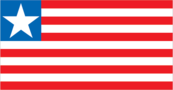
11 equal horizontal stripes of red (top and bottom) alternating with white; there is a white five-pointed star on a blue square in the upper hoist-side corner; the design was based on the US flag Economy Liberia
GDP - composition by sector
- agriculture
- 76.9%
- industry
- 5.4%
- services
- 17.7% (2002 est.)
GDP - per capita
purchasing power parity - $900 (2004 est.)
GDP - real growth rate
21.8% (2004 est.)
GDP (purchasing power parity)
$2.903 billion (2004 est.)
Geographic coordinates
6 30 N, 9 30 W
Geography - note
facing the Atlantic Ocean, the coastline is characterized by lagoons, mangrove swamps, and river-deposited sandbars; the inland grassy plateau supports limited agriculture People Liberia
Government type
republic
Highways
- paved
- 657 km
- total
- 10,600 km
- unpaved
- 9,943 km (1999 est.)
HIV/AIDS - adult prevalence rate
5.9% (2003 est.)
HIV/AIDS - deaths
7,200 (2003 est.)
HIV/AIDS - people living with HIV/AIDS
100,000 (2003 est.)
Household income or consumption by percentage share
lowest 10%: NA highest 10%: NA
Illicit drugs
transshipment point for Southeast and Southwest Asian heroin and South American cocaine for the European and US markets; corruption, criminal activity, arms-dealing, and diamond trade provide significant potential for money laundering, but the lack of well-developed financial system limits the country's utility as a major money-laundering center This page was last updated on 20 October, 2005 ======================================================================
Imports
$5.051 billion f.o.b. (2002 est.)
Imports - commodities
fuels, chemicals, machinery, transportation equipment, manufactured goods; foodstuffs
Imports - partners
South Korea 38.8%, Japan 21.2%, Singapore 12.2%, Croatia 5.3%, Germany 4.2% (2004)
Independence
26 July 1847
Industrial production growth rate
NA
Industries
rubber processing, palm oil processing, timber, diamonds
Infant mortality rate
- female
- 121.9 deaths/1,000 live births (2005 est.)
- male
- 135.64 deaths/1,000 live births
- total
- 128.87 deaths/1,000 live births
Inflation rate (consumer prices)
15% (2003 est.)
International organization participation
ACP, AfDB, AU, ECOWAS, FAO, G-77, IAEA, IBRD, ICAO, ICCt, ICFTU, ICRM, IDA, IFAD, IFC, IFRCS, ILO, IMF, IMO, Interpol, IOC, IOM, ITU, NAM, OPCW (signatory), UN, UNCTAD, UNESCO, UNIDO, UPU, WCL, WCO, WFTU, WHO, WIPO, WMO
Internet country code
.lr
Internet hosts
14 (2004)
Internet Service Providers (ISPs)
2 (2001)
Internet users
1,000 (2002) Transportation Liberia
Irrigated land
30 sq km (1998 est.)
Judicial branch
Supreme Court
Labor force - by occupation
agriculture 70%, industry 8%, services 22% (2000 est.)
Land boundaries
- border countries
- Guinea 563 km, Cote d'Ivoire 716 km, Sierra Leone 306 km
- total
- 1,585 km
Land use
- arable land
- 3.95%
- other
- 93.77% (2001)
- permanent crops
- 2.28%
Languages
English 20% (official), some 20 ethnic group languages, of which a few can be written and are used in correspondence
Legal system
dual system of statutory law based on Anglo-American common law for the modern sector and customary law based on unwritten tribal practices for indigenous sector
Legislative branch
- bicameral National Assembly consists of the Senate (26 seats; members elected by popular vote to serve nine-year terms) and the House of Representatives (64 seats; members elected by popular vote to serve six-year terms)
- election results
- Senate - percent of vote by party - NA%; seats by party - NPP 21, UP 3, ALCOP 2; House of Representatives - percent of vote by party - NA%; seats by party - NPP 49, UP 7, ALCOP 3, Alliance of Political Parties 2, UPP 2, LPP 1
- elections
- Senate - last held 19 July 1997 (next to be held 11 October 2005); House of Representatives - last held 19 July 1997 (next to be held 11 October 2005)
Life expectancy at birth
- female
- 40.81 years (2005 est.)
- male
- 37.03 years
- total population
- 38.89 years
Literacy
- definition: age 15 and over can read and write
- female
- 41.6% (2003 est.) Government Liberia
- male
- 73.3%
- total population
- 57.5%
Location
Western Africa, bordering the North Atlantic Ocean, between Cote d'Ivoire and Sierra Leone
Major infectious diseases
- aerosolized dust or soil contact disease
- Lassa fever (2004)
- degree of risk
- very high
- food or waterborne diseases
- bacterial and protozoal diarrhea, hepatitis A, and typhoid fever
- vectorborne diseases
- malaria and yellow fever are high risks in some locations
- water contact disease
- schistosomiasis
Manpower available for military service
males age 18-49: 659,795 (2005 est.)
Manpower fit for military service
males age 18-49: 360,373 (2005 est.)
Map references
Africa
Maritime claims
- territorial sea
- 200 nm
Median age
- female
- 18.42 years (2005 est.)
- male
- 17.69 years
- total
- 18.06 years
Merchant marine
- by type
- barge carrier 3, bulk carrier 275, cargo 91, chemical tanker 173, combination ore/oil 22, container 388, liquefied gas 78, passenger 2, passenger/cargo 2, petroleum tanker 324, refrigerated cargo 57, roll on/roll off 6, specialized tanker 9, vehicle carrier 35
- foreign-owned
- 1,392 (Argentina 8, Australia 2, Austria 13, Bahamas 3, Brazil 6, British 1, Canada 2, Chile 1, China 36, Croatia 7, Cyprus 1, Denmark 5, France 3, Germany 511, Greece 149, Hong Kong 29, India 4, Indonesia 1, Isle of Man 5, Israel 7, Italy 12, Japan 106, Latvia 18, Monaco 10, Netherlands 18, Nigeria 1, Norway 57, Pakistan 1, Poland 14, Romania 1, Russia 63, Saudi Arabia 23, Singapore 29, Slovenia 1, South Korea 4, Sweden 12, Switzerland 10, Taiwan 54, Turkey 4, Ukraine 7, UAE 10, United Kingdom 56, United States 84, Uruguay 3) (2005)
- total
- 1,465 ships (1,000 GRT or over) 50,555,752 GRT/79,125,329 DWT
Military branches
- Armed Forces of Liberia (AFL)
- Army, Navy, Air Force
Military expenditures - dollar figure
$1.5 million (2004)
Military expenditures - percent of GDP
0.2% (2004) Transnational Issues Liberia
Military service age and obligation
18 years of age for voluntary military service; no conscription (2001)
National holiday
Independence Day, 26 July (1847)
Nationality
- adjective
- Liberian
- noun
- Liberian(s)
Natural hazards
dust-laden harmattan winds blow from the Sahara (December to March)
Natural resources
iron ore, timber, diamonds, gold, hydropower
Net migration rate
0 migrant(s)/1,000 population note: at least 200,000 Liberian refugees are in surrounding countries; the uncertain security situation has hindered their ability to return (2005 est.)
Oil - consumption
3,100 bbl/day (2001 est.)
Oil - imports
NA
Oil - production
0 bbl/day (2001 est.)
Political parties and leaders
Alliance of Political Parties (a coalition of LAP and LUP) [leader NA]; All Liberia Coalition Party or ALCOP [Peter KERBAY]; Liberian Action Party or LAP [C. Gyude BRYANT]; Liberian People's Party or LPP [Koffa NAGBE]; Liberia Unification Party or LUP [leader NA]; National Patriotic Party or NPP [Cyril ALLEN] - governing party; United People's Party or UPP [Wesley JOHNSON]; Unity Party or UP [Charles CLARKE]
Political pressure groups and leaders
NA
Population
3,482,211 (July 2005 est.)
Population below poverty line
80%
Population growth rate
2.64% (2005 est.)
Ports and harbors
Buchanan, Monrovia
Radio broadcast stations
AM 0, FM 7, shortwave 2 (2001)
Radios
790,000 (1997)
Railways
- narrow gauge
- 145 km 1.067-m gauge note: none of the railways are in operation because of the civil war (2004)
- standard gauge
- 345 km 1.435-m gauge
- total
- 490 km
Refugees and internally displaced persons
- IDPs
- 500,000 (civil war from 1990-2004; IDP resettlement began in November 2004) (2004)
- refugees (country of origin)
- 13,941 (Sierra Leone) 38,325 (Cote d'Ivoire)
Religions
indigenous beliefs 40%, Christian 40%, Muslim 20%
Sex ratio
- at birth
- 1.03 male(s)/female under 15 years: 1.02 male(s)/female 15-64 years: 0.95 male(s)/female 65 years and over: 1.01 male(s)/female
- total population
- 0.98 male(s)/female (2005 est.)
Suffrage
18 years of age; universal
Telephone system
- domestic
- fully automatic system with very low density of .21 fixed mainlines per 100 persons; limited wireless service available
- general assessment
- the limited services available are found almost exclusively in the capital Monrovia
- international
- country code - 231; satellite earth station - 1 Intelsat (Atlantic Ocean)
Telephones - main lines in use
7,000 (2001)
Telephones - mobile cellular
2,000 (2001)
Television broadcast stations
1 (plus four low-power repeaters) (2001)
Televisions
70,000 (1997)
Terrain
mostly flat to rolling coastal plains rising to rolling plateau and low mountains in northeast
Total fertility rate
6.09 children born/woman (2005 est.)
Unemployment rate
85% (2003 est.)