1998 Edition
CIA World Factbook 1998 (Internet Archive)
Geography
Area
total: 111,370 sq km land: 96,320 sq km water: 15,050 sq km
Area-comparative
slightly larger than Tennessee
Climate
tropical; hot, humid; dry winters with hot days and cool to cold nights; wet, cloudy summers with frequent heavy showers
Coastline
579 km
Elevation extremes
lowest point: Atlantic Ocean 0 m highest point: Mount Wuteve 1,380 m
Environment-current issues
tropical rain forest subject to deforestation; soil erosion; loss of biodiversity; pollution of rivers from the dumping of iron ore tailings and of coastal waters from oil residue and raw sewage
Environment-international agreements
party to: Desertification, Endangered Species, Nuclear Test Ban, Ozone Layer Protection, Ship Pollution, Tropical Timber 83, Tropical Timber 94 signed, but not ratified: Biodiversity, Climate Change, Environmental Modification, Law of the Sea, Marine Dumping, Marine Life Conservation
Geographic coordinates
6 30 N, 9 30 W
Irrigated land
20 sq km (1993 est.)
Land boundaries
total: 1,585 km border countries: Guinea 563 km, Cote d'Ivoire 716 km, Sierra Leone 306 km
Land use
arable land: 1% permanent crops: 3% permanent pastures: 59% forests and woodland: 18% other: 19% (1993 est.)
Location
Western Africa, bordering the North Atlantic Ocean, between Cote d'Ivoire and Sierra Leone
Map references
Africa
Maritime claims
territorial sea: 200 nm
Natural hazards
dust-laden harmattan winds blow from the Sahara (December to March)
Natural resources
iron ore, timber, diamonds, gold
Terrain
mostly flat to rolling coastal plains rising to rolling plateau and low mountains in northeast
People and Society
Age structure
0-14 years: 45% (male 622,797; female 616,902) 15-64 years: 52% (male 734,425; female 700,124) 65 years and over: 3% (male 47,099; female 50,554) (July 1998 est.)
Birth rate
41.88 births/1,000 population (1998 est.)
Death rate
11.28 deaths/1,000 population (1998 est.)
Ethnic groups
indigenous African tribes 95% (including Kpelle, Bassa, Gio, Kru, Grebo, Mano, Krahn, Gola, Gbandi, Loma, Kissi, Vai, and Bella), Americo-Liberians 2.5% (descendants of immigrants from the US who had been slaves)
Infant mortality rate
103.13 deaths/1,000 live births (1998 est.)
Languages
English 20% (official), about 20 tribal languages, of which a few can be written and are used in correspondence
Life expectancy at birth
total population: 59.45 years male: 56.81 years female: 62.16 years (1998 est.)
Literacy
definition: age 15 and over can read and write total population: 38.3% male: 53.9% female: 22.4% (1995 est.)
Nationality
noun: Liberian(s) adjective: Liberian
Net migration rate
27.02 migrant(s)/1,000 population (1998 est.) note: until domestic peace is restored, many Liberian refugees will not return from exile
Population
2,771,901 (July 1998 est.)
Population growth rate
5.76% (1998 est.)
Religions
traditional 70%, Muslim 20%, Christian 10%
Sex ratio
at birth: 1.03 male(s)/female under 15 years: 1 male(s)/female 15-64 years: 1.04 male(s)/female 65 years and over: 0.93 male(s)/female (1998 est.)
Total fertility rate
6.09 children born/woman (1998 est.)
Government
Administrative divisions
13 counties; Bomi, Bong, Grand Bassa, Grand Cape Mount, Grand Gedeh, Grand Kru, Lofa, Margibi, Maryland, Montserrado, Nimba, River Cess, Sinoe
Constitution
6 January 1986
Country name
conventional long form: Republic of Liberia conventional short form: Liberia
Data code
LI
Executive branch
chief of state: President Charles Ghankay TAYLOR (since 2 August 1997); note-the president is both the chief of state and head of government head of government: President Charles Ghankay TAYLOR (since 2 August 1997); note-the president is both the chief of state and head of government cabinet: Cabinet appointed by the president elections: the president is elected by universal adult suffrage for a four-year term (renewable); election last held 19 July 1997 (next to be held NA July 2003) election results: Charles Ghankay TAYLOR elected president; percent of vote-Charles Ghankay TAYLOR (NPP) 75.3%, Ellen Johnson SIRLEAF (UP) 9.6%, Alhaji KROMAH (ALCOP) 4%, other 11.1%
FAX
[231] 226-148
Flag description
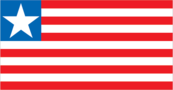
11 equal horizontal stripes of red (top and bottom) alternating with white; there is a white five-pointed star on a blue square in the upper hoist-side corner; the design was based on the US flag
Government type
republic
Independence
26 July 1847
International organization participation
ACP, AfDB, CCC, ECA, ECOWAS, FAO, G-77, IAEA, IBRD, ICAO, ICFTU, ICRM, IDA, IFAD, IFC, IFRCS, ILO, IMF, IMO, Inmarsat, Intelsat (nonsignatory user), Interpol, IOC, IOM, ITU, NAM, OAU, UN, UNCTAD, UNESCO, UNIDO, UPU, WCL, WFTU, WHO, WIPO, WMO Diplomatic representation in the US: chief of mission: Ambassador designate Rachel DIGGS; Charge d'Affaires ad interim Konah K. BLACKETT chancery: 5201 16th Street NW, Washington, DC 20011 telephone: [1] (202) 723-0437 consulate(s) general: New York Diplomatic representation from the US: chief of mission: Ambassador (vacant); Chief of Mission William MILAM embassy: 111 United Nations Drive, Monrovia mailing address: P. O. Box 100098, Mamba Point, Monrovia telephone: [231] 226-370
Judicial branch
Supreme Court Political parties and leaders: ruling party: National Patriotic Party or NPP [Charles Ghankay TAYLOR, leader] opposition party: All Liberia Coalition Party or ALCOP [Alhaji KROMAH, chairman]; Free Democratic Party or FDP [Fayah GBOLLIE, chairman]; Liberian Action Party or LAP [Cletis WOTORSON]; Liberian National Union or LINU [Harry MONIBA, chairman]; Liberian Peoples Party or LPP [Togba-Nah TIPOTEH, chairman]; Liberian Unification Party or LUP [Laveli SUPUWOOD]; National Democratic Party of Liberia or NDPL [Dr. George E. Saigbe BOLEY, chairman]; National Reformation Party or NRP [Martin SHERIF, chairman]; People's Democratic Party of Liberia or PDPL [George Toe WASHINGTON, chairman]; People's Progressive Party or PPP [Chea CHEAPOO, chairman]; Reformation Alliance Party or RAP [Henry Boimah FAHNBULLEH, chairman]; True Whig Party or TWP [Rudolph SHERMAN, chairman]; Unity Party or UP [Ellen JOHNSON-SIRLEAF, chairman]; United People's Party or UPP [Gabriel Baccus MATTHEWS, chairman]
Legal system
dual system of statutory law based on Anglo-American common law for the modern sector and customary law based on unwritten tribal practices for indigenous sector
Legislative branch
bicameral National Assembly consists of the Senate (26 seats; members serve NA-year terms) and the House of Representatives (64 seats; members serve NA-year terms) elections: Senate-last held 19 July 1997 (next to be held in NA 2003); House of Representatives-last held 19 July 1997 (next to be held in NA 2003) election results: Senate: percent of vote by party-NA; seats by party-NPP 21, UP 3, ALCOP 2; House of Representatives: percent of vote by party-NA; seats by party-NPP 49, UP 7, ALCOP 3, Alliance of Political Parties 2, UPP 2, LPP 1; note-the Alliance of Political Parties was a coalition of Liberian Action Party and Liberian Unification Party
National capital
Monrovia
National holiday
Independence Day, 26 July (1847)
Suffrage
18 years of age; universal
Economy
Agriculture-products
rubber, coffee, cocoa, rice, cassava (tapioca), palm oil, sugarcane, bananas; sheep, goats; timber
Budget
revenues: $NA expenditures: $NA
Currency
1 Liberian dollar (L$) = 100 cents
Debt-external
$2 billion (1997 est.)
Economic aid
recipient: ODA, $NA
Economy-overview
Civil war since 1990 has destroyed much of Liberia's economy, especially the infrastructure in and around Monrovia. Many businessmen have fled the country, taking capital and expertise with them. Some returned during 1997. Many will not return. Richly endowed with water, mineral resources, forests, and a climate favorable to agriculture, Liberia had been a producer and exporter of basic products, while local manufacturing, mainly foreign owned, had been small in scope. The democratically elected government, installed in August 1997, inherited massive international debts and currently relies on revenues from its maritime registry to provide the bulk of its foreign exchange earnings. The restoration of the infrastructure and the raising of incomes in this ravaged economy depends on continued disarmament of factions and the implementation of sound macroand micro-economic policies of the new government.
Electricity-capacity
332,000 kW (1995)
Electricity-consumption per capita
154 kWh (1995)
Electricity-production
472 million kWh (1995)
Exchange rates
Liberian dollars (L$) per US$1-1.0000 (officially fixed rate since 1940); market exchange rate: Liberian dollars (L$) per US$1-50 (October 1995), 7 (January 1992); market rate floats against the US dollar
Exports
total value: $667 million (f.o.b., 1995 est.) commodities: diamonds, iron ore, rubber, timber, coffee partners: US, EU, Netherlands, Singapore
Fiscal year
calendar year Communications
GDP
purchasing power parity-$2.6 billion (1997 est.)
GDP-composition by sector
agriculture: 30% industry: 36% services: 34%
GDP-per capita
purchasing power parity-$1,000 (1997 est.)
GDP-real growth rate
NA% (1997 est.)
Imports
total value: $5.8 billion (f.o.b., 1995 est.) commodities: mineral fuels, chemicals, machinery, transportation equipment, manufactured goods; rice and other foodstuffs partners: US, EU, Japan, China, Netherlands, ECOWAS, South Korea
Industrial production growth rate
NA%
Industries
rubber processing, food processing, construction materials, furniture, palm oil processing, iron ore, diamonds
Inflation rate-consumer price index
NA%
Labor force
by occupation: agriculture 70%
Radio broadcast stations
AM 3, FM 4, shortwave 0
Radios
622,000 (1992 est.)
Telephone system
telephone and telegraph service via microwave radio relay network; main center is Monrovia domestic: NA international: satellite earth station-1 Intelsat (Atlantic Ocean)
Telephones
less than 25,000 (1991 est.)
Television broadcast stations
2 (1998)
Televisions
51,000 (1992 est.)
Unemployment rate
NA%
Transportation
Airports
46 (1997 est.) Airports-with paved runways: total: 2 over 3,047 m: 1 1,524 to 2,437 m: 1 (1997 est.) Airports-with unpaved runways: total: 44 1,524 to 2,437 m: 3 914 to 1,523 m: 6 under 914 m: 35 (1997 est.)
Highways
total: 10,600 km paved: 657 km unpaved: 9,943 km (1996 est.) Ports and harbors: Buchanan, Greenville, Harper, Monrovia
Merchant marine
total: 1,620 ships (1,000 GRT or over) totaling 59,521,524 GRT/97,187,450 DWT ships by type: barge carrier 4, bulk 413, cargo 117, chemical tanker 143, combination bulk 28, combination ore/oil 54, container 168, liquefied gas tanker 89, multifunction large-load carrier 1, oil tanker 424, passenger 35, refrigerated cargo 67, roll-on/roll-off cargo 21, short-sea passenger 4, specialized tanker 11, vehicle carrier 41 note: a flag of convenience registry; includes ships from 54 countries among which are Germany 198, US 181, Norway 153, Greece 148, Japan 137, Hong Kong 109, China 58, UK 48, Singapore 43, and Monaco 41 (1997 est.)
Railways
total: 490 km (single track); note-three rail systems owned and operated by foreign steel and financial interests in conjunction with Liberian Government; one of these, the Lamco Railroad, closed in 1989 after iron ore production ceased; the other two were shut down by the civil war standard gauge: 345 km 1.435-m gauge narrow gauge: 145 km 1.067-m gauge
Military and Security
Military branches
note: The new government of Liberia has developed a plan for the armed forces: total strength 5,000, of which Army 3,400, Navy 1,100, Air Force 500; note - the Navy is to have several small coastal patrol vessels and the Air Force is to comprise two air wings
Military expenditures-dollar figure
$14 million (1993)
Military expenditures-percent of GDP
2.9% (1993)
Military manpower-availability
males age 15-49: 631,546 (1998 est.) Military manpower-fit for military service: males: 337,744 (1998 est.)
Transnational Issues
Disputes-international
none
Illicit drugs
increasingly a transshipment point for Southeast and Southwest Asian heroin and South American cocaine for the European and US markets