1989 Edition
CIA World Factbook 1989 (Internet Archive)
Geography
Climate
- tropical; hot, humid; dry winters with hot days and cool to cold nights; wet, cloudy summers with frequent heavy showers
- Mediterranean along coast; dry, extreme desert interior
- continental; cold, cloudy winters with frequent snow or rain; cool to moderately warm, cloudy, humid summers
Coastline
- 579 km
- 1,770 km
- none — landlocked
Comparative area
- slightly larger than Tennessee
- slightly larger than Alaska
- about 0.9 times the size of Washington, DC
Continental shelf
200 meters or to depth of exploitation
Disputes
claims and occupies a small portion of the Aozou Strip in northern Chad; maritime boundary dispute with Tunisia; Libya claims about 19,400 km2 in northern Niger; Libya claims about 19,400 km2 in southeastern Algeria
Environment
- West Africa's largest tropical rain forest, subject to deforestation
- hot, dry, dust-laden ghibli is a southern wind lasting one to four days in spring and fall; desertification; sparse natural surface-water resources
- variety of microclimatic variations based on elevation
GulfofSidra closing line
32° 30' N
Land boundaries
- 1,585 km total; Guinea 563 km, Ivory Coast 716 km, Sierra Leone 306 km
- 4,383 km total; Algeria 982 km, Chad 1,055 km, Egypt 1,150 km, Niger 354 km, Sudan 383 km, Tunisia 459km
- 78 km total; Austria 37 km, Switzerland 41 km
Land use
- 1% arable land; 3% permanent crops; 2% meadows and pastures; 39% forest and woodland; 55% other; includes NEGL% irrigated
- 1% arable land; 0% permanent crops; 8% meadows and pastures; 0% forest and woodland; 91% other; includes NEGL% irrigated
- 25% arable land; 0% permanent crops; 38% meadows and pastures; 19% forest and woodland; 18% other
Maritime claims
none — landlocked
Natural resources
- iron ore, timber, diamonds, gold
- crude oil, natural gas, gypsum
- hydroelectric potential
Note
- the Great Manmade River Project, the largest water development scheme in the world, is being built to bring water from large aquifers under the Sahara to coastal cities
- landlocked
Terrain
- mostly flat to rolling coastal plains rising to rolling plateau and low mountains in northeast
- mostly barren, flat to undulating plains, plateaus, depressions
- mostly mountainous (Alps) with Rhine Valley in western third
Territorial sea
- 200 nm
- 1 2 nm
Total area
- 1 1 1,370 km2; land area: 96,320 km2
- 1,759,540 km2; land area: 1,759,540km2
- 160 km2; land area: 160 km2
Total area
10O km North Atlantic Ocean S« regional map VII Harper
People and Society
Birth rate
- 45 births/ 1 ,000 population (1990)
- 37 births/ 1,000 population (1990)
- 13 births/ 1,000 population (1990)
Death rate
- 14 deaths/ 1,000 population (1990)
- 7 deaths/ 1 ,000 population (1990)
- 7 deaths/ 1,000 population (1990)
Ethnic divisions
- 95% indigenous African tribes, including Kpelle, Bassa, Gio, Kru, Grebo, Mano, Krahn, Gola, Gbandi, Loma, Kissi, Vai, and Bella; 5% descendants of repatriated slaves known as Americo-Liberians
- 97% Berber and Arab; some Greeks, Maltese, Italians, Egyptians, Pakistanis, Turks, Indians, and Tunisians
- 95% Alemannic, 5% Italian and other
Infant mortality rate
- 126 deaths/ 1,000 live births (1990)
- 64 deaths/ 1,000 live births (1990)
- 5 deaths/ 1,000 live births (1990)
Labor force
- 510,000, including 220,000 in the monetary economy; 70.5% agriculture, 10.8% services, 4.5% industry and commerce, 14.2% other; nonAfrican foreigners hold about 95% of the top-level management and engineering jobs; 52% of population of working age
- 1,000,000; includes about 280,000 resident foreigners; 31% industry, 27% services, 24% government, 1 8% agriculture
- 12,258; 5,078 foreign workers (mostly from Switzerland and Austria); 54.4% industry, trade, and building; 41.6% services; 4.0% agriculture, fishing, forestry, and horticulture
Language
- English (official); more than 20 local languages of the Niger-Congo language group; English used by about 20%
- Arabic; Italian and English widely understood in major cities
- German (official), Alemannic dialect
Life expectancy at birth
- 54 years male, 58 years female (1990)
- 65 years male, 70 years female (1990)
- 73 years male, 81 years female (1990)
Literacy
- 35%
- 50-60%
- 100%
Nationality
- noun — Liberian(s); adjective — Liberian
- noun — Libyan(s); adjective — Libyan
- noun — Liechtensteiner(s); adjective— Liechtenstein
Net migration rate
- 2 migrants/ 1 ,000 population (1990)
- 0 migrants/ 1 ,000 population (1990)
- 1 migrant/ 1 ,000 population (1990)
Organized labor
- 2% of labor force
- National Trade Unions' Federation, 275,000 members; General Union for Oil and Petrochemicals; PanAfrica Federation of Petroleum Energy and Allied Workers
- NA
Population
- 2,639,809 (July 1990), growth rate 3.4% (1990)
- 4,221,141 (July 1990), growth rate 3.1% (1990)
- 28,292 (July 1990), growth rate 0.7% (1990)
Religion
- 70% traditional, 20% Muslim, 10% Christian
- 97% Sunni Muslim
- 82.7% Roman Catholic, 7.1% Protestant, 10.2% other
Total fertility rate
- 6.6 children born/ woman (1990)
- 5.2 children born/ woman (1990)
- 1.5 children born/ woman (1990)
Government
Administrative divisions
- 1 3 counties; Bomi, Bong, Grand Bassa, Grand Cape Mount, Grand Jide, Grand Kru, Lofa, Margibi, Maryland, Montserrado, Nimba, Rivercess, Sino
- 46 municipalities (baladlyat, singular — baladtyah); Ajdabiya, Al Aby5r, Al 'Azlzlyah, Al Bayda', Al Jufrah, Al Jumayl, Al Khums, Al Kufrah, Al Marj, Al QarabQllI, Al Qubbah, Al 'Ujaylat, Ash Shati', Awbarl, Az Zahra', Az Zawiyah, BanghazI, BanI WalTd, Bin Jawwad, Darnah, Ghadamis, Gharyan, Ghat, JadQ, Jala, Janzdr, Masallatah, Misratah, Mizdah, Murzuq, NalQt, Qamlnis, Qasr Bin Ghashlr, Sabha, Sabratah, Shahhat, Surm3n, Surt, TajflrS', Tarabulus, Tarhunah, Tubruq, TQkrah, Yafran, Zlltan, Zuwarah; note— the number of municipalities may have been reduced to 1 3 named Al Jabal alAkhdar, Al Jabal al-Gharbi, Al Jabal alKhums, Al Batnam, Al Kufrah, Al Marqab, Al Marzuq, Az Zawiyah, BanghazI, Khalij Surt, Sabha, Tripoli, Wadi al-Hayat
- 1 1 communes (gemeinden, singular — gemeinde); Balzers, Eschen, Gamprin, Mauren, Planken, Ruggell, Schaan, Schellenberg, Triesen, Triesenberg, Vaduz
Capital
- Monrovia
- Tripoli
- Vaduz
Communists
none
Constitution
- 6 January 1986
- 11 December 1969, amended 2 March 1977
- 5 October 1921
Diplomatic representation
- Ambassador Eugenia A. WORDSWORTHSTEVENSON; Chancery at 5201 16th Street NW, Washington DC 20011; telephone (202) 723-0437 through 0440; there is a Liberian Consulate General in New York; US — Ambassador James K. BISHOP; Embassy at 1 1 1 United Nations Drive, Monrovia (mailing address is P. O. Box 98, Monrovia, or APO New York 09155); telephone [231] 222991 through
- in routine diplomatic matters, Liechtenstein is represented in the US by the Swiss Embassy; US — the US has no diplomatic or consular mission in Liechtenstein, but the US Consul General at Zurich (Switzerland) has consular accreditation at Vaduz
Elections
- President — last held on 1 5 October 1985 (next to be held October 1991); results— Samuel Kanyon Doe (NDPL) 50.9%, Jackson Doe (LAP) 26.4%, others 22.7%; Senate— last held on 15 October 1985 (next to be held 15 October 1991); results — percent of vote by party NA; seats— (26 total) NDPL 21, LAP 3, UP 1, LUP I; House of Representatives — last held on 1 5 October 1985 (next to be held October 1 99 1 ); results — percent of vote by party NA; seats— (64 total) NDPL 51, LAP 8, UP 3, LUP 2
- national elections are indirect through a hierarchy of revolutionary committees
- Diet — last held on 5 March 1989 (next to be held by March 1993); results — percent of vote by party NA; seats— (25 total) VU 13, FBP 12
Executive branch
- president, vice president, Cabinet
- revolutionary leader, chairman of the General People's Committee, General People's Committee (cabinet)
- reigning prince, hereditary prince, prime minister, deputy prime minister
Flag
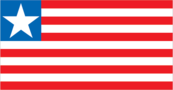
- 1 1 equal horizontal stripes of red (top and bottom) alternating with white; there is a white five-pointed star on a blue square in the upper hoist-side corner; the design was based on the US flag
- plain green; green is the traditional color of Islam (the state religion)
Independence
- 26 July 1847
- 24 December 1951 (from Italy)
- 23 January 1719, Imperial Principality of Liechtenstein established
Judicial branch
- People's Supreme Court
- Supreme Court
- Supreme Court (Oberster Gerichtshof) for criminal cases and Superior Court (Obergericht) for civil cases
Leaders
- Chief of State and Head of Government— President Gen. Dr. Samuel Kanyon DOE (since 12 April 1980); Vice President Harry F. MONIBA (since 6 January 1986) Political parties and leaders: National Democratic Party of Liberia (NDPL), Augustus Caine, chairman; Liberian Action Party (LAP), Emmanuel Koromah, chairman; Unity Party (UP), Carlos Smith, chairman; United People's Party (UPP), Gabriel Baccus Matthews, chairman
- Chief of State — Revolutionary Leader Col. Mu'ammar Abu Minyar alQADHAFI (since 1 September 1969); Head of Government — Chairman of the General People's Committee (Premier) 'Umar Mustafa al-MUNTASIR (since 1 March 1987) Political parties and leaders: none
- Chief of State— Prince HANS ADAM von und zu Liechtenstein (since 13 November 1989; assumed executive powers 26 August 1984); Head of Government — Prime Minister Hans BRUNHART (since 26 April 1978); Deputy Prime Minister Dr. Herbert WILLE (since 2 February 1986) Political parties and leaders: Fatherland Union (VU), Dr. Otto Hasler; Progressive Citizens' Party (FBP), Dr. Herbert Batliner; Christian Social Party, Fritz Kaiser
Legal system
- dual system of statutory law based on Anglo-American common law for the modern sector and customary law based on unwritten tribal practices for indigenous sector
- based on Italian civil law system and Islamic law; separate religious courts; no constitutional provision for judicial review of legislative acts; has not accepted compulsory ICJ jurisdiction
- local civil and penal codes; accepts compulsory ICJ jurisdiction, with reservations
Legislative branch
- bicameral National Assembly consists of an upper house or Senate and a lower house or House of Representatives
- unicameral General People's Congress
- unicameral Diet (Landtag)
Long-form name
- Republic of Liberia
- Socialist People's Libyan Arab Jamahiriya
- Principality of Liechtenstein
Member of
- ACP, AfDB, CCC, ECA, ECOWAS, FAO, G-77, IAEA, IBRD, ICAO, ICO, IDA, IFAD, IFC, ILO, IMF, 1MO, INTERPOL, IPU, IRC, ITU, Mano River Union, NAM, OAU, UN, UNESCO, UPU, WHO, WMO
- Council of Europe, EFTA, IAEA, INTELSAT, INTERPOL, ITU, UNCTAD, UNIDO, UNICEF, UPU, WIPO; considering UN membership; has consultative status in the EC
National holiday
- Independence Day, 26 July (1847)
- Revolution Day, 1 September (1969)
- St. Joseph's Day, 19 March
Suffrage
- universal at age 18
- universal and compulsory at age
- universal at age 18
Type
- republic
- Jamahiriya (a state of the masses); in theory, governed by the populace through local councils; in fact, a military dictatorship
- hereditary constitutional monarchy
Economy
Agriculture
- accounts for about 40% of GDP (including fishing and forestry); principal products — rubber, timber, coffee, cocoa, rice, cassava, palm oil, sugarcane, bananas, sheep, and goats; not self-sufficient in food, imports 25% of rice consumption
- 5% of GNP; cash crops — wheat, barley, olives, dates, citrus fruits, peanuts; 75% of food is imported
Aid
- US commitments, including Ex-Im (FY70-88), $634 million; Western (nonUS) countries, ODA and OOF bilateral commitments (1970-87), $793 million; OPEC bilateral aid (1979-89), $25 million; Communist countries (1970-88), $77 million
- Western (non-US) countries, ODA and OOF bilateral commitments (197087), $242 million
Budget
- revenues $242.1 million; expenditures $435.4 million, including capital expenditures of $29.5 million (1989) Liberia (continued) Libya
- revenues $6.4 billion; expenditures $11.3 billion, including capital expenditures of $3.6 billion (1986 est.)
Currency
- Liberian dollar (plural — dollars); 1 Liberian dollar (L$) = 100 cents
- Libyan dinar (plural — dinars); 1 Libyan dinar (LD) = 1,000 dirhams
Electricity
- 400,000 kW capacity; 730 million kWh produced, 290 kWh per capita (1989)
- 4,580,000 kW capacity; 13,360 million kWh produced, 3,270 kWh per capita (1989)
Exchange rates
- Liberian dollars (L$) per US$1 — 1.00 (fixed rate since 1940); unofficial parallel exchange rate of L$2.5 = US$1, January 1989
- Libyan dinars (LD) per US$1— 0.2896 (January 1990), 0.2922 (1989), 0.2853 (1988), 0.2706 (1987), 0.3139(1986), 0.2961 (1985)
Exports
- $550 million (f.o.b., 1989); commodities— iron ore 61%, rubber 20%, timber 11%, coffee; partners— US, EC, Netherlands
- $6.1 billion (f.o.b., 1988 est.); commodities — petroleum, peanuts, hides; partners— Italy, USSR, FRG, Spain, France, Belgium/Luxembourg, Turkey
External debt
- $1.7 billion (December 1989est.)
- $2.1 billion, excluding military debt (December 1988)
Fiscal year
- calendar year
- calendar year
GDP
$988 million, per capita $395; real growth rate 1.5% (1988)
GNP
$20 billion, per capita $5,410; real growth rate 0% (1988 est.)
Imports
- $335 million (c.i.f., 1989); commodities— rice, mineral fuels, chemicals, machinery, transportation equipment, other foodstuffs; partners — US, EC, Japan, China, Netherlands, ECOWAS
- $5.0 billion (f.o.b., 1988 est.); commodities — machinery, transport equipment, food, manufactured goods; partners— Italy, USSR, FRG, UK, Japan
Industrial production
- growth rate 1.5% in manufacturing (1987)
- growth rate NA%
Industries
- rubber processing, food processing, construction materials, furniture, palm oil processing, mining (iron ore, diamonds)
- petroleum, food processing, textiles, handicrafts, cement
Inflation rate (consumer prices)
- 1 2% (1989)
- 20% (1988 est.)
Overview
- In 1988 and 1989 the Liberian economy posted its best two years in a decade, thanks to a resurgence of the rubber industry and rapid growth in exports of forest products. Richly endowed with water, mineral resources, forests, and a climate favorable to agriculture, Liberia is a producer and exporter of basic products. Local manufacturing, mainly foreign owned, is small in scope. Liberia imports primarily machinery and parts, transportation equipment, petroleum products, and foodstuffs. Persistent budget deficits, the flight of capital, and deterioration of transport and other infrastructure continue to hold back economic progress.
- The socialist-oriented economy depends primarily upon revenues from the oil sector, which contributes virtually all export earnings and over 50% to GNP. Since 1980, however, the sharp drop in oil prices and resulting decline in export revenues has adversely affected economic development. In 1986 per capita GNP was the highest in Africa at $5,410, but it had been $2,000 higher in 1982. Severe cutbacks in imports over the past five years have led to shortages of basic goods and foodstuffs, although the reopening of the Libyan-Tunisian border in April 1988 and the Libyan-Egyptian border in December 1989 have somewhat eased shortages. Austerity budgets and a lack of trained technicians have undermined the government's ability to implement a number of planned infrastructure development projects. The nonoil industrial and construction sectors, which account for about 15% of GNP, have expanded from processing mostly agricultural products to include petrochemicals, iron, steel, and aluminum. Although agriculture accounts for less than 5% of GNP, it employs 20% of the labor force. Climatic conditions and poor soils severely limit farm output, requiring Libya to import about 75% of its food requirements.
Unemployment rate
- 43% urban (1988)
- 2% (1988 est.)
Communications
Airports
- 76 total, 60 usable; 2 with permanent-surface runways; none with runways over 3,659 m; 1 with runways 2,440-3,659 m; 4 with runways 1, 220-2,439 m
- 1 30 total, 1 22 usable; 53 with permanent-surface runways; 7 with runways over 3,659 m; 30 with runways 2,440-3,659 m; 44 with runways 1,2202,439 m
Branches
- Armed Forces of Liberia, Liberia National Coast Guard
- Armed Forces of the Libyan Arab Jamahariya includes People's Defense (Army), Arab Air Force and Air Defense Command, Arab Navy Military manpower males 15-49, 991,368; 584,512 fit for military service; 50,379 reach military age (17) annually; conscription now being implemented
Civil air
- 3 major transport aircraft
- 59 major transport aircraft
Defense expenditures
- 2.4% of GDP (1987) JRIPOLI Mediterranean Sea
- 1 1 . 1 % of GNP (1987) Ruggel 5 km
Highways
- 10,087 km total; 603 km bituminous treated, 2,848 km all weather, 4,313 km dry weather; there are also 2,323 km of private, laterite-surfaced roads open to public use, owned by rubber and timber companies
- 32,500 km total; 24,000 km bituminous and bituminous treated, 8,500 km gravel, crushed stone and earth
Merchant marine
- 1,379 ships (1,000 GRT or over) totaling 48,655,666 DWT/ 90,005,898 DWT; includes 1 1 passenger, 148 cargo, 26 refrigerated cargo, 18 rollon/roll-off cargo, 42 vehicle carrier, 42 container, 4 barge carrier, 436 petroleum, oils, and lubricants (POL) tanker, 100 chemical, 63 combination ore/oil, 41 liquefied gas, 6 specialized tanker, 413 bulk, 2 multifunction large-load carrier, 26 combination bulk; note — a flag of convenience registry; all ships are foreign owned; the top four owning flags are US 17%, Hong Kong 13%, Japan 10%, and Greece 10%; China owns at least 20 ships and Vietnam owns 1
- 30 ships (1,000 GRT or over) totaling 816,546 GRT/ 1,454,874 DWT; includes 3 short-sea passenger, 1 1 cargo, 4 roll-on/roll-off cargo, 1 1 petroleum, oils, and lubricants (POL) tanker, 1 chemical tanker
Military manpower
males 15-49, 627,519; 335,063 fit for military service; no conscription
Pipelines
crude oil 4,383 km; natural gas 1 ,947 km; refined products 443 km (includes 256 km liquid petroleum gas)
Ports
- Monrovia, Buchanan, Greenville, Harper (or Cape Palmas)
- Tobruk, Tripoli, Banghazi, Misratah, Marsa el Brega
Railroads
480 km total; 328 km 1.435meter standard gauge, 1 52 km 1.067-meter narrow gauge; all lines single track; rail systems owned and operated by foreign steel and financial interests in conjunction with Liberian Government
Telecommunications
- telephone and telegraph service via radio relay network; main center is Monrovia; 8,500 telephones; stations — 3 AM, 4 FM, 5 TV; 2 Atlantic Ocean INTELSAT earth stations Defense Forces
- modern telecommunications system using radio relay, coaxial cable, tropospheric scatter, and domestic satellite stations; 370,000 telephones; stations—18 AM, 3 FM, 13 TV; satellite earth stations — 1 Atlantic Ocean INTELSAT, 1 Indian Ocean INTELSAT, and 14 domestic; submarine cables to France and Italy; radio relay to Liechtenstein Tunisia; tropospheric scatter to Greece; planned ARABSAT and Intersputnik satellite stations