2003 Edition
CIA World Factbook 2003 (Project Gutenberg)
Introduction
Administrative divisions
- 7 provinces (oblastlar, singular - oblasty) and 1 city* (shaar); Batken Oblasty, Bishkek Shaary*, Chuy Oblasty (Bishkek), Jalal-Abad Oblasty, Naryn Oblasty, Osh Oblasty, Talas Oblasty, Ysyk-Kol Oblasty (Karakol)
- note
- administrative divisions have the same names as their administrative centers (exceptions have the administrative center name following in parentheses)
Age structure
0-14 years: 33.8% (male 836,593; female 819,615) 15-64 years: 59.9% (male 1,436,371; female 1,492,884) 65 years and over: 6.3% (male 117,405; female 189,940) (2003 est.)
Agriculture - products
tobacco, cotton, potatoes, vegetables, grapes, fruits and berries; sheep, goats, cattle, wool
Airports
68 (2002)
Airports - with paved runways
- over 3,047 m
- 1 2,438 to 3,047 m: 2 1,524 to 2,437 m: 11 914 to 1,523 m: 1
- total
- 18
- under 914 m
- 3 (2002)
Airports - with unpaved runways
- total
- 50 2,438 to 3,047 m: 3 1,524 to 2,437 m: 5 914 to 1,523 m: 6
- under 914 m
- 36 (2002) Military Kyrgyzstan
Area
- land
- 191,300 sq km
- total
- 198,500 sq km
- water
- 7,200 sq km
Area - comparative
slightly smaller than South Dakota
Background
- A Central Asian country of incredible natural beauty and proud nomadic traditions, Kyrgyzstan was annexed by Russia in 1864; it achieved independence from the Soviet Union in 1991. Current
- concerns include
- privatization of state-owned enterprises, expansion of democracy and political freedoms, interethnic relations, and combating terrorism. Geography Kyrgyzstan
Birth rate
26.06 births/1,000 population (2003 est.)
Budget
- expenditures
- $238.7 million, including capital expenditures of $NA (1999 est.)
- revenues
- $207.4 million
Capital
Bishkek
Climate
dry continental to polar in high Tien Shan; subtropical in southwest (Fergana Valley); temperate in northern foothill zone
Coastline
0 km (landlocked)
Constitution
adopted 5 May 1993; note - amendment proposed by President AKAYEV and passed in a national referendum on 2 February 2003 significantly expands the powers of the president at the expense of the legislature
Country name
- conventional long form
- Kyrgyz Republic
- conventional short form
- Kyrgyzstan
- former
- Kirghiz Soviet Socialist Republic
- local long form
- Kyrgyz Respublikasy
- local short form
- none
Currency
Kyrgyzstani som (KGS)
Currency code
KGS
Death rate
9.1 deaths/1,000 population (2003 est.)
Debt - external
$1.5 billion (2002 est.)
Diplomatic representation from the US
- chief of mission
- Ambassador Stephen M. YOUNG
- embassy
- 171 Prospect Mira, 720016 Bishkek
- mailing address
- use embassy street address
- telephone
- [996] (312) 551-241, (517) 777-217
Diplomatic representation in the US
- chief of mission
- Ambassador Bakyt ABDRISAYEV
Disputes - international
Kyrgyzstan's constitutional court has ruled that 1,270 sq km ceded to China in a 2000 delimitation agreement were legally transferred; delimitation with Kazakhstan is largely complete with only minor disputed areas; disputes in Isfara Valley delay completion of delimitation with Tajikistan; serious disputes with Uzbekistan around Uzbek enclaves mar progress on delimitation efforts
Distribution of family income - Gini index
34.6 (1999)
Economic aid - recipient
$50 million from the US (2001)
Economy - overview
Kyrgyzstan is a small, poor, mountainous country with a predominantly agricultural economy. Cotton, tobacco, wool, and meat are the main agricultural products, although only tobacco and cotton are exported in any quantity. Industrial exports include gold, mercury, uranium, and natural gas and electricity. Kyrgyzstan has been fairly progressive in carrying out market reforms, such as an improved regulatory system and land reform. Kyrgyzstan was the first CIS country to be accepted into the World Trade Organization. With fits and starts, inflation has been lowered to an estimated 7% in 2001, 2.1% in 2002, and 4.0% in 2003. Much of the government's stock in enterprises has been sold. Drops in production had been severe after the breakup of the Soviet Union in December 1991, but by mid-1995 production began to recover and exports began to increase. Growth was held down to 2.1% in 1998 largely because of the spillover from Russia's economic difficulties, but moved ahead to 3.6% in 1999, 5% in 2000, and 5% again in 2001. The drop in output at the Kumtor gold mine sparked a 0.5% decline in GDP in 2002 and again in 2003. On the positive side, the government and the international financial institutions have been engaged in a comprehensive medium-term poverty reduction and economic growth strategy. Further restructuring of domestic industry and success in attracting foreign investment are keys to future growth.
Electricity - consumption
10.46 billion kWh (2001)
Electricity - exports
2.25 billion kWh (2001)
Electricity - imports
200 million kWh (2001)
Electricity - production
13.45 billion kWh (2001)
Electricity - production by source
- fossil fuel
- 7.6%
- hydro
- 92.4%
- nuclear
- 0%
- other
- 0% (2001)
Elevation extremes
- highest point
- Jengish Chokusu (Pik Pobedy) 7,439 m
- lowest point
- Kara-Daryya (Karadar'ya) 132 m
Environment - current issues
water pollution; many people get their water directly from contaminated streams and wells; as a result, water-borne diseases are prevalent; increasing soil salinity from faulty irrigation practices
Environment - international agreements
- party to
- Air Pollution, Biodiversity, Climate Change, Desertification, Hazardous Wastes, Ozone Layer Protection
- signed, but not ratified
- none of the selected agreements
Ethnic groups
Kyrgyz 52.4%, Russian 18%, Uzbek 12.9%, Ukrainian 2.5%, German 2.4%, other 11.8%
Exchange rates
soms per US dollar - 46.94 (2002), 48.38 (2001), 47.7 (2000), 39.01 (1999), 20.84 (1998)
Executive branch
- cabinet
- Cabinet of Ministers appointed by the president on the recommendation of the prime minister
- chief of state
- President Askar AKAYEV (since 28 October 1990)
- election results
- Askar AKAYEV reelected president; percent of vote - Askar AKAYEV 74%, Omurbek TEKEBAYEV 14%, other candidates 12%; note - election marred by serious irregularities
- elections
- president reelected by popular vote for a five-year term; elections last held 29 October 2000 (next to be held November or December 2005); prime minister appointed by the president
- head of government
- Prime Minister Nikolay TANAYEV (since 22 May 2002); note - Prime Minister Kurmanbek BAKIYEV resigned on 22 May 2002 when five demonstrators were killed in a clash with police in March of 2002
Exports
$488 million f.o.b. (2002 est.)
Exports - commodities
cotton, wool, meat, tobacco; gold, mercury, uranium, natural gas, hydropower; machinery; shoes
Exports - partners
Switzerland 19.9%, Russia 16.5%, UAE 14.2%, China 8.5%, Kazakhstan 7.6%, US 7.4%, Uzbekistan 5.7% (2002)
FAX
- [1] (202) 338-5139
- [996] (312) 551-264
- chancery
- 1732 Wisconsin Avenue NW, Washington, DC 20007
- consulate(s)
- New York
- telephone
- [1] (202) 338-5141
Fiscal year
calendar year Communications Kyrgyzstan
Flag description
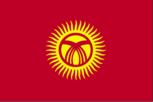
red field with a yellow sun in the center having 40 rays representing the 40 Kyrgyz tribes; on the obverse side the rays run counterclockwise, on the reverse, clockwise; in the center of the sun is a red ring crossed by two sets of three lines, a stylized representation of the roof of the traditional Kyrgyz yurt Economy Kyrgyzstan
GDP
purchasing power parity - $13.88 billion (2002 est.)
GDP - composition by sector
- agriculture
- 35%
- industry
- 25%
- services
- 40% (2002 est.)
GDP - per capita
purchasing power parity - $2,900 (2002 est.)
GDP - real growth rate
5.3% (2002 est.)
Geographic coordinates
41 00 N, 75 00 E
Geography - note
landlocked; entirely mountainous, dominated by the Tien Shan range; many tall peaks, glaciers, and high-altitude lakes People Kyrgyzstan
Government type
republic
Highways
- paved
- 16,854 km (including 140 km of expressways)
- total
- 18,500 km
- unpaved
- 1,646 km (1999 est.)
HIV/AIDS - adult prevalence rate
less than 0.1% (2001 est.)
HIV/AIDS - deaths
less than 100 (2001 est.)
HIV/AIDS - people living with HIV/AIDS
over 500 (2001 est.)
Household income or consumption by percentage share
- highest 10%
- 27.7% (1999)
- lowest 10%
- 3.2%
Illicit drugs
limited illicit cultivation of cannabis and opium poppy for CIS markets; limited government eradication of illicit crops; transit point for Southwest Asian narcotics bound for Russia and the rest of Europe This page was last updated on 18 December, 2003
Imports
$587 million f.o.b. (2002 est.)
Imports - commodities
oil and gas, machinery and equipment, chemicals, foodstuffs
Imports - partners
Kazakhstan 21.1%, Russia 19.9%, Uzbekistan 10.2%, China 10.1%, US 8.1%, Germany 5.3% (2002)
Independence
31 August 1991 (from Soviet Union)
Industrial production growth rate
6% (2000 est.)
Industries
small machinery, textiles, food processing, cement, shoes, sawn logs, refrigerators, furniture, electric motors, gold, rare earth metals
Infant mortality rate
- female
- 65.5 deaths/1,000 live births (2003 est.)
- male
- 84.72 deaths/1,000 live births
- total
- 75.34 deaths/1,000 live births
Inflation rate (consumer prices)
2.1% (2002 est.)
International organization participation
AsDB, CIS, EAPC, EBRD, ECE, ECO, ESCAP, FAO, IBRD, ICAO, ICCt (signatory), ICRM, IDA, IDB, IFAD, IFC, IFRCS, ILO, IMF, Interpol, IOC, IOM, ISO (correspondent), ITU, NAM (observer), OIC, OPCW (signatory), OSCE, PCA, PFP, SCO, UN, UNAMSIL, UNCTAD, UNESCO, UNIDO, UNMIK, UPU, WCO, WFTU, WHO, WIPO, WMO, WToO, WTrO
Internet country code
.kg
Internet Service Providers (ISPs)
NA
Internet users
51,600 (2001) Transportation Kyrgyzstan
Irrigated land
10,740 sq km (1998 est.)
Judicial branch
Supreme Court (judges are appointed for 10-year terms by the Supreme Council on the recommendation of the president); Constitutional Court; Higher Court of Arbitration
Labor force
2.7 million (2000)
Labor force - by occupation
agriculture 55%, industry 15%, services 30% (2000 est.)
Land boundaries
- border countries
- China 858 km, Kazakhstan 1,051 km, Tajikistan 870 km, Uzbekistan 1,099 km
- total
- 3,878 km
Land use
- arable land
- 7.04%
- note
- Kyrgyzstan has the world's largest natural growth walnut forest (1998 est.)
- other
- 92.57%
- permanent crops
- 0.39%
Languages
- Kyrgyz - official language, Russian - official language
- note
- in December 2001, the Kyrgyzstani legislature made Russian an official language, equal in status to Kyrgyz
Legal system
based on civil law system
Legislative branch
- bicameral Supreme Council or Zhogorku Kenesh consists of the Assembly of People's Representatives (70 seats; members are elected by popular vote to serve five-year terms) and the Legislative Assembly (35 seats; members are elected by popular vote to serve five-year terms)
- election results
- Assembly of People's Representatives - percent of vote by party - NA%; seats by party - NA; and Legislative Assembly - percent of vote by party - NA%; seats by party - NA; note - total seats by party in the Supreme Council were as follows: Union of Democratic Forces 12, Communists 6, My Country Party of Action 4, independents 73, other 10
- elections
- Assembly of People's Representatives - last held 20 February and 12 March 2000 (next to be held NA February 2005); Legislative Assembly - last held 20 February and 12 March 2000 (next to be held NA February 2005)
- note
- the legislature became bicameral for the 5 February 1995 elections; the 2000 election results include both the Assembly of People's Representatives and the Legislative Assembly
Life expectancy at birth
- female
- 68.03 years (2003 est.)
- male
- 59.49 years
- total population
- 63.66 years
Literacy
- definition
- age 15 and over can read and write
- female
- 96% (1989 est.) Government Kyrgyzstan
- male
- 99%
- total population
- 97%
Location
Central Asia, west of China
Map references
Asia
Maritime claims
none (landlocked)
Median age
- female
- 23.6 years (2002)
- male
- 21.8 years
- total
- 22.7 years
Military branches
Army, Air and Air Defense, Security Forces, Border Troops
Military expenditures - dollar figure
$19.2 million (FY01)
Military expenditures - percent of GDP
1.4% (FY01) Transnational Issues Kyrgyzstan
Military manpower - availability
- males age 15-49
- 1,265,019 (2003 est.)
Military manpower - fit for military service
- males age 15-49
- 1,026,063 (2003 est.)
Military manpower - military age
18 years of age (2003 est.)
Military manpower - reaching military age annually
- males
- 54,445 (2003 est.)
National holiday
Independence Day, 31 August (1991)
Nationality
- adjective
- Kyrgyzstani
- noun
- Kyrgyzstani(s)
Natural gas - consumption
2.016 billion cu m (2001 est.)
Natural gas - exports
0 cu m (2001 est.)
Natural gas - imports
2 billion cu m (2001 est.)
Natural gas - production
16 million cu m (2001 est.)
Natural hazards
NA
Natural resources
abundant hydropower; significant deposits of gold and rare earth metals; locally exploitable coal, oil, and natural gas; other deposits of nepheline, mercury, bismuth, lead, and zinc
Net migration rate
-2.37 migrant(s)/1,000 population (2003 est.)
Oil - consumption
20,000 bbl/day (2001 est.)
Oil - exports
NA (2001)
Oil - imports
NA (2001)
Oil - production
2,000 bbl/day (2001 est.)
Pipelines
gas 367 km; oil 13 km (2003)
Political parties and leaders
Agrarian Labor Party of Kyrgyzstan [Uson S. SYDYKOV]; Agrarian Party of Kyrgyzstan [Arkin ALIYEV]; Ata-Meken or Fatherland [Omurbek TEKEBAYEV]; Banner National Revival Party or ASABA [Chaprashty BAZARBAY]; Democratic Movement of Kyrgyzstan or DDK [Jypar JEKSHEYEV]; Democratic Women's Party of Kyrgyzstan [T. A. SHAILIYEVA]; Dignity Party [Feliks KULOV]; Erkin Kyrgyzstan Progressive and Democratic Party [Tursunbay Bakir UULU]; Justice Party [Chingiz AYTMATOV]; Movement for the People's Salvation [Jumgalbek AMAMBAYEV]; Mutual Help Movement or Ashar [Jumagazy USUPOV]; My Country Party of Action [Almazbek ISMANKULOV]; National Unity Democratic Movement or DDNE [Yury RAZGULYAYEV]; Party of Communists of Kyrgyzstan or KCP [Absamat M. MASALIYEV]; Party of the Veterans of the War in Afghanistan [leader NA]; Peasant Party [leader NA]; People's Party [Melis ESHIMKANOV]; Republican Popular Party of Kyrgyzstan [J. SHARSHENALIYEV]; Social Democratic Party or PSD [J. IBRAMOV]; Union of Democratic Forces (composed of Social Democratic Party of Kyrgyzstan or PSD [J. IBRAMOV], Economic Revival Party, and Birimdik Party)
Political pressure groups and leaders
Council of Free Trade Unions; Kyrgyz Committee on Human Rights [Ramazan DYRYLDAYEV]; National Unity Democratic Movement; Union of Entrepreneurs
Population
4,892,808 (July 2003 est.)
Population below poverty line
55% (2001 est.)
Population growth rate
1.46% (2003 est.)
Ports and harbors
Balykchy (Ysyk-Kol or Rybach'ye)
Radio broadcast stations
AM 12 (plus 10 repeater stations), FM 14, shortwave 2 (1998)
Radios
520,000 (1997)
Railways
- broad gauge
- 420 km 1.520-m gauge (2002)
- total
- 420 km
Religions
Muslim 75%, Russian Orthodox 20%, other 5%
Sex ratio
- at birth
- 1.05 male(s)/female
- total population
- 0.96 male(s)/female (2003 est.)
- under 15 years
- 1.02 male(s)/female 15-64 years: 0.96 male(s)/female 65 years and over: 0.62 male(s)/female
Suffrage
18 years of age; universal
Telephone system
- domestic
- principally microwave radio relay; one cellular provider, probably limited to Bishkek region
- general assessment
- poorly developed; about 100,000 unsatisfied applications for household telephones
- international
- connections with other CIS countries by landline or microwave radio relay and with other countries by leased connections with Moscow international gateway switch and by satellite; satellite earth stations - 1 Intersputnik and 1 Intelsat; connected internationally by the Trans-Asia-Europe (TAE) fiber-optic line
Telephones - main lines in use
351,000 (1997)
Telephones - mobile cellular
NA
Television broadcast stations
NA (repeater stations throughout the country relay programs from Russia, Uzbekistan, Kazakhstan, and Turkey) (1997)
Televisions
210,000 (1997)
Terrain
peaks of Tien Shan and associated valleys and basins encompass entire nation
Total fertility rate
3.12 children born/woman (2003 est.)
Unemployment rate
7.2% (1999 est.)
Waterways
600 km (1990)