2012 Edition
CIA World Factbook 2012 Archive (HTML)
Introduction
Background
- Ethnic Kazakhs, a mix of Turkic and Mongol nomadic tribes who migrated into the region in the 13th century, were rarely united as a single nation. The area was conquered by Russia in the 18th century, and Kazakhstan became a Soviet Republic in 1936. During the 1950s and 1960s agricultural "Virgin Lands" program, Soviet citizens were encouraged to help cultivate Kazakhstan's northern pastures. This influx of immigrants (mostly Russians, but also some other deported nationalities) skewed the ethnic mixture and enabled non-ethnic Kazakhs to outnumber natives. Non-Muslim ethnic minorities departed Kazakhstan in large numbers from the mid-1990s through the mid-2000s and a national program has repatriated about a million ethnic Kazakhs thus far back to Kazakhstan. These trends have allowed Kazakhs to become the titular majority again. This dramatic demographic shift has also undermined the previous religious diversity and made the country more than 70 percent Muslim. Kazakhstan's economy is larger than those of all the other Central Asian states largely due to the country's vast natural resources. Current issues include: developing a cohesive national identity; managing Islamic revivalism; expanding the development of the country's vast energy resources and exporting them to world markets; diversifying the economy outside the oil, gas, and mining sectors; enhancing Kazakhstan's economic competitiveness; developing a multiparty parliament and advancing political and social reform; and strengthening relations with neighboring states and other foreign powers.
- Ethnic Kazakhs, a mix of Turkic and Mongol nomadic tribes who migrated into the region in the 13th century, were rarely united as a single nation. The area was conquered by Russia in the 18th century, and Kazakhstan became a Soviet Republic in 1936. Durin
- developing a cohesive national identity; managing Islamic revivalism; expanding the development of the country's vast energy resources and exporting them to world markets; diversifying the economy outside the oil, gas, and mining sectors; enhancing Kazakhstan's economic competitiveness; developing a multiparty parliament and advancing political and social reform; and strengthening relations with neighboring states and other foreign powers.
Geography
Area
- 2,724,900 sq km 2,699,700 sq km 25,200 sq km
- total
- 2,724,900 sq km
- water
- 25,200 sq km
Area - comparative
slightly less than four times the size of Texas
Climate
continental, cold winters and hot summers, arid and semiarid
Coastline
0 km (landlocked); note - Kazakhstan borders the Aral Sea, now split into two bodies of water (1,070 km), and the Caspian Sea (1,894 km)
Elevation extremes
- Vpadina Kaundy -132 m Khan Tangiri Shyngy (Pik Khan-Tengri) 6,995 m
- highest point
- Khan Tangiri Shyngy (Pik Khan-Tengri) 6,995 m
- lowest point
- Vpadina Kaundy -132 m
Environment - current issues
radioactive or toxic chemical sites associated with former defense industries and test ranges scattered throughout the country pose health risks for humans and animals; industrial pollution is severe in some cities; because the two main rivers that flowed into the Aral Sea have been diverted for irrigation, it is drying up and leaving behind a harmful layer of chemical pesticides and natural salts; these substances are then picked up by the wind and blown into noxious dust storms; pollution in the Caspian Sea; soil pollution from overuse of agricultural chemicals and salination from poor infrastructure and wasteful irrigation practices
Environment - international agreements
- Air Pollution, Biodiversity, Climate Change, Desertification, Endangered Species, Environmental Modification, Hazardous Wastes, Ozone Layer Protection, Ship Pollution, Wetlands Climate Change-Kyoto Protocol
- party to
- Air Pollution, Biodiversity, Climate Change, Desertification, Endangered Species, Environmental Modification, Hazardous Wastes, Ozone Layer Protection, Ship Pollution, Wetlands
- signed, but not ratified
- Climate Change-Kyoto Protocol
Freshwater withdrawal (domestic/industrial/agricultural)
- 35 cu km/yr (2%/17%/82%) 2,360 cu m/yr (2000)
- per capita
- 2,360 cu m/yr (2000)
- total
- 35 cu km/yr (2%/17%/82%)
Geographic coordinates
48 00 N, 68 00 E
Geography - note
landlocked; Russia leases approximately 6,000 sq km of territory enclosing the Baykonur Cosmodrome; in January 2004, Kazakhstan and Russia extended the lease to 2050
Irrigated land
35,560 sq km (2003)
Land boundaries
- 12,185 km China 1,533 km, Kyrgyzstan 1,224 km, Russia 6,846 km, Turkmenistan 379 km, Uzbekistan 2,203 km
- border countries
- China 1,533 km, Kyrgyzstan 1,224 km, Russia 6,846 km, Turkmenistan 379 km, Uzbekistan 2,203 km
- total
- 12,185 km
Land use
- 8.28% 0.05% 91.67% (2005)
- arable land
- 8.28%
- other
- 91.67% (2005)
- permanent crops
- 0.05%
Location
Central Asia, northwest of China; a small portion west of the Ural (Zhayyq) River in eastern-most Europe
Map references
Asia
Maritime claims
none (landlocked)
Natural hazards
earthquakes in the south; mudslides around Almaty
Natural resources
major deposits of petroleum, natural gas, coal, iron ore, manganese, chrome ore, nickel, cobalt, copper, molybdenum, lead, zinc, bauxite, gold, uranium
Terrain
vast flat steppe extending from the Volga in the west to the Altai Mountains in the east and from the plains of western Siberia in the north to oases and deserts of Central Asia in the south
Total renewable water resources
109.6 cu km (1997)
People and Society
Age structure
- 24.4% (male 2,154,544/ female 2,126,508) 68.8% (male 5,846,991/ female 6,213,990) 6.7% (male 404,254/ female 775,723) (2012 est.)
- 0-14 years
- 24.4% (male 2,154,544/ female 2,126,508)
- 15-64 years
- 68.8% (male 5,846,991/ female 6,213,990)
- 65 years and over
- 6.7% (male 404,254/ female 775,723) (2012 est.)
Birth rate
20.44 births/1,000 population (2012 est.)
Children under the age of 5 years underweight
4.9% (2006)
Death rate
8.52 deaths/1,000 population (July 2012 est.)
Education expenditures
2.8% of GDP (2007)
Ethnic groups
Kazakh (Qazaq) 63.1%, Russian 23.7%, Uzbek 2.8%, Ukrainian 2.1%, Uighur 1.4%, Tatar 1.3%, German 1.1%, other 4.5% (1999 census)
Health expenditures
4.3% of GDP (2009)
HIV/AIDS - adult prevalence rate
0.1% (2009 est.)
HIV/AIDS - deaths
fewer than 500 (2009 est.)
HIV/AIDS - people living with HIV/AIDS
13,000 (2009 est.)
Hospital bed density
7.6 beds/1,000 population (2009)
Infant mortality rate
- 23.06 deaths/1,000 live births 25.83 deaths/1,000 live births 20.46 deaths/1,000 live births (2012 est.)
- female
- 20.46 deaths/1,000 live births (2012 est.)
- total
- 23.06 deaths/1,000 live births
Languages
Kazakh (Qazaq, state language) 64.4%, Russian (official, used in everyday business, designated the "language of interethnic communication") 95% (2001 est.)
Life expectancy at birth
- 69.63 years 64.34 years 74.59 years (2012 est.)
- female
- 74.59 years (2012 est.)
- total population
- 69.63 years
Literacy
- age 15 and over can read and write 99.5% 99.8% 99.3% (1999 est.)
- definition
- age 15 and over can read and write
- female
- 99.3% (1999 est.)
- male
- 99.8%
- total population
- 99.5%
Major cities - population
Almaty 1.383 million; ASTANA (capital) 650,000 (2009)
Maternal mortality rate
51 deaths/100,000 live births (2010)
Median age
- 29.3 years 27.9 years 30.8 years (2012 est.)
- female
- 30.8 years (2012 est.)
- male
- 27.9 years
- total
- 29.3 years
Nationality
- Kazakhstani(s) Kazakhstani
- adjective
- Kazakhstani
- noun
- Kazakhstani(s)
Net migration rate
0.43 migrant(s)/1,000 population (2012 est.)
Physicians density
3.877 physicians/1,000 population (2007)
Population
17,522,010 (July 2012 est.)
Population growth rate
1.235% (2012 est.)
Religions
Muslim 47%, Russian Orthodox 44%, Protestant 2%, other 7%
Sanitation facility access
- urban: 97% of population rural: 98% of population total: 97% of population urban: 3% of population rural: 2% of population total: 3% of population
- rural
- 2% of population
- total
- 3% of population
- urban
- 3% of population
School life expectancy (primary to tertiary education)
- 15 years 15 years 16 years (2010)
- female
- 16 years (2010)
- male
- 15 years
- total
- 15 years
Sex ratio
- 0.94 male(s)/female 1.01 male(s)/female 0.94 male(s)/female 0.52 male(s)/female 0.92 male(s)/female (2011 est.)
- 15-64 years
- 0.94 male(s)/female
- 65 years and over
- 0.52 male(s)/female
- at birth
- 0.94 male(s)/female
- total population
- 0.92 male(s)/female (2011 est.)
- under 15 years
- 1.01 male(s)/female
Total fertility rate
2.41 children born/woman (2012 est.)
Unemployment, youth ages 15-24
- 6.7% 6.8% 8.2% (2008)
- female
- 8.2% (2008)
- total
- 6.7%
Urbanization
- 59% of total population (2010) 1.3% annual rate of change (2010-15 est.)
- rate of urbanization
- 1.3% annual rate of change (2010-15 est.)
- urban population
- 59% of total population (2010)
Government
Administrative divisions
14 provinces (oblystar, singular - oblys) and 3 cities* (qalalar, singular - qala); Almaty Oblysy, Almaty Qalasy*, Aqmola Oblysy (Astana), Aqtobe Oblysy, Astana Qalasy*, Atyrau Oblysy, Batys Qazaqstan Oblysy [West Kazakhstan] (Oral), Bayqongyr Qalasy [Baykonur]*, Mangghystau Oblysy (Aqtau), Ongtustik Qazaqstan Oblysy [South Kazakhstan] (Shymkent), Pavlodar Oblysy, Qaraghandy Oblysy, Qostanay Oblysy, Qyzylorda Oblysy, Shyghys Qazaqstan Oblysy [East Kazakhstan] (Oskemen), Soltustik Qazaqstan Oblysy [North Kazakhstan] (Petropavlovsk), Zhambyl Oblysy (Taraz) administrative divisions have the same names as their administrative centers (exceptions have the administrative center name following in parentheses); in 1995, the Governments of Kazakhstan and Russia entered into an agreement whereby Russia would lease for a period of 20 years an area of 6,000 sq km enclosing the Baykonur space launch facilities and the city of Bayqongyr (Baykonur, formerly Leninsk); in 2004, a new agreement extended the lease to 2050
Capital
- Astana 51 10 N, 71 25 E UTC+6 (11 hours ahead of Washington, DC during Standard Time) Kazakhstan is divided into two time zones
- geographic coordinates
- 51 10 N, 71 25 E
- name
- Astana
- time difference
- UTC+6 (11 hours ahead of Washington, DC during Standard Time)
Constitution
first post-independence constitution adopted 28 January 1993; new constitution adopted by national referendum 30 August 1995, amended May 2007 and February 2011
Country name
- Republic of Kazakhstan Kazakhstan Qazaqstan Respublikasy Qazaqstan Kazakh Soviet Socialist Republic
- conventional long form
- Republic of Kazakhstan
- conventional short form
- Kazakhstan
- former
- Kazakh Soviet Socialist Republic
- local long form
- Qazaqstan Respublikasy
- local short form
- Qazaqstan
Diplomatic representation from the US
- Ambassador Kenneth FAIRFAX Ak Bulak 4, Str. 23-22, Building #3, Astana 010010 use embassy street address [7] (7172) 70-21-00 [7] (7172) 34-08-90
- chief of mission
- Ambassador Kenneth FAIRFAX
- embassy
- Ak Bulak 4, Str. 23-22, Building #3, Astana 010010
- FAX
- [7] (7172) 34-08-90
- mailing address
- use embassy street address
- telephone
- [7] (7172) 70-21-00
Diplomatic representation in the US
- Ambassador Kayrat UMAROV 1401 16th Street NW, Washington, DC 20036 [1] (202) 232-5488 [1] (202) 232-5845 Los Angeles New York
- chancery
- 1401 16th Street NW, Washington, DC 20036
- chief of mission
- Ambassador Kayrat UMAROV
- consulate(s)
- New York
- consulate(s) general
- Los Angeles
- FAX
- [1] (202) 232-5845
- telephone
- [1] (202) 232-5488
Executive branch
- President Nursultan A. NAZARBAYEV (chairman of the Supreme Soviet from 22 February 1990, elected president 1 December 1991) Prime Minister Serik AKHMETOV (since 24 September 2012); Deputy Prime Ministers Yerbol ORYNBAYEV (since 29 October 2007), Kairat KELIMBETOV (since 20 January 2011), Aset ISEKESHEV (since 25 September 2012), Krymbek KUSHERBAYEV (since 27 September 2012) Council of Ministers appointed by the president president elected by popular vote for a five-year term; election last held on 3 April 2011 (next to be held in 2016); prime minister and deputy prime ministers appointed by the president, with Mazhilis approval; note - constitutional amendments of May 2007 shortened the presidential term from seven years to five years and established a two-consecutive-term limit; NAZARBAYEV has official status as the "First President of Kazakhstan" and is allowed an unlimited amount of terms constitutional amendments of February 2011 moved election date from 2012 to April 2011 but kept five-year term; subsequent election to take place in 2016 Nursultan A. NAZARBAYEV reelected president; percent of vote - Nursultan A. NAZARBAYEV 95.5%, other 4.5%
- cabinet
- Council of Ministers appointed by the president
- chief of state
- President Nursultan A. NAZARBAYEV (chairman of the Supreme Soviet from 22 February 1990, elected president 1 December 1991)
- election results
- Nursultan A. NAZARBAYEV reelected president; percent of vote - Nursultan A. NAZARBAYEV 95.5%, other 4.5%
- elections
- president elected by popular vote for a five-year term; election last held on 3 April 2011 (next to be held in 2016); prime minister and deputy prime ministers appointed by the president, with Mazhilis approval; note - constitutional amendments of May 2007 shortened the presidential term from seven years to five years and established a two-consecutive-term limit; NAZARBAYEV has official status as the "First President of Kazakhstan" and is allowed an unlimited amount of terms
- head of government
- Prime Minister Serik AKHMETOV (since 24 September 2012); Deputy Prime Ministers Yerbol ORYNBAYEV (since 29 October 2007), Kairat KELIMBETOV (since 20 January 2011), Aset ISEKESHEV (since 25 September 2012), Krymbek KUSHERBAYEV (since 27 September 2012)
Flag description
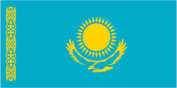
a gold sun with 32 rays above a soaring golden steppe eagle, both centered on a sky blue background; the hoist side displays a national ornamental pattern "koshkar-muiz" (the horns of the ram) in gold; the blue color is of religious significance to the Turkic peoples of the country, and so symbolizes cultural and ethnic unity; it also represents the endless sky as well as water; the sun, a source of life and energy, exemplifies wealth and plenitude; the sun's rays are shaped like grain, which is the basis of abundance and prosperity; the eagle has appeared on the flags of Kazakh tribes for centuries and represents freedom, power, and the flight to the future
Government type
republic; authoritarian presidential rule, with little power outside the executive branch
Independence
16 December 1991 (from the Soviet Union)
International law organization participation
has not submitted an ICJ jurisdiction declaration; non-party state to the ICCt
International organization participation
ADB, CICA, CIS, CSTO, EAEC, EAPC, EBRD, ECO, EITI (candidate country), FAO, GCTU, IAEA, IBRD, ICAO, ICC (NGOs), ICRM, IDA, IDB, IFAD, IFC, IFRCS, ILO, IMF, IMO, Interpol, IOC, IOM, IPU, ISO, ITSO, ITU, MIGA, NAM (observer), NSG, OAS (observer), OIC, OPCW, OSCE, PFP, SCO, UN, UNCTAD, UNESCO, UNIDO, UNWTO, UPU, WCO, WFTU (NGOs), WHO, WIPO, WMO, WTO (observer), ZC
Judicial branch
Supreme Court (44 members); Constitutional Council (seven members)
Legal system
civil law system influenced by Roman-Germanic law and by the theory and practice of the Russian Federation
Legislative branch
- bicameral Parliament consists of the Senate (47 seats; 15 members are appointed by the president; 32 members elected by local assemblies; members serve six-year terms, but elections are staggered with half of the members up for re-election every three years) and the Mazhilis (107 seats; 9 out of the 107 Mazhilis members elected by the Assembly of the People of Kazakhstan, a presidentially appointed advisory body designed to represent the country's ethnic minorities; non-appointed members are popularly elected to serve five-year terms) Senate - (indirect) last held in August 2011 (next to be held in 2014); Mazhilis - last held on 15 January 2012 (next to be held in 2017) Senate - percent of vote by party - NA; seats by party - Nur Otan 16; Mazhilis - percent of vote by party - Nur-Otan 81%, Ak Zhol 7.5%, Communist People's Party 7.2%, other 4.3%; seats by party - Nur-Otan 83, Ak Zhol 8, Communist People's Party 7
- election results
- Senate - percent of vote by party - NA; seats by party - Nur Otan 16; Mazhilis - percent of vote by party - Nur-Otan 81%, Ak Zhol 7.5%, Communist People's Party 7.2%, other 4.3%; seats by party - Nur-Otan 83, Ak Zhol 8, Communist People's Party 7
- elections
- Senate - (indirect) last held in August 2011 (next to be held in 2014); Mazhilis - last held on 15 January 2012 (next to be held in 2017)
National anthem
- "Menin Qazaqstanim" (My Kazakhstan) Zhumeken NAZHIMEDENOV and Nursultan NAZARBAYEV/Shamshi KALDAYAKOV adopted 2006; President Nursultan NAZARBAYEV played a role in revising the lyrics
- lyrics/music
- Zhumeken NAZHIMEDENOV and Nursultan NAZARBAYEV/Shamshi KALDAYAKOV
- name
- "Menin Qazaqstanim" (My Kazakhstan)
National holiday
Independence Day, 16 December (1991)
National symbol(s)
golden eagle
Political parties and leaders
Adilet (Justice) [Maksut NARIKBAYEV, Serik ABDRAHMANOV, Bakhytbek AKHMETZHAN, Yerkin ONGARBAYEV, Tolegan SYDYKOV] (formerly Democratic Party of Kazakhstan); Agrarian and Industrial Union of Workers Block or AIST (Agrarian Party and Civic Party); Ak Zhol Party (Bright Path) [Azat PERUASHEV]; Alga [Vladimir KOZLOV] (unregistered and banned as extremist in November 2012); Auyl (Village) [Gani KALIYEV]; Azat (Freedom) Party [Bolat ABILOV] (formerly True Ak Zhol Party); Azat NSDP [co-chaired by Bolat ABILOV and Zharmakhan TUYAKBAY]; Azat and NSDP united in 2009, but the authorities have refused to register Azat NSDP as a single party; Communist Party of Kazakhstan or KPK [Serikbolsyn ABDILDIN] (unregistered); Communist People's Party of Kazakhstan [Vladislav KOSAREV]; National Social Democratic Party or NSDP [Zharmakhan TUYAKBAY]; Nur Otan (Fatherland's Ray of Light) [Nursultan NAZARBAYEV, Nurlan NIGMATULIN] (the Agrarian, Asar, and Civic parties merged with Otan); Patriots' Party [Gani KASYMOV]; Rukhaniyat (Spirituality) [Altynshash ZHAGANOVA]
Political pressure groups and leaders
Adil-Soz [Tamara KALEYEVA]; Almaty Helsinki Committee [Ninel FOKINA]; Confederation of Free Trade Unions [Sergei BELKIN]; For Fair Elections [Yevgeniy ZHOVTIS, Sabit ZHUSUPOV, Sergey DUVANOV, Ibrash NUSUPBAYEV]; Kazakhstan International Bureau on Human Rights [Yevgeniy ZHOVTIS, executive director]; Khalyk Maidany (Peoples' Front) - an informal union between the unregistered Alga Party, the unregistered Communist Party of Kazakhstan, and several opposition-oriented civil society groups, banned in November 2012 [no formal leader]; Pan-National Social Democratic Party of Kazakhstan [Zharmakhan TUYAKBAY]; Pensioners Movement or Pokoleniye [Irina SAVOSTINA, chairwoman]; Republican Network of International Monitors [Daniyar LIVAZOV]; Transparency International [Sergey ZLOTNIKOV]
Suffrage
18 years of age; universal
Economy
Agriculture - products
grain (mostly spring wheat and barley), potatoes, vegetables, melons; livestock
Budget
- $43.08 billion $48.04 billion (2012 est.)
- expenditures
- $48.04 billion (2012 est.)
- revenues
- $43.08 billion
Budget surplus (+) or deficit (-)
-2.5% of GDP (2012 est.)
Central bank discount rate
7.5% (31 December 2011 est.) 4.25% (31 December 2010 est.)
Commercial bank prime lending rate
6.3% (31 December 2012 est.) 6.71% (31 December 2011 est.)
Current account balance
$12.69 billion (2012 est.) $14.11 billion (2011 est.)
Debt - external
$105.5 billion (31 December 2012 est.) $103.3 billion (31 December 2011 est.)
Distribution of family income - Gini index
26.7 (2009) 31.5 (2003)
Economy - overview
Kazakhstan, geographically the largest of the former Soviet republics, excluding Russia, possesses enormous fossil fuel reserves and plentiful supplies of other minerals and metals, such as uranium, copper, and zinc. It also has a large agricultural sector featuring livestock and grain. In 2002 Kazakhstan became the first country in the former Soviet Union to receive an investment-grade credit rating. Extractive industries have been and will continue to be the engine of Kazakhstan's growth, although the country is aggressively pursuing diversification strategies. Landlocked, with restricted access to the high seas, Kazakhstan relies on its neighbors to export its products, especially oil and grain. Although its Caspian Sea ports, pipelines, and rail lines carrying oil have been upgraded, civil aviation and roadways continue to need attention. Telecoms are improving, but require considerable investment, as does the information technology base. Supply and distribution of electricity can be erratic because of regional dependencies, but the country is moving forward with plans to improve reliability of electricity and gas supply to its population. At the end of 2007, global financial markets froze up and the loss of capital inflows to Kazakhstani banks caused a credit crunch. The subsequent and sharp fall of oil and commodity prices in 2008 aggravated the economic situation, and Kazakhstan plunged into recession. While the global financial crisis took a significant toll on Kazakhstan's economy, it has rebounded well, helped by prudent government measures. GDP increased 7.5% year-on-year in 2011, and 5.5% in 2012. Rising commodity prices have helped the recovery. Despite solid macroeconomic indicators, the government realizes that its economy suffers from an overreliance on oil and extractive industries, the so-called "Dutch disease." In response, Kazakhstan has embarked on an ambitious diversification program, aimed at developing targeted sectors like transport, pharmaceuticals, telecommunications, petrochemicals and food processing. In 2010 Kazakhstan joined the Belarus-Kazakhstan-Russia Customs Union in an effort to boost foreign investment and improve trade relationships and is planning to accede to the World Trade Organization in 2013.
Exchange rates
tenge (KZT) per US dollar - 148.6 (2012 est.) 146.62 (2011 est.) 147.36 (2010 est.) 147.5 (2009) 120.25 (2008)
Exports
$88.61 billion (2012 est.) $88.47 billion (2011 est.)
Exports - commodities
oil and oil products 59%, ferrous metals 19%, chemicals 5%, machinery 3%, grain, wool, meat, coal
Exports - partners
China 21.7%, France 9.4%, Germany 8.3%, Russia 5.3%, Italy 5.2%, Canada 4.5%, Romania 4.5% (2011)
Fiscal year
calendar year
GDP - composition by sector
- 5.2% 37.9% 56.9% (2011 est.)
- agriculture
- 5.2%
- industry
- 37.9%
- services
- 56.9% (2011 est.)
GDP - per capita (PPP)
$13,900 (2012 est.) $13,200 (2011 est.) $12,500 (2010 est.) data are in 2012 US dollars
GDP - real growth rate
5.5% (2012 est.) 7.5% (2011 est.) 7.3% (2010 est.)
GDP (official exchange rate)
$200.6 billion (2012 est.)
GDP (purchasing power parity)
$232.3 billion (2012 est.) $220.3 billion (2011 est.) $204.9 billion (2010 est.) data are in 2012 US dollars
Household income or consumption by percentage share
- 4% 23.8% (2009 est.)
- highest 10%
- 23.8% (2009 est.)
- lowest 10%
- 4%
Imports
$42.82 billion (2012 est.) $41.21 billion (2011 est.)
Imports - commodities
machinery and equipment, metal products, foodstuffs
Imports - partners
China 30.1%, Russia 20%, Germany 7.4%, Ukraine 5% (2011)
Industrial production growth rate
3.4% (2011 est.)
Inflation rate (consumer prices)
5.2% (2012 est.) 8.3% (2011 est.)
Investment (gross fixed)
21.6% of GDP (2012 est.)
Labor force
8.973 million (2012 est.)
Labor force - by occupation
- 25.9% 11.9% 62.2% (2010 est.)
- agriculture
- 25.9%
- industry
- 11.9%
- services
- 62.2% (2010 est.)
Market value of publicly traded shares
$43.3 billion (31 December 2011) $60.74 billion (31 December 2010) $57.66 billion (31 December 2009)
Population below poverty line
8.2% (2009 est.)
Public debt
15.5% of GDP (2012 est.) 12.6% of GDP (2011 est.)
Reserves of foreign exchange and gold
$32.82 billion (31 December 2012 est.) $29.33 billion (31 December 2011 est.)
Stock of broad money
$65.71 billion (31 December 2011 est.) $57.51 billion (31 December 2010 est.)
Stock of direct foreign investment - abroad
$20.29 billion (31 December 2012 est.) $18.29 billion (31 December 2011 est.)
Stock of direct foreign investment - at home
$105.5 billion (31 December 2012 est.) $92.04 billion (31 December 2011 est.)
Stock of domestic credit
$75.55 billion (31 December 2012 est.) $75.12 billion (31 December 2011 est.)
Stock of narrow money
$27.55 billion (31 December 2012 est.) $26 billion (31 December 2011 est.)
Taxes and other revenues
21.5% of GDP (2012 est.)
Unemployment rate
5.3% (2012 est.) 5.4% (2011 est.)
Energy
Carbon dioxide emissions from consumption of energy
184.5 million Mt (2010 est.)
Crude oil - exports
1.078 million bbl/day (2009 est.)
Crude oil - imports
122,600 bbl/day (2009 est.)
Crude oil - production
1.635 million bbl/day (2011 est.)
Crude oil - proved reserves
30 billion bbl (1 January 2012 est.)
Electricity - consumption
88.11 billion kWh (2011 est.)
Electricity - exports
1.8 billion kWh (2011 est.)
Electricity - from fossil fuels
88.2% of total installed capacity (2009 est.)
Electricity - from hydroelectric plants
11.8% of total installed capacity (2009 est.)
Electricity - from nuclear fuels
0% of total installed capacity (2009 est.)
Electricity - from other renewable sources
0% of total installed capacity (2009 est.)
Electricity - imports
3.7 billion kWh (2011 est.)
Electricity - installed generating capacity
18.73 million kW (2009 est.)
Electricity - production
86.2 billion kWh (2011 est.)
Natural gas - consumption
10.2 billion cu m (2011 est.)
Natural gas - exports
8.1 billion cu m (2011 est.)
Natural gas - imports
3.7 billion cu m (2011 est.)
Natural gas - production
20.2 billion cu m (2011 est.)
Natural gas - proved reserves
2.407 trillion cu m (1 January 2012 est.)
Refined petroleum products - consumption
244,200 bbl/day (2011 est.)
Refined petroleum products - exports
92,880 bbl/day (2011 est.)
Refined petroleum products - imports
94,430 bbl/day (2008 est.)
Refined petroleum products - production
301,500 bbl/day (2008 est.)
Communications
Broadcast media
state owns nearly all radio and TV transmission facilities and operates national TV and radio networks; nearly all nationwide TV networks are wholly or partly owned by the government; some former state-owned media outlets have been privatized; households with satellite dishes have access to foreign media; a small number of commercial radio stations operating along with state-run radio stations; recent legislation requires all media outlets to register with the government and all TV poviders to broadcast in digital format by 2015 (2008)
Internet country code
.kz
Internet hosts
67,464 (2012)
Internet users
5.299 million (2009)
Telephone system
- inherited an outdated telecommunications network from the Soviet era requiring modernization intercity by landline and microwave radio relay; number of fixed-line connections is gradually increasing and fixed-line teledensity now roughly 25 per 100 persons; mobile-cellular usage has increased rapidly and the subscriber base now exceeds 140 per 100 persons country code - 7; international traffic with other former Soviet republics and China carried by landline and microwave radio relay and with other countries by satellite and by the Trans-Asia-Europe (TAE) fiber-optic cable; satellite earth stations - 2 Intelsat (2008)
- domestic
- intercity by landline and microwave radio relay; number of fixed-line connections is gradually increasing and fixed-line teledensity now roughly 25 per 100 persons; mobile-cellular usage has increased rapidly and the subscriber base now exceeds 140 per 100 persons
- general assessment
- inherited an outdated telecommunications network from the Soviet era requiring modernization
- international
- country code - 7; international traffic with other former Soviet republics and China carried by landline and microwave radio relay and with other countries by satellite and by the Trans-Asia-Europe (TAE) fiber-optic cable; satellite earth stations - 2 Intelsat (2008)
Telephones - main lines in use
4.266 million (2011)
Telephones - mobile cellular
25.24 million (2011)
Transportation
Airports
97 (2012)
Airports - with paved runways
- 8 (2012)
- 1,524 to 2,437 m
- 16
- 2,438 to 3,047 m
- 25
- 914 to 1,523 m
- 5
- over 3,047 m
- 10
- total
- 64
- under 914 m
- 8 (2012)
Airports - with unpaved runways
- 13 (2012)
- 1,524 to 2,437 m
- 3
- 2,438 to 3,047 m
- 7
- 914 to 1,523 m
- 5
- over 3,047 m
- 5
- total
- 33
- under 914 m
- 13 (2012)
Heliports
3 (2012)
Merchant marine
- cargo 1, petroleum tanker 8, refrigerated cargo 1, specialized tanker 1 3 (Austria 1, Ireland 1, Turkey 1) (2010)
- foreign-owned
- 3 (Austria 1, Ireland 1, Turkey 1) (2010)
- total
- 11
Pipelines
condensate 658 km; gas 12,317 km; oil 11,201 km; refined products 1,095 km; water 1,465 km (2010)
Ports and terminals
Aqtau (Shevchenko), Atyrau (Gur'yev), Oskemen (Ust-Kamenogorsk), Pavlodar, Semey (Semipalatinsk)
Railways
- 15,079 km 15,079 km 1.520-m gauge (4,000 km electrified) (2008)
- total
- 15,079 km
Roadways
- 93,612 km 84,100 km 9,512 km (2008)
- total
- 93,612 km
- unpaved
- 9,512 km (2008)
Waterways
4,000 km (on the Ertis (Irtysh) River (80%) and Syr Darya (Syrdariya) River) (2010)
Military and Security
Manpower available for military service
- 4,163,629 4,179,051 (2010 est.)
- females age 16-49
- 4,179,051 (2010 est.)
- males age 16-49
- 4,163,629
Manpower fit for military service
- 2,909,999 3,528,169 (2010 est.)
- females age 16-49
- 3,528,169 (2010 est.)
- males age 16-49
- 2,909,999
Manpower reaching militarily significant age annually
- 125,322 119,541 (2010 est.)
- female
- 119,541 (2010 est.)
- male
- 125,322
Military branches
- Kazakhstan Armed Forces: Ground Forces, Navy, Air Mobile Forces, Air Defense Forces (2010)
- Kazakhstan Armed Forces
- Ground Forces, Navy, Air Mobile Forces, Air Defense Forces (2010)
Military expenditures
1.1% of GDP (2010)
Military service age and obligation
18 years of age for compulsory military service; conscript service obligation - 2 years; minimum age for volunteers NA (2004)
Transnational Issues
Disputes - international
Kyrgyzstan has yet to ratify the 2001 boundary delimitation with Kazakhstan; field demarcation of the boundaries commenced with Uzbekistan in 2004 and with Turkmenistan in 2005; ongoing demarcation with Russia began in 2007; demarcation with China was completed in 2002; creation of a seabed boundary with Turkmenistan in the Caspian Sea remains under discussion; Azerbaijan, Kazakhstan, and Russia ratified Caspian seabed delimitation treaties based on equidistance, while Iran continues to insist on a one-fifth slice of the sea
Illicit drugs
significant illicit cultivation of cannabis for CIS markets, as well as limited cultivation of opium poppy and ephedra (for the drug ephedrine); limited government eradication of illicit crops; transit point for Southwest Asian narcotics bound for Russia and the rest of Europe; significant consumer of opiates
Refugees and internally displaced persons
- 3,700 (Russia); 508 (Afghanistan) (2007)
- refugees (country of origin)
- 3,700 (Russia); 508 (Afghanistan) (2007)