1999 Edition
CIA World Factbook 1999 (Internet Archive)
Introduction
Background
As a republic within the USSR (1920-91), Kazakhstan suffered greatly from Stalinist purges, from environmental damage, and saw the ethnic Russian portion of its population rise to 37% while other non-Kazakhs made up almost 20%. Current issues include the pace of market reform and privatization; fair and free elections and democratic reform; ethnic differences between Russians and Kazakhs; environmental problems; and how to convert the country's abundant energy resources into a better standard of living.
Geography
Area
total: 2,717,300 sq km land: 2,669,800 sq km water: 47,500 sq km
Area--comparative
slightly less than four times the size of Texas
Climate
continental, cold winters and hot summers, arid and semiarid
Coastline
0 km (landlocked) note: Kazakhstan borders the Aral Sea, now split into two bodies of water (1,070 km), and the Caspian Sea (1,894 km)
Elevation extremes
lowest point: Vpadina Kaundy -132 m highest point: Zhengis Shingy (Pik Khan-Tengri) 6,995 m
Environment--current issues
radioactive or toxic chemical sites associated with its former defense industries and test ranges are found throughout the country and pose health risks for humans and animals; industrial pollution is severe in some cities; because the two main rivers which flowed into the Aral Sea have been diverted for irrigation, it is drying up and leaving behind a harmful layer of chemical pesticides and natural salts; these substances are then picked up by the wind and blown into noxious dust storms; pollution in the Caspian Sea; soil pollution from overuse of agricultural chemicals and salination from faulty irrigation practices
Environment--international agreements
party to: Biodiversity, Climate Change, Desertification, Ozone Layer Protection, Ship Pollution signed, but not ratified: none of the selected agreements
Geographic coordinates
48 00 N, 68 00 E
Geography--note
landlocked
Irrigated land
22,000 sq km (1996 est.)
Land boundaries
total: 12,012 km border countries: China 1,533 km, Kyrgyzstan 1,051 km, Russia 6,846 km, Turkmenistan 379 km, Uzbekistan 2,203 km
Land use
arable land: 12% permanent crops: 11% permanent pastures: 57% forests and woodland: 4% other: 16% (1996 est.)
Location
Central Asia, northwest of China
Map references
Commonwealth of Independent States
Maritime claims
none (landlocked)
Natural hazards
earthquakes in the south, mudslides around Almaty
Natural resources
major deposits of petroleum, natural gas, coal, iron ore, manganese, chrome ore, nickel, cobalt, copper, molybdenum, lead, zinc, bauxite, gold, uranium
Terrain
extends from the Volga to the Altai Mountains and from the plains in western Siberia to oases and desert in Central Asia
People and Society
Age structure
0-14 years: 28% (male 2,432,519; female 2,359,375) 15-64 years: 65% (male 5,279,877; female 5,580,271) 65 years and over: 7% (male 392,934; female 779,849) (1999 est.)
Birth rate
17.16 births/1,000 population (1999 est.)
Death rate
10.34 deaths/1,000 population (1999 est.)
Ethnic groups
Kazakh (Qazaq) 46%, Russian 34.7%, Ukrainian 4.9%, German 3.1%, Uzbek 2.3%, Tatar 1.9%, other 7.1% (1996)
Infant mortality rate
58.82 deaths/1,000 live births (1999 est.)
Languages
Kazakh (Qazaq) (state language) 40%, Russian (official, used in everyday business) 66%
Life expectancy at birth
total population: 63.39 years male: 57.92 years female: 69.13 years (1999 est.)
Literacy
definition: age 15 and over can read and write total population: 98% male: 99% female: 96% (1989 est.)
Nationality
noun: Kazakhstani(s) adjective: Kazakhstani
Net migration rate
-7.73 migrant(s)/1,000 population (1999 est.)
Population
16,824,825 (July 1999 est.)
Population growth rate
-0.09% (1999 est.)
Religions
Muslim 47%, Russian Orthodox 44%, Protestant 2%, other 7%
Sex ratio
at birth: 1.05 male(s)/female under 15 years: 1.03 male(s)/female 15-64 years: 0.95 male(s)/female 65 years and over: 0.5 male(s)/female total population: 0.93 male(s)/female (1999 est.)
Total fertility rate
2.09 children born/woman (1999 est.)
Government
Administrative divisions
14 oblystar (singular--oblysy) and 3 cities (qala, singular--qalasy)*; Almaty, Almaty*, Aqmola (Astana), Aqtobe, Astana*, Atyrau, Batys Qazaqstan (Oral), Bayqongyr*, Mangghystau (Aqtau; formerly Gur'yev), Ongtustik Qazaqstan (Shymkent), Pavlodar, Qaraghandy, Qostanay, Qyzylorda, Shyghys Qazaqstan (Oskemen; formerly Ust'-Kamenogorsk), Soltustik Qazaqstan (Petropavl), Zhambyl (Taraz; formerly Dzhambul) note: administrative divisions have the same names as their administrative centers (exceptions have the administrative center name following in parentheses); in 1995 the Governments of Kazakhstan and Russia entered into an agreement whereby Russia would lease for a period of 20 years an area of 6,000 sq km enclosing the Bayqongyr (Baykonur) space launch facilities and the city of Bayqongyr (formerly Leninsk)
Capital
Astana note: the government moved from Almaty to Astana in December 1998
Constitution
adopted by national referendum 30 August 1995; first post-independence constitution was adopted 28 January 1993
Country name
conventional long form: Republic of Kazakhstan conventional short form: Kazakhstan local long form: Qazaqstan Respublikasy local short form: none former: Kazakh Soviet Socialist Republic
Data code
KZ
Executive branch
chief of state: President Nursultan A. NAZARBAYEV (chairman of the Supreme Soviet from 22 February 1990-91, president since 1 December 1991) head of government: Prime Minister Nurlan BALGIMBAYEV (since 10 October 1997) and First Deputy Prime Minister Uraz ZHANDOSOV (since 20 February 1998) cabinet: Council of Ministers appointed by the president elections: president elected by popular vote for a seven-year term; election last held 10 January 1999, a year before it was previously scheduled (next to be held NA 2006); note--President NAZARBAYEV's previous term had been extended to 2000 by a nationwide referendum held 30 April 1995; prime minister and first deputy prime minister appointed by the president election results: Nursultan A. NAZARBAYEV elected president; percent of vote--Nursultan NAZARBAYEV 82%, Serikbolsyn ABDILDIN 12% note: President NAZARBAYEV expanded his presidential powers by decree: only he can initiate constitutional amendments, appoint and dismiss the government, dissolve Parliament, call referenda at his discretion, and appoint administrative heads of regions and cities
Flag description
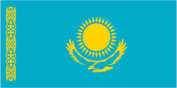
sky blue background representing the endless sky and a gold sun with 32 rays soaring above a golden steppe eagle in the center; on the hoist side is a "national ornamentation" in yellow
Government type
republic
Independence
16 December 1991 (from the Soviet Union)
International organization participation
AsDB, CCC, CIS, EAPC, EBRD, ECE, ECO, ESCAP, FAO, IAEA, IBRD, ICAO, IDA, IFC, ILO, IMF, IMO, Intelsat, Interpol, IOC, IOM (observer), ITU, OAS (observer), OIC, OPCW, OSCE, PFP, UN, UNCTAD, UNESCO, UPU, WFTU, WHO, WIPO, WMO, WToO, WTrO (applicant) Diplomatic representation in the US: chief of mission: Ambassador Bolat K. NURGALIYEV chancery: 1401 16th Street, NW, Washington, DC 20036 consulate(s): New York Diplomatic representation from the US: chief of mission: Ambassador Richard H. JONES embassy: 99/97A Furmanova Street, Almaty, Republic of Kazakhstan 480091 mailing address: American Embassy Almaty, Department of State, Washington, DC 20521-7030
Judicial branch
Supreme Court (44 members); Constitutional Council (7 members) Political parties and leaders: People's Unity Party or PUP (was Political pressure groups and leaders: Independent Trade Union chairman]
Legal system
based on civil law system
Legislative branch
bicameral Parliament consists of the Senate (47 seats; 7 senators are appointed by the president; other members are popularly elected, two from each oblast and Almaty, to serve four-year terms) and the Majilis (67 seats; members are popularly elected to serve four-year terms); note--with the oblasts being reduced to 14, the Senate will eventually be reduced to 37 elections: Senate--(indirect) last held 5 December 1995 (next to be held NA 1999); Majilis--last held 9 December and 23 December 1995 (next to be held NA 1999) election results: Senate--percent of vote by party--NA; seats by party--party members 13, no party affiliation 34, of which "independent" state officials 25, nominated by the president 7, elected by popular vote 15; Majilis--percent of vote by party--NA; seats by party--PUP 24, December National Democratic Party 12, Kazakhstan Agrarian Union 5, Confederation of Kazakh Trade Unions 5, KPK 2, independents and others 19
National holiday
Day of the Republic, 25 October (1990) (date on which Kazakhstan declared its sovereignty)
Suffrage
18 years of age; universal
Economy
Agriculture--products
grain (mostly spring wheat), cotton; wool, livestock
Budget
revenues: $2.9 billion expenditures: $4.2 billion, including capital expenditures of $NA (1998 est.)
Currency
1 Kazakhstani tenge = 100 tiyn
Debt--external
$3.1 billion (1998 est.)
Economic aid--recipient
$409.6 million (1995)
Economy--overview
Kazakhstan, the second largest of the former Soviet republics in territory, possesses enormous untapped fossil fuel reserves as well as plentiful supplies of other minerals and metals. It also has considerable agricultural potential with its vast steppe lands accommodating both livestock and grain production. Kazakhstan's industrial sector rests on the extraction and processing of these natural resources and also on a relatively large machine building sector specializing in construction equipment, tractors, agricultural machinery, and some defense items. The breakup of the USSR and the collapse of demand for Kazakhstan's traditional heavy industry products have resulted in a sharp contraction of the economy since 1991, with the steepest annual decline occurring in 1994. In 1995-97 the pace of the government program of economic reform and privatization quickened, resulting in a substantial shifting of assets into the private sector. The December 1996 signing of the Caspian Pipeline Consortium agreement to build a new pipeline from western Kazakhstan's Tengiz oil field to the Black Sea increases prospects for substantially larger oil exports in several years. Kazakhstan's economy turned downward in 1998 with a 2.5% decline in GDP growth due to slumping oil prices and the August financial crisis in Russia. 1999 will also be a difficult year.
Electricity--consumption
64.34 billion kWh (1996)
Electricity--exports
1.75 billion kWh (1996)
Electricity--imports
8.5 billion kWh (1996)
Electricity--production
52 billion kWh (1997)
Electricity--production by source
fossil fuel: 86.3% hydro: 13.6% nuclear: 0.1% other: 0% (1997)
Exchange rates
tenges per US$1--85.2 (February 1999), 78.30 (1998), 75.44 (1997), 67.30 (1996), 60.95 (1995), 35.54 (1994)
Exports
$6.3 billion (1998 est.)
Exports--commodities
oil, ferrous and nonferrous metals, chemicals, grain, wool, meat, coal
Exports--partners
Russia, UK, Ukraine, Uzbekistan, Netherlands, China, Italy, Germany (1997)
Fiscal year
calendar year
GDP
purchasing power parity--$52.9 billion (1998 est.)
GDP--composition by sector
agriculture: 11.5% industry: 32.6% services: 55.9% (1997 est.)
GDP--per capita
purchasing power parity?$3,100 (1998 est.)
GDP--real growth rate
-2.5% (1998 est.)
Household income or consumption by percentage share
lowest 10%: 3.1% highest 10%: 24.9% (1993)
Imports
$7.4 billion (1998 est.)
Imports--commodities
machinery and parts, industrial materials, oil and gas, consumer goods
Imports--partners
Russia, Ukraine, US, Uzbekistan, Turkey, UK, Germany, South Korea (1997)
Industrial production growth rate
-2.1% (1998 est.)
Industries
oil, coal, iron ore, manganese, chromite, lead, zinc, copper, titanium, bauxite, gold, silver, phosphates, sulfur, iron and steel, nonferrous metal, tractors and other agricultural machinery, electric motors, construction materials; much of industrial capacity is shut down and/or is in need of repair
Inflation rate (consumer prices)
10% (1998 est.)
Labor force
8.8 million (1997)
Labor force--by occupation
industry 27%, agriculture and forestry 23%, other 50% (1996)
Population below poverty line
NA%
Unemployment rate
13.7% (1998 est.)
Communications
Radio broadcast stations
AM NA, FM NA, shortwave NA
Radios
4.088 million (with multiple speakers for program diffusion 6.082 million)
Telephone system
service is poor domestic: landline and microwave radio relay; AMPS standard cellular systems are available in most of Kazakhstan international: international traffic with other former Soviet republics and China carried by landline and microwave radio relay and with other countries by satellite and through 8 international telecommunications circuits at the Moscow international gateway switch; satellite earth stations--1 Intelsat and a new digital satellite earth station established at Almaty; a third satellite earth station at Atyrau provides teleconnectivity to the AT&T network via Intelsat; cable connected by the Trans-Asia-Europe Fiber-Optic Line
Telephones
2 million (1997)
Television broadcast stations
20 (of which at least eight are government stations and at least 12 are private stations--seven of those are satellite TV relay stations) (1997)
Televisions
4.75 million
Transportation
Airports
10 (1997 est.) Airports--with paved runways: total: 9 over 3,047 m: 4 2,438 to 3,047 m: 3 1,524 to 2,437 m: 2 (1997 est.) Airports--with unpaved runways: total: 1 914 to 1,523 m: 1 (1997 est.)
Highways
total: 141,000 km paved: 104,200 km unpaved: 36,800 km (1997 est.)
Pipelines
crude oil 2,850 km; refined products 1,500 km; natural gas 3,480 km (1992) Ports and harbors: Aqtau (Shevchenko), Atyrau (Gur'yev), Oskemen (Ust-Kamenogorsk), Pavlodar, Semey (Semipalatinsk)
Railways
total: 14,400 km in common carrier service; does not include industrial lines broad gauge: 14,400 km 1.520-m gauge (3,299 km electrified) (1997)
Waterways
3,900 km on the Syrdariya (Syr Darya) and Ertis (Irtysh)
Military and Security
Military branches
General Purpose Forces (Army), Air Force, Border Guards, Navy, Republican Guard
Military expenditures--dollar figure
$232.4 million (1998)
Military expenditures--percent of GDP
1% (1998)
Military manpower--availability
males age 15-49: 4,450,258 (1999 est.) Military manpower--fit for military service: males age 15-49: 3,550,645 (1999 est.)
Military manpower--military age
18 years of age
Military manpower--reaching military age annually
males: 155,767 (1999 est.)
Transnational Issues
Disputes--international
Caspian Sea boundaries are not yet determined among Azerbaijan, Iran, Kazakhstan, Russia, and Turkmenistan; Russia leases approximately 6,000 sq km of territory enclosing the Baykonur Cosmodrome
Illicit drugs
significant illicit cultivation of cannabis and limited cultivation of opium poppy and ephedra (for the drug ephedrone); limited government eradication program; cannabis consumed largely in the CIS; used as transshipment point for illicit drugs to Russia, North America, and Western Europe from Southwest Asia