1994 Edition
CIA World Factbook 1994 (Project Gutenberg)
Introduction
Administrative divisions
19 oblystar (singular - oblys) and 1 city (qalalar, singular - qala)*; Almaty*, Almaty Oblysy, Aqmola Oblysy, Aqtobe Oblysy, Atyrau Oblysy, Batys Qazaqstan Oblysy (Oral), Kokshetau Oblysy, Mangghystau Oblysy, Ongtustik Qazaqstan Oblysy (Shymkent), Qaraghandy Oblysy, Qostanay Oblysy, Qyzylorda Oblysy, Pavlodar Oblysy, Semey Oblysy, Shyghys Qazaqstan Oblysy (Oskemen; formerly Ust'-Kamenogorsk), Soltustik Qazaqstan Oblysy (Petropavl), Taldyqorghan Oblysy, Torghay Oblysy, Zhambyl Oblysy, Zhezqazghan Oblysy note: names in parentheses are administrative centers when name differs from oblys name
Agriculture
accounts for almost 40% of net material product; employs about 26% of the labor force; grain, mostly spring wheat; meat, cotton, wool
Airports
total: 365 usable: 152 with permanent-surface runways: 49 with runways over 3,659 m: 8 with runways 2,440-3,659 m: 38 with runways 1,220-2,439 m: 71
Area
total area: 2,717,300 sq km land area: 2,669,800 sq km comparative area: slightly less than four times the size of Texas
Birth rate
19.4 births/1,000 population (1994 est.)
Branches
Army, National Guard, Security Forces (internal and border troops)
Budget
revenues: $NA expenditures: $NA, including capital expenditures of $1.76 billion (1991 est.)
Capital
Almaty
Climate
continental, cold winters and hot summers, arid and semiarid
Coastline
0 km note: Kazakhstan borders the Aral Sea (1,015 km) and the Caspian Sea (1,894 km)
Constitution
adopted 28 January 1993
Currency
national currency the tenge introduced on 15 November 1993
Death rate
7.93 deaths/1,000 population (1994 est.)
Defense expenditures
69,326 million rubles, NA% of GDP (forecast for 1993); note - conversion of the military budget into US dollars using the current exchange rate could produce misleading results
Digraph
KZ
Diplomatic representation in US
chief of mission: Ambassador Tuleutai SULEYMENOV chancery: 3421 Massachusetts Avenue, NW, Washington, DC 20007 telephone: (202) 333-4504/7
Economic aid
recipient: approximately $1 billion in foreign credits to become available in 1994
Electricity
capacity: 19,135,000 kW production: 81.3 billion kWh consumption per capita: 4,739 kWh (1992)
Environment
current issues: radioactive or toxic chemical sites associated with its former defense industries and test ranges are found throughout the country and pose health risks for humans and animals; industrial pollution is severe in some cities; because the two main rivers which flowed into the Aral Sea have been diverted for irrigation, it is drying up and leaving behind a harmful layer of chemical pesticides and natural salts; these substances are then picked up by the wind and blown into noxious dust storms; pollution in the Caspian Sea; soil pollution from overuse of agricultural chemicals and salinization from faulty irrigation practices natural hazards: NA international agreements: signed, but not ratified - Biodiversity, Climate Change
Ethnic divisions
Kazakh (Qazaq) 41.9%, Russian 37%, Ukrainian 5.2%, German 4.7%, Uzbek 2.1%, Tatar 2%, other 7.1% (1991 official data)
Exchange rates
NA
Executive branch
chief of state: President Nursultan A. NAZARBAYEV (since NA April 1990); Vice President Yerik ASANBAYEV (since 1 December 1991); election last held 1 December 1991 (next to be held NA 1995); percent of vote by party NA; Nursultan A. NAZARBAYEV ran unopposed head of government: Prime Minister Sergey TERESHCHENKO (since 14 October 1991); First Deputy Prime Minister Arkezhan KAZHEGELDIN (since NA November 1993) cabinet: Council of Ministers; appointed by the prime minister
Exports
$1.3 billion to outside the FSU countries (1993) commodities: oil, ferrous and nonferrous metals, chemicals, grain, wool, meat (1992) partners: Russia, Ukraine, Uzbekistan
External debt
$1.5 billion debt to Russia
FAX
- (202) 333-4509
- (7) (3272) 63-38-83
Fiscal year
calendar year
Flag
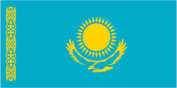
sky blue background representing the endless sky and a gold sun with 32 rays soaring above a golden steppe eagle in the center; on the hoist side is a "national ornamentation" in yellow
Highways
total: 189,000 km paved and graveled: 108,100 km unpaved: earth 80,900 km (1990)
Illicit drugs
illicit cultivation of cannabis and opium poppy; mostly for CIS consumption; limited government eradication program; used as transshipment point for illicit drugs to Western Europe and North America from Central and Southwest Asia
Imports
$358.3 million from outside the FSU countries (1993) commodities: machinery and parts, industrial materials, oil and gas (1992) partners: Russia and other former Soviet republics, China
Independence
16 December 1991 (from the Soviet Union)
Industrial production
growth rate -16% (1993)
Industries
extractive industries (oil, coal, iron ore, manganese, chromite, lead, zinc, copper, titanium, bauxite, gold, silver, phosphates, sulfur), iron and steel, nonferrous metal, tractors and other agricultural machinery, electric motors, construction materials
Infant mortality rate
40.9 deaths/1,000 live births (1994 est.)
Inflation rate (consumer prices)
28% per month (1993)
Inland waterways
Syrdariya River, Ertis River
International disputes
Russia may dispute current de facto maritime border to midpoint of Caspian Sea from shore
Irrigated land
23,080 sq km (1990)
Judicial branch
Supreme Court
Labor force
7.356 million by occupation: industry and construction 31%, agriculture and forestry 26%, other 43% (1992)
Land boundaries
total 12,012 km, China 1,533 km, Kyrgyzstan 1,051 km, Russia 6,846 km, Turkmenistan 379 km, Uzbekistan 2,203 km
Land use
arable land: 15% permanent crops: NEGL % meadows and pastures: 57% forest and woodland: 4% other: 24%
Languages
Kazakh (Qazaqz) official language spoken by over 40% of population, Russian (language of interethnic communication) spoken by two-thirds of population and used in everyday business
Legal system
based on civil law system
Legislative branch
unicameral
Life expectancy at birth
total population: 68.04 years male: 63.39 years female: 72.93 years (1994 est.)
Literacy
age 9-49 can read and write (1970) total population: 100% male: 100% female: 100%
Location
Central Asia, between Russia and Uzbekistan, bordering on the Caspian Sea and the Aral Sea
Manpower availability
males age 15-49 4,432,716; fit for military service 3,554,209; reach military age (18) annually 154,989 (1994 est.)
Map references
Asia, Commonwealth of Independent States - Central Asian States, Standard Time Zones of the World
Maritime claims
landlocked, but borders with Russia, Azerbaijan, and Turkmenistan in the Caspian Sea are under negotiation at present
Member of
CCC, CIS, CSCE, EBRD, ECO, ESCAP, IBRD, ICAO, IDA, IFC, ILO, IMF, INTELSAT (nonsignatory user), INTERPOL, IOD, NACC, OIC (observer), UN, UNCTAD, UNESCO, UPU, WHO, WMO
Names
conventional long form: Republic of Kazakhstan conventional short form: Kazakhstan local long form: Kazakhstan Respublikasy local short form: none former: Kazakh Soviet Socialist Republic
National holiday
Independence Day, 16 December (1991)
National product
GDP - purchasing power equivalent - $60.3 billion (1993 estimate from the UN International Comparison Program, as extended to 1991 and published in the World Bank's World Development Report 1993; and as extrapolated to 1993 using official Kazakhstani statistics, which are very uncertain because of major economic changes since 1990)
National product per capita
$3,510 (1993 est.)
National product real growth rate
-13% (1993 est.)
Nationality
noun: Kazakhstani(s) adjective: Kazakhstani
Natural resources
major deposits of petroleum, coal, iron ore, manganese, chrome ore, nickel, cobalt, copper, molybdenum, lead, zinc, bauxite, gold, uranium
Net migration rate
-5.09 migrant(s)/1,000 population (1994 est.)
Note
landlocked
Other political or pressure groups
Independent Trade Union Center (Birlesu; an association of independent trade union and business associations), Leonid SOLOMIN, president
Overview
Kazakhstan, the second largest of the former Soviet states in territory, possesses vast oil, coal, rare metals, and agricultural resources. While the economy is gradually making the transition from a Soviet command system to a market system, strong elements of state control persist including government ownership of most economic assets and a continued system of mandatory state procurement for the key products such as grain and energy; likewise, agriculture remains largely collectivized. On the other hand, new businesses are forming rapidly, the economy is opening to foreign investment, and 12% of state-owned commercial enterprises have been privatized. In 1993, a three-year industrial privatization program was launched; an independent currency was successfully introduced; and two large joint ventures were established with western oil companies. These far-reaching structural transformations have resulted in a cumulative decline in national income of more than 30% since 1990. Loose monetary policies have kept the inflation rate high, averaging 28% per month for 1993 and accelerating at the end with the disruption caused by a new currency. Since the introduction of its independent currency in November 1993, the government has renewed its commitment to fiscal discipline and accelerating economic reform. However, growing economic hardship and rising ethnic tensions between Kazakhs and Russians over the division of economic assets will likely lead to strong pressure to backtrack.
Pipelines
crude oil 2,850 km; refined products 1,500 km; natural gas 3,480 km (1992)
Political parties and leaders
Peoples Unity Movement (PUU), Kuanysh SULTANOV, chairman; Peoples Congress, Olzhas SULEYMENOV, chairman; Kazakhstan Socialist Party (SPK; former Communist Party), Piotr SVOIK, co-chairman; Republican Party (Azat), Kamal ORMANTAYEV, chairman; Democratic Progress (Russian) Party, Alexandra DOKUCHAYEVA, chairman; Union Peoples' Unity of Kazakhstan (SNEK); Federation of Trade Unions of the Republic of Kazakhstan; Peasant Union of the Republic Kazakhstan; Social Movement LAD (Slavic Rebirth Society), V. MIKHAYLOV, chairman; Union of Youth of Kazakhstan; Democratic Committee for Human Rights; Association of Lawyers of Kazakhstan; International Public Committee "Aral-Asia-Kazakhstan"; Congress of Entrepreneurs of Kazakhstan; Deputies of the 12th Supreme Soviet
Population
17,267,554 (July 1994 est.)
Population growth rate
0.64% (1994 est.)
Ports
inland - Atyrau (formerly Gur'yev; on Caspian Sea)
Railroads
14,460 km (all 1.520-meter gauge); does not include industrial lines (1990)
Religions
Muslim 47%, Russian Orthodox 44%, Protestant 2%, other 7%
Suffrage
18 years of age; universal
Supreme Council
elections last held 7 March 1994 (next to be held NA 1999); results - percent of vote by party NA; seats - (177 total) Union Peoples' Unity of Kazakhstan 33, Federation of Trade Unions of the Republic of Kazakhstan 11, People's Congress of Kazakhstan Party 9, Socialist Party of Kazakhstan 8, Peasant Union of the Republic Kazakhstan 4, Social Movement "LAD" 4, Organization of Veterans 1, Union of Youth of Kazakhstan 1, Democratic Committee for Human Rights 1, Association of Lawyers of Kazakhstan 1, International Public Committee "Aral-Asia-Kazakhstan" 1, Congress of Entrepreneurs of Kazakhstan 1, Deputies of the 12th Supreme Soviet 40, independents 62
Telecommunications
telephone service is poor, with only about 17 telephones for each 100 persons in urban areas and 7.6 telephones per 100 persons in rural areas; of the approximately 2.2 million telephones, Almaty has 184,000; broadcast receivers - TVs 4,750,000, radios 4,088,000, radio receiver systems with multiple speakers for program diffusion 6,082,000; international traffic with other former USSR republics and China carried by landline and microwave, and with other countries by satellite and through 8 international telecommunications circuits at the Moscow international gateway switch; satellite earth stations - INTELSAT and Orbita (TV receive only); new satellite ground station established at Almaty with Turkish financial help (December 1992) with 2500 channel band width
Terrain
extends from the Volga to the Altai Mountains and from the plains in western Siberia to oasis and desert in Central Asia
Total fertility rate
2.44 children born/woman (1994 est.)
Type
republic
Unemployment rate
0.6% includes only officially registered unemployed; also large numbers of underemployed workers
US diplomatic representation
chief of mission: Ambassador William H. COURTNEY embassy: 99/97 Furmanova Street, Almaty, Republic of Kazakhstan 480012 mailing address: American Embassy Almaty, c/o Department of State, Washington, DC, 20521-7030 telephone: (7) (3272) 63-17-70, 63-24-26, 63-28-80, 63-34-05