1992 Edition
CIA World Factbook 1992 (Project Gutenberg)
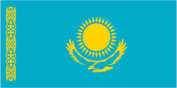
Geography
Climate
dry continental, about half is desert
Coastline
0 km note: Kazakhstan does border the Aral Sea (1,015 km) and the Caspian Sea (1,894 km)
Comparative area
slightly less than four times the size of Texas
Disputes
none
Environment
drying up of Aral Sea is causing increased concentrations of chemical pesticides and natural salts; industrial pollution
Land area
2,669,800 km2
Land boundaries
12,012 km; China 1,533 km, Kyrgyzstan 1,051 km, Russia 6,846 km, Turkmenistan 379 km, Uzbekistan 2,203 km
Land use
NA% arable land; NA% permanent crops; NA% meadows and pastures; NA% forest and woodland; NA% other; includes NA% irrigated
Maritime claims
none - landlocked
Natural resources
petroleum, coal, iron, manganese, chrome, nickel, cobalt, copper, molybdenum, lead, zinc, bauxite, gold, uranium, iron
Terrain
extends from the Volga to the Altai mountains and from the plains in western Siberia to oasis and desert in Central Asia
Total area
2,717,300 km2
People and Society
Birth rate
23 births/1,000 population (1992)
Death rate
8 deaths/1,000 population (1992)
Ethnic divisions
Kazakh (Qazaq) 40%, Russian 38%, other Slavs 7%, Germans 6%, other 9%
Infant mortality rate
25.9 deaths/1,000 live births (1992)
Labor force
8,267,000 (1989)
Languages
Kazakh (Qazaq; official language), Russian
Life expectancy at birth
63 years male, 72 years female (1992)
Literacy
NA% (male NA%, female NA%) age 15 and over can read and write
Nationality
noun - Kazakh(s); adjective - Kazakhstani
Net migration rate
-6.1 migrants/1,000 population (1991)
Organized labor
official trade unions, independent coal miners' union
Population
17,103,927 (July 1992), growth rate 1.0% (1992)
Religions
Muslim 47% Russian Orthodox NA%, Lutheran NA%
Total fertility rate
2.9 children born/woman (1992)
Government
Administrative divisions
19 oblasts (oblastey, singular - oblast'); Aktyubinsk, Alma-Ata, Atyrau, Chimkent, Dzhambul, Dzhezkazgan, Karaganda, Kokchetav, Kustanay, Kzyl-Orda, Mangistauz (Aqtau), Pavlodar, Semipalatinsk, Severo-Kazakhstan (Petropavlovsk), Taldy-Kurgan, Tselinograd, Turgay (Arkalyk), Ural'sk, Vostochno-Kazakhstan (Ust'-Kamenogorsk); note - an oblast has the same name as its administrative center (exceptions have the administrative center name following in parentheses)
Capital
Alma-Ata (Almaty)
Chief of State
President Nursultan A. NAZARBAYEV (since April 1990), Vice President Yerik ASANBAYEV (since 1 December 1991)
Communists
party disbanded 6 September 1992
Constitution
new postindependence constitution under preparation
Diplomatic representation
Ambassador NA; Chancery at NA NW, Washington, DC 200__; telephone NA; there are NA Consulates General US: Ambassador-designate William Courtney; Embassy at Hotel Kazakhstan, Alma-Ata, (mailing address is APO AE 09862); telephone 8-011-7-3272-61-90-56
Executive branch
president with presidential appointed cabinet of ministers
Flag
no national flag yet adopted
Head of Government
Prime Minister Sergey TERESHCHENKO (since 14 October 1991), Deputy Prime Minister Davlat SEMBAYEV (since November 1990)
Independence
16 December 1991; from the Soviet Union (formerly the Kazakh Soviet Socialist Republic)
Judicial branch
NA
Legal system
NA
Legislative branch
Supreme Soviet
Long-form name
Republic of Kazakhstan
Member of
CIS, CSCE, IMF, NACC, OIC, UN, UNCTAD
National holiday
NA
Political parties and leaders
Peoples Forum Party, Olzhas SULEIMENOV and Mukhtar SHAKHANOV, co-chairmen; Socialist Party (former Communist Party), Anuar ALIJANOV, chairman; ZHOLTOKSAN, Hasan KOJAKHETOV, chairmen; AZAT Party, Sabitkazi AKETAEV, chairman
President
last held 1 December 1991 (next to be held NA); percent of vote by party NA; seats - (NA total) percent of seats by party NA
Suffrage
universal at age 18
Type
republic
Economy
Agriculture
employs 30% of the labor force; grain, mostly spring wheat; meat, cotton, wool
Budget
revenues $NA million; expenditures $NA million, including capital expenditures of $1.76 billion (1991)
Currency
as of May 1992, retaining ruble as currency
Economic aid
US commitments, including Ex-Im (FY70-87), $NA billion; Western (non-US) countries, ODA and OOF bilateral commitments (1970-86), $NA million; Communist countries (1971-86), $NA million
Electricity
17,900,000 kW capacity; 79,100 million kWh produced, 4,735 kWh per capita (1991)
Exchange rates
NA
Exports
$4.2 billion (f.o.b., 1991) commodities: oil, ferrous and nonferrous metals, chemicals, grain, wool, meat (1991) partners: Russia, Ukraine, Uzbekistan
External debt
$2.6 billion (1991 est.)
Fiscal year
calendar year
GDP
purchasing power equivalent - $NA; per capita NA; real growth rate - 7% (1991 est.)
Illicit drugs
illicit producers of cannabis and opium; mostly for domestic consumption; status of government eradication programs unknown; used as transshipment points for illicit drugs to Western Europe
Imports
$NA million (c.i.f., 1990) commodities: machinery and parts, industrial materials partners: Russia and other former Soviet republics
Industrial production
growth rate 0.7% (1991)
Industries
extractive industries (oil, coal, iron ore, manganese, chromite, lead, zinc, copper, titanium, bauxite, gold, silver, phosphates, sulfur) iron and steel, nonferrous metal, tractors and other agricultural machinery, electric motors, construction materials
Inflation rate (consumer prices)
83% (1991)
Overview
The second-largest in area of the 15 former Soviet republics, Kazakhstan has vast oil, coal, and agricultural resources. Kazakhstan is highly dependent on trade with Russia, exchanging its natural resources for finished consumer and industrial goods. Kazakhstan now finds itself with serious pollution problems, backward technology, and little experience in foreign markets. The government in 1991 pushed privatization of the economy at a faster pace than Russia's program. The ongoing transitional period - marked by sharp inflation in wages and prices, lower output, lost jobs, and disruption of time-honored channels of supply - has brought considerable social unrest. Kazakhstan lacks the funds, technology, and managerial skills for a quick recovery of output. US firms have been enlisted to increase oil output but face formidable obstacles; for example, oil can now reach Western markets only through pipelines that run across independent (and sometimes unfriendly) former Soviet republics. Finally, the end of monolithic Communist control has brought ethnic grievances into the open. The 6 million Russians in the republic, formerly the favored class, now face the hostility of a society dominated by Muslims. Ethnic rivalry will be just one of the formidable obstacles to the creation of a productive, technologically advancing society.
Unemployment rate
NA%
Communications
Airports
NA
Civil air
NA major transport aircraft
Highways
189,000 km total (1990); 188,900 km hard surfaced (paved or gravel), 80,900 km earth
Inland waterways
NA km perennially navigable
Pipelines
crude oil NA km, refined products NA km, natural gas NA
Ports
none - landlocked; inland - Guryev
Railroads
14,460 km (all 1.520-meter gauge); does not include industrial lines (1990)
Telecommunications
telephone service is poor, with only about 6 telephones for each 100 persons; of the approximately 1 million telephones, Alma-Ata has 184,000; international traffic with other former USSR republics and China carried by landline and microwave, and with other countries by satellite and through the Moscow international gateway switch; satellite earth stations - INTELSAT and Orbita
Military and Security
Branches
Republic Security Forces (internal and border troops), National Guard; CIS Forces (Ground, Air, Air Defense, and Strategic Rocket)
Defense expenditures
$NA, NA% of GDP
Manpower availability
males 15-49, NA fit for military service; NA reach military age (18) annually