2018 Edition
CIA World Factbook 2018 Archive (Wayback Machine)
Introduction
Background
Following World War I and the dissolution of the Ottoman Empire, the League of Nations awarded Britain the mandate to govern much of the Middle East. Britain demarcated a semi-autonomous region of Transjordan from Palestine in the early 1920s. The area gained its independence in 1946 and thereafter became The Hashemite Kingdom of Jordan. The country's long-time ruler, King HUSSEIN (1953-99), successfully navigated competing pressures from the major powers (US, USSR, and UK), various Arab states, Israel, and a large internal Palestinian population. Jordan lost the West Bank to Israel in the 1967 Six-Day War. King HUSSEIN in 1988 permanently relinquished Jordanian claims to the West Bank; in 1994 he signed a peace treaty with Israel. King ABDALLAH II, King HUSSEIN's eldest son, assumed the throne following his father's death in 1999. He has implemented modest political reforms, including the passage of a new electoral law in early 2016 ahead of legislative elections held in September, and significant economic liberalization and reforms to promote growth and address chronic budget deficits. In 2016, the Islamic Action Front, which is the political arm of the Jordanian Muslim Brotherhood, returned to parliament with 15 seats after boycotting the previous two elections in 2010 and 2013.
Geography
Area
- land
- 88,802 sq km
- total
- 89,342 sq km
- water
- 540 sq km
Area Comparative
about three-quarters the size of Pennsylvania; slightly smaller than Indiana
Climate
mostly arid desert; rainy season in west (November to April)
Coastline
26 km
Elevation
- elevation extremes
- -431 m lowest point: Dead Sea
- mean elevation
- 812 m
- note
- 1854 highest point: Jabal Umm ad Dami
Environment Current Issues
limited natural freshwater resources; declining water table; salinity; deforestation; overgrazing; soil erosion; desertification; biodiversity and ecosystem damage/loss
Environment International Agreements
- party to
- Biodiversity, Climate Change, Climate Change-Kyoto Protocol, Desertification, Endangered Species, Hazardous Wastes, Law of the Sea, Marine Dumping, Ozone Layer Protection, Wetlands
- signed, but not ratified
- none of the selected agreements
Geographic Coordinates
31 00 N, 36 00 E
Geography Note
strategic location at the head of the Gulf of Aqaba and as the Arab country that shares the longest border with Israel and the occupied West Bank
Irrigated Land
964 sq km (2012)
Land Boundaries
- border countries (5)
- Iraq 179 km, Israel 307 km, Saudi Arabia 731 km, Syria 379 km, West Bank 148 km
- total
- 1,744 km
Land Use
- arable land: 2% (2011 est.) / permanent crops: 1% (2011 est.) / permanent pasture: 8.4% (2011 est.)
- agricultural land
- 11.4% (2011 est.)
- forest
- 1.1% (2011 est.)
- other
- 87.5% (2011 est.)
Location
Middle East, northwest of Saudi Arabia, between Israel (to the west) and Iraq
Map References
Middle East
Maritime Claims
- territorial sea
- 3 nm
Natural Hazards
droughts; periodic earthquakes; flash floods
Natural Resources
phosphates, potash, shale oil
Population Distribution
population heavily concentrated in the west, and particularly the northwest, in and around the capital of Amman; a sizeable, but smaller population is located in the southwest along the shore of the Gulf of Aqaba
Terrain
mostly desert plateau in east, highland area in west; Great Rift Valley separates eastern and western banks of the Jordan River
People and Society
Age Structure
- 0-14 years
- 34.14% (male 1,835,094 /female 1,735,773)
- 15-24 years
- 19.98% (male 1,114,783 /female 975,086)
- 25-54 years
- 37.72% (male 2,137,424 /female 1,807,573)
- 55-64 years
- 4.64% (male 253,029 /female 232,652)
- 65 years and over
- 3.51% (male 180,652 /female 186,347) (2018 est.)
Birth Rate
23.6 births/1,000 population (2018 est.)
Children Under The Age Of 5 Years Underweight
3% (2012)
Contraceptive Prevalence Rate
61.2% (2012)
Death Rate
3.4 deaths/1,000 population (2018 est.)
Dependency Ratios
- elderly dependency ratio
- 6.2 (2015 est.)
- potential support ratio
- 16 (2015 est.)
- total dependency ratio
- 66.1 (2015 est.)
- youth dependency ratio
- 59.8 (2015 est.)
Drinking Water Source
- improved: urban: 97.8% of population
- rural: 92.3% of population
- total: 96.9% of population
- unimproved: urban: 2.2% of population
- rural: 7.7% of population
- total: 3.1% of population (2015 est.)
Education Expenditures
3.9% of GDP (2016)
Ethnic Groups
- Jordanian 69.3%, Syrian 13.3%, Palestinian 6.7%, Egyptian 6.7%, Iraqi 1.4%, other 2.6% (includes Armenian, Circassian) (2015 est.)
- note
- data represent population by self-identified nationality
Health Expenditures
7.5% of GDP (2014)
Hiv Aids Adult Prevalence Rate
<.1% (2016 est.)
Hiv Aids Deaths
<100 (2016 est.)
Hiv Aids People Living With Hiv Aids
<500 (2016 est.)
Hospital Bed Density
1.4 beds/1,000 population (2015)
Infant Mortality Rate
- female
- 12.9 deaths/1,000 live births (2018 est.)
- male
- 14.5 deaths/1,000 live births (2018 est.)
- total
- 13.7 deaths/1,000 live births (2018 est.)
Languages
Arabic (official), English (widely understood among upper and middle classes)
Life Expectancy At Birth
- female
- 76.6 years (2018 est.)
- male
- 73.6 years (2018 est.)
- total population
- 75 years (2018 est.)
Literacy
- definition
- age 15 and over can read and write (2015 est.)
- female
- 92.9% (2015 est.)
- male
- 97.7% (2015 est.)
- total population
- 95.4% (2015 est.)
Major Urban Areas Population
2.065 million AMMAN (capital) (2018)
Maternal Mortality Rate
58 deaths/100,000 live births (2015 est.)
Median Age
- female
- 22.3 years (2018 est.)
- male
- 23.2 years
- total
- 22.8 years
Mother S Mean Age At First Birth
- 24.7 years (2012 est.)
- note
- median age at first birth among women 25-29
Nationality
- adjective
- Jordanian
- noun
- Jordanian(s)
Net Migration Rate
0 migrant(s)/1,000 population (2017 est.)
Obesity Adult Prevalence Rate
35.5% (2016)
Physicians Density
3.43 physicians/1,000 population (2015)
Population
- 10,458,413 (July 2018 est.)
- note
- increased estimate reflects revised assumptions about the net migration rate due to the increased flow of Syrian refugees
Population Growth Rate
2.02% (2018 est.)
Religions
Muslim 97.2% (official; predominantly Sunni), Christian 2.2% (majority Greek Orthodox, but some Greek and Roman Catholics, Syrian Orthodox, Coptic Orthodox, Armenian Orthodox, and Protestant denominations), Buddhist 0.4%, Hindu 0.1%, Jewish <0.1, folk religionist <0.1, unaffiliated <0.1, other <0.1 (2010 est.)
Sanitation Facility Access
- improved: urban: 98.6% of population (2015 est.)
- rural: 98.9% of population (2015 est.)
- total: 98.6% of population (2015 est.)
- unimproved: urban: 1.4% of population (2015 est.)
- rural: 1.1% of population (2015 est.)
- total: 1.4% of population (2015 est.)
School Life Expectancy Primary To Tertiary Education
- female
- 13 years (2012)
- male
- 12 years (2012)
- total
- 13 years (2012)
Sex Ratio
- 0-14 years
- 1.05 male(s)/female (2017 est.)
- 15-24 years
- 1.05 male(s)/female (2017 est.)
- 25-54 years
- 1 male(s)/female (2017 est.)
- 55-64 years
- 0.95 male(s)/female (2017 est.)
- 65 years and over
- 0.89 male(s)/female (2017 est.)
- at birth
- 1.06 male(s)/female (2017 est.)
- total population
- 1.02 male(s)/female (2017 est.)
Total Fertility Rate
3.14 children born/woman (2018 est.)
Unemployment Youth Ages 15 24
- female
- 48.8% (2012 est.)
- male
- 25.2% (2012 est.)
- total
- 29.3% (2012 est.)
Urbanization
- rate of urbanization
- 2.43% annual rate of change (2015-20 est.)
- urban population
- 91% of total population (2018)
Government
Administrative Divisions
12 governorates (muhafazat, singular - muhafazah); 'Ajlun, Al 'Aqabah, Al Balqa', Al Karak, Al Mafraq, Al ‘Asimah (Amman), At Tafilah, Az Zarqa', Irbid, Jarash, Ma'an, Madaba
Capital
- daylight saving time
- +1hr, begins last Friday in March; ends last Friday in October
- geographic coordinates
- 31 57 N, 35 56 E
- name
- Amman
- time difference
- UTC+2 (7 hours ahead of Washington, DC, during Standard Time)
Citizenship
- citizenship by birth
- no
- citizenship by descent only
- the father must be a citizen of Jordan
- dual citizenship recognized
- yes
- residency requirement for naturalization
- 15 years
Constitution
- amendments
- proposed by 10 or more members of the Senate or by the House of Representatives followed by referral to the relevant House committee for its review and opinion; if accepted, the proposal is referred to the government for restatement as a draft; passage requires two-thirds majority vote of both the Senate and the House and ratification by the king; amended several times, last in 2016 (2016)
- history
- previous 1928 (preindependence); latest initially adopted 28 November 1947, revised and ratified 1 January 1952 (2016)
Country Name
- conventional long form
- Hashemite Kingdom of Jordan
- conventional short form
- Jordan
- etymology
- named for the Jordan River, which makes up part of Jordan's northwest border
- former
- Transjordan
- local long form
- Al Mamlakah al Urduniyah al Hashimiyah
- local short form
- Al Urdun
Diplomatic Representation From The Us
- chief of mission
- Ambassador (vacant); Charge d'Affaires Henry T. WOOSTER (since 24 March 2017)
- embassy
- Abdoun, Al-Umawyeen St., Amman
- FAX
- [962] (6) 592-0163
- mailing address
- P. O. Box 354, Amman 11118 Jordan; Unit 70200, Box 5, DPO AE 09892-0200
- telephone
- [962] (6) 590-6000
Diplomatic Representation In The Us
- chancery
- 3504 International Drive NW, Washington, DC 20008
- chief of mission
- Ambassador Dina Khalil Tawiq KAWAR (since 27 June 2016)
- FAX
- [1] (202) 966-3110
- telephone
- [1] (202) 966-2664
Executive Branch
- cabinet
- Cabinet appointed by the prime minister in consultation with the monarch
- chief of state
- King ABDALLAH II (since 7 February 1999); Crown Prince HUSSEIN (born 28 June 1994), eldest son of King ABDALLAH II
- elections/appointments
- the monarchy is hereditary; prime minister appointed by the monarch
- head of government
- Prime Minister Omar al-RAZZAZ (since 4 June 2018)
Flag Description
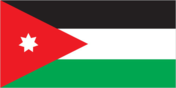
three equal horizontal bands of black (top), representing the Abbassid Caliphate, white, representing the Ummayyad Caliphate, and green, representing the Fatimid Caliphate; a red isosceles triangle on the hoist side, representing the Great Arab Revolt of 1916, and bearing a small white seven-pointed star symbolizing the seven verses of the opening Sura (Al-Fatiha) of the Holy Koran; the seven points on the star represent faith in One God, humanity, national spirit, humility, social justice, virtue, and aspirations; design is based on the Arab Revolt flag of World War I
Government Type
parliamentary constitutional monarchy
Independence
25 May 1946 (from League of Nations mandate under British administration)
International Law Organization Participation
has not submitted an ICJ jurisdiction declaration; accepts ICCt jurisdiction
International Organization Participation
ABEDA, AFESD, AMF, CAEU, CD, CICA, EBRD, FAO, G-11, G-77, IAEA, IBRD, ICAO, ICC (national committees), ICCt, ICRM, IDA, IDB, IFAD, IFC, IFRCS, ILO, IMF, IMO, IMSO, Interpol, IOC, IOM, IPU, ISO, ITSO, ITU, ITUC (NGOs), LAS, MIGA, MINUSTAH, MINUSMA, MONUSCO, NAM, OIC, OPCW, OSCE (partner), PCA, UN, UNAMID, UNCTAD, UNESCO, UNHCR, UNIDO, UNMIL, UNMISS, UNOCI, UNRWA, UNWTO, UPU, WCO, WFTU (NGOs), WHO, WIPO, WMO, WTO
Judicial Branch
- highest courts
- Court of Cassation or Supreme Court (consists of 11 members including the chief justice; Constitutional Court (consists of 15 members)
- judge selection and term of office
- Supreme Court chief justice appointed by the king; other judges nominated by the Judicial Council, an 11-member judicial policy-making body consisting of high-level judicial officials and judges, and approved by the king; judge tenure generally not limited; Constitutional Court members appointed by the king for 6-year non-renewable terms with one-third of the membership renewed every 2 years
- subordinate courts
- Courts of Appeal; Great Felonies Court; religious courts; military courts; juvenile courts; Land Settelment Courts; Income Tax Court; Higher Administrative Court; Customs Court; special courts to include State Security Court
Legal System
mixed system developed from codes instituted by the Ottoman Empire (based on French law), British common law, and Islamic law
Legislative Branch
- description
- bicameral National Assembly or Majlis al-'Umma consists of:Senate or the House of Notables or Majlis al-Ayan (65 seats; members appointed by the monarch to serve 4-year terms) Chamber of Deputies or House of Representatives or Majlis al-Nuwaab (130 seats; 115 members directly elected in single- and multi-seat constituencies by open-list proportional representation vote and 15 seats for women; 12 of the 115 seats reserved for Christian, Chechen, and Circassian candidates; members serve 4-year terms)
- election results
- Chamber of Deputies - percent of vote by party - NA; seats by party - NA
- elections
- Chamber of Deputies - last held on 20 September 2016 (next to be held in 2020)
National Anthem
- lyrics/music
- Abdul-Mone'm al-RIFAI'/Abdul-Qader al-TANEER
- name
- "As-salam al-malaki al-urdoni" (Long Live the King of Jordan)
- note
- adopted 1946; the shortened version of the anthem is used most commonly, while the full version is reserved for special occasions
National Holiday
Independence Day, 25 May (1946)
National Symbol S
eagle; national colors: black, white, green, red
Political Parties And Leaders
Ahrar al-Urdun (Free People of Jordan) Party [Samir al-ZU'BI]Al-Awn al-Watani (National Aid) Party [Faysal al-AWAR]Al-Balad al-Amin Party [Khalil al-SAYED]Al-Itijah al-Watani (National Trend Party) [Ahmad al-KAYED]Al-Mustaqbal (Future) Party [Salah al-QUDAH]Al-Nida’ Party [Abd-al-Majid ABU-KHALID]Al-Rayah Party (Flag Party) [Bilal DHEISAT]Al-Shahama Party [Mashhour ZREIQAT]Al-Shura Party [Firas al-ABBADI]Arab Socialist Ba’th Party [Zyad AL-HOMSI]Conservatives Party [Hasan RASHID]Democratic Popular Unity Party [Sa’eed DHIYAB]Democratic Sha’b Party (HASHD) [Abla ABU-OLBEH]Freedom and Equality Party [Hamad Abu ZEID]Islamic Action Front [Muhammad AL-ZYOUD]Islamic Centrist Party [Madallah AL-TARAWNEH]Jordanian Al-Ansar Party [Awni al-RJOUB]Jordanian Al-Hayah Party [Abd-al-Fattah al-KILANI]Jordanian Communist Party [Faraj ITMIZYEH]Jordanian Current Party [Abd-al-Hadi al-MAJALI]Jordanian Democratic Socialist Party [Jamil al-NIMRI]Jordanian Democratic Tabiy’ah (Nature) Party [Ali ASFOUR]Jordanian Equality Party [Zuhair al-SHURAFA]Jordanian Fursan (Cavaliers Party) [Ali al-DHWEIB]Jordanian Justice and Development Party [Ali al-SHURAFA]Jordanian National Action Party [Abd-al-Hadi al-MAHARMAH]Jordanian National Constitutional Party [Ahmad al-SHUNNAQ]Jordanian National Democratic Grouping Party [Shakir al-ABBADI]Jordanian National Party [Muna ABU-BAKR]Jordanian National Union Party [Zeid ABU-ZEID]Jordanian Progressive Ba’th Party [Fu’ad DABBOUR]Jordanian Promise Party [Mahmoud al-KHALILI]Jordanian Reform Party [Eid DHAYYAT]Jordanian Social Justice Party [Abd-al-Fattah al-NSOUR]Jordanian Wafa’ (Loyalty) Party [Mazin al-QADI]Justice and Reform Party [Sa’eed Nathir ARABIYAT]Modernity and Change Party [Nayef al-HAMAYDEH]National Renaissance Front Party [Isma’il KHATATBEH]National Unity Party [Muhammad al-ZBOUN]Pan Arab Movement Party [Dayfallah FARRAJ]Partnership and Salvation Party [Muhammad al-HAMMOURI]Reform and Renewal Party [Mazin RYAL]Risalah Party [Hazim QASHOU’]Stronger Jordan Party [Rula al-HROUB]Unified Jordanian Front Party [Farouq AL-ABBADI]Zamzam [Irhayil GHARAYBEH]
Suffrage
18 years of age; universal
Economy
Agriculture Products
citrus, tomatoes, cucumbers, olives, strawberries, stone fruits; sheep, poultry, dairy
Budget
- expenditures
- 11.51 billion (2017 est.)
- revenues
- 9.462 billion (2017 est.)
Budget Surplus Or Deficit
-5.1% (of GDP) (2017 est.)
Central Bank Discount Rate
- 3.75% (31 December 2015)
- 0.3% (31 December 2010)
Commercial Bank Prime Lending Rate
- 8.65% (31 December 2017 est.)
- 7.83% (31 December 2016 est.)
Current Account Balance
- -$4.257 billion (2017 est.)
- -$3.693 billion (2016 est.)
Debt External
- $29.34 billion (31 December 2017 est.)
- $26.38 billion (31 December 2016 est.)
Distribution Of Family Income Gini Index
- 39.7 (2007)
- 36.4 (1997)
Economy Overview
Jordan's economy is among the smallest in the Middle East, with insufficient supplies of water, oil, and other natural resources, underlying the government's heavy reliance on foreign assistance. Other economic challenges for the government include chronic high rates of unemployment and underemployment, budget and current account deficits, and government debt.King ABDALLAH, during the first decade of the 2000s, implemented significant economic reforms, such as expanding foreign trade and privatizing state-owned companies that attracted foreign investment and contributed to average annual economic growth of 8% for 2004 through 2008. The global economic slowdown and regional turmoil contributed to slower growth from 2010 to 2017 - with growth averaging about 2.5% per year - and hurt export-oriented sectors, construction/real estate, and tourism. Since the onset of the civil war in Syria and resulting refugee crisis, one of Jordan’s most pressing socioeconomic challenges has been managing the influx of approximately 660,000 UN-registered refugees, more than 80% of whom live in Jordan’s urban areas. Jordan’s own official census estimated the refugee number at 1.3 million Syrians as of early 2016.Jordan is nearly completely dependent on imported energy—mostly natural gas—and energy consistently makes up 25-30% of Jordan’s imports. To diversify its energy mix, Jordan has secured several contracts for liquefied and pipeline natural gas, developed several major renewables projects, and is currently exploring nuclear power generation and exploitation of abundant oil shale reserves. In August 2016, Jordan and the IMF agreed to a $723 million Extended Fund Facility that aims to build on the three-year, $2.1 billion IMF program that ended in August 2015 with the goal of helping Jordan correct budgetary and balance of payments imbalances.
Exchange Rates
- Jordanian dinars (JOD) per US dollar -
- 0.71 (2017 est.)
- 0.71 (2016 est.)
- 0.71 (2015 est.)
- 0.71 (2014 est.)
- 0.71 (2013 est.)
Exports
- $7.511 billion (2017 est.)
- $7.509 billion (2016 est.)
Exports Commodities
textiles, fertilizers, potash, phosphates, vegetables, pharmaceuticals
Exports Partners
US 24.9%, Saudi Arabia 12.8%, India 8.2%, Iraq 8.2%, Kuwait 5.4%, UAE 4.6% (2017)
Fiscal Year
calendar year
Gdp Composition By End Use
- exports of goods and services
- 34.2% (2017 est.)
- government consumption
- 19.8% (2017 est.)
- household consumption
- 80.5% (2017 est.)
- imports of goods and services
- -58% (2017 est.)
- investment in fixed capital
- 22.8% (2017 est.)
- investment in inventories
- 0.7% (2017 est.)
Gdp Composition By Sector Of Origin
- agriculture
- 4.5% (2017 est.)
- industry
- 28.8% (2017 est.)
- services
- 66.6% (2017 est.)
Gdp Official Exchange Rate
$40.13 billion (2017 est.) (2017 est.)
Gdp Per Capita Ppp
- $9,200 (2017 est.)
- $9,200 (2016 est.)
- $9,300 (2015 est.)
- note
- data are in 2017 dollars
Gdp Purchasing Power Parity
- $89 billion (2017 est.)
- $87.28 billion (2016 est.)
- $85.56 billion (2015 est.)
- note
- data are in 2017 dollars
Gdp Real Growth Rate
- 2% (2017 est.)
- 2% (2016 est.)
- 2.4% (2015 est.)
Gross National Saving
- 9.1% of GDP (2017 est.)
- 9.3% of GDP (2016 est.)
- 10.2% of GDP (2015 est.)
Household Income Or Consumption By Percentage Share
- highest 10%
- 28.7% (2010 est.)
- lowest 10%
- 28.7% (2010 est.)
Imports
- $18.21 billion (2017 est.)
- $17.14 billion (2016 est.)
Imports Commodities
crude oil, refined petroleum products, machinery, transport equipment, iron, cereals
Imports Partners
China 13.6%, Saudi Arabia 13.6%, US 9.9%, UAE 4.9%, Germany 4.4% (2017)
Industrial Production Growth Rate
1.4% (2017 est.)
Industries
tourism, information technology, clothing, fertilizer, potash, phosphate mining, pharmaceuticals, petroleum refining, cement, inorganic chemicals, light manufacturing
Inflation Rate Consumer Prices
- 3.3% (2017 est.)
- -0.8% (2016 est.)
Labor Force
2.295 million (2017 est.)
Labor Force By Occupation
- agriculture
- 2%
- industry
- 20%
- services
- 78% (2013 est.)
Market Value Of Publicly Traded Shares
- $24.25 billion (31 December 2016 est.)
- $25.45 billion (31 December 2015 est.)
- $25.55 billion (31 December 2014 est.)
Population Below Poverty Line
14.2% (2002 est.)
Public Debt
- 95.9% of GDP (2017 est.)
- 95.1% of GDP (2016 est.)
- note
- data cover central government debt and include debt instruments issued (or owned) by government entities other than the treasury; the data include treasury debt held by foreign entities; the data exclude debt issued by subnational entities, as well as intragovernmental debt; intragovernmental debt consists of treasury borrowings from surpluses in the social funds, such as for retirement, medical care, and unemployment; debt instruments for the social funds are not sold at public auctions
Reserves Of Foreign Exchange And Gold
- $15.56 billion (31 December 2017 est.)
- $15.54 billion (31 December 2016 est.)
Stock Of Broad Money
- $14.64 billion (31 December 2017 est.)
- $14.63 billion (31 December 2016 est.)
Stock Of Direct Foreign Investment Abroad
- $646.5 million (31 December 2017 est.)
- $612.5 million (31 December 2016 est.)
Stock Of Direct Foreign Investment At Home
- $33.83 billion (31 December 2017 est.)
- $32.15 billion (31 December 2016 est.)
Stock Of Domestic Credit
- $42.7 billion (31 December 2017 est.)
- $41.87 billion (31 December 2016 est.)
Stock Of Narrow Money
- $14.64 billion (31 December 2017 est.)
- $14.63 billion (31 December 2016 est.)
Taxes And Other Revenues
23.6% (of GDP) (2017 est.)
Unemployment Rate
- 18.3% (2017 est.)
- 15.3% (2016 est.)
- note
- official rate; unofficial rate is approximately 30%
Energy
Carbon Dioxide Emissions From Consumption Of Energy
27.39 million Mt (2017 est.)
Crude Oil Exports
0 bbl/day (2015 est.)
Crude Oil Imports
67,980 bbl/day (2015 est.)
Crude Oil Production
22 bbl/day (2017 est.)
Crude Oil Proved Reserves
1 million bbl (1 January 2018 est.)
Electricity Access
- electrification - rural areas
- 99.4% (2012)
- electrification - total population
- 99.5% (2012)
- electrification - urban areas
- 99% (2012)
- population without electricity
- 40,926 (2012)
Electricity Consumption
16.82 billion kWh (2016 est.)
Electricity Exports
50 million kWh (2015 est.)
Electricity From Fossil Fuels
87% of total installed capacity (2016 est.)
Electricity From Hydroelectric Plants
0% of total installed capacity (2017 est.)
Electricity From Nuclear Fuels
0% of total installed capacity (2017 est.)
Electricity From Other Renewable Sources
12% of total installed capacity (2017 est.)
Electricity Imports
334 million kWh (2016 est.)
Electricity Installed Generating Capacity
4.764 million kW (2016 est.)
Electricity Production
18.6 billion kWh (2016 est.)
Natural Gas Consumption
5.238 billion cu m (2017 est.)
Natural Gas Exports
1.359 billion cu m (2017 est.)
Natural Gas Imports
6.456 billion cu m (2017 est.)
Natural Gas Production
121.8 million cu m (2017 est.)
Natural Gas Proved Reserves
6.031 billion cu m (1 January 2018 est.)
Refined Petroleum Products Consumption
139,000 bbl/day (2016 est.)
Refined Petroleum Products Exports
0 bbl/day (2015 est.)
Refined Petroleum Products Imports
68,460 bbl/day (2015 est.)
Refined Petroleum Products Production
67,240 bbl/day (2015 est.)
Communications
Broadband Fixed Subscriptions
- subscriptions per 100 inhabitants
- 4 (2017 est.)
- total
- 456,610 (2017 est.)
Broadcast Media
radio and TV dominated by the government-owned Jordan Radio and Television Corporation (JRTV) that operates a main network, a sports network, a film network, and a satellite channel; first independent TV broadcaster aired in 2007; international satellite TV and Israeli and Syrian TV broadcasts are available; roughly 30 radio stations with JRTV operating the main government-owned station; transmissions of multiple international radio broadcasters are available (2007)
Internet Country Code
.jo
Internet Users
- percent of population
- 62.3% (July 2016 est.)
- total
- 5,099,674 (July 2016 est.)
Telephone System
- domestic
- 1995 telecommunications law opened all non-fixed-line services to private competition; in 2005, monopoly over fixed-line services terminated and the entire telecommunications sector was opened to competition; currently multiple mobile-cellular providers with subscribership up to 96 per 100 persons; fixed-line 4 per 100 persons (2017)
- general assessment
- microwave radio relay transmission and coaxial and fiber-optic cable are employed on trunk lines; growing mobile-cellular usage in both urban and rural areas is reducing use of fixed-line services; recent influx of refugees putting burden on country's econmy, infrastructure and society; mobile broadband area of growth with 4G services (2017)
- international
- country code - 962; landing point for the Fiber-Optic Link Around the Globe (FLAG) FEA and FLAG Falcon submarine cable networks; satellite earth stations - 33 (3 Intelsat, 1 Arabsat, and 29 land and maritime Inmarsat terminals); fiber-optic cable to Saudi Arabia and microwave radio relay link with Egypt and Syria; participant in Medarabtel (2016)
Telephones Fixed Lines
- subscriptions per 100 inhabitants
- 4 (July 2016 est.)
- total subscriptions
- 404,112 (July 2016 est.)
Telephones Mobile Cellular
- subscriptions per 100 inhabitants
- 96 (July 2016 est.)
- total subscriptions
- 9,818,446 (July 2016 est.)
Transportation
Airports
18 (2013)
Airports With Paved Runways
- 1,524 to 2,437 m
- 2 (2017)
- 2,438 to 3,047 m
- 5 (2017)
- 914 to 1,523 m
- 1 (2017)
- over 3,047 m
- 8 (2017)
- total
- 16 (2017)
Airports With Unpaved Runways
- total
- 2 (2013)
- under 914 m
- 2 (2013)
Civil Aircraft Registration Country Code Prefix
JY (2016)
Heliports
1 (2012)
Merchant Marine
- by type
- general cargo 9, oil tanker 1, other 21 (2017)
- total
- 31 (2017)
National Air Transport System
- annual freight traffic on registered air carriers
- 169.105 million mt-km (2015)
- annual passenger traffic on registered air carriers
- 3,065,145 (2015)
- inventory of registered aircraft operated by air carriers
- 40 (2015)
- number of registered air carriers
- 7 (2015)
Pipelines
473 km gas, 49 km oil (2013)
Ports And Terminals
- major seaport(s)
- Al 'Aqabah
Railways
- narrow gauge
- 509 km 1.050-m gauge (2014)
- total
- 509 km (2014)
Roadways
- paved
- 7,203 km (2011)
- total
- 7,203 km (2011)
Military and Security
Military Branches
Jordanian Armed Forces (JAF): Royal Jordanian Land Force (RJLF), Royal Jordanian Navy, Royal Jordanian Air Force (Al-Quwwat al-Jawwiya al-Malakiya al-Urduniya, RJAF), Special Operations Command (Socom); Public Security Directorate (normally falls under Ministry of Interior, but comes under JAF in wartime or crisis) (2017)
Military Expenditures
- 4.8% of GDP (2017)
- 4.58% of GDP (2016)
- 4.31% of GDP (2015)
- 4.32% of GDP (2014)
- 4.3% of GDP (2013)
Military Service Age And Obligation
17 years of age for voluntary male military service; initial service term 2 years, with option to reenlist for 18 years; conscription at age 18 suspended in 1999; women are not conscripted, but can volunteer to serve in noncombat military positions in the Royal Jordanian Arab Army Women's Corps and RJAF (2013)
Transnational Issues
Disputes International
2004 Agreement settles border dispute with Syria pending demarcation
Refugees And Internally Displaced Persons
- refugees (country of origin)
- 2,175,491 (Palestinian refugees) (2017), 671,148 (Syria), 67,084 (Iraq), 12,967 (Yemen), 5,307 Sudan (2018)