2010 Edition
CIA World Factbook 2010 (Project Gutenberg)
Introduction
Background
Following World War I and the dissolution of the Ottoman Empire, the UK received a mandate to govern much of the Middle East. Britain separated out a semi-autonomous region of Transjordan from Palestine in the early 1920s, and the area gained its independence in 1946; it adopted the name of Jordan in 1950. The country's long-time ruler was King HUSSEIN (1953-99). A pragmatic leader, he successfully navigated competing pressures from the major powers (US, USSR, and UK), various Arab states, Israel, and a large internal Palestinian population. Jordan lost the West Bank to Israel in the 1967 war and barely managed to defeat Palestinian rebels who attempted to overthrow the monarchy in 1970. King HUSSEIN in 1988 permanently relinquished Jordanian claims to the West Bank. In 1989, he reinstituted parliamentary elections and initiated a gradual political liberalization; political parties were legalized in 1992. In 1994, he signed a peace treaty with Israel. King ABDALLAH II, the son of King HUSSEIN, assumed the throne following his father's death in February 1999. Since then, he has consolidated his power and undertaken an aggressive economic reform program. Jordan acceded to the World Trade Organization in 2000, and began to participate in the European Free Trade Association in 2001. In 2003, Jordan staunchly supported the Coalition ouster of Saddam in Iraq and following the outbreak of insurgent violence in Iraq, absorbed thousands of displaced Iraqis. Municipal elections were held in July 2007 under a system in which 20% of seats in all municipal councils were reserved by quota for women. Parliamentary elections were held in November 2010 and saw independent pro-government candidates win the vast majority of seats.
Geography
Area
- land
- 88,802 sq km
- total
- 89,342 sq km
- water
- 540 sq km
Area - comparative
slightly smaller than Indiana
Climate
mostly arid desert; rainy season in west (November to April)
Coastline
26 km
Elevation extremes
- highest point
- Jabal Umm ad Dami 1,854 m
- lowest point
- Dead Sea -408 m
Environment - current issues
limited natural fresh water resources; deforestation; overgrazing; soil erosion; desertification
Environment - international agreements
- party to
- Biodiversity, Climate Change, Climate Change-Kyoto Protocol, Desertification, Endangered Species, Hazardous Wastes, Law of the Sea, Marine Dumping, Ozone Layer Protection, Wetlands signed, but not ratified: none of the selected agreements
Freshwater withdrawal (domestic/industrial/agricultural)
- per capita
- 177 cu m/yr (2000)
- total
- 1.01 cu km/yr (21%/4%/75%)
Geographic coordinates
31 00 N, 36 00 E
Geography - note
strategic location at the head of the Gulf of Aqaba and as the Arab country that shares the longest border with Israel and the occupied West Bank
Irrigated land
750 sq km (2003)
Land boundaries
- border countries
- Iraq 181 km, Israel 238 km, Saudi Arabia 744 km, Syria 375 km, West Bank 97 km
- total
- 1,635 km
Land use
- arable land
- 3.32%
- other
- 95.5% (2005)
- permanent crops
- 1.18%
Location
Middle East, northwest of Saudi Arabia
Map references
Middle East
Maritime claims
- territorial sea
- 3 nm
Natural hazards
droughts; periodic earthquakes
Natural resources
phosphates, potash, shale oil
Terrain
mostly desert plateau in east, highland area in west; Great Rift Valley separates East and West Banks of the Jordan River
Total renewable water resources
0.9 cu km (1997)
People and Society
Age structure
0-14 years: 36% (male 1,161,484/female 1,096,441) 15-64 years: 59.4% (male 1,892,472/female 1,829,112) 65 years and over: 4.6% (male 143,058/female 146,718) (2010 est.)
Birth rate
27.06 births/1,000 population (2010 est.)
Death rate
2.66 deaths/1,000 population (July 2010 est.)
Education expenditures
4.9% of GDP (1999)
Ethnic groups
Arab 98%, Circassian 1%, Armenian 1%
HIV/AIDS - adult prevalence rate
less than 0.1% (2001 est.)
HIV/AIDS - deaths
fewer than 500 (2003 est.)
HIV/AIDS - people living with HIV/AIDS
600 (2007 est.)
Infant mortality rate
- female
- 16.48 deaths/1,000 live births (2010 est.)
- male
- 17.55 deaths/1,000 live births
- total
- 17.03 deaths/1,000 live births
Languages
Arabic (official), English widely understood among upper and middle classes
Life expectancy at birth
- female
- 81.28 years (2010 est.)
- male
- 78.64 years
- total population
- 79.92 years
Literacy
- definition: age 15 and over can read and write
- female
- 84.7% (2003 est.)
- male
- 95.1%
- total population
- 89.9%
Median age
- female
- 22.1 years (2010 est.)
- male
- 21.6 years
- total
- 21.8 years
Nationality
- adjective
- Jordanian
- noun
- Jordanian(s)
Net migration rate
-2.81 migrant(s)/1,000 population (2010 est.)
Population
6,407,085 (July 2010 est.)
Population growth rate
2.159% (2010 est.)
Religions
Sunni Muslim 92%, Christian 6% (majority Greek Orthodox, but some Greek and Roman Catholics, Syrian Orthodox, Coptic Orthodox, Armenian Orthodox, and Protestant denominations), other 2% (several small Shia Muslim and Druze populations) (2001 est.)
School life expectancy (primary to tertiary education)
- female
- 13 years (2008)
- male
- 13 years
- total
- 13 years
Sex ratio
- at birth
- 1.06 male(s)/female under 15 years: 1.06 male(s)/female 15-64 years: 1.03 male(s)/female 65 years and over: 0.97 male(s)/female
- total population
- 1.04 male(s)/female (2010 est.)
Total fertility rate
3.42 children born/woman (2010 est.)
Urbanization
- rate of urbanization
- 3.1% annual rate of change (2005-10 est.)
- urban population
- 78% of total population (2008)
Government
Administrative divisions
12 governorates (muhafazat, singular - muhafazah); Ajlun, Al 'Aqabah, Al Balqa', Al Karak, Al Mafraq, 'Amman, At Tafilah, Az Zarqa', Irbid, Jarash, Ma'an, Madaba
Capital
- daylight saving time
- +1hr, begins last Friday in March; ends last Friday in October
- geographic coordinates
- 31 57 N, 35 56 E
- name
- Amman
- time difference
- UTC+2 (7 hours ahead of Washington, DC during Standard Time)
Constitution
1 January 1952; amended many times
Country name
- conventional long form
- Hashemite Kingdom of Jordan
- conventional short form
- Jordan
- former
- Transjordan
- local long form
- Al Mamlakah al Urduniyah al Hashimiyah
- local short form
- Al Urdun
Diplomatic representation from the US
- chief of mission
- Ambassador Robert S. BEECROFT
- embassy
- Abdoun, Amman
- FAX
- [962] (6) 592-0121
- mailing address
- P. O. Box 354, Amman 11118 Jordan; Unit 70200, Box 5, DPO AE 09892-0200
- telephone
- [962] (6) 590-6000
Diplomatic representation in the US
- chancery
- 3504 International Drive NW, Washington, DC 20008
- chief of mission
- Ambassador Alia Hatough BOURAN
- FAX
- [1] (202) 966-3110
- telephone
- [1] (202) 966-2664
Executive branch
- cabinet
- Cabinet appointed by the prime minister in consultation with the monarch (For more information visit the World Leaders website )
- chief of state
- King ABDALLAH II (since 7 February 1999); Crown Prince HUSSEIN (born 28 June 1994), eldest son of King ABDALLAH II
- elections
- the monarchy is hereditary; prime minister appointed by the monarch
- head of government
- Prime Minister Samir al-RIFAI (since 9 December 2009); Deputy Prime Ministers Ayman al-SAFADI, Khalid al-KARAKI, Sa'ad Hayel SROUR
Flag description
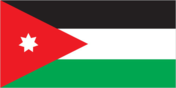
three equal horizontal bands of black (top), representing the Abbassid Caliphate, white, representing the Ummayyad Caliphate, and green, representing the Fatimid Caliphate; a red isosceles triangle on the hoist side, representing the Great Arab Revolt of 1916, and bearing a small white seven-pointed star symbolizing the seven verses of the opening Sura (Al-Fatiha) of the Holy Koran; the seven points on the star represent faith in One God, humanity, national spirit, humility, social justice, virtue, and aspirations; design is based on the Arab Revolt flag of World War I
Government type
constitutional monarchy
Independence
25 May 1946 (from League of Nations mandate under British administration)
International organization participation
ABEDA, AFESD, AMF, CAEU, CICA, FAO, G-11, G-77, IAEA, IBRD, ICAO, ICC, ICCt, ICRM, IDA, IDB, IFAD, IFC, IFRCS, ILO, IMF, IMO, Interpol, IOC, IOM, IPU, ISO, ITSO, ITU, ITUC, LAS, MIGA, MINURSO, MINUSTAH, MONUSCO, NAM, OIC, OPCW, OSCE (partner), PCA, UN, UNAMID, UNCTAD, UNESCO, UNHCR, UNIDO, UNMIL, UNMIS, UNOCI, UNRWA, UNWTO, UPU, WCO, WFTU, WHO, WIPO, WMO, WTO
Judicial branch
Court of Cassation (Supreme Court)
Legal system
based on Islamic law and French codes; judicial review of legislative acts in a specially provided High Tribunal; has not accepted compulsory ICJ jurisdiction
Legislative branch
- bicameral National Assembly or Majlis al-'Umma consists of the Senate, also called the House of Notables or Majlis al-Ayan (60 seats; members appointed by the monarch to serve four-year terms) and the Chamber of Deputies, also called the House of Representatives or Majlis al-Nuwaab (120 seats; members elected using a single, non-transferable vote system in multi-member districts to serve four-year terms); note - the new electoral law enacted in May 2010 allocated an additional 10 seats (6 seats added to the number reserved for women, bringing the total to 12; 2 additional seats for Amman; and 1 seat each for the cities of Zarqa and Irbid; unchanged are 9 seats reserved for Christian candidates, 9 for Bedouin candidates, and 3 for Jordanians of Chechen or Circassian descent
- election results
- Chamber of Deputies - percent of vote by party - NA; seats by party - independents and other 120 (includes 12 seats filled by women's quota and 1 woman was directly elected); note - the IAF boycotted the election
- elections
- Chamber of Deputies - last held on 9 November 2010 (next scheduled in 2014); note - the King dissolved the previous Chamber of Deputies in November 2009, midway through the parliamentary term
National anthem
- lyrics/music
- Abdul-Mone'm al-RIFAI'/Abdul-Qader al-TANEER note: adopted 1946; the shortened version of the anthem is used most commonly, while the full version is reserved for special occasions
- name
- "As-salam al-malaki al-urdoni" (Long Live the King of Jordan)
National holiday
Independence Day, 25 May (1946)
Political parties and leaders
Arab Ba'ath Socialist Party [Fuad DABBOUR]; Ba'ath Arab Progressive Party [Tayseer al-HAMSI]; Call Party [Mohammed Abu BAKR]; Democratic People's Party [Ablah al-ULBAH]; Democratic Popular Unity Party [Sa'ed DIAB]; Islamic Action Front or IAF [Hamzeh MANSOUR]; Islamic Center Party [Marwan al-FA'OURI; Jordanian Communist Party [Munir HAMARNEH]; Jordanian National Party [Mona Abu BAKR]; Jordanian United Front [Amjad al-MAJALI]; Life Party [Thaher 'AMROU]; Message Party [Hazem QASHOU]; National Constitution Party [Ahmed al-SHUNAQ]; National Current Party [Abd al-Hadi al-MAJALI]; National Movement for Direct Democracy [Mohammed al-QAQ]
Political pressure groups and leaders
Anti-Normalization Committee [Hamzeh MANSOUR, chairman]; Higher Coordination Committee of Opposition Parties [Hamzeh MANZOUR]; Jordan Bar Association [Saleh al-ARMUTI, chairman]; Jordanian Press Association [Sayf al-SHARIF, president]; Jordanian Muslim Brotherhood [Dr. Hamam SAID, controller general]
Suffrage
18 years of age; universal
Economy
Agriculture - products
citrus, tomatoes, cucumbers, olives, strawberries, stone fruits; sheep, poultry, dairy
Central bank discount rate
4.75% (31 December 2009) 6.25% (31 December 2008)
Commercial bank prime lending rate
9.25% (31 December 2009 est.) 9.03% (31 December 2008 est.)
Current account balance
-$975 million (2010 est.) -$1.27 billion (2009 est.)
Debt - external
$5.522 billion (31 December 2010 est.) $6.766 billion (31 December 2009 est.)
Distribution of family income - Gini index
39.7 (2007) 36.4 (1997)
Economy - overview
Jordan's economy is among the smallest in the Middle East, with insufficient supplies of water, oil, and other natural resources, underlying the government's heavy reliance on foreign assistance. Other economic challenges for the government include chronic high rates of poverty, unemployment, inflation, and a large budget deficit. Since assuming the throne in 1999, King ABDALLAH has implemented significant economic reforms, such as opening the trade regime, privatizing state-owned companies, and eliminating most fuel subsidies, which in the past few years have spurred economic growth by attracting foreign investment and creating some jobs. The global economic slowdown, however, has depressed Jordan's GDP growth. Export-oriented sectors such as manufacturing, mining, and the transport of re-exports have been hit the hardest. The Government approved two supplementary budgets in 2010, but sweeping tax cuts planned for 2010 did not materialize because of Amman's need for additional revenue to cover excess spending. The budget deficit is likely to remain high, at 5-6% of GDP, and Amman likely will continue to depend heavily on foreign assistance to finance the deficit in 2011. Jordan's financial sector has been relatively isolated from the international financial crisis because of its limited exposure to overseas capital markets. Jordan is currently exploring nuclear power generation to forestall energy shortfalls.
Electricity - consumption
10.4 billion kWh (2007 est.)
Electricity - exports
176 million kWh (2007 est.)
Electricity - imports
200 million kWh (2007 est.)
Electricity - production
12.21 billion kWh (2007 est.)
Exchange rates
Jordanian dinars (JOD) per US dollar - 0.709 (2010), 0.709 (2009), 0.709 (2008), 0.709 (2007), 0.709 (2006)
Exports
$7.333 billion (2010 est.) $6.366 billion (2009 est.)
Exports - commodities
clothing, fertilizers, potash, phosphates, vegetables, pharmaceuticals
Exports - partners
US 17.13%, Iraq 17%, India 13.59%, Saudi Arabia 10.56%, Syria 4.18%, UAE 4.09% (2009)
GDP - composition by sector
- agriculture
- 3.4%
- industry
- 30.3%
- services
- 66.2% (2010 est.)
GDP - per capita (PPP)
$5,300 (2010 est.) $5,200 (2009 est.) $5,200 (2008 est.) note: data are in 2010 US dollars
GDP - real growth rate
3.2% (2010 est.) 2.4% (2009 est.) 5.8% (2008 est.)
GDP (official exchange rate)
$27.13 billion (2010 est.)
GDP (purchasing power parity)
$33.79 billion (2010 est.) $32.74 billion (2009 est.) $31.98 billion (2008 est.) note: data are in 2010 US dollars
Household income or consumption by percentage share
lowest 10%: 3% highest 10%: 30.7% (2006)
Imports
$12.97 billion (2010 est.) $12.5 billion (2009 est.)
Imports - commodities
crude oil, machinery, transport equipment, iron, cereals
Imports - partners
Saudi Arabia 17.3%, China 10.95%, US 6.94%, Germany 6.29%, Egypt 6.1% (2009)
Industrial production growth rate
2.7% (2010 est.)
Industries
clothing, fertilizers, potash, phosphate mining, pharmaceuticals, petroleum refining, cement, inorganic chemicals, light manufacturing, tourism
Inflation rate (consumer prices)
4.4% (2010 est.) -0.7% (2009 est.)
Investment (gross fixed)
30.1% of GDP (2010 est.)
Labor force
1.719 million (2010 est.)
Labor force - by occupation
- agriculture
- 2.7%
- industry
- 20%
- services
- 77.4% (2007 est.)
Market value of publicly traded shares
$31.86 billion (31 December 2009) $35.85 billion (31 December 2008) $41.22 billion (31 December 2007)
Natural gas - consumption
2.97 billion cu m (2008 est.)
Natural gas - exports
0 cu m (2008 est.)
Natural gas - imports
2.72 billion cu m (2008 est.)
Natural gas - production
250 million cu m (2008 est.)
Natural gas - proved reserves
6.031 billion cu m (1 January 2010 est.)
Oil - consumption
108,000 bbl/day (2009 est.)
Oil - exports
0 bbl/day (2007 est.)
Oil - imports
108,200 bbl/day (2007 est.)
Oil - production
0 bbl/day (2008 est.)
Oil - proved reserves
1 million bbl (1 January 2010 est.)
Population below poverty line
14.2% (2002)
Public debt
61.4% of GDP (2010 est.) 64.7% of GDP (2009 est.)
Reserves of foreign exchange and gold
$12.64 billion (31 December 2010 est.) $12.14 billion (31 December 2009 est.)
Stock of broad money
$35.53 billion (31 December 2010 est.) $33.38 billion (31 December 2009 est.)
Stock of direct foreign investment - abroad
$NA
Stock of direct foreign investment - at home
$22.19 billion (31 December 2010 est.) $19.76 billion (31 December 2009 est.)
Stock of domestic credit
$26.85 billion (31 December 2010 est.) $25.14 billion (31 December 2009 est.)
Stock of narrow money
$9.386 billion (31 December 2010 est) $8.437 billion (31 December 2009 est)
Unemployment rate
13.4% (2010 est.) 12.9% (2009 est.) note: official rate; unofficial rate is approximately 30%
Communications
Broadcast media
radio and TV dominated by the government-owned Jordan Radio and Television Corporation (JRTV) that operates a main network, a sports network, a film network, and a satellite channel; first independent TV broadcaster aired in 2007; international satellite TV and Israeli and Syrian TV broadcasts are available; roughly 30 radio stations operational with JRTV operating the main government-owned station; transmissions of multiple international radio broadcasters are available (2007)
Internet country code
.jo
Internet hosts
42,412 (2010)
Internet users
1.642 million (2009)
Telephone system
- domestic
- 1995 telecommunications law opened all non-fixed-line services to private competition; in 2005, monopoly over fixed-line services terminated and the entire telecommunications sector was opened to competition; currently multiple mobile-cellular providers with subscribership rapidly approaching 100 per 100 persons
- general assessment
- service has improved recently with increased use of digital switching equipment; microwave radio relay transmission and coaxial and fiber-optic cable are employed on trunk lines; growing mobile-cellular usage in both urban and rural areas is reducing use of fixed-line services; Internet penetration remains modest and slow-growing
- international
- country code - 962; landing point for the Fiber-Optic Link Around the Globe (FLAG) FEA and FLAG Falcon submarine cable networks; satellite earth stations - 33 (3 Intelsat, 1 Arabsat, and 29 land and maritime Inmarsat terminals); fiber-optic cable to Saudi Arabia and microwave radio relay link with Egypt and Syria; participant in Medarabtel (2010)
Telephones - main lines in use
501,200 (2009)
Telephones - mobile cellular
6.014 million (2009)
Transportation
Airports
18 (2010)
Airports - with paved runways
- total
- 16 over 3,047 m: 8 2,438 to 3,047 m: 5 1,524 to 2,437 m: 1 914 to 1,523 m: 1 under 914 m: 1 (2010)
Airports - with unpaved runways
- total
- 2 under 914 m: 2 (2010)
Heliports
1 (2010)
Merchant marine
- by type
- cargo 5, passenger/cargo 6, petroleum tanker 1, roll on/roll off 1
- foreign-owned
- 7 (UAE 7)
- registered in other countries
- 20 (Bahamas 2, Egypt 2, Panama 13, Syria 2, unknown 1) (2010)
- total
- 13
Pipelines
gas 439 km; oil 49 km (2009)
Ports and terminals
Al 'Aqabah
Railways
- narrow gauge
- 507 km 1.050-m gauge (2008)
- total
- 507 km
Roadways
- paved
- 7,891 km (2009)
- total
- 7,891 km
Military and Security
Manpower available for military service
males age 16-49: 1,646,215 females age 16-49: 1,579,268 (2010 est.)
Manpower fit for military service
males age 16-49: 1,416,681 females age 16-49: 1,358,608 (2010 est.)
Manpower reaching militarily significant age annually
- female
- 69,359 (2010 est.)
- male
- 73,554
Military branches
- Jordanian Armed Forces (JAF)
- Royal Jordanian Land Force (RJLF), Royal Jordanian Navy, Royal Jordanian Air Force (Al-Quwwat al-Jawwiya al-Malakiya al-Urduniya, RJAF), Special Operations Command (Socom); Public Security Directorate (normally falls under Ministry of Interior, but comes under JAF in wartime or crisis) (2008)
Military expenditures
8.6% of GDP (2006)
Military service age and obligation
17 years of age for voluntary military service; conscription at age 18 was suspended in 1999, although all males under age 37 are required to register; women not subject to conscription, but can volunteer to serve in non-combat military positions in the Royal Jordanian Arab Army Women's Corps; conscription for males only resurrected in July 2007 in order to provide youth training necessary for job market needs (2010)
Transnational Issues
Disputes - international
approximately two million Iraqis have fled the conflict in Iraq, with the majority taking refuge in Syria and Jordan; 2004 Agreement settles border dispute with Syria pending demarcation
Refugees and internally displaced persons
- IDPs
- 160,000 (1967 Arab-Israeli War) (2007) page last updated on January 20, 2011 ======================================================================
- refugees (country of origin)
- 1,835,704 (Palestinian Refugees (UNRWA)); 500,000 (Iraq)