1987 Edition
CIA World Factbook 1987 (Internet Archive)
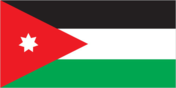
Geography
Administrative divisions
eight governorates under centrally appointed officials
Boundary disputes
separated from Israel by 1949 Armistice Line; West Bank and Gaza Strip are Israeli occupied with status to be determined
Branches
King holds balance of power; Prime Minister exercises executive authority in name of King; Cabinet appointed by Jordan (continued) King and responsible to parliament; bicameral parliament with House of Representatives, dissolved by King in February 1976, and reconvened in January 1984, following national elections; Senate last appointed by King in January 1984; secular court system based on differing legal systems of the former Transjordan and Palestine; law Western in concept and structure; Sharia (religious) courts for Muslims, and religious community council courts for non-Muslim communities; desert police carry out quasi-judicial functions in desert areas
Capital
Amman
Climate
mostly arid desert; rainy season in west (November to March)
Coastline
26 km
Communists
party actively repressed, membership estimated at less than 500
Comparative area
about the size of Minnesota
Environment
lack of natural water resources; deforestation; overgrazing; soil erosion; desertification
Government leaders
HUSSEIN I, King (since August 1952); Zayd al-RIFA‘I, Prime Minister (since April 1985)
Land boundaries
1,770 km total (before 1967 war)
Land use
4% arable land; .5% permanent crops; 1% meadows and pastures; .5% forest and woodland; 94% other; includes .5% irrigated
Legal system
based on Islamic law and French codes; constitution adopted 1952; judicial review of legislative acts in a specially provided High Tribunal; has not accepted compulsory ICJ jurisdiction
Member of
Arab League, FAO, G-77, IAEA, IBRD, ICAO, IDA, IDB—Islamic Development Bank, IFAD, IFC, ILO, IMF, IMO, INTELSAT, INTERPOL, IPU, ITU, NAM, OIC, UN, UNESCO, UPU, WFTU, WHO, WIPO, WMO, WTO
National holiday
Independence Day, 25 May
Note
the war between Israel and the Arab states in June 1967 ended with Israel in control of the West Bank; as stated in the 1978 Camp David Accords and reaffirmed by the President’s 1 September 1982 peace initiative, the final status of the West Bank and Gaza Strip, their relationship with their neighbors, and a peace treaty between Israel and Jordan are to be negotiated among the concerned parties; Camp David further specifies that these negotiations will resolve the location of the respective boundaries; pending the completion of this process, it is US policy that the final status of the West Bank and Gaza Strip has yet to be determined
Special notes
none
Suffrage
universal adult at age 20 Political parties and leaders: political party activity illegal since 1957
Terrain
mostly high desert plateau in east; Great Rift Valley separates East and West Banks of Jordan River
Territorial sea
3 nm
Total area
- on page 276) Boundary representation is not necessarily authoritative
- 97,740 km?; land area: 97,180 km?
Type
constitutional monarchy
People and Society
Ethnic divisions
98% Arab, 1% Circassian, 1% Armenian
Infant mortality rate
62/1,000 (1983)
Labor force
580,000 (1983 est.); 20% agriculture, 20% manufacturing and mining
Language
Arabic (official); English widely understood among upper and middle classes
Life expectancy
61.7
Literacy
about 71%
Nationality
noun—Jordanian(s), adjective—Jordanian
Organized labor
about 10% of labor force
Population
2,761,695 (July 1987), average annual growth rate 3.65%
Religion
95% Sunni Muslim, 5% Christian
Government
Official name
Hashemite Kingdom of
Economy
Agriculture
vegetables, fruits, olive oil, wheat; self-sufficient in few foodstuffs
Aid
US, including Ex-Im (1970-84), $1.3 billion; Western (non-US) countries, ODA and OOF (1970-84), $988 million; Communist countries (1970-85), $71 million
Budget
total revenues, $1,836 million; current expenditures, $1,267 million; capital expenditures, $675 million (1984)
Electric power
972,000 kW capacity; 2,840 million kWh produced, 1,080 kWh per capita (1986)
Exports
$789 million (f.0.b., 1985); fruits and vegetables, phosphates, fertilizers
Fiscal year
calendar year
GNP
$4.9 billion, $1,900 per capita; 2.0% real growth rate (1984)
Imports
$2,733 million (c.i.f., 1985); crude oil, petroleum, textiles, capital goods, motor vehicles, foodstuffs
Major industries
phosphate mining, petroleum refining, cement production, light manufacturing
Military transfers
US (FY70-85), $2.2 billion
Monetary conversion rate
.35 Jordanian dinar=US$1 (November 1986)
Natural resources
phosphates, potash, shale oil
Communications
Airfields
21 total, 19 usable; 14 with permanent-surface runways; 2 with runways over 3,659 m, 14 with runways 2,440-3,659 m, 1 with runways 1,2202,489 m
Civil air
28 major transport aircraft
Highways
6,332 total; 4,887 paved, 1,495 gravel and crushed stone
Pipelines
crude oil, 209 km
Ports
1 major (Al ‘Aqabah)
Railroads
817 km 1.050-meter gauge, single track
Telecommunications
adequate system of radio-relay, cable, and radio; 81,500 telephones (8 per 100 popl.); 3 AM, 2 FM, 24 TV stations; | Atlantic Ocean INTELSAT station, 1 Indian Ocean INTELSAT station; 1 ARABSAT station; coaxial cable and radio-relay to Iraq, Saudi Arabia, and Syria; radio-relay to Lebanon inactive
Military and Security
Branches
Jordan Arab Army, Royal Jordanian Air Force, Royal Jordanian Coast Guard
Military manpower
males 15-49, 639,000; 456,000 fit for military service; 36,000 reach military age (18) annually