1989 Edition
CIA World Factbook 1989 (Internet Archive)
Geography
Climate
predominantly Mediterranean; Alpine in far north; hot, dry in south
Coastline
4,996 km
Comparative area
slightly larger than Arizona
Continental shelf
200 m or to depth of exploitation
Disputes
South Tyrol question with Austria
Environment
regional risks include landslides, mudflows, snowslides, earthquakes, volcanic eruptions, flooding, pollution; land sinkage in Venice
Flag
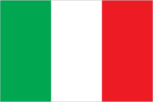
three equal vertical bands of green (hoist side), white, and red; similar to the flag of Ireland which is longer and is green (hoist side), white, and orange; also similar to the flag of the Ivory Coast which has the colors reversed — orange (hoist side), white, and green
Land boundaries
1,902.2 km total; Austria 430 km, France 488 km, San Marino 39 km, Switzerland 740 km, Vatican City 3.2 km, Yugoslavia 202 km
Land use
32% arable land; 10% permanent crops; 1 7% meadows and pastures; 22% forest and woodland; 19% other; includes 10% irrigated
Natural resources
mercury, potash, marble, sulfur, dwindling natural gas and crude oil reserves, fish, coal
Note
strategic location dominating central Mediterranean as well as southern sea and air approaches to Western Europe
Terrain
mostly rugged and mountainous; some plains, coastal lowlands
Territorial sea
1 2 nm
Total area
301,230 km2; land area: 294,020 km2; includes Sardinia and Sicily
Total area
neto 1 19/A, 00187-Rome (mailing address is APO New York 09794); telephone [39] (6) 46741; there are US Consulates General in Florence, Genoa, Milan, Naples, and Palermo (Sicily)
People and Society
Birth rate
10 births/ 1,000 population (1990)
Death rate
9 deaths/ 1 ,000 population (1990)
Ethnic divisions
primarily Italian but population includes small clusters of Gerrnan- , French-, and Slovene-Italians in the north and Albanian-Italians in the south; Sicilians; Sardinians
Infant mortality rate
6 deaths/ 1,000 live births (1990)
Labor force
23,670,000; 56.7% services, 37.9% industry, 5.4% agriculture (1987)
Language
Italian; parts of Trentino-Alto Adige region are predominantly German speaking; significant French-speaking minority in Valle d'Aosta region; Slovenespeaking minority in the Trieste-Gorizia area
Life expectancy at birth
74 years male, 81 years female (1990)
Literacy
93%
Nationality
noun — Italian(s); adjective — Italian
Net migration rate
1 migrant/ 1 ,000 population (1990)
Organized labor
40-45% of labor force (est.)
Population
57,664,405 (July 1990), growth rate 0.2% (1990)
Religion
almost 100% nominally Roman Catholic
Total fertility rate
1.4 children born/ woman (1990)
Government
Administrative divisions
20 regions (regioni, singular — regione); Abruzzi, Basilicata, Calabria, Campania, Emilia-Romagna, Friuli-Venezia Giulia, Lazio, Liguria, Lombardia, Marche, Molise, Piemonte, Puglia, Sardegna, Sicilia, Toscana, Trentino-Alto Adige, Umbria, Valle d'Aosta, Veneto
Capital
Rome
Communists
1,673,751 members (1983)
Constitution
1 January 1948
Diplomatic representation
Ambassador Rinaldo PETRIGNANI; Chancery at 1601 Fuller Street NW, Washington DC 20009; telephone (202) 328-5500; there are Italian Consulates General in Boston, Chicago, Houston, New Orleans, Los Angeles, Philadelphia, San Francisco, and Consulates in Detroit and Newark (New Jersey); US — Ambassador
Elections
Senate— last held 14-15 June 1987 (next to be held by June 1992); results—DC 33.9%, PCI 28.3%, PSI 10.7%, others 27.1%; seats — (320 total, 315 elected) DC 125, PCI 100, PSI 36, others 54; Chamber of Deputies — last held 14-15 June 1987 (next to be held by June 1992); results— DC 34.3%, PCI 26.6%, PSI 14.3%, MSI 5.9%, PRI 3.7%, PSDI 3.0%, Radicals 2.6%, Greens 2.5%, PLI 2.1%, Proletarian Democrats 1.7%, others 3.3%; seats— (630 total) DC 234, PCI 177, PSI 94, MSI 35, PRI 21, PSDI 17, Radicals 13, Greens 13, PLI 11, Proletarian Democrats 8, others 7
Executive branch
president, prime minister,
Independence
17 March 1861, Kingdom of Italy proclaimed
Judicial branch
Constitutional Court (Corte Costituzionale)
Leaders
Chief of State — President Francesco COSSIGA (since 3 July 1985); Head of Government — Prime Minister Giulio ANDREOTTI (since 22 July 1989, heads the government for the sixth time); Deputy Prime Minister Claudio MARTELLI (since 23 July 1989) Political parties and leaders: Christian Democratic Party (DC), Arnaldo Forlani (general secretary), Ciriaco De Mita (president); Communist Party (PCI), Achille Occhetto (secretary general); Socialist Party (PSI), Bettino Craxi (party secretary); Social Democratic Party (PSDI), Antonio Cariglia (party secretary); Liberal Party (PLI), Renato Altissimo (secretary general); Italian Social Movement (MSI), Giuseppe (Pino) Rauti (national secretary); Republican Party (PRI), Giorgio La Malfa (political secretary); Italy's 49th postwar government was formed on 23 July 1989, with Prime Minister Andreotti, a Christian Democrat, presiding over a five-party coalition consisting of the Christian Democrats, Socialists, Social Democrats, Republicans, and Liberals
Legal system
based on civil law system, with ecclesiastical law influence; judicial review under certain conditions in Constitutional Court; has not accepted compulsory ICJ jurisdiction
Legislative branch
bicameral Parliament (Parlamento) consists of an upper chamber or Senate (Senate) and a lower chamber or Chamber of Deputies (Camera dei Deputati)
Long-form name
Italian Republic
Member of
ADB/ ASSIMER, CCC, Council of Europe, DAC, EC, ECOWAS, EIB, EMS, ESA, FAO, GATT, IAEA, IBRD, ICAC, ICAO, ICO, IDA, IDB— Inter-American Development Bank, IFAD, IEA, IFC, IHO, ILO, ILZSG, IMF, IMO, INTELSAT, INTERPOL, IOOC, IPU, IRC, ITC, ITU, NATO, OAS (observer), OECD, UN, UNESCO, UPU, WEU, WHO, WIPO, WMO, WSG
National holiday
Anniversary of the Republic, 2 June (1946)
Other political or pressure groups
Vatican City; three major trade union confederations (CGIL — Communist dominated, CISL — Christian Democratic, and UfL — Social Democratic, Socialist, and Republican); Italian manufacturers association (Confindustria); organized farm groups (Confcoltivatori, Confagricoltura)
Suffrage
universal at age 18 (except in senatorial elections, where minimum age is 25)
Type
republic
Economy
Agriculture
accounts for about 5% of GNP and 5% of the work force; self-sufficient in foods other than meat and dairy products; principal crops — fruits, vegetables, grapes, potatoes, sugar beets, soybeans, grain, olives; fish catch of 554,000 metric tons in 1987
Aid
donor — ODA and OOF commitments (1970-87), $18.7 billion
Budget
revenues $355 billion; expenditures $448 billion, including capital expenditures of $NA (1989)
Currency
Italian lira (plural — lire); 1 Italian lira (Lit) = 100 centesimi
Electricity
56,022,000 kW capacity; 201,400 million kWh produced, 3,500 kWh per capita (1989)
Exchange rates
Italian lire (Lit) per US$1— 1,262.5 (January 1990), 1,372.1 (1989), 1,301.6(1988), 1,296.1 (1987), 1,490.8 (1986), 1,909.4 (1985) Fiscal year calendar year
Exports
$141.6 billion (f.o.b., 1989); commodities— textiles, wearing apparel, metals, transportation equipment, chemicals; partners— EC 57%, US 9%, OPEC 4%
External debt
NA
GDP
$803.3 billion, per capita $14,000; real growth rate 3.3% (1989 est.)
Imports
$143.1 billion (f.o.b., 1989); commodities— petroleum, industrial machinery, chemicals, metals, food, agricultural products; partners-— EC 57%, OPEC 6%, US 6%
Industrial production
growth rate 2.9% (1989)
Industries
machinery and transportation equipment, iron and steel, chemicals, food processing, textiles, motor vehicles
Inflation rate (consumer prices)
6.6% (1989 est.)
Overview
Since World War II the economy has changed from one based on agriculture into a ranking industrial economy, with approximately the same total and per capita output as France and the UK. The country is still divided into a developed industrial north, dominated by large private companies and state enterprises and an undeveloped agricultural south. Services account for 58% of GDP, industry 37%, and agriculture 5%. Most raw materials needed by industry and over 75% of energy requirements must be imported. The economic recovery that began in mid1983 has continued through 1989, with the economy growing at an annual average rate of 3%. For the 1990s, Italy faces the problems of refurbishing a tottering communications system, curbing the increasing pollution in major industrial centers, and adjusting to the new competitive forces accompanying the ongoing economic integration of the European Community.
Unemployment rate
1 1.9% (1989)
Communications
Airports
143 total, 138 usable; 88 with permanent-surface runways; 2 with runways over 3,659 m; 35 with runways 2,440-3,659 m; 42 with runways 1,2202,439 m
Branches
Army, Navy, Air Force
Defense expenditures
2.4% of GDP, or $19 billion (1989 est.)
Highways
294,410 km total; autostrada 5,900 km, state highways 45,170 km, provincial highways 101,680 km, communal highways 141,660 km; 260,500 km concrete, bituminous, or stone block, 26,900 km gravel and crushed stone, 7,010 km earth
Inland waterways
2,400 km for various types of commercial traffic, although of limited overall value
Merchant marine
547 ships (1,000 GRT or over) totaling 6,871,505 GRT/ 10,805,368 DWT; includes 6 passenger, 41 short-sea passenger, 100 cargo, 5 refrigerated cargo, 22 container, 72 roll-on/ roll-off cargo, 4 vehicle carrier, 1 multifunction large-load carrier, 2 livestock carrier, 147 petroleum, oils, and lubricants (POL) tanker, 37 chemical tanker, 29 liquefied gas, 8 specialized tanker, 16 combination ore/oil, 55 bulk, 2 combination bulk Civil air 1 32 major transport aircraft
Military manpower
males 15-49, 14,721,704; 12,855,022 fit for military service; 430,782 reach military age (18) annually
Pipelines
crude oil, 1 ,703 km; refined products, 2,148 km; natural gas, 19,400 km
Ports
Cagliari (Sardinia), Genoa, La Spezia, Livorno, Naples, Palermo (Sicily), Taranto, Trieste, Venice
Railroads
20,011 km total; 16,066 km 1.435-meter government-owned standard gauge (8,999 km electrified); 3,945 km privately owned — 2,100km 1.435-meter standard gauge (1,155 km electrified) and 1,845 km 0.950-meter narrow gauge (380 km electrified)
Telecommunications
well engineered, constructed, and operated; 28,000,000 telephones; stations — 144 AM, 54 (over 1,800 repeaters) FM, 135 (over 1,300 repeaters) TV; 22 submarine cables; communication satellite earth stations operating in INTELSAT 3 Atlantic Ocean and 2 Indian Ocean, INMARSAT, and EUTELSAT systems Defense Forces