1995 Edition
CIA World Factbook 1995 (Project Gutenberg)
Geography
Area
total area: 20,770 sq km land area: 20,330 sq km comparative area: slightly larger than New Jersey
Climate
temperate; hot and dry in southern and eastern desert areas
Coastline
273 km
Environment
current issues: limited arable land and natural fresh water resources pose serious constraints; desertification; air pollution from industrial and vehicle emissions; groundwater pollution from industrial and domestic waste, chemical fertilizers, and pesticides natural hazards: sandstorms may occur during spring and summer international agreements: party to - Biodiversity, Endangered Species, Hazardous Wastes, Nuclear Test Ban, Ozone Layer Protection, Ship Pollution; signed, but not ratified - Climate Change, Desertification, Marine Life Conservation
International disputes
separated from Lebanon, Syria, and the West Bank by the 1949 Armistice Line; the Gaza Strip and Jericho area, formerly occupied by Israel, are now administered largely by the Palestinian Authority; other areas of the West Bank outside Jericho are administered jointly by Israel and the Palestinian Authority; Golan Heights is Israeli occupied; Israeli troops in southern Lebanon since June 1982
Irrigated land
2,140 sq km (1989)
Land boundaries
total 1,006 km, Egypt 255 km, Gaza Strip 51 km, Jordan 238 km, Lebanon 79 km, Syria 76 km, West Bank 307 km
Land use
arable land: 17% permanent crops: 5% meadows and pastures: 40% forest and woodland: 6% other: 32%
Location
Middle East, bordering the Mediterranean Sea, between Egypt and Lebanon
Map references
Middle East
Maritime claims
continental shelf: to depth of exploitation territorial sea: 12 nm
Natural resources
copper, phosphates, bromide, potash, clay, sand, sulfur, asphalt, manganese, small amounts of natural gas and crude oil
Note
there are 199 Jewish settlements and civilian land use sites in the West Bank, 42 in the Israeli-occupied Golan Heights, 24 in the Gaza Strip, and 25 in East Jerusalem (August 1994 est.)
Terrain
Negev desert in the south; low coastal plain; central mountains; Jordan Rift Valley
People and Society
Age structure
0-14 years: 29% 15-64 years: 61% 65 years and over: 10%
Birth rate
20.39 births/1,000 population (1995 est.)
Death rate
6.38 deaths/1,000 population (1995 est.)
Ethnic divisions
Jewish 82% (Israel born 50%, Europe/Americas/Oceania born 20%, Africa born 7%, Asia born 5%), non-Jewish 18% (mostly Arab) (1993 est.)
Infant mortality rate
8.4 deaths/1,000 live births (1995 est.)
Labor force
1.9 million (1992) by occupation: public services 29.3%, industry 22.1%, commerce 13.9%, finance and business 10.4%, personal and other services 7.4%, construction 6.5%, transport, storage, and communications 6.3%, agriculture, forestry, and fishing 3.5%, other 0.6% (1992)
Languages
Hebrew (official), Arabic used officially for Arab minority, English most commonly used foreign language
Life expectancy at birth
total population: 78.14 years male: 76 years female: 80.39 years (1995 est.)
Literacy
age 15 and over can read and write (1992) total population: 95% male: 97% female: 93%
Nationality
noun: Israeli(s) adjective: Israeli
Net migration rate
0 migrant(s)/1,000 population (1995 est.)
Population
5,433,134 (July 1995 est.) note: includes 122,000 Jewish settlers in the West Bank, 14,500 in the Israeli-occupied Golan Heights, 4,800 in the Gaza Strip, and 149,000 in East Jerusalem (August 1994 est.)
Population growth rate
1.4% (1995 est.)
Religions
Judaism 82%, Islam 14% (mostly Sunni Muslim), Christian 2%, Druze and other 2%
Total fertility rate
2.81 children born/woman (1995 est.)
Government
Administrative divisions
6 districts (mehozot, singular - mehoz); Central, Haifa, Jerusalem, Northern, Southern, Tel Aviv
Capital
Jerusalem note: Israel proclaimed Jerusalem its capital in 1950, but the US, like nearly all other countries, does not recognize this status, and maintains its Embassy in Tel Aviv
Constitution
no formal constitution; some of the functions of a constitution are filled by the Declaration of Establishment (1948), the basic laws of the parliament (Knesset), and the Israeli citizenship law
Digraph
IS
Diplomatic representation in US
chief of mission: Ambassador Itamar RABINOVICH chancery: 3514 International Drive NW, Washington, DC 20008 telephone: [1] (202) 364-5500
Executive branch
chief of state: President Ezer WEIZMAN (since 13 May 1993) election last held 24 March 1993 (next to be held NA March 1999); results - Ezer WEIZMAN elected by Knesset head of government: Prime Minister Yitzhak RABIN (since NA July 1992) cabinet: Cabinet; selected from and approved by the Knesset
FAX
- [1] (202) 364-5610 consulate(s) general: Atlanta, Boston, Chicago, Houston, Los Angeles, Miami, New York, Philadelphia, and San Francisco
- [972] (3) 663-449 consulate(s) general: Jerusalem
Flag
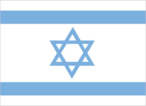
white with a blue hexagram (six-pointed linear star) known as the Magen David (Shield of David) centered between two equal horizontal blue bands near the top and bottom edges of the flag
Independence
14 May 1948 (from League of Nations mandate under British administration)
Judicial branch
Supreme Court
Legal system
mixture of English common law, British Mandate regulations, and, in personal matters, Jewish, Christian, and Muslim legal systems; in December 1985, Israel informed the UN Secretariat that it would no longer accept compulsory ICJ jurisdiction
Legislative branch
unicameral parliament (Knesset): elections last held NA June 1992 (next to be held by NA 1996); results - percent of vote by party NA; seats - (120 total) Labor 44, Likud 32, MERETZ 12, Tzomet 8, National Religious Party 6, SHAS 6, United Torah Jewry 4, Democratic Front for Peace and Equality (Hadash) 3, Moledet 3, Arab Democratic Party 2; note - in 1994 four legislators broke party ranks, resulting in the following new distribution of seats - Labor Party 44, Likud bloc 32, MERETZ 12, National Religious Party 6, SHAS 6, Tzomet 5, United Torah Jewry 4, Democratic Front for Peace and Equality (Hadash) 3, Moledet 2, Arab Democratic Party 2, independents 4 (1 in coalition, 3 voting with opposition)
Member of
AG (observer), CCC, CE (observer), CERN (observer), EBRD, ECE, FAO, GATT, IADB, IAEA, IBRD, ICAO, ICC, ICFTU, IDA, IFAD, IFC, ILO, IMF, IMO, INMARSAT, INTELSAT, INTERPOL, IOC, IOM, ISO, ITU, OAS (observer), PCA, UN, UNCTAD, UNESCO, UNHCR, UNIDO, UPU, WHO, WIPO, WMO, WTO
Names
conventional long form: State of Israel conventional short form: Israel local long form: Medinat Yisra'el local short form: Yisra'el
National holiday
Independence Day, 14 May 1948 (Israel declared independence on 14 May 1948, but the Jewish calendar is lunar and the holiday may occur in April or May)
Other political or pressure groups
Gush Emunim, Israeli nationalists advocating Jewish settlement on the West Bank and Gaza Strip; Peace Now supports territorial concessions in the West Bank and is critical of government's Lebanon policy
Political parties and leaders
members of the government: Labor Party, Prime Minister Yitzhak RABIN; MERETZ, Minister of Communications Shulamit ALONI; independent, Gonen SEGEV not in coalition, but voting with the government: Democratic Front for Peace and Equality (Hadash), Hashim MAHAMID; Arab Democratic Party, Abd al Wahab DARAWSHAH opposition parties: Likud Party, Binyamin NETANYAHU; Tzomet, Rafael EITAN; National Religious Party, Zevulun HAMMER; United Torah Jewry, Avraham SHAPIRA; Moledet, Rehavam ZEEVI; Peace Guard (independent), Shaul GUTMAN; SHAS, Arieh DERI note: Israel currently has a coalition government comprising 2 parties and an independent that hold 57 seats of the Knesset's 120 seats
Suffrage
18 years of age; universal
Type
republic
US diplomatic representation
chief of mission: Ambassador Martin INDYK embassy: 71 Hayarkon Street, Tel Aviv mailing address: PSC 98, Box 100, Tel Aviv; APO AE 09830 telephone: [972] (3) 517-4338
Economy
Agriculture
citrus and other fruits, vegetables, cotton; beef, poultry, dairy products
Budget
revenues: $42.3 billion expenditures: $45.4 billion, including capital expenditures of $11.1 billion (FY92/93)
Currency
1 new Israeli shekel (NIS) = 100 new agorot
Economic aid
recipient: US commitments, including Ex-Im (FY70-90), $18.2 billion; Western (non-US) countries, ODA and OOF bilateral commitments (1970-89), $2.8 billion
Electricity
capacity: 4,140,000 kW production: 23 billion kWh consumption per capita: 4,290 kWh (1993)
Exchange rates
new Israeli shekels (NIS) per US$1 - 3.070 (December 1994), 3.0111 (1994), 2.8301 (1993), 2.4591 (1992), 2.2791 (1991), 2.0162 (1990), 1.9164 (1989)
Exports
$16.2 billion (f.o.b., 1994 est.) commodities: machinery and equipment, cut diamonds, chemicals, textiles and apparel, agricultural products, metals partners: US, EU, Japan
External debt
$25.9 billion (November 1994 est.)
Fiscal year
calendar year (since 1 January 1992)
Illicit drugs
increasingly concerned about cocaine and heroin abuse and trafficking
Imports
$22.5 billion (c.i.f., 1994 est.) commodities: military equipment, investment goods, rough diamonds, oil, other productive inputs, consumer goods partners: EU, US, Japan
Industrial production
growth rate 8% (1994 est.); accounts for about 30% of GDP
Industries
food processing, diamond cutting and polishing, textiles and apparel, chemicals, metal products, military equipment, transport equipment, electrical equipment, miscellaneous machinery, potash mining, high-technology electronics, tourism
Inflation rate (consumer prices)
14.5% (1994)
National product
GDP - purchasing power parity - $70.1 billion (1994 est.)
National product per capita
$13,880 (1994 est.)
National product real growth rate
6.8% (1994 est.)
Overview
Israel has a market economy with substantial government participation. It depends on imports of crude oil, grains, raw materials, and military equipment. Despite limited natural resources, Israel has intensively developed its agricultural and industrial sectors over the past 20 years. Industry employs about 22% of Israeli workers, construction 6.5%, agriculture, forestry, and fishing 3.5%, and services most of the rest. Israel is largely self-sufficient in food production except for grains. Diamonds, high-technology equipment, and agricultural products (fruits and vegetables) are leading exports. Israel usually posts current account deficits, which are covered by large transfer payments from abroad and by foreign loans. Roughly half of the government's external debt is owed to the United States, which is its major source of economic and military aid. To earn needed foreign exchange, Israel has been targeting high-technology niches in international markets, such as medical scanning equipment. The influx of Jewish immigrants from the former USSR, which topped 450,000 during the period 1990-94, increased unemployment, intensified housing problems, and strained the government budget. At the same time, the immigrants bring to the economy valuable scientific and professional expertise.
Unemployment rate
7.5% (1994 est.)
Communications
Radio
broadcast stations: AM 9, FM 45, shortwave 0 radios: NA
Telephone system
1,800,000 telephones; most highly developed in the Middle East although not the largest local: NA intercity: good system of coaxial cable and microwave radio relay international: 3 submarine cables; 3 INTELSAT (2 Atlantic Ocean and 1 Indian Ocean) earth stations
Television
broadcast stations: 20 televisions: NA
Transportation
Airports
total: 57 with paved runways over 3,047 m: 2 with paved runways 2,438 to 3,047 m: 6 with paved runways 1,524 to 2,437 m: 8 with paved runways 914 to 1,523 m: 7 with paved runways under 914 m: 31 with unpaved runways 914 to 1,523 m: 3
Highways
total: 13,461 km paved: 13,461 km
Merchant marine
total: 32 ships (1,000 GRT or over) totaling 624,861 GRT/720,765 DWT ships by type: cargo 7, container 22, refrigerated cargo 2, roll-on/roll-off cargo 1
Pipelines
crude oil 708 km; petroleum products 290 km; natural gas 89 km
Ports
Ashdod, Ashqelon, Elat, Hadera, Haifa, Tel Aviv-Yafo
Railroads
total: 520 km (diesel operated; single track) standard gauge: 520 km 1.435-m gauge
Military and Security
Branches
Israel Defense Forces (includes ground, naval, and air components), Pioneer Fighting Youth (Nahal), Frontier Guard, Chen (women); note - historically there have been no separate Israeli military services
Defense expenditures
exchange rate conversion - $6.5 billion, about 10% of GDP (1995) ________________________________________________________________________ ITALY
Manpower availability
males age 15-49 1,309,502; females age 15-49 1,283,923; males fit for military service 1,072,501; females fit for military service 1,047,575; males reach military age (18) annually 47,950; females reach military age (18) annually 45,839 (1995 est.) note: military service mandatory for men and women