2008 Edition
CIA World Factbook 2008 (Project Gutenberg)
Introduction
Background
Part of the Norwegian Kingdom of the Hebrides until the 13th century when it was ceded to Scotland, the isle came under the British crown in 1765. Current concerns include reviving the almost extinct Manx Gaelic language. Isle of Man is a British crown dependency but is not part of the UK. However, the UK Government remains constitutionally responsible for its defense and international representation.
Geography
Area
total: 572 sq km land: 572 sq km water: 0 sq km
Area - comparative
slightly more than three times the size of Washington, DC
Climate
temperate; cool summers and mild winters; overcast about one-third of the time
Coastline
160 km
Elevation extremes
lowest point: Irish Sea 0 m highest point: Snaefell 621 m
Environment - current issues
waste disposal (both household and industrial); transboundary air pollution
Geographic coordinates
54 15 N, 4 30 W
Geography - note
one small islet, the Calf of Man, lies to the southwest and is a bird sanctuary
Irrigated land
0 sq km
Land boundaries
0 km
Land use
arable land: 9% permanent crops: 0% other: 91% (permanent pastures, forests, mountain, and heathland) (2002)
Location
Western Europe, island in the Irish Sea, between Great Britain and Ireland
Map references
Europe
Maritime claims
territorial sea: 12 nm exclusive fishing zone: 12 nm
Natural hazards
NA
Natural resources
none
Terrain
hills in north and south bisected by central valley
People and Society
Age structure
0-14 years: 17% (male 6,629/female 6,318) 15-64 years: 65.9% (male 25,251/female 24,959) 65 years and over: 17.1% (male 5,294/female 7,769) (2008 est.)
Birth rate
10.86 births/1,000 population (2008 est.)
Death rate
11.02 deaths/1,000 population (2008 est.)
Education expenditures
NA
Ethnic groups
Manx (Norse-Celtic descent), Britons
HIV/AIDS - adult prevalence rate
NA
HIV/AIDS - deaths
NA
HIV/AIDS - people living with HIV/AIDS
NA
Infant mortality rate
total: 5.62 deaths/1,000 live births male: 6.55 deaths/1,000 live births female: 4.64 deaths/1,000 live births (2008 est.)
Languages
English, Manx Gaelic
Life expectancy at birth
total population: 78.8 years male: 75.46 years female: 82.32 years (2008 est.)
Literacy
NA
Median age
total: 40 years male: 38.8 years female: 41.3 years (2008 est.)
Nationality
noun: Manxman (men), Manxwoman (women) adjective: Manx
Net migration rate
5.25 migrant(s)/1,000 population (2008 est.)
Population
76,220 (July 2008 est.)
Population growth rate
0.509% (2008 est.)
Religions
Anglican, Roman Catholic, Methodist, Baptist, Presbyterian, Society of Friends
Sex ratio
at birth: 1.06 male(s)/female under 15 years: 1.05 male(s)/female 15-64 years: 1.01 male(s)/female 65 years and over: 0.68 male(s)/female total population: 0.95 male(s)/female (2008 est.)
Total fertility rate
1.65 children born/woman (2008 est.)
Government
Administrative divisions
none; there are no first-order administrative divisions as defined by the US Government, but there are 24 local authorities each with its own elections
Capital
name: Douglas geographic coordinates: 54 09 N, 4 29 W time difference: UTC 0 (five hours ahead of Washington, DC during Standard Time) daylight saving time: +1hr, begins last Sunday in March; ends last Sunday in October
Constitution
unwritten; note - The Isle of Man Constitution Act of 1961 does not embody the unwritten Manx Constitution
Country name
conventional long form: none conventional short form: Isle of Man abbreviation: I.O.M.
Dependency status
British crown dependency
Diplomatic representation from the US
none (British crown dependency)
Diplomatic representation in the US
none (British crown dependency)
Executive branch
chief of state: Lord of Mann Queen ELIZABETH II (since 6 February 1952); represented by Lieutenant Governor Sir Paul K. HADDACKS (since 17 October 2005) head of government: Chief Minister Tony BROWN (since 14 December 2006) cabinet: Council of Ministers elections: the monarch is hereditary; lieutenant governor appointed by the monarch for a five-year term; the chief minister is elected by the Tynwald; election last held 14 December 2006 (next to be held in December 2008) election results: House of Keys speaker Tony BROWN elected chief minister by the Tynwald
Flag description
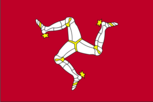
red with the Three Legs of Man emblem (Trinacria), in the center; the three legs are joined at the thigh and bent at the knee; in order to have the toes pointing clockwise on both sides of the flag, a two-sided emblem is used
Government type
parliamentary democracy
Independence
none (British crown dependency)
International organization participation
UPU
Judicial branch
High Court of Justice (justices are appointed by the Lord Chancellor of England on the nomination of the lieutenant governor)
Legal system
the laws of the UK, where applicable, apply and Manx statutes
Legislative branch
bicameral Tynwald consists of the Legislative Council (11 seats; members composed of the President of Tynwald, the Lord Bishop of Sodor and Man, a nonvoting attorney general, and 8 others named by the House of Keys) and the House of Keys (24 seats; members are elected by popular vote to serve five-year terms) elections: House of Keys - last held 23 November 2006 (next to be held in November 2011) election results: House of Keys - percent of vote by party - NA; seats by party - Liberal Vannin Party 2, Man Labor Party 1, independents 21
National holiday
Tynwald Day, 5 July
Political parties and leaders
Alliance for Progressive Government; Liberal Vannin Party [Peter KARRAN]; Man Labor Party; Man Nationalist Party (Mec Vannin) [Bernard MOFFATT] note: most members sit as independents
Political pressure groups and leaders
Alliance for Progressive Government or APG (a government watchdog); Mec Vannin (political party advocating a sovereign state and environment policies); note - has only had one member elected to the Tynwald
Suffrage
16 years of age; universal
Economy
Agriculture - products
cereals, vegetables; cattle, sheep, pigs, poultry
Budget
revenues: $965 million expenditures: $943 million (FY05/06 est.)
Currency (code)
Isle of Man pound (IMP), also known as the Manx pound note: the British pound is also legal tender, but change is given in IMP
Currency code
GBP
Debt - external
$NA
Economic aid - recipient
$NA
Economy - overview
Offshore banking, manufacturing, and tourism are key sectors of the economy. The government offers incentives to high-technology companies and financial institutions to locate on the island; this has paid off in expanding employment opportunities in high-income industries. As a result, agriculture and fishing, once the mainstays of the economy, have declined in their shares of GDP. The Isle of Man also attracts online gambling sites and the film industry. Trade is mostly with the UK. The Isle of Man enjoys free access to EU markets.
Exchange rates
Manx pounds (IMP) per US dollar - 0.4993 (2007), 0.5418 (2006), 0.5493 (2005), 0.5462 (2004), 0.6125 (2003) note: the Manx pound is at par with the British pound
Exports
$NA
Exports - commodities
tweeds, herring, processed shellfish, beef, lamb
Exports - partners
UK (2006)
Fiscal year
1 April - 31 March
GDP - composition by sector
agriculture: 1% industry: 13% services: 86% (2000 est.)
GDP - per capita (PPP)
$35,000 (2005 est.)
GDP - real growth rate
5.2% (2005)
GDP (official exchange rate)
$2.719 billion (2005 est.)
GDP (purchasing power parity)
$2.719 billion (2005 est.)
Household income or consumption by percentage share
lowest 10%: NA% highest 10%: NA%
Imports
$NA
Imports - commodities
timber, fertilizers, fish
Imports - partners
UK (2006)
Industrial production growth rate
3.2% (FY96/97)
Industries
financial services, light manufacturing, tourism
Inflation rate (consumer prices)
3.1% (December 2006 est.)
Labor force
39,690 (2001)
Labor force - by occupation
agriculture, forestry, and fishing 3%, manufacturing 11%, construction 10%, transport and communication 8%, wholesale and retail distribution 11%, professional and scientific services 18%, public administration 6%, banking and finance 18%, tourism 2%, entertainment and catering 3%, miscellaneous services 10% (2001)
Market value of publicly traded shares
$NA
Population below poverty line
NA%
Unemployment rate
1.5% (December 2006 est.)
Communications
Internet country code
.im
Internet hosts
426 (2008)
Internet Service Providers (ISPs)
NA
Internet users
NA
Radio broadcast stations
AM 1, FM 1, shortwave 0 (1998)
Radios
NA
Telephone system
general assessment: NA domestic: landline, telefax, mobile cellular telephone system international: fiber-optic cable, microwave radio relay, satellite earth station, submarine cable
Telephones - main lines in use
51,000 (1999)
Television broadcast stations
0 (receives broadcasts from the UK and satellite) (1999)
Televisions
27,490 (1999)
Transportation
Airports
1 (2007)
Airports - with paved runways
total: 1 1,524 to 2,437 m: 1 (2007)
Merchant marine
total: 273 by type: bulk carrier 31, cargo 50, chemical tanker 48, container 12, liquefied gas 41, passenger/cargo 1, petroleum tanker 73, refrigerated cargo 4, roll on/roll off 8, vehicle carrier 5 foreign-owned: 181 (Chile 6, Denmark 29, France 1, Germany 56, Greece 50, Ireland 1, Japan 6, Monaco 3, Netherlands 1, Norway 20, Singapore 1, Sweden 1, Turkey 2, US 4) registered in other countries: 7 (Bahamas 1, Liberia 5, Marshall Islands 1) (2008)
Ports and terminals
Douglas, Ramsey
Railways
total: 65 km standard gauge: 7 km 1.067-m gauge (7 km electrified) narrow gauge: 58 km 0.914-m gauge (29 km electrified) note: primarily summer tourist attractions (2006)
Roadways
total: 500 km (2008)
Military and Security
Manpower reaching militarily significant age annually
male: 471 female: 447 (2008 est.)
Military - note
defense is the responsibility of the UK
Transnational Issues
Disputes - international
none This page was last updated on 18 December, 2008